
城市轨道交通

Search documents
四线齐发,深圳竞逐地铁“第三城”背后
Xin Lang Cai Jing· 2025-12-30 04:37
Core Insights - The opening of four new metro lines in Shenzhen on December 28 marks a significant expansion of the city's rail transit system, increasing the total operational mileage to 634.5 kilometers and achieving full coverage across all districts [4][6] - The new lines, including the west extension of Line 5, are expected to enhance commuter experience by reducing travel time and easing congestion in key areas [5][8] - The competition between Shenzhen and Guangzhou in metro development is intensifying, with both cities aiming to improve their rail networks to support economic growth and urban development [11][12] Summary by Sections Metro Expansion - Shenzhen's metro system now spans 634.5 kilometers with 441 stations, maintaining the highest network density among mainland cities in China [5][6] - The new Line 5 west extension, measuring 2.88 kilometers, adds three stations and alleviates passenger pressure in the core area of Luohu [6][8] - The opening of the 8th, 11th, and 13th lines further enhances connectivity and operational capacity, particularly during peak hours [4][6] Economic Impact - The metro system is evolving from a mere commuting tool to a vital artery for urban development, influencing the economic landscape of the Greater Bay Area [5][15] - The new lines are expected to drive consumer traffic to commercial hubs in Luohu, such as the Shenzhen MixC and Dongmen Pedestrian Street, thereby boosting local economic activity [8] - The 13th line's connectivity to key areas like the Shenzhen Bay Port and Nanshan Technology Park facilitates the flow of talent and resources, promoting regional collaboration and integration [8][9] Competitive Landscape - The competition for the title of "third city" in metro operations is heating up, with Shenzhen's ridership numbers approaching those of Guangzhou, indicating a shift in the dynamics of urban transit [11][12] - As of November 2025, Guangzhou's metro recorded a passenger volume of 29.84 million, while Shenzhen's reached 28.26 million, narrowing the gap significantly [11][12] - The differing development strategies of the two cities highlight the importance of urban planning and the integration of transit systems with economic activities [12][14] Future Developments - Future plans indicate that both cities will continue to expand their metro networks, with Shenzhen aiming to exceed 800 kilometers by 2030 [14] - The integration of metro systems across the Greater Bay Area, including connections to Dongguan and Hong Kong, is anticipated to create the largest metro network in the country [13][14]

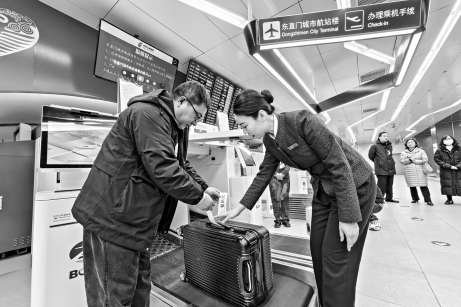
首都机场线东直门站托运行李服务开通
Bei Jing Ri Bao Ke Hu Duan· 2025-12-29 22:21
Core Points - The Beijing Capital Airport Line has introduced a self-service check-in and baggage handling system at Dongzhimen Station for passengers traveling on domestic flights with Air China [1] - The self-service process allows travelers to check in and tag their luggage before boarding the subway, enhancing travel efficiency and reducing congestion at the airport [1][2] Group 1 - The self-service check-in and baggage handling system is now operational at Dongzhimen Station, allowing passengers to complete check-in and baggage drop-off before arriving at the airport [1] - Passengers must complete the baggage check-in at least three hours before their flight departure [1] - The project aims to support the development of Beijing's international aviation "dual hub" and alleviate ground traffic pressure at the capital airport [1] Group 2 - The renovation includes the integration of the B1 level hall with the check-in area, adding two dedicated luggage elevators connecting B1 to B4 platforms [2] - The project also features the installation of self-service check-in equipment, luggage ramps, and elevators, ensuring a smooth luggage transport flow [2] - Adjustments have been made to platform doors and train stopping positions to facilitate efficient luggage handling [2]
四条地铁新线同步开通 深圳实现“区区通地铁”
Nan Fang Ri Bao Wang Luo Ban· 2025-12-29 09:01
Core Points - Shenzhen's new metro lines have opened, increasing the total operational length of urban rail transit to 634.5 kilometers with 441 stations, maintaining the highest network density among mainland cities at 0.32 kilometers per square kilometer [1] - The four new lines (segments) opened total approximately 24.9 kilometers, enhancing the backbone network of urban rail transit [1] - The 5th line west extension connects to the core business district of Luohu, alleviating transfer pressure at Huangbeiling Station [1] - The 11th line's second phase creates an "efficiency corridor," allowing direct travel from Bao'an to Luohu in 30 minutes [1] - The 8th line's third phase ends the lack of metro service in Dapeng New District, facilitating tourism [1] - The 13th line's first phase north section activates a vertical traffic artery in western Shenzhen [1] Line Details - The 13th line's north section is the longest among the newly opened segments, spanning approximately 16 kilometers with 9 stations, connecting existing stations and enhancing north-south transit [1] - The 8th line's third phase extends from Xiaomeisha Station to Xiyong Station, addressing the transportation gap in Dapeng and linking key urban areas [2] - The new lines collectively improve access to both urban centers and coastal resources, supporting commuting and tourism in Shenzhen's eastern region [2]
地铁新线分流效应初步显现
Bei Jing Wan Bao· 2025-12-29 07:26
Core Insights - The newly opened Beijing Metro Line 18 has successfully handled its first morning rush hour, with a manageable flow of passengers and positive feedback on its convenience [1][2] Group 1: Line 18 Performance - Line 18 spans approximately 19.8 kilometers and includes 11 stations, connecting major residential areas and the Zhongguancun Software Park, serving as a diversion line for commuters [2] - During the morning peak from 8 AM to 10 AM, the overall congestion level of Line 18 remained at a comfortable "green" level, indicating efficient passenger flow [2] - The line's peak characteristics are evident, with significant outbound traffic at stations near major tech companies, while residential areas see more inbound traffic [2][3] Group 2: Line 17 Performance - On the first working day after the opening of the new section of Line 17, the total entry and exit volume reached 66,200 passengers during the morning peak [4] - The highest interchange volume occurred at Yong'anli Station, with 11,000 transfers between Line 17 and Line 1, facilitating commuter travel [4] - The operational schedule for Line 17 includes a minimum interval of 6 minutes during peak hours, ensuring efficient service [5] Group 3: Airport Line Developments - The East Dongzhimen Station of the Airport Line has introduced a luggage check-in service, allowing passengers to check in and drop off luggage before heading to the airport [8][9] - This service aims to enhance the travel experience by providing seamless connectivity from the subway to the airport, thereby alleviating ground traffic pressure [8][9] - The implementation includes self-service check-in kiosks and dedicated luggage elevators, ensuring a smooth transportation process for travelers [9]
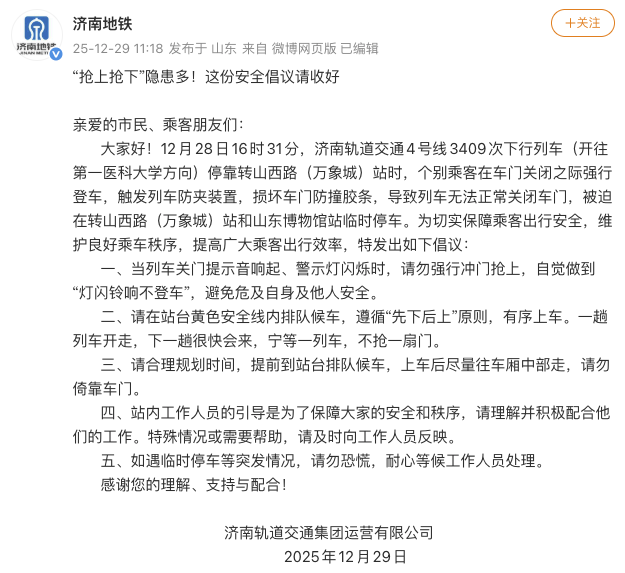
乘客强行登车致设备损坏列车临时停车,济南地铁发布安全倡议
Xin Jing Bao· 2025-12-29 06:13
Core Viewpoint - Jinan Metro issued a safety initiative to enhance passenger safety and maintain order after an incident involving passengers forcing their way onto a train, which led to operational disruptions [1][2] Group 1: Safety Measures - Passengers are advised not to force their way onto trains when the closing door alert sounds and warning lights flash, emphasizing the principle of "do not board when lights flash and bells ring" to ensure safety [1] - Passengers should queue within the yellow safety line on the platform and follow the "let passengers exit before boarding" rule to maintain order [1] Group 2: Passenger Conduct - It is recommended that passengers plan their time wisely, arrive early at the platform, and move towards the middle of the carriage after boarding, avoiding leaning against the doors [2] - Passengers are encouraged to cooperate with station staff, who are there to ensure safety and order, and to report any special situations or needs for assistance [2] - In case of unexpected stops, passengers should remain calm and wait patiently for staff to address the situation [2]
济南地铁4号线发生乘客强行登车致设备损坏临时停车事件,轨交公司发布安全倡议
Xin Lang Cai Jing· 2025-12-29 05:51
Core Viewpoint - The Jinan Rail Transit Group has issued a safety initiative to enhance passenger safety and maintain order after an incident involving passengers forcing doors to close on a train, which led to operational disruptions [3][4][5]. Group 1: Safety Measures - Passengers are advised not to forcefully board trains when the closing door warning sounds and lights flash, emphasizing the importance of safety [3]. - A queueing system is encouraged, with passengers instructed to wait behind the yellow safety line and follow the "let passengers exit before boarding" principle [4]. - Passengers should plan their time effectively, arrive early at the station, and move towards the middle of the carriage after boarding, avoiding leaning against the doors [4]. Group 2: Cooperation and Response - The initiative highlights the role of station staff in ensuring safety and order, urging passengers to cooperate with their guidance [4]. - In case of unexpected stops or emergencies, passengers are advised to remain calm and wait for staff assistance [5]. - The company expresses gratitude for the understanding and support of passengers in maintaining a safe travel environment [6].
西安地铁15号线开通运营 地铁通车里程已达422公里
Xin Hua She· 2025-12-29 05:25
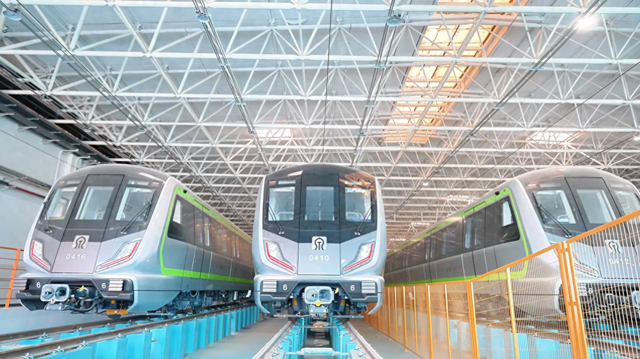
新华社西安12月29日电(记者张斌)西安地铁15号线(一期)12月29日正式开通运营。 ...
济南地铁“三线齐发”重构城市格局,三期规划正在编制
Xin Lang Cai Jing· 2025-12-29 05:23
Core Viewpoint - The opening of three new metro lines in Jinan marks a significant transformation from single-line operation to a networked system, enhancing the city's public transportation infrastructure and connectivity [1][3]. Group 1: Metro Line Developments - Jinan's metro system has expanded to six lines with the recent opening of Line 4, Line 6 East Section, and Line 8, which are key components of the city's transportation network [1][3]. - Line 4, the longest at 40.3 kilometers with 33 stations, significantly alleviates traffic pressure along Jinan's major thoroughfare, connecting various urban core areas [3]. - Line 8 spans 25.3 kilometers with 14 stations, linking multiple districts and serving as a crucial connector for industrial and educational hubs [3]. - The East Section of Line 6 enhances connectivity in the eastern urban area, linking key development zones and providing rapid transit for high-density passenger flows [3]. Group 2: Impact on Daily Life - The new metro lines are expected to transform daily commuting for residents, reducing travel times significantly; for instance, the commute from the West Railway Station to the CBD is cut from one hour to 40 minutes [7][9]. - The integration of the new lines facilitates a "half-hour commuting circle" for residents of Zhangqiu, making it feasible to live outside the city while working in the urban center [9]. - The "Jinan Yunba" system, which connects to the metro, addresses short-distance commuting challenges for employees in industrial parks [9]. Group 3: Economic and Urban Development - The metro's expansion is anticipated to drive commercial growth, with new business opportunities emerging around transit hubs and along the lines, enhancing the city's economic landscape [10]. - The TOD (Transit-Oriented Development) model is being leveraged to upgrade Jinan's commercial structure, with new urban complexes being developed near key stations [10]. - The metro lines are reshaping the urban landscape, promoting resource optimization and collaborative development across various districts [15][16]. Group 4: Technological Innovations - Jinan's metro construction has incorporated advanced technologies to address geological challenges, ensuring minimal impact on the local ecosystem while facilitating urban transit [12][13]. - The use of intelligent tunneling machines has enhanced safety and efficiency in construction, setting a precedent for future urban transit projects in complex environments [13]. Group 5: Future Outlook - The ongoing development of Jinan's metro system is part of a broader strategy to enhance urban mobility and connectivity, with plans for further expansions and improvements already underway [16][17].
西安地铁15号线明日开通运营
Xi An Ri Bao· 2025-12-29 04:16
Core Points - The Xi'an Metro Line 15 Phase I will commence initial operations on December 29 at 11:00 AM, marking the completion of the city's third phase of rail transit construction, with the total operational mileage reaching 422 kilometers [1] - The new line features a total length of 19.4 kilometers with 13 underground stations, enhancing the urban rail network and facilitating seamless transfers with existing lines 2, 4, and 6 [2] Summary by Sections Operational Details - The first and last train times for Dongzhaoyu Station are 06:15 and 23:00, while for Xiliu Station, they are 06:00 and 22:45, providing a total operational service duration of 17 hours and 31 minutes, with a minimum train interval of 5 minutes and 30 seconds [1] - The ticket pricing follows a distance-based pricing system, with a full fare of 5 yuan and a maximum fare of 13 yuan, and all stations support QR code scanning and facial recognition for boarding [1] Technical Features - The line is equipped with smart stations and utilizes the highest level of automation with the G0A4 fully automated operation system, featuring A-type trains capable of reaching speeds up to 100 km/h [1] - The line employs a mixed operation mode of 4/6 train formations to accommodate passenger flow patterns, with a one-way travel time of approximately 29 minutes [1] Urban Impact - As a major east-west trunk line in the southern part of the main urban area, the opening of Line 15 will enhance the urban rail network, alleviate traffic congestion, and promote rapid development in sectors such as science and technology, education, and cultural tourism in the southern region of Xi'an [2]
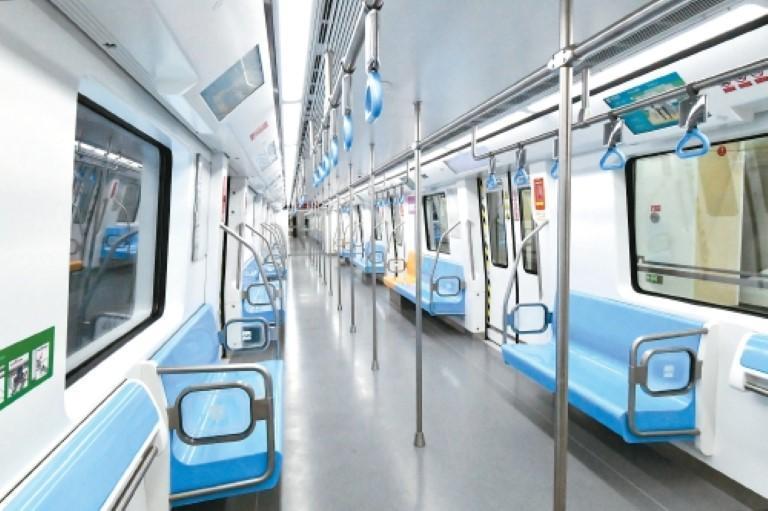
年内运送乘客超32亿人次
Shen Zhen Shang Bao· 2025-12-29 03:05
Group 1 - In 2025, Shenzhen Metro's passenger volume reached a record high, transporting over 3.2 billion passengers, marking a year-on-year increase that leads among first-tier cities [1][2] - The average daily passenger flow reached 8.9853 million, showing a significant year-on-year growth of 6.2%, with single-day passenger volume exceeding 10 million becoming a new norm [1] - Shenzhen is advancing the construction of Metro Line Phase V, with expectations to exceed 800 kilometers of operational mileage by 2030, laying the foundation for a "railway urban circle" [1][2] Group 2 - The expanding metro network is driving the optimization of regional industrial layout and accelerating urbanization, with new lines primarily extending from the city center to the outskirts [2] - The construction of new metro lines has facilitated extensive coverage in areas outside the original special economic zone, enhancing connectivity between urban centers and promoting economic integration [2] - Future metro lines are planned to connect with neighboring Dongguan and Huizhou, providing potential for the development of a metropolitan area centered around Shenzhen [2]