
种植业

Search documents
农业农村部:完善农产品贸易和国内生产协调机制 支持扩大优势特色农产品出口
智通财经网· 2026-02-06 00:42
Core Insights - The Ministry of Agriculture and Rural Affairs has released implementation opinions to advance agricultural modernization and rural revitalization, emphasizing the need for a stable agricultural supply chain and international competitiveness in agricultural enterprises [1][4][5]. Group 1: Agricultural Production and Quality - The focus is on enhancing agricultural production capacity and quality, ensuring stable supply of key agricultural products, with a target of maintaining grain production at around 1.4 trillion jin [5][6]. - The implementation of a new round of grain production capacity enhancement actions is prioritized, alongside the promotion of high-quality agricultural practices [5][6]. Group 2: Livestock and Aquaculture Development - The modernization of the livestock industry is emphasized, with measures to regulate pig production and support the recovery of beef cattle and dairy industries [6][7]. - High-quality development of fisheries is targeted, including the promotion of ecological aquaculture and the development of deep-sea farming [7]. Group 3: Agricultural Diversification and Sustainability - A multi-faceted food supply system is to be developed, promoting modern facility agriculture and enhancing the quality of agricultural products [8][10]. - Strengthening soil protection and quality improvement measures is crucial, with a focus on high-standard farmland construction and sustainable agricultural practices [8][9]. Group 4: Rural Revitalization and Support Mechanisms - The implementation of regular assistance policies is integrated into the rural revitalization strategy, ensuring stable financial support and resource allocation [2][11]. - Continuous monitoring and support for poverty alleviation efforts are emphasized to prevent large-scale poverty recurrence [2][12]. Group 5: Agricultural Technology and Innovation - Enhancing agricultural technology innovation is a priority, with a focus on integrating technology into agricultural practices and promoting the development of agricultural technology enterprises [14][15]. - The transformation and application of agricultural technology achievements are to be accelerated, fostering a robust agricultural innovation ecosystem [15][16]. Group 6: Rural Infrastructure and Living Conditions - The improvement of rural infrastructure and public services is essential for enhancing living conditions in rural areas, with a focus on building quality living spaces [20][21]. - Initiatives to improve rural sanitation and environmental conditions are to be launched, addressing issues such as waste management and sanitation facilities [21][22]. Group 7: Land and Property Management - The stability of land contracting relationships is to be maintained, with a pilot program for extending land contracts for an additional 30 years [24][30]. - The management of rural land use and property rights is emphasized, ensuring orderly transfer and utilization of land resources [24][30]. Group 8: Financial and Investment Support - The establishment of a multi-source investment mechanism for rural revitalization is crucial, with a focus on optimizing public budget allocations and encouraging private investment [26][27]. - Financial support mechanisms for agriculture are to be enhanced, promoting innovative financial products tailored for the agricultural sector [26][27].

大棚“热土”入“冬忙”
Xin Hua Ri Bao· 2026-02-05 22:00
Core Insights - The article highlights the transformation of winter agriculture in Lianyungang's Huai'an Yuntai Farm, showcasing the use of modern technology to enhance productivity and efficiency in crop cultivation [1][2] Group 1: Technological Advancements - The farm utilizes advanced soilless cultivation techniques, including coconut coir as a substrate, air-source temperature control systems, and integrated water and fertilizer drip irrigation, creating an ideal environment for hop growth [1] - The implementation of these technologies allows for precise control of water and nutrients, resulting in higher yields and reduced labor costs [1] Group 2: Crop Diversification and Market Strategy - The farm is focusing on high-value crops such as strawberries and specialty tomatoes, ensuring a steady supply for the winter market while also introducing blueberries to enhance crop diversity [2] - The integration of agriculture and tourism has attracted visitors, expanding revenue channels for farmers and transforming previously idle winter fields into productive land [2]
龙游14个村喜提2000万元“过年红包”
Xin Lang Cai Jing· 2026-02-05 18:10
(来源:衢州日报) 转自:衢州日报 "钱来了!钱来了!"一声呐喊响起,村民们纷纷踮脚张望、搓手雀跃。礼堂中央的长条桌上,一摞摞崭 新现金整齐码放,厚厚地叠成一座小山丘,鲜红封条透着喜庆。"2月3日至5日,我们将发放220余万元 现金,此外,村集体将收到90多万元收益。"龙游红专种粮专业合作社负责人董红专介绍,本次分红覆 盖夏金村及周边共14个村庄,总金额达2000万元。 "签字、按手印、领钱!"流程简单顺畅,却处处透着暖意。工作人员麻利清点现金,村民董土良接过钱 款,指尖抚过崭新票面,笑得合不拢嘴:"把田交给合作社,不仅一分不荒,年年都按时发钱,从不拖 欠,这让大家伙儿心里特别踏实。" 记者 邓亮 报组组 楼郁馨 叶奕暄 通讯员 罗敏 2月4日上午8时许,龙游县夏金村村道上,一道道身影从村庄四面八方汇聚而来,快步赶往村文化礼 堂。忽然,"咔哒"一声钥匙转动的轻响,礼堂大门被缓缓推开,村民们有序涌入,静静等候一年一度土 地流转租金与劳务工资"年终红包"的发放。 这份沉甸甸的"年终红包"背后是合作社对农村土地资源的有效盘活。"发现金程序虽繁琐,但能为村民 新年讨个好彩头。"合作社负责人表示,此前,传统农业效益低下 ...
中央一号文件强化农业生产“质效”提升 一揽子措施促农民增收
Zhong Guo Jing Ying Bao· 2026-02-05 15:53
Core Viewpoint - The 2026 Central Document emphasizes the modernization of agriculture and rural areas, aiming to ensure food security and enhance agricultural productivity and quality through a series of strategic policies and measures [1][2]. Group 1: Agricultural Production and Food Security - The document highlights the importance of maintaining food security, with a target of stabilizing grain production at around 1.4 trillion jin (approximately 933 million tons) [2][3]. - It stresses the need to enhance agricultural production capacity and quality, focusing on the integration of production, ecology, and income generation [2][3]. - The document outlines a new round of actions to increase grain production capacity, emphasizing the protection and improvement of arable land quality [4][6]. Group 2: Agricultural Technology and Innovation - The document outlines a clear direction for agricultural technology innovation, aiming to enhance the overall effectiveness of the agricultural technology innovation system [6][7]. - It encourages the integration of key technologies and common technologies to address weaknesses in agricultural technology innovation [7]. - The focus is on promoting the application of advanced technologies such as artificial intelligence, drones, and IoT in agriculture [6][7]. Group 3: Rural Economic Development and Farmers' Income - The document aims to boost farmers' income by developing county-level industries and supporting local economic growth [8][11]. - It emphasizes the importance of increasing operational and wage income for farmers, proposing a comprehensive set of measures to enhance income channels [12]. - The document also highlights the need to stabilize farmers' earnings from agricultural production through policies like price support and insurance [12]. Group 4: Specific Case Studies - The case of Shangsi County in Guangxi illustrates successful agricultural practices, including the development of sugarcane as a key industry, which has significantly increased farmers' income [9][10]. - The county has implemented innovative agricultural techniques and established a modern agricultural industrial park, contributing to local economic growth [9][10]. - The income of rural residents in Shangsi County has seen a substantial increase, reflecting the effectiveness of targeted agricultural policies [11].
锚定农业农村现代化,宁波如何持续发力?
Feng Huang Wang Cai Jing· 2026-02-05 14:24
Group 1: Core Insights - The central theme of the news is the release of the 2026 Central No. 1 Document, which outlines a clear roadmap for agricultural modernization and rural revitalization in Ningbo [1][2] - Ningbo aims to develop a "coastal urban agriculture" industry, focusing on enhancing agricultural production capacity and quality, while ensuring food security [2][3] - The city plans to integrate advanced technologies such as AI, drones, and IoT into agricultural practices to improve efficiency and reduce costs [3] Group 2: Agricultural Development Strategies - Ningbo will focus on four key agricultural areas: technological agriculture, green agriculture, quality agriculture, and brand agriculture [2] - The city intends to enhance grain production capabilities and promote a diversified food supply system, including modern breeding and facility agriculture [3][4] - A new "vegetable basket" project will be implemented to ensure a balanced supply of various vegetables throughout the year [2] Group 3: Rural Revitalization Initiatives - Ningbo has established a framework for creating beautiful and livable rural areas, achieving a 72% coverage rate of beautiful villages [4][5] - The city will develop a spatial layout of "one circle and three belts" to enhance rural aesthetics and functionality [5] - Plans include the construction of 20 key village clusters and over 80 landmark projects to promote rural tourism and cultural integration [5][6] Group 4: Talent and Community Engagement - Strengthening party leadership and talent support is crucial for rural revitalization, with new village leaders assigned to assist in community development [6] - Ningbo has created 120 youth practice stations to encourage young talent to return to rural areas for entrepreneurship, resulting in significant income increases for local farmers [6] - The city aims to attract more young professionals, including university graduates and veterans, to contribute to rural economic growth [6] Group 5: Agricultural Product Development - The focus will be on enhancing the entire agricultural product supply chain, particularly for local specialties, with a target of achieving a total output value of 70 billion yuan by 2030 [7] - Ningbo plans to develop key local products such as milk, flowers, and pickled vegetables, promoting their full industry chain development [7]
北大荒:公司将继续聚焦主责主业
Zheng Quan Ri Bao· 2026-02-05 14:22
Core Viewpoint - The company, Beidahuang, emphasizes its commitment to focusing on its core business and enhancing economic efficiency while seeking new profit growth points to reward investors' trust [1] Group 1 - The company will continue to concentrate on its main responsibilities and operations [1] - There is a strong intention to improve economic benefits [1] - The company aims to explore new avenues for profit growth [1]

泰州姜堰:农村改革试验工作获农业农村部肯定
Zhong Guo Fa Zhan Wang· 2026-02-05 14:16
Group 1 - The core viewpoint of the news highlights the recognition of Jiangyan District's rural reform efforts by national authorities, emphasizing the importance of practical support for related reform pilot projects [1] - Jiangyan District has cultivated over 1,500 family farms, covering an area of 430,000 acres, and established 86 family farm service alliances to achieve comprehensive service coverage [1] - The district has pioneered a new model of coordinated development between "two subjects," effectively revitalizing land resource efficiency [1] Group 2 - The initiative focuses on three aspects: farmland protection, technology integration, and talent cultivation to steadily improve grain yield per unit area [2] - Farmland protection efforts include a comprehensive management approach, achieving over 90% high-standard farmland construction rate, and a 3% increase in rice and wheat yield through a specific soil improvement technique [2] - The establishment of agricultural service networks, consisting of 2 comprehensive service centers, 18 town-level centers, and multiple village service stations, aims to provide comprehensive and precise services to farm owners [2]
中央一号文件来啦,可以挖掘哪些“宝藏”ETF?
Xin Lang Cai Jing· 2026-02-05 01:04
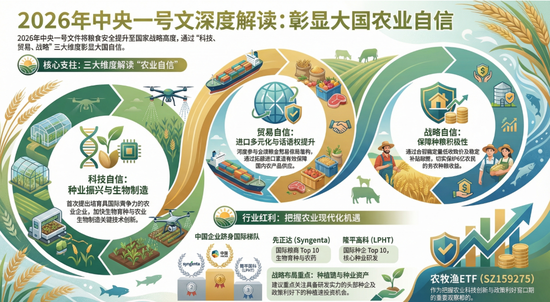
Core Insights - The 2026 Central Document emphasizes the transition from "ensuring quantity" to "improving quality" in agriculture, marking the beginning of the 14th Five-Year Plan [2][27] - The document sets a target for grain production at approximately 1.4 trillion jin (around 700 million tons) and initiates a new round of actions to enhance grain production capacity [2][27] - The focus shifts to "new agricultural productivity," indicating a transition from resource input to technology-driven development [2][27] Policy Highlights - The document introduces a "bottom line" and "action" plan, ensuring stable grain production and enhancing agricultural capacity, which will create sustained demand in the planting industry [2][27] - It upgrades the policy on pig production from "monitoring" to "comprehensive capacity regulation," aiming to balance supply and demand in the pork market [2][28] - The document proposes a financial mechanism to support agriculture, utilizing special bonds and long-term bonds to lower financing costs for agricultural enterprises [2][28] Industry Confidence - The document reflects four types of confidence in agriculture: technological confidence, trade confidence, subject confidence, and strategic confidence, which collectively aim to strengthen the agricultural sector [5][30] - The emphasis on technological advancements and international competitiveness in agriculture is expected to benefit leading agricultural enterprises [5][30] ETF Insights - The Agricultural, Animal Husbandry, and Fishery ETF (159275) tracks the CSI Agricultural Index, with its top holdings aligned with the key areas highlighted in the document [6][31] - The ETF's top ten holdings include major companies in pig farming and feed production, which are expected to benefit from the new policies [6][31] - The ETF is viewed as a strategic investment tool for gaining exposure to the core agricultural industry chain, especially at a time when the industry cycle is at a low point [34][45] Market Performance - Following the release of the document, the Agricultural ETF saw a 1.12% increase, indicating rising investor interest [19][40] - Key stocks within the ETF, such as Haida Group and Muyuan Foods, experienced notable price increases, reflecting heightened market attention [19][42] Future Outlook - Short-term policy benefits and seasonal trends may lead to a surge in ETF performance, while mid-term prospects depend on pig prices and capacity adjustments [44][45] - Long-term agricultural modernization is a national strategy, with leading companies expected to capture more market share as industry concentration increases [45][46]





经济日报金观平:提升农业产能和质量效益
Jing Ji Ri Bao· 2026-02-05 00:56
Group 1 - The central government's primary focus this year is to enhance agricultural comprehensive production capacity and quality efficiency, balancing immediate supply stability with long-term agricultural development [1] - Food security is a critical national priority, with a target of achieving a grain output of 1.43 trillion jin by 2025, marking historical highs in total and per unit yield, while maintaining a per capita grain availability of 1000 jin [1] - Despite improvements, structural shortages in food supply remain a significant challenge, necessitating continuous vigilance in food security efforts [1] Group 2 - The strategy emphasizes stabilizing grain and oil production through area maintenance and yield improvement, ensuring grain output remains above 1.4 trillion jin [2] - There is a call for optimizing planting structures and expanding the production of diverse oilseeds, while also promoting a multi-faceted food supply system that includes agriculture, forestry, animal husbandry, and fishery [2] - The government aims to enhance agricultural production capacity through infrastructure improvements, technological advancements, and strict land use regulations [2] Group 3 - The focus is shifting from quantity to quality in agricultural production, ensuring that products are of high quality, well-marketed, and yield high returns [3] - There is an emphasis on adapting to consumer trends by improving product varieties, quality, branding, and standardization, while also ensuring food safety from farm to table [3] - The strategy includes promoting the export of competitive domestic agricultural products and managing imports of essential goods to stabilize the domestic market [3]
“粮食安全这根弦必须始终绷紧”
Ren Min Ri Bao· 2026-02-05 00:39
Core Viewpoint - The central document emphasizes the importance of food security and outlines actionable policies to enhance agricultural productivity and farmer income, while addressing both immediate and long-term agricultural challenges [1][2]. Group 1: Food Security and Agricultural Production - The overall food security situation in China is stable, with grain production expected to reach 1.43 trillion jin by 2025, maintaining a historical high [2]. - The document stresses the need to maintain a proactive stance on food security, ensuring that production capacity, ecological sustainability, and income growth are prioritized together [2]. - Continuous efforts will be made to stabilize grain production at around 1.4 trillion jin, focusing on improving land quality and agricultural technology [2][3]. Group 2: Farmer Income and Employment - Increasing farmer income is a central task, with measures proposed to stabilize agricultural earnings through minimum purchase prices and subsidies [4]. - Support for rural employment includes policies to stabilize jobs for migrant workers and enhance vocational training to match job market needs [5]. - The document encourages the utilization of idle rural resources to increase farmers' property income through legal means [5]. Group 3: Agricultural Technology and Innovation - The document outlines a focus on agricultural modernization through technological innovation, emphasizing the integration of research and development [6]. - China aims to expand the application of advanced technologies such as drones and artificial intelligence in agriculture, enhancing productivity and efficiency [6][7]. - There is a commitment to transforming agricultural technology achievements into practical applications to address farmers' production challenges [7]. Group 4: Long-term Support and Poverty Alleviation - The transition to normalized assistance for poverty alleviation is highlighted, with a focus on dynamic management of support for at-risk populations [8]. - The document emphasizes the importance of precise and efficient assistance methods, avoiding blanket approaches and ensuring targeted support for industries and employment [8]. - Financial and resource support will remain stable to ensure the sustainability of poverty alleviation efforts [8]. Group 5: Modern Agricultural Industry Development - The goal of transforming agriculture into a modernized large industry is emphasized, focusing on enhancing the value and diversity of agricultural products [9][10]. - The document advocates for a comprehensive approach to agriculture that includes ecological conservation and the development of new industries such as rural tourism [10].