
Mobile Phones

Search documents
手机App强制跳转!国家出手
新华网财经· 2025-11-27 11:36
Group 1 - The core viewpoint of the article emphasizes the need for compliance in the mobile phone and application platform industry to combat unfair competition practices [2] - The State Administration for Market Regulation (SAMR) has identified significant issues of irrational competition in the mobile sector, where some companies exploit technological and data advantages to engage in unfair practices such as traffic hijacking and forced redirects [2] - SAMR calls for industry players to enhance their awareness of responsibilities, thoroughly learn the new anti-unfair competition law, and establish robust internal compliance management systems to maintain a fair market environment [2] Group 2 - The article mentions that SAMR will continue to strengthen enforcement against unfair competition and improve the rules for fair competition, utilizing tiered regulatory tools to protect market fairness and consumer rights [2] - The event included participation from various stakeholders, including representatives from market regulation departments in Guangdong, Shanghai, and Chongqing, as well as mobile companies, application platform enterprises, industry associations, and media [3]


市场监管总局对手机行业开展合规指导
2 1 Shi Ji Jing Ji Bao Dao· 2025-11-27 08:39
市场监管总局强调,手机行业相关经营者要切实增强责任意识,深入学习新反不正当竞争法,高度重视 反不正当竞争合规工作。要全面排查风险隐患,建立健全内部合规管理体系,自觉维护公平竞争市场环 境。要坚决停止并防范各类不正当竞争行为,推动形成优质优价、良性竞争的市场秩序。要遵守法律和 商业道德,共同构建健康有序、互利共赢的产业生态。 市场监管总局将持续强化反不正当竞争监管执法,不断完善公平竞争制度规则,用好梯次性监管工具, 切实维护市场公平竞争和消费者合法权益,推动手机行业规范健康可持续发展。 记者从市场监管总局获悉,11月26日,市场监管总局在广东深圳对手机和手机应用平台企业开展反不正 当竞争合规指导。 市场监管总局通报了手机行业不正当竞争典型案例,并指出,作为数字经济关键组成部分,手机和手机 应用领域当前非理性竞争问题较为突出,部分企业利用技术、数据、平台规则等优势实施流量劫持、强 制跳转、恶意不兼容等不正当竞争行为,损害其他经营者和消费者的合法权益,扰乱市场公平竞争秩 序。 (原标题:市场监管总局对手机行业开展合规指导) 21世纪经济报道记者 王俊 ...
AI手机竞速智能应用,卡点在哪里?
2 1 Shi Ji Jing Ji Bao Dao· 2025-11-20 10:06
Core Insights - The focus of leading domestic smartphone manufacturers has shifted from performance metrics of large models to practical applications of edge AI, enabling rich functionalities in offline scenarios [1][2] - The rapid development of open-source large models, exemplified by DeepSeek, has facilitated the miniaturization of models, which is a fundamental reason for the enhanced capabilities of edge AI in smartphones this year [1][3] - AI smartphones are transitioning from being seen as a novelty to becoming a necessity, indicating a critical point in their evolution [1] AI Underlying Evolution - Recent breakthroughs in AI large models, including miniaturization, multimodality, and long-context expansion, have provided foundational conditions for edge applications in smartphones [1] - The integration of cloud and edge computing paradigms presents key opportunities for terminal manufacturers [2] - The miniaturization of models has significantly improved the feasibility of deploying powerful models on smartphones, allowing for enhanced offline AI functionalities [3][5] Application and Ecosystem Development - OPPO has identified three strategic pillars for AI: new computing, new perception, and new ecosystem [3] - The deployment of edge models has reduced memory requirements, allowing for more efficient use of high-end smartphones [4][5] - The evolution of AI applications is expected to enhance user experiences by integrating AI into traditional functionalities like voice assistants and photo management [6] Agent Ecosystem and User Interaction - The year 2025 is anticipated to be pivotal for the development of AI agents, with manufacturers focusing on embedding AI capabilities into smartphones [7] - The transition from basic smart assistants to more sophisticated systems with multi-agent architectures is underway, enabling complex tasks like food delivery and ride-hailing [7][8] - Challenges remain in user adaptation to AI-driven interactions, as many users are accustomed to traditional GUI methods [8] Market Dynamics and Consumer Behavior - The perception of AI capabilities in smartphones has historically been limited, impacting consumer purchasing decisions [9] - The success of AI features will depend on their ability to address user pain points and enhance convenience [9][10] - The competition among AI smartphones is shifting from technical specifications to the ability to create open and unified ecosystems that align with user interaction habits [10]
曾与华为、小米争锋,年销4000万台的巨头,如今靠百元机在老年机市场求生!头部手机厂商也瞄准了3.29亿“银发冲浪者”
Mei Ri Jing Ji Xin Wen· 2025-11-18 07:27
今年"双11",手机仍是竞争最激烈的产品品类,各大手机厂商均在"双11"之前就做足准备。此刻,谁是此次较量的最终赢家成为市场关注焦点。京东发布 的手机竞速排行榜显示,苹果、小米、vivo位列前三,包揽品牌销量累计榜前三。在智能机"厮杀"的主战场之外,飞利浦、天语等主打功能机业务的手机 品牌也跻身TOP10。 每经记者|王晶 每经编辑|程鹏 黄博文 品牌商与消费者双向奔赴、全民狂欢的"双11"电商节在全网热度中徐徐落幕。 智能手机的普及,曾让功能机一度退居"老人机"赛道。如今,这片最后的阵地也正面临来自智能终端的渗透与重塑。 李大爷的手机又坏了,家人匆匆在电商平台下单,买来一台百元左右的"老人机"——功能极其简单、字体大、音量高、待机时间长。熟悉智能设备的张大 姐则花两千多元买了部智能手机,能刷短视频、视频通话、扫码支付…… QuestMobile(北京贵士信息科技有限公司)指出,截至2024年9月,银发人群(通常指60岁及以上的老年群体)月活用户约3.29亿,人均月使用时长高达 129小时,相当于每天网上"冲浪"超过4小时,其中短视频、社交、资讯、电商等位居使用时长前四位。同时,2000元以上中高端智能机的使 ...



荣耀500系列发布会定档 产品线总裁方飞:将打破档位“潜规则”
Feng Huang Wang· 2025-11-17 14:46
Core Viewpoint - Honor is shifting its product strategy from a reactive approach to a proactive one, aiming to redefine user experience in the smartphone industry [1][2] Group 1: Product Strategy - The upcoming Honor 500 series will adopt a "dual super" strategy, simplifying the product line to only standard and Pro versions [1] - The standard version is designed to provide a balanced experience, while the Pro version will offer an enhanced experience for users seeking premium features [1][2] Group 2: Industry Insight - Honor identifies a major pain point in the smartphone industry where standard models are increasingly underperforming, forcing users to pay more for Pro versions [1] - The company aims to address this issue by ensuring that the standard version is not a compromise but rather a preferred choice for consumers [2]
手机厂商不拼性能卷生态:参数已死,体验当立?
3 6 Ke· 2025-11-17 03:45
Core Viewpoint - The smartphone industry is undergoing a significant transformation, shifting focus from hardware specifications to imaging capabilities, ecosystem connectivity, and AI-driven experiences as key competitive factors in a stagnant market [1][2][27]. Group 1: Flagship Model Releases and Imaging Competition - Major smartphone manufacturers, including Apple, Xiaomi, Vivo, Honor, and OPPO, have launched their flagship models in the latter half of 2025, intensifying market competition [3][4]. - The emphasis on imaging and ecosystem applications has replaced traditional hardware specifications as the main selling points of flagship devices [4][6]. - Apple’s iPhone 17, despite some criticism regarding its materials, highlights advancements in AI processing and imaging capabilities, aiming to enable users to capture professional-quality photos [4][5]. Group 2: AI and Ecosystem Connectivity - AI technology is now integrated into daily user experiences, enhancing functionalities such as night photography, portrait optimization, and image stabilization [7][8]. - Manufacturers are focusing on creating a seamless ecosystem where smartphones serve as the central hub for various smart devices, enhancing user experience and encouraging brand loyalty [9][10]. - The interconnectedness of devices, such as OPPO's "super connectivity" features and Vivo's smart home integration, aims to provide a more cohesive user experience [10][11]. Group 3: Market Dynamics and Growth Strategies - The smartphone market is experiencing stagnation, with IDC reporting a slight decline in shipments, necessitating manufacturers to seek new growth avenues [12][13]. - The average smartphone replacement cycle in China has extended from 24 months in 2020 to 36 months in 2024, increasing pressure on manufacturers to innovate [14]. - Companies are prioritizing ecosystem development to retain users and create new revenue streams, with Xiaomi reporting significant income from its IoT and lifestyle products [17][18]. Group 4: Rise of Domestic High-End Phones - Domestic brands like OPPO and Vivo are gaining market share in the high-end segment, with their combined market share increasing from 19% to 38% in the 4000-5999 yuan price range [22]. - Despite the growth of domestic brands, there are concerns regarding product quality and customer service, which could hinder their acceptance in the high-end market [24][26]. - The shift in consumer perception towards domestic high-end phones reflects a search for balance between price and brand value, challenging Apple's dominance [22][24]. Group 5: Conclusion - The smartphone market is transitioning from a focus on hardware specifications to an emphasis on ecosystem integration and user experience, prompting manufacturers to rethink growth strategies [27]. - The ability to deliver seamless experiences across devices will be crucial for companies to thrive in a competitive landscape, driving the industry towards higher quality development [27].

股市面面观丨“非洲手机之王”近期股价暴跌超30% 端侧AI方向潜力仍被看好
Xin Hua Cai Jing· 2025-11-11 15:53
Core Viewpoint - Transsion Holdings, known as the "King of African Mobile Phones," has experienced a significant decline in stock price, dropping nearly 35% over 27 trading days since September 25, making it the worst performer among the STAR Market 50 index stocks, which only fell about 6% during the same period [1][3]. Financial Performance - For the first three quarters of 2023, Transsion Holdings reported revenue of 49.54 billion yuan, a year-on-year decrease of 3.33%, and a net profit of 2.148 billion yuan, down 44.97% year-on-year, marking the lowest level for the same period since 2021 [3]. - The company's gross profit margin has fallen to 19.47%, dipping below 20% for the first time in recent years, attributed to market competition and rising supply chain costs [3][4]. - In Q3 2023, Transsion achieved revenue of 20.466 billion yuan, a year-on-year increase of 22.60% and a quarter-on-quarter increase of 27.33%, but the net profit decreased by 11.06% year-on-year to 0.935 billion yuan [3]. Market Competition - Transsion is facing intensified competition in its traditional African market, with domestic brands like Xiaomi, OPPO, and Honor increasing their presence. Xiaomi's market share in Africa has risen to approximately 14%, while Honor holds about 4% [4]. - Despite the competition, Transsion maintains over 50% market share in Africa, indicating its dominant position [4]. Supply Chain Challenges - The recent surge in storage prices has added pressure to Transsion's operations. The company plans to respond to these cost increases through price adjustments and product structure changes [4]. AI Potential - Transsion's potential in edge AI is viewed positively by institutions, with its TECNO AI and Infinix AI being applied in various functions such as image enhancement and voice assistance [5]. - The company is focusing on localized AI solutions to cater to low-resource languages in emerging markets, which could enhance user experience [5]. Strategic Partnerships - Transsion is actively collaborating with major internet companies like NetEase and Tencent to develop mobile internet products, aiming to enhance user experience and market share in key regions [6]. Investment Ratings - In the past month, nine brokerage firms have issued investment ratings for Transsion, with six firms recommending "buy" and two recommending "hold" [7].


国产新机电池卷到10000mAh,iPhone和充电宝沉默了
3 6 Ke· 2025-11-11 10:39
Core Viewpoint - The smartphone industry is witnessing a significant shift towards larger battery capacities, with several manufacturers testing devices featuring batteries exceeding 10,000mAh, potentially alleviating concerns about battery life [1][6]. Group 1: Battery Innovations - The recently released Honor X70 features a record battery capacity of 8,300mAh, but this record is expected to be surpassed soon with new models testing 10,000mAh batteries [1][6]. - The 10,000mAh battery could enhance video playback time to approximately 30 hours and enable daily usage to last up to three days on a single charge, assuming energy efficiency remains constant [6][8]. - The rapid evolution of battery technology has led to a significant increase in capacity, from an average of 4,000-4,500mAh in 2019 to the current trend of 10,000mAh [8][9]. Group 2: Market Trends - The trend of larger batteries is primarily observed in mid-range and low-end smartphones, as these devices can compromise on other specifications to accommodate the larger battery size [14]. - The Honor X70, priced starting at 1,399 yuan, is noted for its industrial-grade waterproofing and enhanced durability, appealing to outdoor users who prioritize battery life and ruggedness over high-end performance [14][15]. - The anticipated rise in prices for DRAM and NAND flash memory could impact the pricing of new smartphones featuring large batteries, particularly in the mid-range segment [15]. Group 3: Technological Advancements - The successful integration of silicon-carbon anode materials has been a key breakthrough, allowing for higher energy density in batteries compared to traditional graphite anodes [9][13]. - The introduction of fast charging technologies, such as 120W and above, addresses the potential slow charging issues associated with larger batteries, creating a balance between capacity and convenience [13]. Group 4: Future Implications - The trend towards larger batteries may not only influence smartphones but could also extend to electric vehicles, suggesting a broader impact on the technology landscape [16].

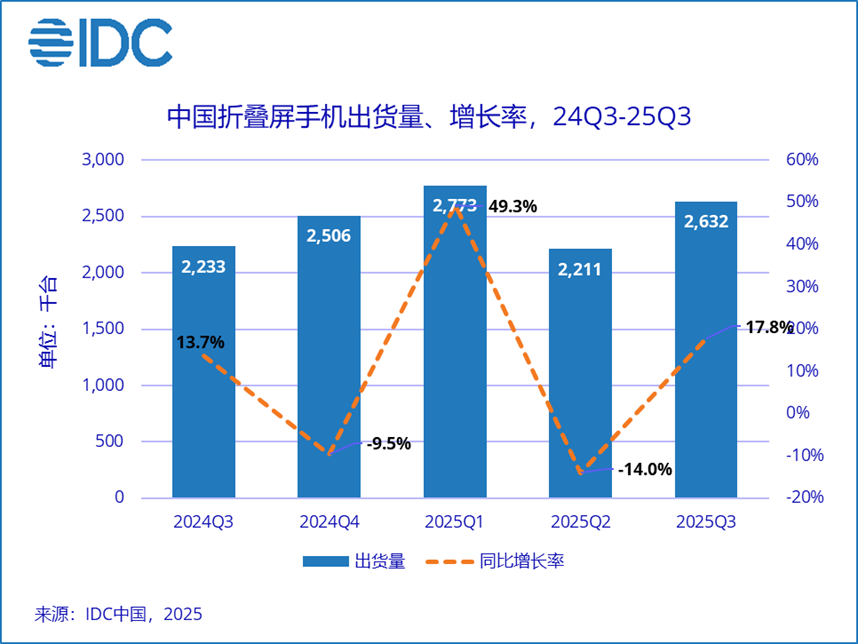
IDC:三季度中国折叠屏手机市场回暖 出货量达263万台 同比增长17.8%
智通财经网· 2025-11-11 06:04
Core Insights - The Chinese foldable smartphone market is experiencing a significant recovery, with Q3 2025 shipments reaching 2.63 million units, a year-on-year increase of 17.8% [1] - The total shipments for the first three quarters of 2025 reached 7.62 million units, reflecting a 14.3% year-on-year growth, with expectations to approach 10 million units by the end of the year [1] - Key advancements in technology have addressed traditional pain points such as weight and thickness, leading to improved product experiences and a shift towards mainstream adoption [1][5] Company Performance - Huawei continues to dominate the foldable smartphone market with nearly 70% market share, having surpassed 15 million cumulative shipments [3] - Honor ranks second with an 11.2% market share, driven by the success of its Magic V5 and Magic V Flip series [3] - Vivo holds a 5.0% market share, focusing on competitive pricing and enhancing interoperability with the iOS ecosystem [3] - OPPO, with its Find N5 series, and Samsung, through its Galaxy Z Fold7 series, are also making strides in the market, with Samsung returning to the top five [3] Industry Trends - The foldable smartphone market is transitioning from niche to mainstream, driven by technological advancements and improved user experiences [5] - Innovations in design and functionality, such as three-fold and wide-fold models, are helping to differentiate products in a previously homogeneous market [5] - The industry is expected to shift from competition based on existing products to innovation-driven competition, with foldable smartphones becoming a key segment in the high-end market [5]
北斗短信重大升级:“文字+图片+语音”来了 红米Note 15 Pro+首支持
Feng Huang Wang· 2025-11-11 05:47
Core Viewpoint - China Mobile has officially launched a significant upgrade to its Beidou SMS service, enhancing communication capabilities to include multimedia messaging such as images and voice, marking a new phase in Beidou communication [1] Group 1: Service Upgrade - The Beidou SMS service now supports the transmission of 40 Chinese characters for outgoing messages and 10 Chinese characters for incoming messages, improving text transmission capabilities [1] - The upgrade allows users to communicate through SMS, voice, and images even in extreme environments without ground network signals, providing communication support for emergency situations, outdoor adventures, maritime operations, and rescue missions in uninhabited areas [1] Group 2: Device Compatibility - The Redmi Note 15 Pro+ is the first smartphone to support the upgraded Beidou SMS service, with software updates already pushed to the device [1] - Other brand terminals are expected to receive upgrades in the near future, expanding the availability of the new features across different devices [1]
