
现代服务业

Search documents
湖北多措并举推动鄂澳两地融合发展 2024年全省赴澳门旅客同比上升11%
Chang Jiang Shang Bao· 2025-09-07 23:10
Group 1 - The core event "Hubei·Wuhan Macao Week" will take place from September 5 to 8, 2024, showcasing Macao's latest tourism resources and cooperation opportunities [1][2] - Hubei's outbound tourists to Macao are projected to increase by 11% year-on-year in 2024, with 567,000 visitors expected [3][4] - The event aims to deepen cooperation between Hubei and Macao across various sectors, enhancing economic prosperity and regional development [1][2] Group 2 - Since 2020, "Macao Week" has been held in 10 cities, attracting nearly 6 million participants and generating 7.86 billion exposures [2] - The event in Wuhan marks the first time "Macao Week" is held in a central city, emphasizing the importance of Hubei as a key market for Macao's tourism [2][3] - Hubei has established direct flights and high-speed rail connections to Macao, facilitating increased travel and exchanges [3][4] Group 3 - The collaboration between Hubei and Macao is supported by various cultural and economic initiatives, including the "Mazu Cultural Tourism Festival" and cross-border financing promotion [3][5] - Hubei's rich traditional Chinese medicine resources and Macao's advantages in the health industry present opportunities for joint development in the health sector [5][6] - Hubei aims to leverage Macao's international exhibition and service industry to enhance its own cultural tourism profile [6]
南京举行月度全市重大产业项目推进活动
Nan Jing Ri Bao· 2025-09-02 00:34
Group 1 - The monthly major industrial project promotion event in Nanjing highlights the city's economic growth and development through significant projects [1][2] - The total investment for the Mufu Zhigu project is approximately 2.7 billion, with around 160 companies already settled in the first phase of the digital economy headquarters [2][5] - The Nanjing Huamao Center project, with a total investment of about 8 billion, includes a shopping center, commercial street, and international office buildings, with over 30,000 square meters of office space already leased [3][8] Group 2 - Major projects are seen as crucial for economic stability and growth, with the government optimizing service mechanisms to support project development [9] - The investment progress for provincial major projects reached 67.7% from January to July, exceeding the scheduled progress by 9.4 percentage points [9] - The focus on high-end modern service platforms and the integration of various industries is expected to enhance resource allocation and economic development [8][9]
河源224个项目集中签约动工竣工投产
Nan Fang Ri Bao Wang Luo Ban· 2025-08-28 07:56
Group 1 - A total of 224 projects were signed, started, completed, and put into production in Heyuan, covering high-end equipment, food and beverage, electronic information, and modern service industries, with a total planned investment of 403 billion yuan [1] - New projects signed include 72 with a total investment of 158 billion yuan, while 79 projects started with an investment of 113 billion yuan, and 73 projects completed with a total investment of 132 billion yuan [1] - New projects are expected to generate an annual output value of 183 billion yuan and an annual tax revenue of 6.6 billion yuan [1] Group 2 - Heyuan National High-tech Zone is a key driver of economic growth and industrial development, leading the city in project signing, commencement, completion, and investment amounts [2] - Since April, 14 industrial projects have been signed in the high-tech zone with a total investment of 43.75 billion yuan, including one project over 10 billion yuan and two over 5 billion yuan [2] - The project by China Shipbuilding Power (Nanjing) Technology Co., Ltd. has an investment of approximately 6 billion yuan and is expected to achieve an annual output value of 10 billion yuan and tax revenue exceeding 30 million yuan [2] Group 3 - The adjustment of the event location to county and district levels reflects Heyuan's incentive for grassroots industrial development [3] - From January to July, the industrial added value in the source district reached 44.87 billion yuan, growing by 14.4%, ranking first in the city for four consecutive months [3] - The company YINENGZHE (Heyuan) Electronic Technology Co., Ltd. aims to invest 10% of its revenue in technology research over the next three years to overcome technical bottlenecks in domestic computer and AI server production [3] Group 4 - Since the launch of the industrial construction "campaign," Heyuan has focused on optimizing platforms, attracting investment, project construction, enterprise cultivation, and service enhancement [4] - In the first half of the year, Heyuan's packaged drinking water manufacturing industry revenue ranked first in the country, with a 5.7% year-on-year growth in industrial added value from January to July, ranking fourth in the province [4] - The water beverage and food industry achieved a rapid growth rate of 49.6%, and future actions will focus on improving the business environment, financial support, trade networks, digital empowerment, and park services [4]
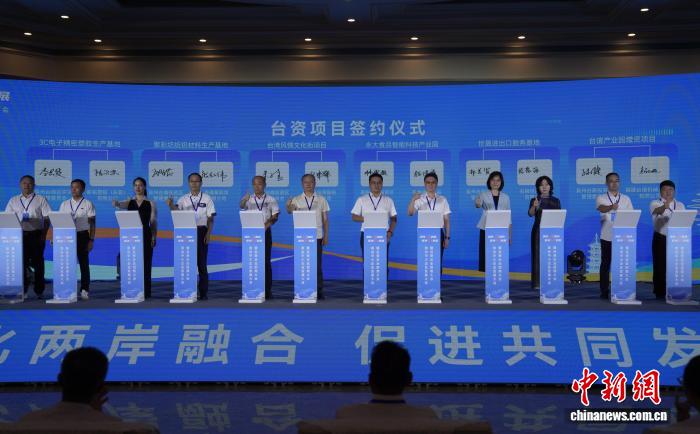
泉州台商投资区18个台资项目集中签约 总投资约55亿元
Zhong Guo Xin Wen Wang· 2025-08-27 08:52
Group 1 - The event "Cross-Strait SMEs Development Conference and Taiwan Investment Promotion Conference" was held in Quanzhou, focusing on deepening cross-strait integration and promoting common development [1][3] - A total of 18 Taiwan-funded projects were signed, with a total investment of approximately 5.5 billion yuan, covering various sectors such as intelligent manufacturing, new materials, food health, and modern services [1][3] - The establishment of a digital service platform for Taiwanese businesses was announced, allowing for streamlined processes in setting up businesses and obtaining necessary permits [3] Group 2 - Agricultural Bank of China and Shanghai Pudong Development Bank provided a combined pre-approval credit of 15 billion yuan to Taiwan-funded enterprises in the Quanzhou Taiwan Investment Zone [3] - Quanzhou is a significant ancestral home for Taiwanese Han compatriots, benefiting from geographical, cultural, and business connections that attract many Taiwanese to work and live there [3] - Over 200 Taiwan-funded enterprises have been established in the Quanzhou Taiwan Investment Zone, creating a collaborative development pattern with local companies in sectors like biomedicine and machinery manufacturing [3]

跨越300公里揽才 汕头学子在“家门口”获深企offer
Nan Fang Ri Bao Wang Luo Ban· 2025-08-25 07:59
Group 1 - The recruitment event "Million Talents Gather in Nanyue - 2025 Deep-Shan Talent Cooperation and Nanshan·Haojiang·Nanao College Graduates Employment Service Special Recruitment Fair" was held in Haojiang District, Shantou City, showcasing collaboration between Shenzhen's Nanshan District and Shantou's Haojiang District and Nanao County [1] - 25 high-quality enterprises from Nanshan participated alongside 32 local enterprises from Haojiang and 3 from Nanao, providing local graduates with direct access to job opportunities from Shenzhen's industrial hub [1] - The event featured a variety of job positions, including software development engineers and robotics research, aligning with regional industrial strengths, while local enterprises focused on manufacturing and modern service sectors [1] Group 2 - Shenzhen BaoRun Technology Co., Ltd. highlighted key benefits such as "weekend off, five days a week" and "meals and accommodation provided" to attract job seekers, addressing concerns about living costs in Shenzhen [2] - The recruitment event included live streaming through the "Yue Employment" mini-program, attracting over 10,000 job seekers and facilitating both offline and online engagement [2] - Dazhu Laser Technology Group provided employment guidance at their booth, emphasizing the importance of work experience over academic qualifications for job seekers [2]

郑永年:大湾区发展现代服务业需让香港“以点带面”
2 1 Shi Ji Jing Ji Bao Dao· 2025-08-23 09:21
Core Viewpoint - The Guangdong province is accelerating the development of a modern service industry, leveraging its unique advantages from Hong Kong to enhance service trade and establish a unified market in the Greater Bay Area [2][3]. Group 1: Development of Modern Service Industry - The modern service industry is a crucial component of the economy, focusing on regulatory management and standards [2]. - Guangdong's modern service industry is currently leading nationally, particularly in technology innovation, financial services, and the digital economy [2]. - Despite its strengths, Guangdong faces challenges such as insufficient high-end supply and regional imbalances [2]. Group 2: Potential and Recommendations - The service trade potential in the Greater Bay Area remains largely untapped, with room for structural optimization [2]. - Compared to other domestic city clusters, the Greater Bay Area has distinct advantages due to its international ports and cultural diversity [3]. - It is suggested that the Greater Bay Area should consider pilot regions to implement a "Hong Kong+" model for modern service industry rules, promoting a unified market across the region [3].
省加快推进现代化产业体系建设第四场专题会议在广州召开 黄楚平出席会议并讲话助力发展优质高效的现代服务业
Nan Fang Ri Bao Wang Luo Ban· 2025-08-23 01:35
Core Viewpoint - The meeting emphasized the importance of developing a modern service industry in Guangdong to enhance economic resilience and support the transformation of the manufacturing sector into a stronger entity [1][2][3] Group 1: Modern Service Industry Development - The meeting highlighted the need for a deep integration of advanced manufacturing and modern services, which is crucial for the growth of the service sector and the overall economy [1][2] - Guangdong's large manufacturing scale and comprehensive system provide ample opportunities for modern services to enhance service supply, facilitating the province's transition from a "manufacturing province" to a "strong manufacturing province" [2] - The government aims to expand digital services, support platform enterprises, and cultivate new business models to drive the growth of the modern service industry [2] Group 2: Strategic Goals and Actions - The meeting outlined specific goals, including enhancing financial services to align with the modern industrial system and improving life services to boost consumption and welfare [2] - Legislative efforts will be accelerated to support the development of modern services, including regulations for express delivery, exhibition industry, and cultural industries [2][3] - Collaboration among various stakeholders, including government departments and enterprises, is essential to overcome bottlenecks in service industry development and to ensure effective implementation of strategies [3]
从主引擎到新引擎,广东现代服务业如何开启“破茧”之旅?
Nan Fang Du Shi Bao· 2025-08-22 13:25
Core Insights - Guangdong's service industry achieved a value-added of 8.14 trillion yuan in 2024, maintaining its position as the largest in the country for 40 consecutive years, contributing 57.5% to the GDP and accounting for 10.6% of the national total [2][3] - The modern service industry is identified as a key driver for economic growth, with a contribution rate of 47.9% to the overall economic growth [3] - The integration of modern service and advanced manufacturing industries is highlighted, with the digital economy in Guangdong reaching 6.9 trillion yuan, leading the nation for eight years [4] Economic Contribution - In 2024, Guangdong's retail sales of consumer goods totaled 4.79 trillion yuan, marking 42 years at the top nationally, supported by a population of over 150 million [3] - The financial sector, information transmission, software, and IT services are recognized as core engines of the service industry [3] Structural Challenges - The service industry faces structural weaknesses, particularly in the supply capabilities of productive services, with low technology conversion rates and a lack of key core technologies [5] - The life service sector is experiencing a mismatch between supply and demand, particularly in high-end care and smart elderly services [8] Talent and Capital Development - There is a significant talent shortage in high-end services such as finance and cross-border services, as well as in the life service sector [8] - Recommendations include building a talent system that integrates education and industry, and fostering innovation through collaboration between universities and leading service enterprises [17] Pathways for Improvement - The report suggests accelerating the domestic replacement of high-end software and enhancing the digital empowerment of productive services [11] - Emphasis is placed on leveraging strategic platforms like Hengqin, Qianhai, Nansha, and He Tao to enhance cooperation with Hong Kong and Macau [11] - The development of new consumption scenarios through AI and digital services is proposed to stimulate economic growth [14]

(粤港澳大湾区)前海集聚现代服务业企业达12.48万家
Zhong Guo Xin Wen Wang· 2025-08-22 12:37
Core Insights - The modern service industry in Qianhai is approaching the advanced level of developed regions globally, according to recent evaluations by professional institutions [1] - Qianhai aims to build a modern service industry system characterized by its unique features and advantages, focusing on high-end factor aggregation and significant radiation effects [1] Group 1: Economic Performance - In 2024, the added value of Qianhai's modern service industry is projected to reach 188.4 billion RMB, with a year-on-year growth of 7.5%, nearly doubling since 2021 [1] - By the first half of 2025, the added value is expected to be 95.26 billion RMB, with a year-on-year growth of 8.6%, accounting for 84% of the service industry’s added value and 65.5% of GDP [1] - Qianhai is on track to achieve the "double 80%" level, where service industry added value accounts for 80% of GDP and modern service industry added value accounts for 80% of service industry added value [1] Group 2: Industry Composition - Among the enterprises in Qianhai, 95% are service industry companies, with Hong Kong enterprises shifting their focus from traditional sectors like finance and logistics to emerging fields such as technology and information services [2] - In the first half of this year, the Qianhai Shekou Free Trade Zone recorded imports and exports with Hong Kong amounting to 59.24 billion RMB, reflecting a year-on-year increase of 90.2%, making Hong Kong its largest trading partner [2]
郑永年:广东可以打造为第四次工业革命服务的平台
Nan Fang Nong Cun Bao· 2025-08-22 12:06
Core Viewpoint - Guangdong has the potential to create a platform that serves the Fourth Industrial Revolution, focusing on sustainable development in the modern service industry [26]. Group 1: Current Status and Challenges - Guangdong's modern service industry is at a leading position nationally, particularly in technology innovation, financial services, and digital economy [4]. - Despite its strengths, the industry faces challenges such as insufficient high-end supply and regional imbalances [5]. - The development of service trade in the Greater Bay Area (GBA) is lagging behind goods trade, with a need for structural optimization [30]. Group 2: Recommendations for Development - It is suggested that the GBA should consider pilot projects to apply modern service industry rules based on Hong Kong's service trade framework, promoting a unified market across the region [6][48]. - A "three-in-one" model is proposed, emphasizing the need for basic research, applied technology, and financial support to drive technological innovation [12][13]. - The establishment of a robust financial support system is crucial, as the lack of a venture capital system is seen as a significant shortcoming in China's technological advancement [22][24]. Group 3: Strategic Advantages of the Greater Bay Area - The GBA has unique advantages, including Hong Kong's status as an international free port, cultural diversity, and proximity to Southeast Asia, which can be leveraged for high-level growth in service trade [39][41]. - There is a call for Guangdong to align its regulatory mechanisms with those of Hong Kong to enhance service trade cooperation and establish a comprehensive business rule system [42][45].
