核电

Search documents
江苏田湾核电7号机组进入调试阶段
news flash· 2025-07-22 23:30
据央视新闻消息,江苏连云港田湾核电7号机组已成功完成冷态功能试验,正式从安装阶段转入调试阶 段。这标志着机组的反应堆性能首次全面考验完成,为后续调试奠定了基础。田湾核电规划建设8台机 组,其中1-6号机组已累计发电超4800亿千瓦时。7号和8号机组是功率最大的两台,计划于2026年和 2027年投入商业运行。全部建成后,田湾核电基地将成为全球装机总量最大的核电基地。 ...
A股重磅!“国家队”,再度出手!中概股,全线上涨!
券商中国· 2025-07-22 23:22
Core Viewpoint - The article highlights the increasing investment in controlled nuclear fusion by China's national team, emphasizing the strategic importance of this sector for future energy solutions and environmental goals [1][5][6]. Investment and Company Formation - On July 22, China Fusion Energy Co., Ltd. was officially established in Shanghai, with significant participation from key government and industry leaders [2]. - China National Nuclear Power Co. plans to invest 1 billion yuan in the fusion company, acquiring a 6.65% stake, as part of a broader investment of approximately 11.49 billion yuan from multiple entities [3][4]. Financial Overview - As of December 31, 2024, the fusion company reported total assets of 611.56 million yuan and a net loss of 202.60 million yuan. By June 30, 2025, total assets are projected to be 5.37 billion yuan with a reduced net loss of 43.26 million yuan [4]. Strategic Importance - The investment aligns with national strategies for energy transition and aims to solidify the central enterprises' leading role in the nuclear fusion industry, supporting the commercialization of fusion technology [5][6]. Industry Development - Controlled nuclear fusion is recognized as a key solution for global energy challenges and is a focal point of technological competition among nations. China has integrated support for this industry into its top-level design, with various policies promoting research and development [7][8]. - The global investment in the fusion sector is projected to reach approximately 1.74 billion USD by 2024, with significant contributions from China and the U.S. [9]. Nuclear Power Expansion - The Chinese government has approved several new nuclear power projects, maintaining a steady pace of approvals, which is expected to continue supporting the growth of nuclear energy as a clean power source [10][11]. - The demand for natural uranium is anticipated to grow at an annual rate of over 4% from 2024 to 2040, indicating a tightening supply situation that could benefit companies in the uranium sector [12].



消息人士:法国电力公司将把重点缩窄至国内、荷兰、瑞典和芬兰的核反应堆项目上。
news flash· 2025-07-22 17:34
消息人士:法国电力公司将把重点缩窄至国内、荷兰、瑞典和芬兰的核反应堆项目上。 ...
消息人士:法国电力公司将退出部分海外核电项目,裁减国际销售团队的职位。
news flash· 2025-07-22 17:34
消息人士:法国电力公司将退出部分海外核电项目,裁减国际销售团队的职位。 ...
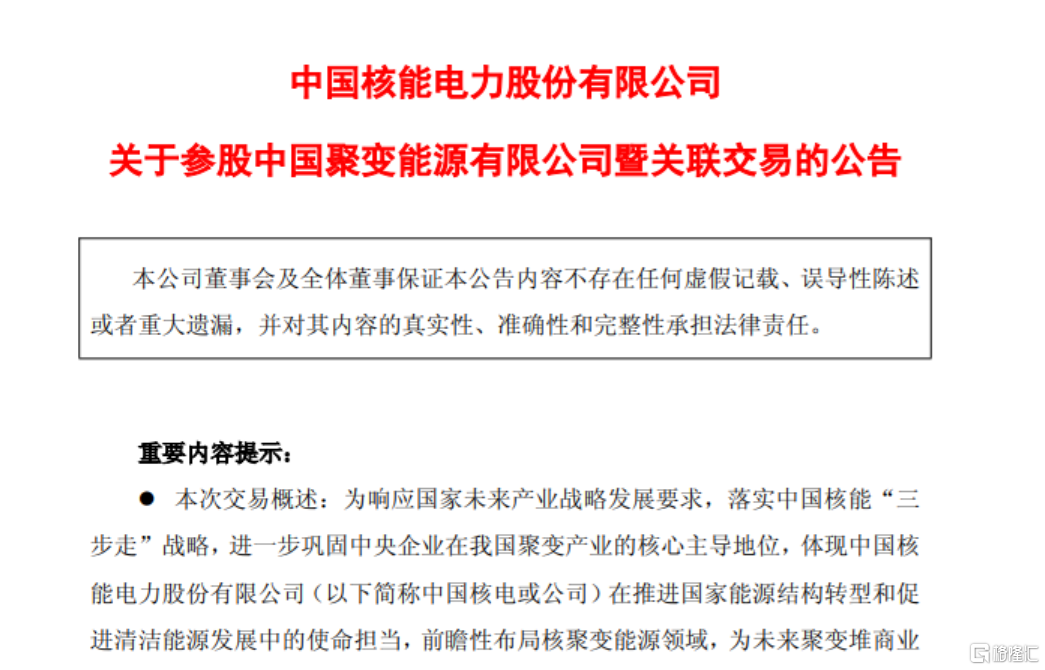
“人造太阳”引巨头争抢!中国核电、浙能电力重金入局
Ge Long Hui· 2025-07-22 16:34
Core Viewpoint - Two major nuclear power companies, China Nuclear Power and Zhejiang Energy Power, announced their investment in China Fusion Energy Co., aiming to strengthen their positions in the nuclear fusion sector and support the national energy transition strategy [2][6]. Investment Details - China Nuclear Power plans to invest 1 billion yuan (approximately 100 million) to acquire a 6.65% stake in the fusion company, while Zhejiang Energy Power intends to invest 751 million yuan (approximately 75.1 million) for a 5% stake [1][6]. - The overall investment round involves multiple institutions, totaling approximately 11.49 billion yuan (around 1.15 billion) for the new registered capital of the fusion company [5][6]. Strategic Importance - The investments are part of a broader strategy to enhance the core leadership of central enterprises in China's fusion industry and to facilitate the commercialization of fusion technology [6][12]. - Both companies view this as a proactive move to maintain competitiveness in the energy transition process [6][10]. Market Trends - The controlled nuclear fusion sector has seen significant interest, with a reported 41.78% increase in related stocks in the A-share market during the first half of 2025 [10][11]. - The global market for controlled nuclear fusion is projected to reach 496.5 billion by 2030 and potentially exceed 1 trillion by 2050 [12]. Technological Advancements - Recent breakthroughs in controlled nuclear fusion technology in China include achieving over 1 million degrees Celsius in plasma operation and the successful ignition of a commercial linear fusion device [11][12]. - The Chinese government has incorporated controlled nuclear fusion into its strategic emerging industry development plan, providing strong policy support for the sector [12][13].

中国广核: 国浩律师(深圳)事务所关于中国广核电力股份有限公司向不特定对象发行A股可转换公司债券在深圳证券交易所上市之法律意见书
Zheng Quan Zhi Xing· 2025-07-22 16:27
Core Viewpoint - China General Nuclear Power Corporation (CGN) is issuing A-share convertible bonds to unspecified investors, which will be listed on the Shenzhen Stock Exchange, with the total amount not exceeding RMB 4.9 billion [3][17]. Group 1: Legal Framework and Compliance - The issuance is in accordance with the Company Law, Securities Law, and relevant regulations, ensuring that all legal procedures have been followed [4][5]. - The company has obtained necessary approvals from its internal authority and the state-owned enterprise, China General Nuclear Group [12][14]. - The issuance has been reviewed and approved by the Shenzhen Stock Exchange and the China Securities Regulatory Commission [13][26]. Group 2: Financial and Operational Conditions - The average distributable profits for the last three years are sufficient to cover the interest on the convertible bonds, meeting the requirements of the Securities Law [15][19]. - The company reported net profits of RMB 1,036.48 million, RMB 1,061.29 million, and RMB 1,071.28 million for the years 2022, 2023, and 2024 respectively, indicating consistent profitability [20]. - The asset-liability ratios for the years 2022, 2023, and 2024 were 61.39%, 60.19%, and 59.49%, respectively, reflecting a stable financial structure [19]. Group 3: Use of Proceeds - The funds raised will be exclusively used for the construction of units 5 and 6 of the Guangdong Lufeng Nuclear Power Plant, aligning with the company's main business operations [17][18]. - The issuance will not be used to cover losses or for non-productive expenditures, complying with regulatory requirements [18][19]. Group 4: Convertible Bond Features - The convertible bonds will have a conversion period starting six months after issuance, allowing bondholders to convert their bonds into shares [21][23]. - The initial conversion price will be determined based on the average trading price of the company's A-shares prior to the issuance, ensuring it meets regulatory standards [22][23]. - The bondholders will have rights to adjust the conversion price under certain conditions, providing them with protection against market fluctuations [24][25].

中国广核: 向不特定对象发行A股可转换公司债券上市公告书
Zheng Quan Zhi Xing· 2025-07-22 16:27
Core Viewpoint - CGN Power Co., Ltd. is issuing A-share convertible bonds totaling RMB 490 million, with the aim of raising funds for its operations and projects [2][6][18]. Overview - The convertible bond is named "Guangke Convertible Bond" with the code 127110 [2]. - The total issuance amount is RMB 490 million, equivalent to 49 million bonds, each with a face value of RMB 100 [6][18]. - The bonds will be listed on the Shenzhen Stock Exchange on July 25, 2025 [2][6]. - The duration of the bonds is from July 9, 2025, to July 8, 2031 [2][6]. - The conversion period for the bonds starts on January 15, 2026, and ends on July 8, 2031 [2][6]. Company Profile - CGN Power Co., Ltd. is primarily engaged in the construction, operation, and management of nuclear power plants, as well as the sale of electricity generated from these plants [10]. - The company was established on March 25, 2014, and is headquartered in Shenzhen, Guangdong Province [8]. - As of December 31, 2024, the company has a registered capital of RMB 5,049,861.11 million [9]. Financial Performance - As of December 31, 2024, CGN Power's total assets amounted to RMB 31,798 million, with a net profit of RMB 2,421.81 million [10][11]. - The company managed to increase its power generation capacity, with a total generation of 2,421.81 billion kWh in 2024, up from 2,282.90 billion kWh in 2023 [10][11]. Shareholder Structure - The largest shareholder, China General Nuclear Power Group, holds approximately 58.89% of the company's shares [9][10]. - The company has a total of 50,498,611,100 shares outstanding, with no shares held in treasury [9][19]. Bond Issuance Details - The bonds will be offered to existing A-share shareholders on a priority basis, with any remaining bonds available to the public [12][18]. - The underwriting of the bonds is managed by Huatai United Securities Co., Ltd. [12][14]. - The bonds are rated AAA by China Chengxin International Credit Rating Co., Ltd. [5][12].
突发!1900亿核电股拟10亿元参股投资中国聚变能源有限公司
Xin Lang Cai Jing· 2025-07-22 13:08
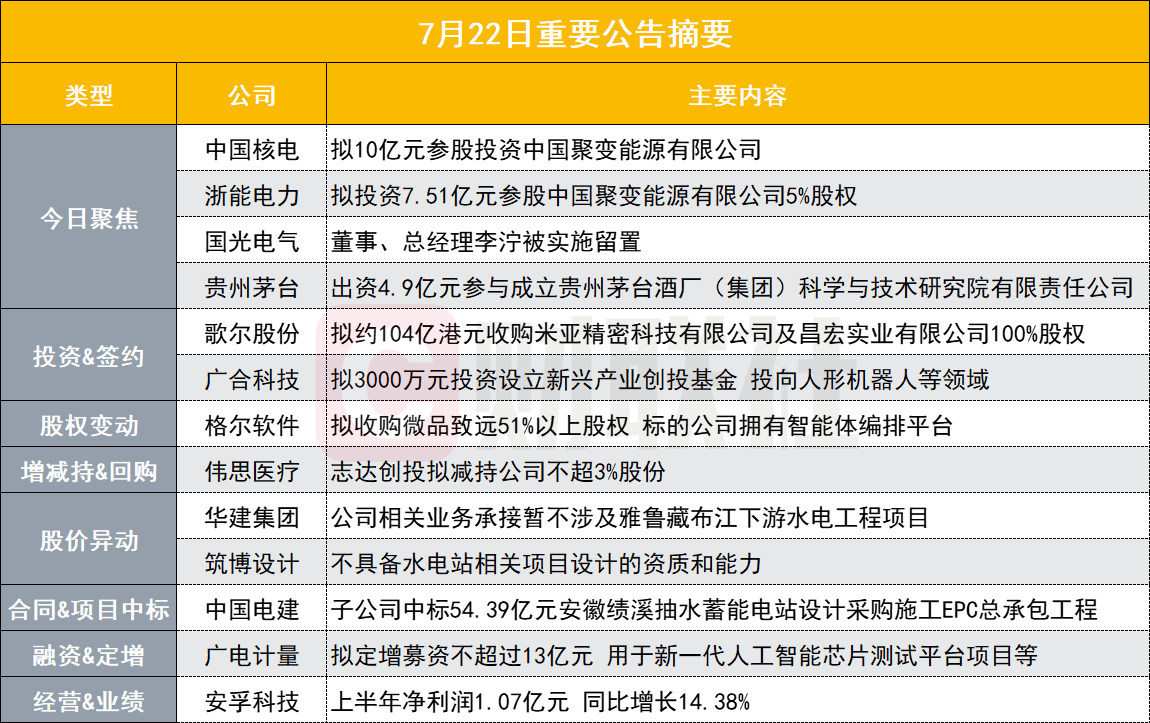
Investment Focus - China Nuclear Power plans to invest 1 billion yuan in China Fusion Energy Co., acquiring a 6.65% stake, while the total investment in the company amounts to approximately 11.49 billion yuan from multiple investors [2] - Zhejiang Energy Power intends to invest 751 million yuan for a 5% stake in China Fusion Energy Co., as part of a broader strategy to enter the nuclear fusion energy sector [2] Corporate Announcements - Guizhou Moutai has contributed 490 million yuan to establish the Guizhou Moutai Brewery (Group) Science and Technology Research Institute, holding a 49% stake [4] - GoerTek plans to acquire 100% of Mia Precision Technology Co., Ltd. and Changhong Industrial Co., Ltd. for approximately 10.4 billion HKD, enhancing its capabilities in precision component manufacturing [4] Management Changes - Guoguang Electric announced that its director and general manager, Li Ning, has been placed under detention, with the chairman temporarily assuming his responsibilities [3] Financial Performance - Anfu Technology reported a net profit of 107 million yuan for the first half of the year, reflecting a year-on-year increase of 14.38% [19] Financing Activities - Guangdian Measurement plans to raise up to 1.3 billion yuan through a private placement to fund projects including a new generation AI chip testing platform [11] Shareholding Changes - Weisi Medical announced that Zhida Venture Capital intends to reduce its stake by up to 3% [12] - Geer Software is in the process of acquiring over 51% of Weipin Zhiyuan, a company specializing in intelligent orchestration platforms [9]




可控核聚变央企,获百亿投资
财联社· 2025-07-22 13:08
Core Viewpoint - The article highlights the significant investment in China's controllable nuclear fusion sector, indicating a strategic move towards advancing nuclear energy technology and addressing the urgent demand for nuclear power in the country [1][4]. Group 1: Investment and Corporate Structure - China Fusion Energy Co., a subsidiary of China National Nuclear Corporation (CNNC), is set to receive an investment of approximately 11.49 billion yuan, marking a substantial step in the country's nuclear fusion development [1]. - Following the investment, CNNC will hold 50.35% of the shares in the fusion company, while China National Nuclear Power will hold 6.65% [2]. - The investment is part of a broader strategy to accelerate the development of controllable nuclear fusion technology, which is still in its early stages and requires significant funding and research [2]. Group 2: Industry Context and Technological Advancements - The Chinese government has emphasized the need for nuclear power development, with projections indicating that nuclear energy's share of total electricity generation could double to 10% by 2035 compared to 2022 [4]. - Various technological routes for nuclear fusion are being pursued, including Tokamak experiments and the Z-pinch fusion-fission hybrid reactor, with significant milestones achieved in recent months [4]. - The successful ignition of plasma in China's first commercial linear field-reversed configuration fusion device marks a critical breakthrough in the commercialization of controllable nuclear fusion technology [4]. Group 3: Market Opportunities and Recommendations - Analysts predict that the controllable nuclear fusion industry will enter a phase of accelerated capital expenditure, with opportunities arising from the construction of FRC and Z-pinch devices [5]. - Companies involved in the supply of critical components for fusion reactors, such as superconducting materials and power systems, are expected to benefit from increased orders and market demand [5]. - Specific companies to watch include those engaged in low-temperature superconducting materials, capacitor switches, and other essential technologies for nuclear fusion applications [5].

中国终于暴露实力!中美差距究竟有多大?张召忠:我可以负责任讲,别再被误导了!
Sou Hu Cai Jing· 2025-07-22 12:07
Economic Milestone - China's GDP, including Hong Kong, Macau, and Taiwan, has surpassed $20 trillion for the first time, reaching $20,196.39 billion [1] - Macau's economy has shown remarkable growth at 8.8%, leading among all provinces, while Taiwan's economy exceeded expectations with a growth rate of 4.59% [1] GDP Comparison with the US - In 2024, the US GDP is projected to be $29.21 trillion, while China's GDP (excluding Hong Kong, Macau, and Taiwan) is estimated at $18.94 trillion, resulting in a gap of $10.26 trillion [1] - This gap is expected to widen to $11 trillion by 2025, influenced by statistical technical factors [1] Currency and Inflation Impact - The average exchange rate of the RMB against the USD depreciated from 7.12 to 7.18 in the first half of 2025, leading to a "loss" of $160 billion in China's GDP when measured in USD [3] - The inflation difference also plays a significant role, with the US experiencing a CPI of 3% in Q1 2025, inflating nominal GDP, while China's nominal growth was only 4.6% despite a real growth of 5.4% [3] Statistical Methodology Differences - The US employs an expenditure approach to GDP calculation, including credit consumption and government stimulus, which inflates the figures, while China uses a production approach focusing on actual goods and services produced [3] Innovation and Development - During the 14th Five-Year Plan, China has made significant innovations in various fields, including shipbuilding, aerospace, and nuclear power, showcasing its technological advancements [3] - R&D investment in China has increased by nearly 50% compared to the end of the 13th Five-Year Plan, with an intensity of 2.68%, approaching developed countries' levels [4] Economic Structure Differences - The US economy is heavily service-oriented, with services accounting for 80% of its GDP, while China's manufacturing sector constitutes 28% and is enhancing its global competitiveness, particularly in the electric vehicle sector [6] - China's per capita GDP remains over six times lower than that of the US, indicating different stages of economic development [6] Environmental and Market Developments - China has reduced its energy consumption per unit of GDP by 11.6% over four years, equivalent to a reduction of 1.1 billion tons of CO2 emissions [6] - The establishment of a unified national market has led to a growth of over 40% in private enterprises compared to the end of the 13th Five-Year Plan [6]