
人工智能

Search documents
小摩:首次覆盖智谱(02513)及MiniMax-WP(00100) 评级为“增持”
智通财经网· 2026-02-10 06:12
该行认为,中国AI行业正迈向以商业化执行力、模型创新及全球拓展能力定义成功的新时期;相信 MiniMax和智谱正脱颖而出,成为最具特色且全球布局加速的两间独立大型语言模型(LLM)开发商。目 前MiniMax超过70%的收入来自海外市场,而两者均正在快速扩展其应用程式介面(API)业务,不仅能多 元化收入来源,并支持更高的利润率,同时亦展现其全球竞争力。 该行预测,全球AI潜在市场规模(TAM)将于2030年达到1.4万亿美元,其中企业级应用与消费级应用均 提供巨大的增长空间。虽然智谱及MiniMax近期上市后股价已有显著波动,但投资者仍应布局有关领 域。 智通财经APP获悉,摩根大通发布研报称,首次覆盖智谱(02513)及MiniMax-WP(00100),均予"增持"评 级,目标价分别为400及700港元,并将其视为捕捉下一波全球人工智能价值创造的首选标的。 ...
普华永道报告:2025年中国企业并购市场显著回暖 交易总额同比激增47%
智通财经网· 2026-02-10 06:12
Group 1 - The core viewpoint of the report indicates a significant recovery in China's M&A market in 2025, with total disclosed transaction value exceeding $400 billion, a year-on-year increase of 47%, marking the first rebound in five years [1] - The total number of transactions surpassed 12,000, reflecting an increase of nearly 20%, indicating enhanced overall market activity [1] - The strong recovery in the M&A market is primarily driven by domestic strategic investments, with 3,639 transactions amounting to $239 billion, representing a substantial year-on-year growth of 83% [1] Group 2 - In 2025, private equity fund transactions reached 1,189, with a total value of $139.4 billion, reflecting annual growth of 14% and 16% respectively [2] - The venture capital market showed remarkable performance, with a record high of 7,382 transactions, driven by the investment boom in AI and robotics, particularly in the high-tech sector [2] - The exit activities for private equity funds were active, with M&A exits being the most significant, and the Hong Kong Stock Exchange IPOs achieving a record of 70 transactions, providing a crucial alternative exit route [2] Group 3 - Looking ahead to 2026, despite uncertainties in global trade and geopolitics, multiple positive factors are expected to continue driving M&A market growth [3] - Key sectors anticipated to be the focus of M&A transactions include high-tech (semiconductors, AI), industrial products, renewable energy, biomedicine, and consumer goods [3] - The overall transaction value and volume in the market are expected to achieve steady growth in 2026 [3]
沪深北交易所宣布优化再融资一揽子措施,聚焦优质上市公司和科技创新领域
Sou Hu Cai Jing· 2026-02-10 06:08
Group 1 - The Shanghai and Shenzhen Stock Exchanges announced a package of measures to optimize refinancing, focusing on high-quality listed companies and technological innovation [1] - Key initiatives include improving review efficiency, revising the recognition standards for "light assets and high R&D investment," and supporting fundraising for new industries, new business formats, and new technologies that are synergistic with the main business [1] - The policy adjustment signals a shift towards supporting high-quality and technology-driven companies, optimizing the refinancing process, and enhancing regulatory oversight throughout the refinancing process [1] Group 2 - Chongqing has introduced a comprehensive set of real estate policies, including subsidies for multi-child families purchasing homes, with 20,000 yuan for two-child families and 30,000 yuan for three-child families [1] - The policies also include subsidies for first-time homebuyers and talent homebuyers, as well as incentives for "selling old to buy new" and optimizing housing provident fund loan policies [1] Group 3 - The first global humanoid robot free-fighting league (URKL) has been launched by Zhongqing Robotics, marking the first commercial free-fighting event focused on humanoid robots worldwide [1] - The league aims to create a comprehensive ecosystem platform, with the highest championship prize valued at 10 million yuan [1] Group 4 - Elon Musk announced that SpaceX is shifting its focus to building a "self-sustaining" city on the Moon, with expectations to achieve this in less than ten years due to faster lunar landing speeds [1] - SpaceX plans to start implementing city construction on Mars within 5 to 7 years, but it is expected to take over 20 years to realize [1] Group 5 - Alibaba's new generation model Qwen3.5 has been revealed, appearing in the largest AI open-source community, HuggingFace [3] - Qwen3.5 features a new hybrid attention mechanism and is likely to be a native model capable of visual understanding as a VLM-type model [3]

专访彭博行业研究高级中国科技分析师:AI的“基建红利”与务实路径
彭博Bloomberg· 2026-02-10 06:06
Core Insights - The global AI competition's outcome may depend more on stable power grids and robust industrial foundations than on algorithmic parameters [1] - China's advanced infrastructure is an underestimated advantage in the AI race, with its vast domestic market providing unique strategic benefits [1][2] Group 1: China's AI Development Strategy - China is adopting a "pragmatic" approach to AI development, embedding technology deeply into its large industrial system and leveraging a vast user base for data resources [2][5] - The "AI+" initiative aims to enhance productivity across various sectors, focusing on practical applications rather than immediate financial returns [3][4] - China's emphasis on cost-effectiveness and resource efficiency contrasts with the U.S. approach, which often prioritizes closed systems and high capital expenditures [4][6] Group 2: Infrastructure and Energy - China has made significant investments in power infrastructure, positioning itself as a leader in renewable energy, which is crucial for AI development [6] - The aging infrastructure in many Western countries, particularly the U.S., presents a stark contrast to China's proactive investments, creating a strategic advantage for China in the AI sector [6] Group 3: Global Market Dynamics - Evidence of market bifurcation is emerging, with geopolitical factors likely leading to a division where U.S. AI models dominate Western markets while China capitalizes on opportunities in emerging markets [7][8] - China's open-source model, combined with competitive pricing strategies, is expected to facilitate technology penetration in new markets, potentially establishing a de facto standard in the long run [8]

豆包下场,春节AI大战愈发热闹
Hua Er Jie Jian Wen· 2026-02-10 06:06
Core Insights - The AI marketing battle during the Spring Festival has intensified, with major players like ByteDance's Doubao, Alibaba's Qianwen, and Tencent's Yuanbao launching aggressive promotional campaigns to attract users [1][12]. Group 1: Doubao's Strategy - Doubao, a product of ByteDance, has targeted the high-traffic platform of CCTV's Spring Festival Gala, offering over 100,000 tech gifts and cash prizes up to 8,888 yuan [1][2]. - The prize lineup includes advanced tech products such as robots and drones, as well as consumer electronics like smartwatches and rice cookers, enhancing its appeal [2][5]. - Doubao's campaign aims to leverage its existing user base of over 100 million daily active users, further expanding its reach through this high-profile collaboration [5]. Group 2: Qianwen's Approach - Qianwen, under Alibaba, adopted a more aggressive strategy with its "30 billion yuan free order" campaign, quickly becoming the top free app on the Apple App Store [6]. - The promotional mechanism offers users a 25 yuan no-threshold free order card, incentivizing user acquisition through referrals, which led to over 1 million orders within hours [6]. - However, the overwhelming response caused server issues, prompting the team to address resource allocation to ensure service stability [6]. Group 3: Market Reactions - The marketing frenzy positively impacted related stocks in the beverage sector, with companies like Gu Ming and Cha Bai Dao seeing significant stock price increases [8]. - Despite the successful promotional activities, Alibaba's stock fell by 3%, indicating investor skepticism regarding the sustainability of user acquisition through high subsidies [8]. Group 4: Competitive Landscape - WeChat has intensified competition by blocking promotional activities from Qianwen and other AI applications, citing disruptions to platform order [9][11]. - This action has created a competitive advantage for Tencent's Yuanbao, as it remains unaffected by WeChat's restrictions [11]. Group 5: Strategic Shifts in the Industry - The ongoing AI marketing battle reflects a deeper strategic shift among China's internet giants, with a focus on AI investments and market defense strategies [12]. - Goldman Sachs predicts that by 2026, total AI capital expenditure from major players like ByteDance, Alibaba, and Tencent will exceed $60 billion (approximately 410 billion yuan) [12]. - The current promotional activities are seen as an entry point into a longer-term competition for dominance in the AI space, with a focus on product quality and user engagement [12].

豆包官宣“参战”!春晚互动将送出10万份大礼!字节含量超29%的科创人工智能ETF(589520)盘中拉升2.4%
Xin Lang Cai Jing· 2026-02-10 06:05
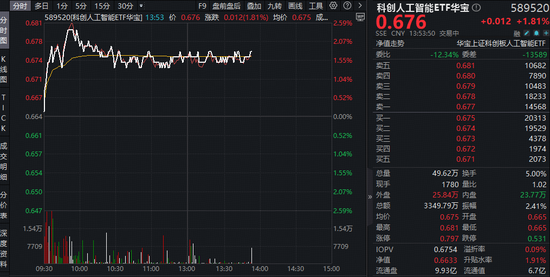
Core Viewpoint - The recent performance of the Sci-Tech Innovation Artificial Intelligence ETF (589520) has been positively influenced by ByteDance's favorable developments, with the ETF's price rising over 2.4% at one point and currently up 1.81% [1][10]. Group 1: ETF Performance - The Sci-Tech Innovation Artificial Intelligence ETF (589520) has a weight of over 29% from ByteDance's industrial chain, indicating strong market interest and investment potential [1][12]. - The ETF's price movement shows a recovery above the 10-day moving average, suggesting positive market sentiment [1][10]. Group 2: Key Stocks Performance - Notable stocks within the ETF include Chipone Technology, which rose over 7%, and Yuntian Lifei, which increased by more than 6%. Other stocks like Hongsoft Technology, CloudWalk Technology, and Anlu Technology also saw gains exceeding 3% [3][13]. - The overall market activity indicates a strong performance from AI-related stocks, reflecting investor confidence in the sector [3][13]. Group 3: Industry Developments - ByteDance's AI application, Doubao, has launched a New Year campaign, distributing over 100,000 cash red envelopes during the Spring Festival, further enhancing its market presence [3][11]. - The introduction of the Seedance 2.0 video generation model by ByteDance has garnered significant attention and positive evaluations within the AI industry, reinforcing its position as a leader in domestic AI [4][12]. Group 4: Policy and Market Trends - The Ministry of Industry and Information Technology is advancing the national computing power interconnection node system, which is expected to boost AI companies' profitability and performance [6][15]. - Analysts suggest that the competition among internet giants for AI traffic entry points is intensifying, with multiple business lines integrating and collaborating, which may drive performance and valuation [6][15]. Group 5: Investment Strategy - The Sci-Tech Innovation Artificial Intelligence ETF focuses on the domestic AI industry chain, with significant holdings in leading companies in GPU and ASIC sectors, indicating a strong offensive strategy [7][16]. - The ETF is positioned as an efficient tool for investors looking to gain exposure to domestic computing power, with a substantial portion of its assets allocated to semiconductor and software industries [7][16].
理想汽车驶向具身智能,锚定下一个技术迁徙
Xin Jing Bao· 2026-02-10 06:05
Core Insights - Li Auto's chairman, Li Xiang, outlined the company's strategy to evolve into an embodiment intelligence enterprise, viewing the ultimate form of automobiles as robots [1] - The company has undergone significant organizational restructuring to support this strategic shift, including the establishment of new teams focused on software and humanoid robots, and the reorganization of its autonomous driving department [1] - Li Auto aims to become a leader in the embodiment intelligence sector within the next 3-5 years, indicating a long-term vision for the integration of AI into its business model [1] Company Strategy - The strategic shift towards embodiment intelligence is not merely a departmental reorganization but a critical move to position Li Auto in the competitive landscape of AI-driven automotive technology [1] - The company is responding to a new wave of AI competition, with Li Xiang asserting that the competition in the mid-to-high-end automotive market will fundamentally revolve around embodiment intelligence [1][2] - Li Auto's transition aligns with broader industry trends, as other automakers also explore the integration of robotics into their vehicles, indicating a growing market for "car + robot" solutions [2] Industry Context - Beijing's supportive policies and initiatives, such as the "Beijing Embodiment Intelligence Technology Innovation and Industry Cultivation Action Plan (2025-2027)," provide a conducive environment for companies like Li Auto to innovate and grow [2] - The automotive industry is entering a phase where growth must come from new avenues, with embodiment intelligence emerging as a significant direction for transformation [2] - The inherent advantages of automotive companies in the embodiment intelligence space stem from the shared core architecture of perception, decision-making, and execution between smart vehicles and intelligent robots [2] Challenges and Considerations - The transition to embodiment intelligence faces multiple challenges, including high costs of advanced technologies and the need for a mature commercial framework [3] - Current cash flow for companies like Li Auto still primarily comes from their core automotive business, highlighting the need for a balanced approach during the transition [3] - The development of embodiment intelligence requires long-term investment and patience, as the path to commercialization and product differentiation is still evolving [3]

中国科技型中小企业走向旷野
经济观察报· 2026-02-10 05:54
Core Viewpoint - The article discusses the emergence of a new wave of technology-driven small and medium enterprises (SMEs) in China, which are leveraging innovative technologies and unique market scenarios to address unprecedented challenges and opportunities in various industries [3][5]. Group 1: Industry Trends - A significant number of new technology SMEs are being established by founders with extensive experience from large state-owned enterprises, research institutions, or leading private companies, indicating a shift from being followers to innovators in the market [2][5]. - The establishment of a supportive ecosystem for technology SMEs, including favorable policies, funding mechanisms, and market access, has created a conducive environment for these companies to thrive [3][6]. - The market is witnessing a re-evaluation of the value of Chinese technology, leading to increased investment interest from traditional listed companies in technology SMEs [6][7]. Group 2: Application Scenarios - Many technology companies are focusing on specific application scenarios rather than just funding or land, with regions like the western part of China providing unique opportunities for testing and deploying new technologies [9][10]. - The shift in comparative advantages between eastern and western regions is highlighted, with western regions offering lower costs and abundant application scenarios, while eastern regions focus on complete supply chains and large consumer markets [10]. Group 3: Entrepreneurial Maturity - Recent entrepreneurs are noted to be more mature and rational, with a clearer understanding of business models, financing, and market positioning compared to previous generations [12][14]. - The emphasis on core technology and application capabilities over mere scale has become a new standard for evaluating enterprises, reflecting a shift in the entrepreneurial landscape [13][14]. - Local governments are also adapting to the changing environment, recognizing that not all industries are suitable for local development and focusing on aligning with local strengths [14].
字节又一新模型!Seedream 5.0上线,对标Nano Banana Pro
Hua Er Jie Jian Wen· 2026-02-10 05:49
市场有风险,投资需谨慎。本文不构成个人投资建议,也未考虑到个别用户特殊的投资目标、财务状况或需要。用户应考虑本文中的任何 意见、观点或结论是否符合其特定状况。据此投资,责任自负。 字节图像生成模型Seedream 5.0在视频编辑应用剪映、剪映海外版Capcut、字节AI创作平台小云雀均已 上线,在即梦AI平台开启灰度测试,图片生成可限时免费体验。新模型对标Nano Banana Pro,能免费 体验。 风险提示及免责条款 ...
智谱连续两日领涨:今日盘中涨超20% 市值逼近1500亿港元
Zheng Quan Ri Bao Wang· 2026-02-10 05:48
Group 1 - The core viewpoint of the articles highlights the strong performance of AI concept stocks in the Hong Kong market, particularly Beijing Zhiyu Huazhang Technology Co., Ltd. (Zhiyu), which saw its stock price surge significantly, reaching a new high of 335 HKD per share and a market capitalization nearing 150 billion HKD [1][2] - Zhiyu's recent activities in the large model sector include the release of its hybrid thinking model GLM-4.7-Flash, which achieved over 1 million downloads on Hugging Face within two weeks of its launch [1] - The global model service platform OpenRouter has introduced an anonymous model named "Pony Alpha," which has garnered attention for its capabilities in coding, long context processing, and agent optimization, leading to speculation that it may be related to Zhiyu's upcoming GLM-5 model [1][2] Group 2 - Pony Alpha is described as a cutting-edge foundational model with strong performance in programming, agent workflows, reasoning, and role-playing, particularly noted for its high accuracy in tool invocation [2] - The recent stock performance of Zhiyu is attributed not only to prior technological breakthroughs but also to positive market expectations regarding the imminent release of a new generation product, which is seen as a significant demonstration of the company's technical strength [2]