住宅建筑

Search documents
Curious about D.R. Horton (DHI) Q1 Performance?
ZACKS· 2026-01-14 15:15
Core Viewpoint - D.R. Horton (DHI) is expected to report a significant decline in quarterly earnings and revenues, reflecting broader challenges in the housing market [1]. Earnings Estimates - The anticipated earnings per share (EPS) for D.R. Horton is $1.96, representing a decline of 24.9% year-over-year [1]. - Analysts have revised the consensus EPS estimate 1.7% lower over the past 30 days, indicating a reevaluation of expectations [1][2]. Revenue Projections - Total revenues are forecasted to be $6.71 billion, which is an 11.9% decrease compared to the previous year [1]. - Specific revenue segments are projected as follows: - Financial Services revenues are expected to reach $163.74 million, down 10.2% year-over-year [4]. - Home sales from Homebuilding are estimated at $6.28 billion, reflecting a 12.1% decline [4]. - Rental revenues are projected at $192.76 million, indicating an 11.5% decrease [4]. - Homebuilding revenues overall are expected to be $6.30 billion, down 12% from the prior year [5]. Geographic Revenue Insights - Geographic revenues for Homebuilding are estimated as follows: - East: $1.20 billion, down 8.9% [5]. - South Central: $1.35 billion, down 9% [6]. - North: $957.85 million, up 1.6% [6]. - Southwest: $948.60 million, down 16.8% [6]. Sales Metrics - Net sales orders for homes sold are projected at 18,607, an increase from 17,837 in the previous year [7]. - Homes closed are expected to total 17,323, down from 19,059 in the same quarter last year [7]. - The average selling price for homes closed is estimated at $362.57 million, down from $374.90 million in the same quarter last year [8]. - The sales order backlog is projected to be 12,005, compared to 11,003 in the same quarter last year [8]. Market Performance - Over the past month, D.R. Horton shares have increased by 3.7%, outperforming the Zacks S&P 500 composite, which rose by 2.1% [8]. - D.R. Horton holds a Zacks Rank of 4 (Sell), suggesting potential underperformance in the upcoming period [8].


美联储主席鲍威尔面临法律诉讼威胁 美国股指期货走低 亚洲股市则大幅上涨
Xin Lang Cai Jing· 2026-01-12 07:30
Group 1: Market Reactions - US stock index futures fell significantly, with S&P 500 futures down 0.6%, Dow Jones Industrial Average futures down 0.5%, and Nasdaq Composite futures down 0.9% following news of a subpoena sent to the Federal Reserve by the Justice Department [1][8] - In contrast, Asian markets saw gains, with the Hong Kong Hang Seng Index up 1.2% at 26,547.64 points, and the Shanghai Composite Index up 1% at 4,163.11 points [9][10] Group 2: Economic Indicators - The US labor market report showed mixed results, with job additions below economists' expectations but an improvement in the unemployment rate, indicating a potential "low hiring, low firing" state that may help avoid a recession [2][11] - Upcoming economic data releases include consumer inflation figures on Tuesday and wholesale price reports on Wednesday [3][12] Group 3: Company-Specific Developments - Vistra's stock surged 10.5% after signing a 20-year agreement with Meta Platforms to supply power from its nuclear plants, highlighting a trend of large tech companies securing energy for AI data centers [3][12] - Builders First Source saw a 12% increase in stock price, while residential builders like Lennar, D.R. Horton, and Pulte Group also experienced significant gains following President Trump's announcement to lower mortgage rates [3][12] - General Motors faced a 2.7% decline in stock price due to a projected $6 billion loss in Q4 2025 from scaling back its electric vehicle business, compounding a previous $1.6 billion charge [4][13] Group 4: Commodity Prices - Gold prices rose by 1.9%, silver surged by 6.4%, and copper increased by 1.4%, reflecting a shift towards safe-haven assets amid market uncertainty [6][15] - Crude oil prices also saw slight increases, with US benchmark crude up 8 cents to $59.20 per barrel and Brent crude up 9 cents to $63.43 per barrel [5][14]
美国商务部长会见建筑商 探讨如何提高住房可负担性
Xin Lang Cai Jing· 2026-01-09 17:39
Core Viewpoint - The U.S. Secretary of Commerce, Wilbur Ross, has recently met with executives from major residential construction companies as part of President Trump's initiative to boost economic support among voters by addressing housing affordability issues [1] Group 1: Government Initiatives - The government has held multiple meetings in recent weeks to solicit feedback from builders on how to improve housing affordability [1] - Discussions have focused on potential incentives that the government could provide to encourage builders to construct more housing [1] Group 2: Industry Impact - President Trump has indicated plans to pressure large home builders to alleviate the rising costs of housing [1]
道指开盘涨0.2%,标普500涨0.2%,纳指涨0.1%
Xin Lang Cai Jing· 2026-01-09 14:39
Group 1 - Real estate stocks continue to rise, with online home trading platform Opendoor increasing by 11.0% and residential builder Lennar rising by 2.7% following Trump's announcement to lower mortgage rates and monthly payments [1] - Meta has signed a nuclear power agreement, leading to a significant increase in nuclear stocks, with Oklo rising by 18.5% and Vistra by 17.6% [1] - General Motors has seen a decline of 2.1% as it reduces its electric vehicle business and records a loss of $6 billion [1] - Revolution shares increased by 14.0% amid reports of Merck negotiating to acquire the company [1]
特朗普住房禁令引发行业疑虑 建筑商担忧“租赁房”业务受阻
Xin Lang Cai Jing· 2026-01-09 12:33
Core Viewpoint - The residential builders face significant uncertainty following President Trump's announcement to potentially ban institutional investors from purchasing homes, which could impact the market dynamics for new housing developments [1] Group 1: Impact of the Proposed Ban - The effect of the ban largely depends on whether it includes homes built specifically for rental purposes, a sector that builders have increasingly relied on in recent years [1] - If the ban encompasses rental-specific homes, builders may lose a counter-cyclical source of demand, potentially leading to a 5% to 10% decline in single-family home starts [1] - Conversely, if the ban excludes such homes, it could actually benefit residential builders, as new homes would become the only avenue for single-family rental operators seeking growth [1]
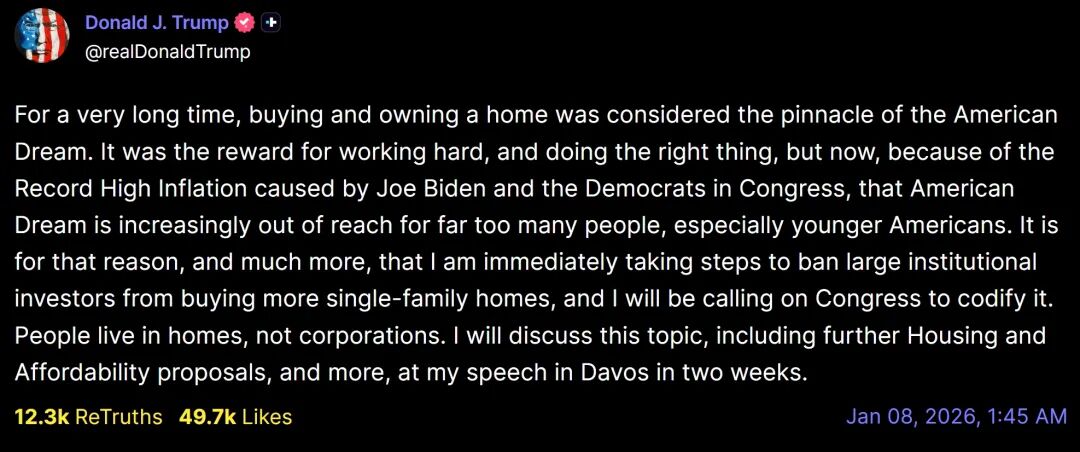
特朗普拟颁布机构投资者“限房令”
Guo Ji Jin Rong Bao· 2026-01-08 12:10
Group 1 - President Trump blames large institutional investors for high housing prices and announces a ban on their purchase of single-family homes to address the housing shortage in the U.S. [1][3] - Following the announcement, stock prices of major rental companies like Invitation Homes and American Homes4Rent dropped significantly, indicating market volatility [2][4] - The U.S. is currently facing a housing shortage of millions of units, exacerbated by a slowdown in housing construction since the 2008 financial crisis, with institutional investors increasingly participating in the market [4][5] Group 2 - The median home price in the U.S. has risen over 50% since 2019, reaching $409,200 in November 2022, contributing to public dissatisfaction [5] - Analysts argue that attributing high housing prices solely to institutional investors lacks sufficient data, suggesting that the core issue is the overall supply shortage rather than investor participation [6][7] - There is skepticism regarding the legislative support for Trump's proposal, with indications that it may face challenges in Congress and potential legal actions from affected companies [7][8]
国金宏观:增长的盛夏,就业的寒冬
Xin Lang Cai Jing· 2025-12-24 14:50
Core Viewpoint - The U.S. economy is experiencing a dichotomy characterized by "summer of growth" and "winter of employment," with significant disparities in economic performance and labor market conditions [3][29]. Economic Growth - The U.S. GDP for Q3 was reported at an annualized rate of 4.3%, exceeding expectations of 3.3%, while the year-on-year growth rate rose to 2.3%, still below the previous year's 2.8% [4][29]. - Key contributors to the GDP growth were consumer spending and net exports, contributing 2.4 and 1.6 percentage points respectively, although consumer spending shows signs of overestimation and disparity [6][30]. Investment Trends - Non-cyclical sectors are showing strong growth, while cyclical sectors are increasingly weak. AI-related investments, despite a decline in growth rate, remain the fastest-growing investment category [8][33]. - Broad AI investments contributed 0.8 percentage points to GDP, while private consumption added 1.1 percentage points, indicating a dual-engine growth model [8][33]. Consumer Behavior - Private consumption is strong overall, but there is a notable disparity among different income groups, with actual disposable income growth slowing down [15][38]. - The consumer spending structure shows significant contributions from healthcare, international travel, and entertainment, while broader service demand indicators have not shown exceptional seasonal performance [18][42]. Employment Conditions - Despite rapid economic growth, unemployment rates are rising, and non-farm payroll growth is declining, indicating a concentration of growth in sectors with lower labor demand [23][47]. - Labor market indicators suggest a potential increase in unemployment, with consumer confidence declining after a brief rebound [23][49]. Policy Implications - Current monetary policy appears misaligned with economic indicators, suggesting a need for a more dovish approach to support employment while addressing growth concerns [25][49].

伯克希尔三季度减仓苹果106亿美元,清仓霍顿持股
Jin Rong Jie· 2025-12-24 07:17
沃伦·巴菲特领导的伯克希尔·哈撒韦公司在2025年前三季度累计抛售了超过240亿美元的股票。该公司在 第三季度对多只持仓股票进行了减仓或清仓操作。 根据公司向美国证券交易委员会提交的13F持仓文件,伯克希尔在第三季度对其最大持仓股苹果公司进 行了减持,减持规模约为106亿美元,持股数量减少近15%。该公司对美国银行的持股也进行了减持, 减持金额为19.2亿美元,减持后其在美国银行的持仓市值约为293亿美元。 声明:市场有风险,投资需谨慎。本文为AI基于第三方数据生成,仅供参考,不构成个人投资建议。 本文源自:市场资讯 作者:观察君 同时,伯克希尔清仓了美国住宅建筑商D.R.霍顿。该公司自2023年第三季度开始持有D.R.霍顿的股票, 此次清仓的股份市值约为1.99亿美元。此外,伯克希尔还对域名服务公司威瑞信和肾脏透析服务提供商 达维塔进行了减持,减持金额分别为12亿美元和2.17亿美元。 ...

巴菲特三季度再减持106亿美元苹果股票,现金储备创纪录超3800亿美元
Jin Rong Jie· 2025-12-24 05:57
Group 1 - Berkshire Hathaway continued to reduce its stake in Apple, selling approximately $10.6 billion worth of shares in Q3 2025 [1] - The reduction in Apple holdings is part of a broader strategy to lower stock exposure during periods of high market valuations, aligning with Warren Buffett's investment principles [1] - In addition to Apple, Berkshire also reduced its positions in other companies such as Bank of America and Verizon, while initiating a new position in Alphabet with a market value of approximately $4.3 billion [1] Group 2 - As of the end of Q3, Berkshire's cash and cash equivalents reached over $380 billion, marking a historical high [2]
KB Home(KBH) - 2025 Q4 - Earnings Call Transcript
2025-12-18 23:02
Financial Data and Key Metrics Changes - Total revenues for fiscal 2025 were over $6.2 billion, with net income of nearly $430 million, resulting in a 10% increase in book value per share [5][6] - In Q4 2025, total revenues were just under $1.7 billion, with Adjusted Diluted Earnings Per Share of $1.92 [7][21] - Housing revenues decreased by 15% in Q4 2025 compared to the previous year, with an average selling price decline of 7% to $466,000 [21][22] Business Line Data and Key Metrics Changes - The company delivered 3,619 homes in Q4 2025, exceeding guidance due to reduced average build times [21] - Housing gross profit margin was 17%, with an Adjusted Housing Gross Profit Margin of 17.8%, reflecting a 310 basis point decrease due to pricing pressure and higher land costs [22] - The company achieved a 27% backlog of the midpoint of its full-year delivery target for 2026, down from 34% at the start of 2025 [11] Market Data and Key Metrics Changes - The cancellation rate was stable at 18%, supporting net orders at an average absorption pace of three per month per community [10] - The company produced 2,414 net orders in Q4, indicating a consistent approach to pricing amid market challenges [8] Company Strategy and Development Direction - The company is focused on increasing the percentage of Built-to-Order (BTO) homes from 57% in Q4 2025 to historical levels of 70% or higher [12][13] - Plans to open between 35 and 40 new communities in Q1 2026, expecting a peak community count during the spring selling season [12] - The company aims to maintain a disciplined approach to capital allocation while returning over $600 million to shareholders in fiscal 2025 [6][18] Management's Comments on Operating Environment and Future Outlook - Management expressed optimism about the housing market, citing favorable demographics and structural undersupply as key demand drivers [7][8] - The company anticipates improved margins throughout 2026 as it shifts its sales mix towards BTO homes [25][60] - Management acknowledged challenges such as low consumer confidence and elevated mortgage rates impacting buyer decisions [8][10] Other Important Information - The company owned or controlled approximately 65,000 lots at year-end, with a focus on markets positioned for long-term growth [16] - A new $1.2 billion revolving credit facility was established to enhance liquidity, with total liquidity of $1.43 billion at quarter-end [29] Q&A Session Summary Question: Can you help understand the conservatism in the gross margin guide? - Management noted that some inventory needs to be cleared, impacting margins due to higher costs associated with older specs [32][33] Question: What are the expectations for the BTO mix in Q1 and the full year? - The BTO mix is expected to remain in the 57%-60% range for Q1, with a goal to reach at least a 70% ratio by year-end [57][58] Question: How is the pricing strategy adapting to competitive pressures? - The company has maintained stable pricing and is focused on increasing the BTO mix, which is expected to improve margins over time [50][51] Question: What is the outlook for capital returns to shareholders in fiscal 2026? - The company plans to continue its share repurchase program, targeting between $50 million and $100 million in the first quarter [75]