
家具零售

Search documents
氪星晚报 |宜家计划在五年内将其在印度的投资增加一倍,至超过22亿美元;百度文心助手月活破2亿;王腾新公司“今日宜休”完成数千万种子轮融资
3 6 Ke· 2026-01-20 11:30
Group 1: Company Performance Forecasts - Yandong Microelectronics expects a net loss of 340 million to 425 million yuan for 2025, primarily due to market changes affecting consumer products and increased R&D and personnel costs [1] - Yonghui Supermarket anticipates a net loss of 2.14 billion yuan for 2025, compared to a loss of 1.47 billion yuan in the previous year [2] - Nanchao Food projects a net profit of 36.26 million to 43.52 million yuan for 2025, representing a year-on-year decrease of 78.39% to 81.99% due to rising raw material costs [5] - Light of Milk Industry forecasts a net loss of 120 million to 180 million yuan for 2025, down from a profit of 722 million yuan in the previous year, mainly due to production issues at its overseas subsidiary [7] - Hikvision expects a net profit of 14.188 billion yuan for 2025, reflecting a year-on-year growth of 18.46% [8] - Tonghuashun anticipates a net profit of 2.735 billion to 3.282 billion yuan for 2025, representing a growth of 50% to 80% compared to the previous year [3] Group 2: Corporate Developments - International Composite Materials announced the retirement of Chairman Jiang Ling, effective immediately upon submission of the resignation report, with Mo Qiushi nominated as the new director candidate [6] - Doubao, a subsidiary of ByteDance, has partnered with the Shanghai Pudong Art Museum to serve as the official AI guide for two major exhibitions [4] Group 3: Investment and Expansion Plans - IKEA plans to double its investment in India over the next five years to over 22 billion yuan, focusing on opening more stores and increasing local procurement [9][10]
宜家计划在五年内将其在印度的投资增加一倍,至超过22亿美元
Xin Lang Cai Jing· 2026-01-20 08:05
Core Viewpoint - IKEA plans to double its investment in India to over 200 billion INR (approximately 2.2 billion USD) over the next five years, focusing on opening more stores and increasing local sourcing [1][3]. Group 1: Investment and Expansion Plans - IKEA will increase its investment in India to over 200 billion INR (approximately 2.2 billion USD) over the next five years [1][3]. - The company aims to expand its store count from 6 to 30 locations in India [1][3]. - IKEA's sales in India are projected to grow by 6% to reach 18.61 billion INR by the fiscal year ending August 2025, with plans to quadruple this figure [1][3]. Group 2: E-commerce Strategy - IKEA plans to launch online order services in four Indian cities where it currently has no physical stores, including Chennai and Coimbatore [1][3]. - The company intends to prioritize online business in new cities before opening physical stores, a first for IKEA globally [1][3]. - Online sales currently account for over 30% of IKEA India's total sales, with a target to increase this to 40% [1][3]. Group 3: Local Sourcing and Production Capacity - IKEA will double its production capacity for local stores and export markets to 800 million EUR (approximately 930 million USD) [2][4]. - The increase in investment is part of a broader trend where global brands are enhancing their export capacities in India to reduce costs [2][4]. Group 4: Market Context - The increase in tariffs on certain Indian imports by former U.S. President Donald Trump has prompted many industries in India to seek new customers in other countries [5]. - Despite these tariff changes, the impact on IKEA's Indian suppliers is minimal, as most of their products are sold in markets outside India [5].
货架被搬空!排队1.5小时进场,宜家广州一商场清仓,超600件3折起甩卖
2 1 Shi Ji Jing Ji Bao Dao· 2026-01-18 23:02
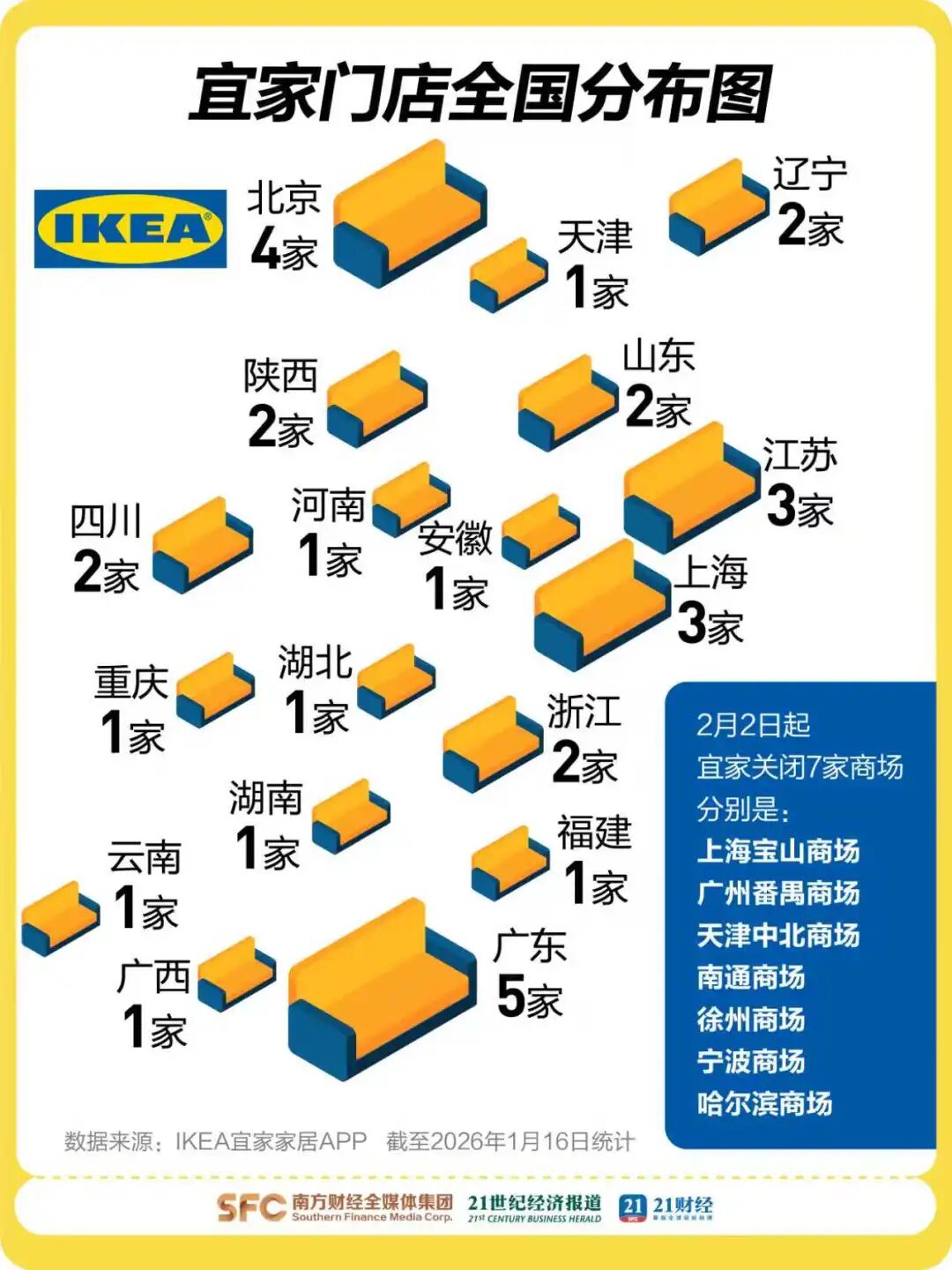
Core Insights - The recent clearance sale at IKEA's Guangzhou Panyu store attracted massive crowds, indicating a strong consumer interest despite underlying sales challenges [1][10] - IKEA is closing nearly one-fifth of its stores in China, raising questions about its market performance and future strategy [3][5] Group 1: Sales Performance and Store Closures - IKEA China reported a revenue of 11.15 billion yuan for the 2024 fiscal year, reflecting a year-on-year decline of 7.6% [5] - The company plans to close seven stores, including locations in Shanghai and Guangzhou, which represents approximately 20% of its total stores in China [3][5] - Despite store closures, Guangdong remains the province with the highest number of IKEA stores in China [4] Group 2: Consumer Behavior and Market Dynamics - The clearance sale saw long wait times, with customers reporting up to 1.5 hours to enter the store, highlighting a disconnect between consumer expectations and available inventory [2][10] - Many consumers expressed frustration over the limited availability of discounted items, with most products already sold out upon entry [2] - The rise of local e-commerce and brands has intensified competition, impacting IKEA's traditional business model [7][8] Group 3: Strategic Adjustments and Future Outlook - IKEA's shift from large suburban stores to smaller, community-focused outlets reflects a broader trend in the home furnishings retail industry [9] - The company faces challenges in maintaining its iconic "one-stop shopping" experience while adapting to changing consumer behaviors and preferences [9][11] - Frequent product recalls have raised concerns about quality, potentially eroding consumer trust in the brand [9]

货架被搬空!宜家广州一商场清仓 超600件商品3折起甩卖
2 1 Shi Ji Jing Ji Bao Dao· 2026-01-18 02:13
Core Insights - IKEA's Guangzhou Panyu store experienced overwhelming customer turnout during its clearance sale, raising questions about its sales performance in China [1][5] - The company is closing nearly one-fifth of its stores in China, indicating significant operational adjustments in response to declining revenue [6] Sales Performance - On January 15, the store saw long queues, with customers waiting up to 1.5 hours to enter, highlighting the urgency and demand for discounted items [1][2] - Despite the high foot traffic, many discounted items were quickly sold out, leading to customer dissatisfaction as only a few items were available at reduced prices [3][4] Revenue Decline - IKEA China's revenue for the 2024 fiscal year is projected at 11.15 billion yuan, a 7.6% decrease year-on-year, while its parent company, Ingka Group, also reported a global revenue decline of 5.5% [6] - The shift in consumer behavior and market dynamics, particularly in the real estate sector, has negatively impacted furniture demand [6] Market Trends - The closure of large stores reflects a broader trend in the home furnishings retail industry towards smaller, community-focused outlets, as consumer shopping habits evolve [8] - The operational costs associated with large stores, such as rent and labor, are becoming increasingly unsustainable in the current market environment [8] Brand Challenges - IKEA has faced challenges with product recalls, which have affected consumer trust, despite the company's commitment to quality and safety [8] - The transition from a large warehouse model to smaller, experience-oriented stores is seen as a necessary evolution, but its success will depend on understanding and meeting the core needs of Chinese consumers [9]
中国市场杀疯了!资本大迁徙全都纷纷押注中国?外资为何要去中国
Sou Hu Cai Jing· 2026-01-17 05:13
Group 1 - The main theme of the capital market in 2026 is a strong focus on investing in China, with significant enthusiasm from foreign investment banks like Goldman Sachs and Morgan Stanley, predicting annual stock market growth of 15%-20% over the next two years [3] - Major international companies are expanding aggressively in China, with Müller planning to open 200-500 stores in five years and Lexus establishing its first overseas electric vehicle base in Shanghai [5] - Despite the excitement, some companies like IKEA are facing challenges, with closures in major locations indicating a potential misalignment with evolving consumer preferences [5][10] Group 2 - The decline of IKEA is attributed not to the failure of the Chinese market but to its inability to adapt to the fast-paced changes in consumer behavior, as traditional large stores are less appealing in the era of instant retail [7][8] - The luxury car market is not declining; rather, domestic brands are capturing market share with innovative electric vehicles, while traditional luxury brands like Porsche and BBA are struggling due to slow adaptation to market trends [12] - Northbound capital is increasingly investing in Chinese assets, with trading volumes expected to exceed 50 trillion yuan in 2025, reflecting a shift from individual stock picking to bulk buying of ETFs [12][14] Group 3 - The A-share market is seen as undervalued with a price-to-earnings ratio of 16 compared to 30 for the US market, making it an attractive investment opportunity, especially with the potential for currency appreciation [14] - The challenges faced by companies like IKEA and BBA are not indicative of a failing market but rather a failure to keep pace with consumer demands and technological advancements [10][14] - The influx of foreign investment and high-profile visits to China signal a strong belief in the country's market potential, suggesting that not investing in China could be a significant risk [14]



现场直击宜家关店清仓3折起售
第一财经· 2026-01-16 10:15
Core Viewpoint - IKEA is closing seven offline stores in China, including the Shanghai Baoshan store, as part of its strategic transformation to build a more resilient foundation for future growth and focus on local relevance [9]. Group 1: Store Closures and Discounts - The IKEA Shanghai Baoshan store will close on February 2, 2026, with discounts starting from January 15, attracting a significant increase in customer traffic, doubling the usual flow [5][7]. - Customers reported long wait times of up to two hours to check out, indicating high demand for discounted items [5][7]. Group 2: Business Strategy and Market Challenges - The decision to close stores is part of IKEA's deeper transformation in China, responding to declining sales in the furniture and home goods market due to a real estate market adjustment and increasing consumer demand for cost-effective products [9]. - IKEA has faced challenges with its large store model, including site selection, cost control, and operational difficulties, compounded by e-commerce competition and price wars [9]. Group 3: Investment in Lower-Priced Products - In the 2026 fiscal year, IKEA plans to invest 160 million yuan to focus on promoting 150 lower-priced products, building on a total investment of 673 million yuan over the past two fiscal years [10]. - The company aims to open over ten small-format stores in the next two years as a strategy to control costs and develop a more flexible offline presence while also expanding its online business [10].

七年关十店!宜家中国“断臂求生”
Sou Hu Cai Jing· 2026-01-16 07:06
Core Viewpoint - IKEA China is set to close seven stores, marking its largest closure in nearly 30 years, indicating a significant shift in its operational strategy in the Chinese market [1][4]. Group 1: Store Closures - IKEA China will cease operations at seven stores, including locations in Shanghai and Guangzhou, effective February 2, 2026, which is its largest batch closure to date [1][4]. - The closure is part of a broader trend where IKEA's store closure strategy has evolved from single-store adjustments to batch optimizations, with a total of 10 stores closed over the past seven years [3][6]. - The closures are attributed to market saturation in certain regions and are aimed at optimizing costs and improving operational efficiency, rather than indicating an inability to operate [6]. Group 2: Financial Performance - IKEA China's sales for the fiscal year 2024 are projected to decline by 7.6% to 11.15 billion yuan, a nearly 30% decrease from its peak sales of 15.77 billion yuan in 2019 [6]. - The global operating profit for IKEA has dropped by over 25%, with the revenue share from the Chinese market slightly decreasing from 3.6% to 3.5% [6]. Group 3: Market Competition - The Chinese market is experiencing slower growth compared to India (31%) and Southeast Asia (22%), with local brands gaining popularity due to their customization options and competitive pricing [7][11]. - Consumers are increasingly favoring local brands that offer integrated services, such as design, production, and installation, which contrasts with IKEA's traditional self-service model [11][13]. Group 4: Strategic Shifts - IKEA plans to open over 10 smaller stores in cities like Beijing and Shenzhen over the next two years, focusing on high-frequency, essential home products [8]. - The company is enhancing its digital capabilities, including partnerships with platforms like JD.com for instant retail trials and improving its app for better customer experience [8][9]. - A new pricing strategy involves a 160 million yuan investment to introduce over 150 lower-priced products, with 70% of this investment focused on bestsellers [9][10]. Group 5: Challenges and Future Outlook - Despite efforts to adapt, IKEA faces challenges such as execution issues with its pricing strategy and competition from local brands that are quicker to adopt digital innovations [10][13]. - The company aims to localize its supply chain, with 80% of its value chain sourced from China, to mitigate cost fluctuations [13]. - The success of IKEA's transformation will depend on its ability to integrate into the local market and meet evolving consumer preferences [13].

Bob’s Discount Furniture申请首次公开募股,筹备上市
Sou Hu Cai Jing· 2026-01-13 08:43
Core Viewpoint - Bob's Discount Furniture has submitted an IPO application to raise funds for debt repayment, planning to list on the New York Stock Exchange under the ticker "BOBS" [1]. Financial Performance - For the 12 months ending September 28, 2025, the company reported revenues of $2 billion and a net profit of $119 million [3]. - The average transaction value is approximately $1,400 [11]. Business Expansion - Currently, Bob's Discount Furniture operates over 200 showrooms across 26 states in the U.S. and plans to expand to over 500 stores by 2035 [5]. Market Context - The IPO plan comes at a time when the retail sector is experiencing a downturn in IPO activity, but it is expected to help revitalize the industry [7]. - The company remains optimistic about the housing market, which is seen as a potential driver for increased demand for home goods [22]. Product and Revenue Structure - The majority of the company's revenue comes from physical stores (86%), with e-commerce accounting for 14% [14]. - Soft furniture is the highest revenue-generating category, followed by case goods [14]. Supply Chain and Production - To mitigate tariff risks, the company has shifted all key production processes out of China, with 63% of product costs sourced from Vietnam and 27% from the U.S. as of October 24 [16]. Customer Demographics - Approximately 46% of the company's customers have annual household incomes exceeding $100,000, and about 27% earn over $150,000 [26]. - The number of new customers with incomes over $150,000 has increased by nearly 25% year-over-year [26].

宜家关店潮,从来不买的人最伤心
36氪· 2026-01-13 00:11
Core Viewpoint - The article discusses the recent closure of seven IKEA stores in China, marking the largest store closure since IKEA entered the Chinese market in 1998. This move is seen as a response to global economic uncertainties, digital transformation, and changing consumer behaviors, indicating a significant shift in IKEA's strategy and market position [3][9][39]. Group 1: Store Closures and Financial Performance - IKEA announced the closure of seven stores, which represents one-sixth of its total stores in China, highlighting a major strategic shift [3][9]. - In the fiscal year 2024, IKEA's sales in China are projected to be approximately 11.15 billion RMB, a decrease of nearly 1 billion RMB compared to the previous fiscal year and a decline of nearly 30% from its peak in 2019 [9][11]. - Despite an increase in the number of stores, sales have declined, signaling a critical warning for the company [9]. Group 2: Consumer Behavior and Market Dynamics - The article notes a shift in consumer perception of IKEA, with the brand being associated with discount shopping rather than a premium lifestyle choice, leading to a potential identity crisis [11][30]. - The changing consumer landscape has led to a more price-sensitive market, where consumers prioritize value for money over brand prestige [22][25]. - The rise of local competitors who can quickly adapt to market demands and offer better services has put IKEA at a disadvantage [18][21]. Group 3: Strategic Responses and Future Directions - In response to declining sales, IKEA has implemented a series of price cuts, with over 500 products marked down in the fiscal year 2024, but this strategy risks damaging its brand image [11][13]. - IKEA is attempting to pivot towards smaller, more centrally located stores, referred to as "design inspiration centers," to better connect with consumers [13][39]. - The company is also trying to enhance its online presence and logistics capabilities to compete with local brands that offer faster and more cost-effective delivery services [11][21]. Group 4: Cultural and Social Implications - The article highlights how IKEA has transformed from a destination for home furnishings to a social space for various demographics, including families and elderly singles, reflecting broader societal changes [30][31][32]. - The brand's role as a community space has evolved, with many consumers now visiting IKEA for its dining options rather than for furniture shopping [30][32]. - This shift raises questions about the adequacy of public spaces in urban China and the evolving definition of "home" and "community" in contemporary society [39].

平价家具零售商Bob‘s Discount Furniture(BOBS.US)申请在美上市 ...
Xin Lang Cai Jing· 2026-01-12 07:15
据悉,Bob's Discount Furniture是美国一家全渠道运营的全国性平价家居用品零售商,成立于1991年, 总部位于康涅狄格州曼彻斯特。截至2025年9月28日,该公司在全美26个州管理着206家展厅。2024财年 期间,其61%的收入来自新英格兰地区、纽约及中大西洋地区。该公司通过"好、更好、最好"的阶梯定 价策略提供各类家具,平均订单价值约为每笔1400美元,并依托五个配送中心和46个第三方区域仓库, 可实现最快三天的送货服务。此外,截至2025年12月28日,该公司拥有290万活跃用户客户群,其中在 2025财年,73%的到店顾客曾通过多个渠道与品牌互动。数据显示,该公司在截至2025年9月30日的十 二个月内营收为23亿美元。 来源:智通财经网 平价家具和床上用品零售商Bob's Discount Furniture上周五向美国证券交易委员会(SEC)提交了首次公开 募股(IPO)申请,筹资规模可能高达4亿美元。定价条款尚未披露。该公司计划在纽约证券交易所上市, 股票代码为"BOBS"。 ...