有色矿业

Search documents
有色矿业ETF招商(159690)开盘跌3.81%,重仓股紫金矿业跌5.07%,洛阳钼业跌5.28%
Xin Lang Cai Jing· 2026-02-06 05:55
Group 1 - The core viewpoint of the article highlights a significant decline in the performance of the non-ferrous metal mining ETF, with a drop of 3.81% on February 6, 2023, closing at 2.120 yuan [1] - Major holdings within the non-ferrous mining ETF experienced notable declines, including Zijin Mining down 5.07%, Luoyang Molybdenum down 5.28%, and Northern Rare Earth down 2.71% [1] - The ETF's performance benchmark is the CSI Non-Ferrous Metals Mining Theme Index, managed by China Merchants Fund Management Co., with a return of 120.70% since its inception on June 21, 2023, and a monthly return of 9.84% [1]



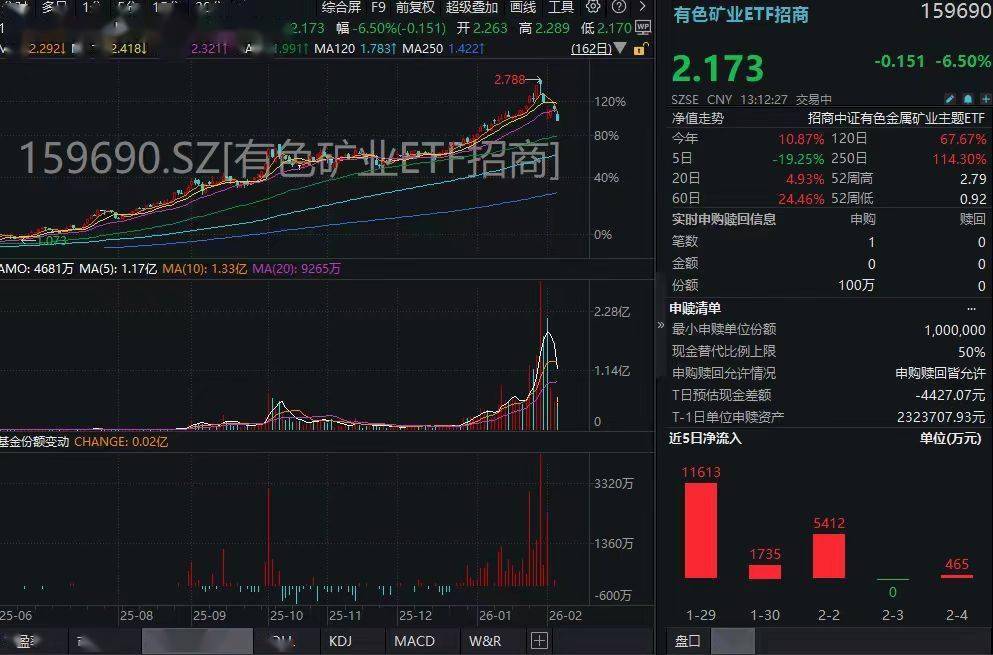
金银惊魂跳水!有色矿业ETF招商(159690)单日重挫6%!白银有色封死跌停!
Sou Hu Cai Jing· 2026-02-05 05:52
Group 1 - The global precious metals market experienced significant volatility on February 5, 2026, with spot gold dropping over $170 and spot silver plunging more than 16% after falling below $80, leading to a temporary suspension of silver futures trading in Thailand [1][2] - The sharp adjustment in precious metals and non-ferrous sectors is primarily driven by a rapid reversal of short-term risk sentiment and concentrated liquidation of overcrowded trades, indicating that the market is in a "bottom-finding" phase [2][3] - Analysts warn that the extreme one-sided trading in gold, which has seen a nearly 20% decline from its peak, suggests that the momentum reversal is substantial and may not recover quickly, with potential support around $4,800 and risks of falling to $4,500 [2][3] Group 2 - Despite the poor price performance, the market's fund flow indicates a contrasting trend, with the non-ferrous mining ETF (159690) continuing to see net inflows during the downturn, and its shares have surged by 429.42% year-to-date, reflecting a long-term value-based contrarian investment strategy [4]


黄金、白银直线拉升!有色板块强势反弹,紫金矿业涨近5%,有色ETF汇添富(159652)跳空高开涨超3%!后市怎么看?
Sou Hu Cai Jing· 2026-02-03 02:00
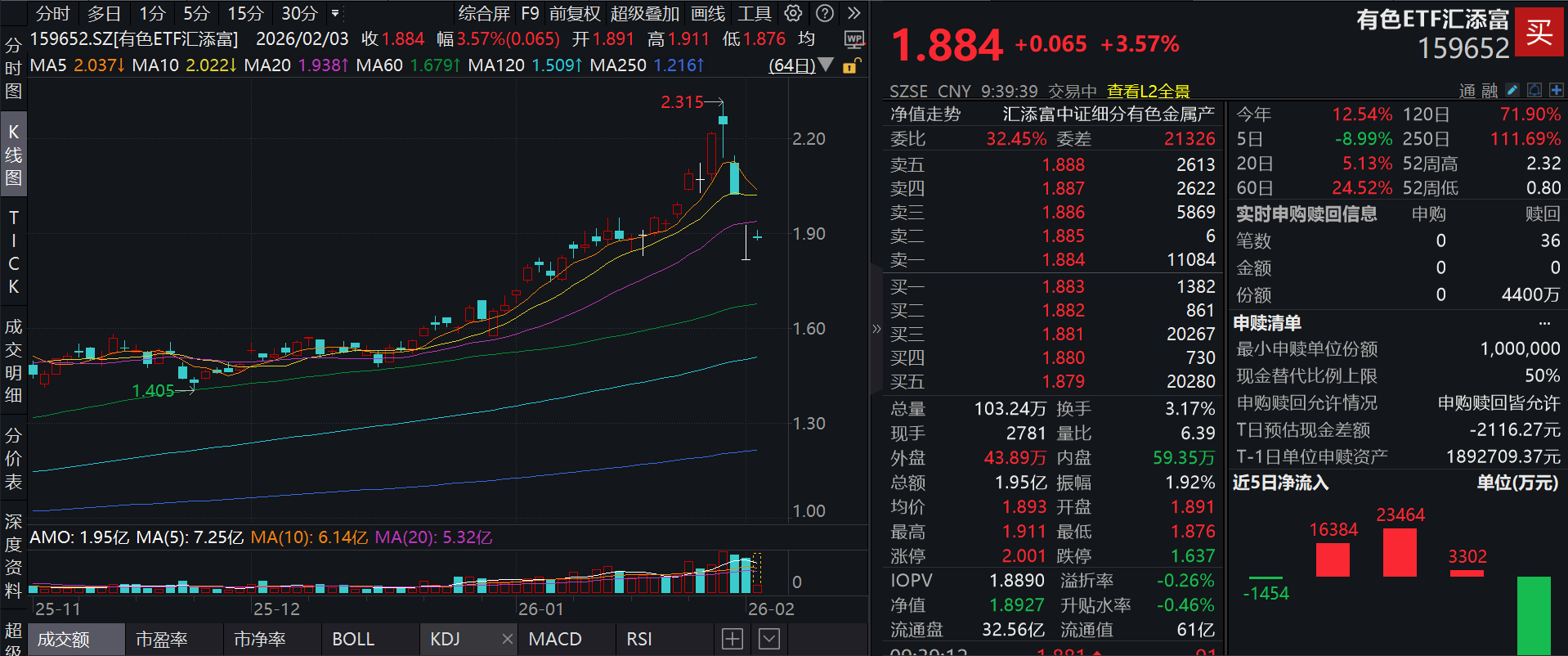
Core Viewpoint - The article discusses the recent performance and outlook of the non-ferrous metals sector, highlighting fluctuations in prices of precious metals like gold and silver, and the implications for investment strategies in related ETFs. Group 1: Market Performance - As of February 3, 2026, the China Securities Index for non-ferrous metals (000811) decreased by 0.21%, with component stocks showing mixed results, including Hunan Gold rising by 4.35% and Xiyang Silver falling by 10.01% [1] - The non-ferrous ETF, Huatai-PineBridge (159652), increased by 3.57%, with a recent price of 1.88 yuan, and has seen a cumulative increase of 8.66% over the past month [1] - The trading volume for the non-ferrous ETF was 1.95 billion yuan, with a turnover rate of 3.17% [1] Group 2: Fund Flows and Leverage - The latest scale of the non-ferrous ETF Huatai-PineBridge reached 61.63 billion yuan, with a net outflow of 3.86 billion yuan recently [3] - Over the past five trading days, there were three days of net inflow totaling 30.47 million yuan, averaging 6.09 million yuan per day [3] - The latest margin buying amount for the non-ferrous ETF was 20.82 million yuan, with a margin balance of 89.63 million yuan [3] Group 3: Precious Metals Outlook - On February 3, 2026, gold and silver prices surged, with spot gold rising over 4% to above 4,800 USD and silver increasing over 5% [2] - Morgan Stanley maintains a bullish mid-term outlook for gold, predicting prices could reach 6,300 USD per ounce by the end of 2026 due to strong demand from central banks and investors [4] - Citigroup holds a cautious view for the second half of 2026, expecting gold prices to drop to 4,000 USD per ounce by 2027, attributing the current bull market to significant capital inflows rather than central bank purchases [4] Group 4: Investment Demand - Global gold demand reached 4,999.4 tons in 2025, an 8% increase year-on-year, with investment demand soaring by 84% to 2,175.3 tons [5] - The total investment amount exceeded 240 billion USD, driven by geopolitical risks, a weakening dollar, and high stock valuations [5] - The fourth quarter's price correction provided a buying opportunity, with total purchases of ETFs, gold bars, and coins reaching a record high of 1,141 tons [5] Group 5: ETF Characteristics - The non-ferrous ETF Huatai-PineBridge (159652) offers comprehensive exposure to various metal sectors, including gold, copper, aluminum, lithium, and rare earths, benefiting from a super cycle in non-ferrous metals [6] - The ETF has a leading "gold-copper content" of 46%, with copper at 34% and gold at 12%, indicating a strong focus on strategic and high-demand commodities [8] - The ETF has shown superior performance since 2022, with a cumulative return leading its peers and a lower maximum drawdown, indicating a better investment experience [10]
多头情绪一夜逆转,有色矿业ETF招商(159690)跌停封板!白银有色、山东黄金等满屏跌停
Sou Hu Cai Jing· 2026-01-30 04:19
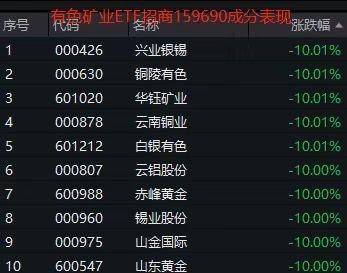
Core Viewpoint - The market experienced a sudden reversal in sentiment on January 30, leading to a panic sell-off in the non-ferrous metals sector, halting the previous bullish trend [1] Group 1: Market Performance - The non-ferrous metals ETF (招商159690) faced significant selling pressure, hitting a 10% limit down, with trading volume sharply increasing [2] - Major stocks in the sector, including 兴业银锡 and 云铝股份, also reached their daily limit down of 10% [2] Group 2: Causes of the Decline - The immediate trigger for the decline was a sharp drop in international precious metals prices, with gold and silver experiencing maximum daily declines of over 5% and 8%, respectively [3] - The underlying cause was attributed to a significant profit-taking demand that had built up in the market, as previous gains had been substantial and some stock prices were seen as overextended relative to short-term fundamentals [3] Group 3: Future Outlook - Most analysts believe that the decline is more of a technical adjustment driven by emotions and capital rather than a fundamental reversal of the industry's long-term logic [3] - Key factors supporting a medium to long-term bull market in non-ferrous metals, such as rigid supply, structural demand from new energy and AI, and the evolution of the global monetary credit system, remain intact [3] - After the short-term panic and valuation pressure are alleviated, the sector is expected to return to a focus on macro policies and industry fundamentals, with structural opportunities based on real supply and demand still worth monitoring [3]

金银新高后闪崩!有色上演“黑色星期五”!有色矿业ETF招商(159690)10CM跌停封板
Sou Hu Cai Jing· 2026-01-30 03:15
Group 1 - The core viewpoint of the article highlights a significant sell-off in the non-ferrous metals sector, described as a "black Friday," driven by panic selling and market corrections [1][3] - The immediate catalyst for the downturn was a sharp reversal in global macro sentiment, with international precious metals experiencing a sudden drop after reaching historical highs, leading to a loss of bullish sentiment in commodities [3] - The internal factor contributing to the decline was the accumulation of profit-taking demands in the market, as previous rapid price increases created a strong technical correction pressure, resulting in panic selling when negative sentiment emerged [3] Group 2 - The article emphasizes that the recent decline is fundamentally a technical adjustment driven by emotions and capital, rather than a systemic deterioration of supply and demand fundamentals [4] - Key supporting factors for a long-term bullish outlook in the non-ferrous metals market remain intact, including rigid global supply, structural demand from sectors like renewable energy, and uncertainties surrounding the dollar's credit [4] - The non-ferrous mining ETF remains an effective tool for investors to capture long-term trends in metal prices, with expectations that market movements will eventually return to a focus on macro policies and supply-demand dynamics after the panic subsides [4]
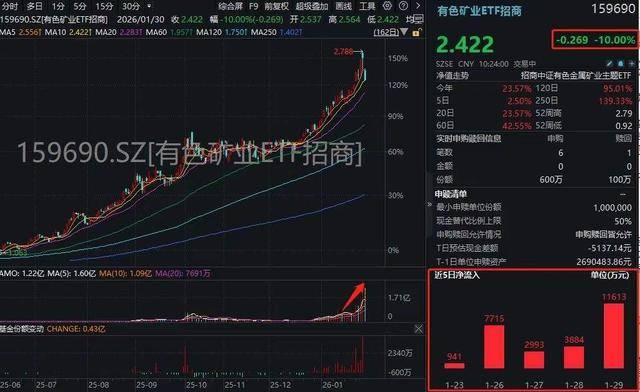
彻底按不住了!有色矿业ETF招商(159690)爆量翻红,成交环比放量超63%再创新高!
Sou Hu Cai Jing· 2026-01-29 03:33
Group 1 - The core viewpoint is that the non-ferrous metal sector is experiencing a rebound, with significant trading volume and price increases observed in related ETFs [1][3] - The non-ferrous metal sector is expected to enter a super cycle driven by the convergence of the "AI leap" and "century change," with historical patterns indicating that commodity cycles can last 25-30 years, with upward trends lasting 8-10 years [3] - Major non-ferrous metal ETFs, such as the one from China Merchants (159690), have a high concentration in key commodities like copper (31%), gold (14%), and aluminum (12%), which together account for nearly 60% of the portfolio [3] Group 2 - Analysts predict that by 2026, the non-ferrous metal industry may experience a bull market driven by a combination of monetary, demand, and supply factors [3] - The non-ferrous metal sector is characterized by a "leverage effect," where rising metal prices lead to significant profit increases for mining companies, resulting in a "Davis double play" scenario where net asset value increases multiple times compared to the commodity price itself [3]
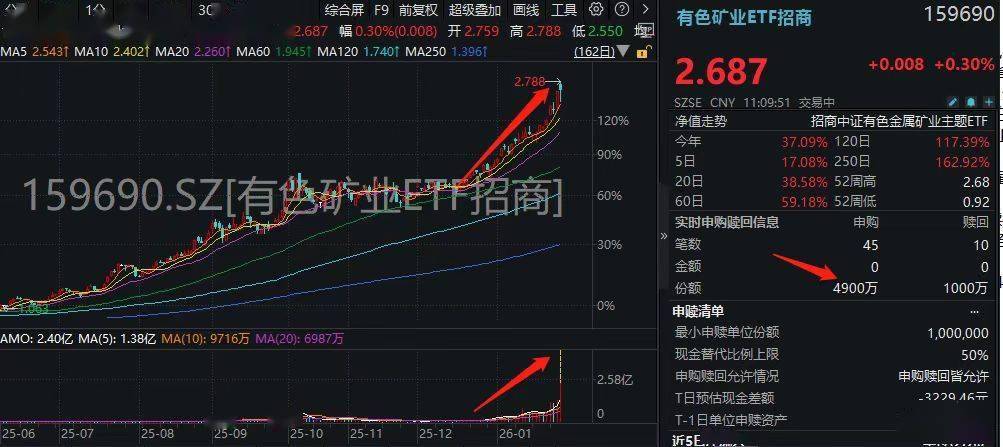
1700一克!黄金暴涨之后,买什么?
Sou Hu Cai Jing· 2026-01-29 03:09
Core Viewpoint - The surge in gold prices and the phenomenon of retail investors, symbolized by "aunties selling dowries to buy gold," indicate a significant shift in public perception towards the value of resources, particularly in the non-ferrous mining sector [1][3]. Group 1: Market Dynamics - Gold prices have reached a historic high, surpassing 5540 USD per ounce, with significant movements in the A-share market, particularly in precious and non-ferrous metals [1]. - The non-ferrous mining ETF (159690) has seen substantial inflows, with a net subscription of 31 million shares in a single session, reflecting strong retail interest [1]. Group 2: Underlying Factors - The current strength in gold prices is a reflection of a global restructuring of the credit system and a surge in demand for safe-haven assets [3]. - Three solid foundations support the mid-term logic of the non-ferrous sector: 1. A clear shift in global liquidity, with a downward trend in interest rates expected to benefit precious metals first, followed by industrial metals [4]. 2. A fundamental reshaping of supply and demand structures, with low global copper inventories and increasing demand from sectors like renewable energy and AI hardware [4]. 3. A migration in asset allocation, as traditional investment avenues like real estate and bank deposits become less attractive, leading to a growing interest in non-ferrous resources as a hedge against inflation [4]. Group 3: Investment Solutions - The non-ferrous mining ETF (159690) offers a solution for ordinary investors, allowing them to invest in a diversified basket of core resource companies, thus sharing in the growth of the entire resource sector without the risks associated with individual stocks [5]. - The phenomenon of "aunties buying gold" should be viewed as a sign of the resource value moving from professional circles into broader public awareness, indicating a potential for sustained market trends [7].
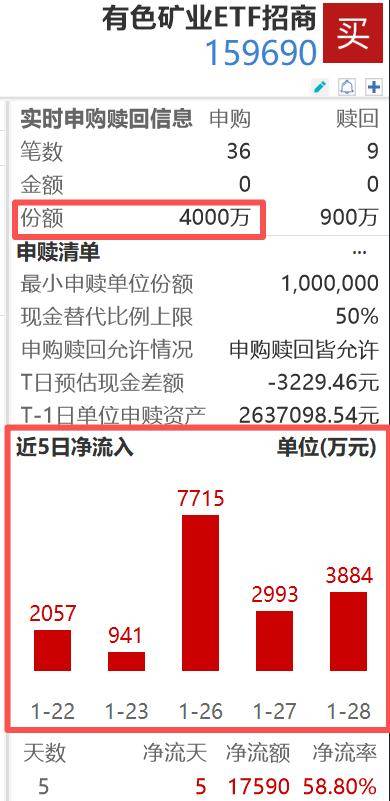
开盘猛怼!有色矿业ETF招商(159690)5分钟狂揽近6000万,湖南黄金、白银有色封板!
Jin Rong Jie· 2026-01-29 02:16
Group 1 - The core viewpoint of the news highlights a significant surge in the performance of the non-ferrous metals sector, particularly driven by the "Non-Ferrous Amplifier" ETF, which saw a 3.88% increase, with major players like Hunan Gold and Zhongjin Gold leading the gains [1] - The COMEX gold futures experienced a strong rally, closing at $5,411 per ounce, marking a 6.46% increase, following the Federal Reserve's decision to maintain interest rates, which has led to heightened expectations for future monetary easing [3] - The "Non-Ferrous Amplifier" ETF, which has a high concentration in leading upstream resource companies, benefits from a "Davis Double Play" scenario where rising metal prices significantly enhance profits, resulting in net asset value increases that can outpace the underlying commodity price movements [3]


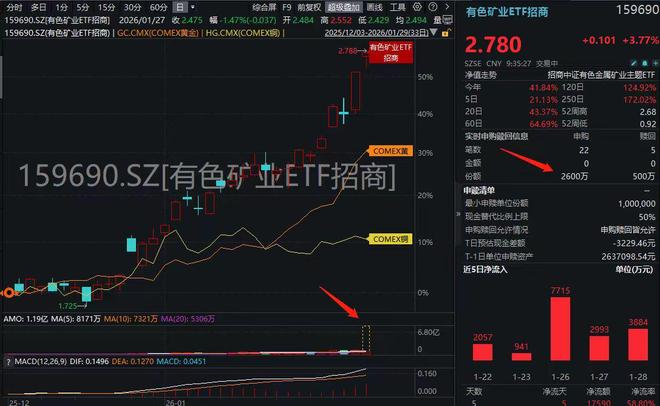
有色金属板块掀涨停潮,有色矿业ETF招商、矿业ETF涨超7%
Ge Long Hui A P P· 2026-01-28 08:53
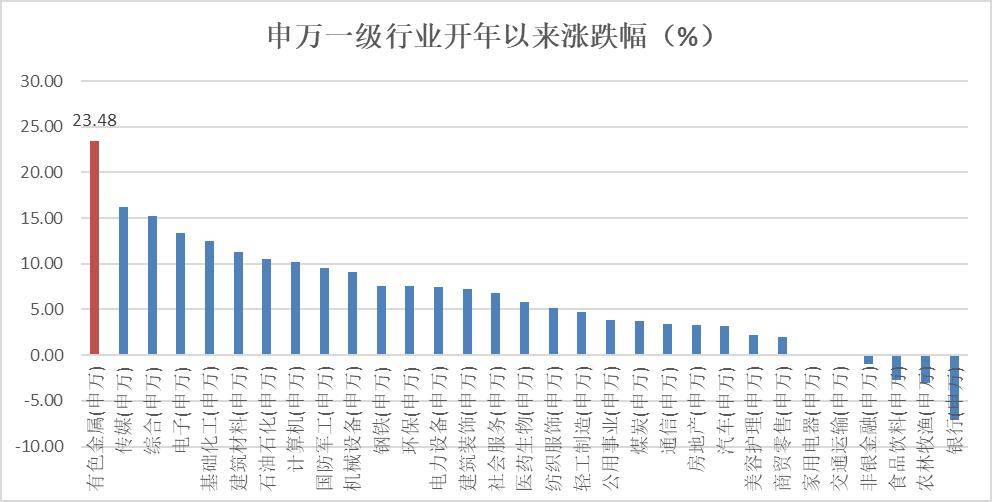
Core Viewpoint - The non-ferrous metal sector is experiencing a significant surge, with various companies such as China Aluminum and Yunnan Copper seeing substantial gains, driven by a favorable market environment and increasing demand for metals [1][4]. Group 1: Market Performance - The non-ferrous mining ETF has risen by 8.24% today and has a year-to-date increase of 36.68%, with an estimated scale of 458 million [2]. - The mining ETF managed by Guotai Fund has increased by 7.38% today and has a year-to-date increase of 36.25%, with an estimated scale of 3.161 billion [2]. - The non-ferrous mining index has seen a rise of over 34% since early 2026, outperforming other non-ferrous thematic indices [2]. Group 2: Price Drivers - The current macroeconomic and financial cycles, including the U.S. dollar credit cycle and global liquidity environment, are foundational to the pricing of non-ferrous metals, with expectations of interest rate cuts abroad and policy easing domestically [5]. - Structural changes in supply and demand are evident, with global mining capital expenditures being insufficient and new mine production cycles extending to 7-10 years, alongside increasing demand from sectors like renewable energy and AI [6]. Group 3: Strategic Importance - New materials such as rare earth permanent magnets and high-temperature alloys are becoming crucial for high-end manufacturing and defense technology [8]. - Historical patterns indicate that commodity market trends typically start with precious metals, followed by industrial metals, energy, and then agricultural products [8].

连续逼空!有色为何不回调?
Sou Hu Cai Jing· 2026-01-28 03:58
Group 1 - The core viewpoint of the article highlights the strong performance of the non-ferrous metals sector, which has been the "champion of growth" since the beginning of the year, with significant interest from investors [1][3] - The non-ferrous metals ETF (159690) has seen a year-to-date increase of 33.62% and a cumulative increase of over 156% in the past 250 days, indicating strong market confidence [1][3] - The current rally in the non-ferrous sector is driven by three main factors: expectations of global liquidity easing, rigid supply constraints for certain commodities, and long-term support from downstream demand in sectors like renewable energy [3][4] Group 2 - The supply chain vulnerabilities for copper and the entire non-ferrous sector remain significant, with global copper inventories at historically low levels and ongoing supply disruptions from South American mines [4] - The demand narrative is shifting from macroeconomic trends to micro-level confirmations, with more downstream companies engaging in hedging against future price increases, reflecting confidence in long-term demand [6] - The financial and commodity attributes of metals are rebalancing, with precious metals currently attracting investment due to risk aversion, but historical trends suggest a return to mean for the "gold-copper ratio" once macro conditions stabilize [6]