有色矿业ETF招商

Search documents
公募基金大举增持关键矿产!2025年有色相关基金规模激增至666亿
Sou Hu Cai Jing· 2026-02-24 02:24
Group 1 - The core viewpoint of the articles highlights a significant rise in the non-ferrous metal sector, particularly precious metals, driven by economic concerns and geopolitical risks, leading to a systemic re-evaluation of the strategic value of key minerals [1][2] - The PCE index, a preferred inflation indicator by the Federal Reserve, increased by 0.4% month-on-month in December, surpassing the expected 0.3%, and showed a year-on-year increase of 3.0%, exceeding the Fed's 2% target [1] - Analysts suggest that the combination of weak economic growth and persistent inflation raises concerns about stagflation, which supports the price trends of precious metals [1][2] Group 2 - Capital markets are increasingly allocating resources towards key minerals, with projections indicating a substantial growth in the net asset value of public funds related to non-ferrous and chemical sectors, expected to rise from 14.3 billion yuan in 2024 to 96.7 billion yuan in 2025 [2] - The scale of non-ferrous related funds is anticipated to grow from 11.1 billion yuan in 2024 to 66.6 billion yuan in 2025, with leading mining companies like Zijin Mining and Yunnan Aluminum showing significant increases in investment [2] - Short-term expectations for precious metals indicate a challenging environment for price declines due to fluctuating Fed interest rate expectations, while long-term views remain positive amid geopolitical uncertainties [2] Group 3 - The non-ferrous mining ETF (159690) tracks the non-ferrous mining index, focusing on upstream resource extraction companies, which benefit directly from rising metal prices, showing a cumulative increase of 117.66% over the past year [3] - The non-ferrous mining index exhibits higher price elasticity and beta value, making it particularly aggressive in commodity bull markets or inflationary environments [3]
金银相继转涨!有色矿业ETF招商(159690)低开冲高振幅超5%!湖南黄金领衔
Sou Hu Cai Jing· 2026-02-06 02:45
Core Viewpoint - The recent rebound in precious metals, particularly silver and gold, is driven by macroeconomic changes, industrial revolutions, and a consensus among investors regarding the value of non-fiat currencies [1][3]. Group 1: Market Performance - On February 6, precious metals experienced a rebound, with spot silver and gold turning positive after significant declines, with silver previously dropping nearly 10% and gold over 2% [1]. - The color metal mining ETF, known as "cycle amplifier," opened lower but surged over 5%, closing up 0.91% [1]. - Key constituent stocks such as Hunan Gold, Zhongtung High-tech, Xiamen Tungsten, Zhongmin Resources, and Yun Aluminum saw significant gains [1]. Group 2: Macro Logic - The core driving force behind the current price movements is the long-term concern over the credibility of the US dollar, leading to a re-evaluation of metals as "hard currency" [3]. - The weakening marginal credibility of the dollar is prompting funds to view colored metals as a hedge against currency depreciation and inflation, resulting in a systematic price elevation [3]. Group 3: Industrial Logic - The global mining industry faces rigid supply constraints due to insufficient capital expenditure and declining ore grades, severely limiting new production capacity [3]. - Demand is shifting from traditional sectors to new drivers such as renewable energy, artificial intelligence (including computing centers and grid upgrades), and national strategic reserves, creating a potential "super cycle" lasting several years [3]. Group 4: Trading Logic - The focus is on upstream mining companies that can capture price elasticity effectively, as these companies will see the greatest profit elasticity when metal prices rise [3]. - The color metal mining ETF is highly concentrated on listed companies with mineral resources, making it a key vehicle for capturing commodity market trends [3].


黄金创207个月来最大单日涨幅!有色矿业ETF招商(159690)高开2%,湖南黄金再冲高
Sou Hu Cai Jing· 2026-02-04 01:49
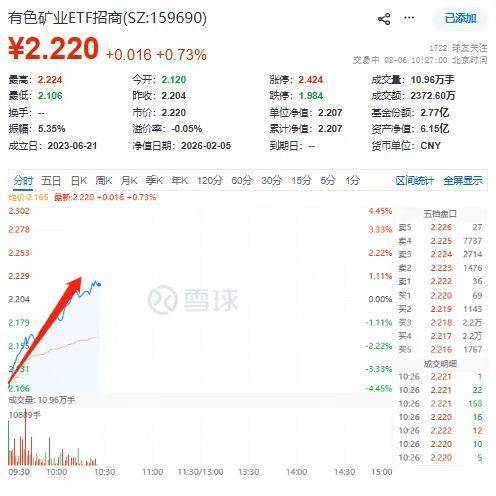
Group 1 - The core point of the news is the significant rebound in precious metals, with spot gold surging by 5.96% in a single day, reaching over $4,980 per ounce, marking the largest single-day increase since November 2008 [1] - Spot silver also experienced a dramatic rise, with an intraday increase of over 10%, surpassing the $89 mark [1] - The A-share non-ferrous metal sector opened strongly, with the non-ferrous mining ETF (招商, 159690) rising by 2.11%, and leading stocks such as Hunan Gold, Luoyang Molybdenum, and Northern Copper showing notable gains [1] Group 2 - The rebound is attributed to technical recovery and long-term value reassessment, with gold prices hitting key support levels after a historic drop, prompting short sellers to cover positions and long-term investors to buy on dips [1] - The fundamental support for a long-term bull market in gold remains intact, driven by expectations of global monetary easing, geopolitical risks, and central bank gold purchases, which form the value foundation after price declines [1] - The market is expected to experience high volatility in the near term, with gold prices likely entering a wide fluctuation phase unless new macro catalysts emerge [1] Group 3 - The non-ferrous mining ETF (招商, 159690) has a high concentration in its top three weighted commodities: copper (31%), gold (14%), and aluminum (12%), accounting for nearly 60% of its total [3] - The ETF is described as a "non-ferrous amplifier" due to its concentrated investment in upstream resource leaders, where rising prices of non-ferrous metals lead to significant profit increases, resulting in a "Davis double play" effect with net value growth multiples exceeding that of the commodities themselves [3]
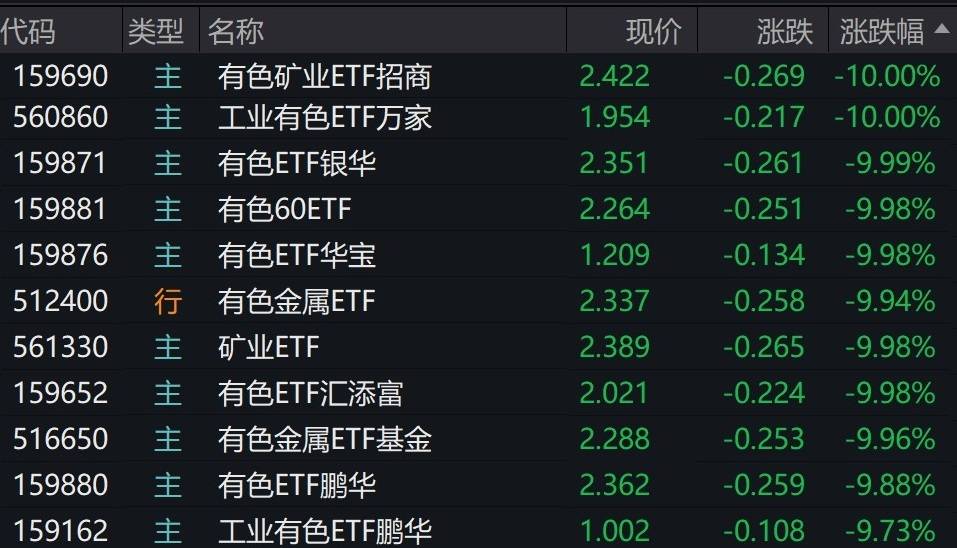
有色金属概念股走弱,矿业、有色相关ETF跌超5%
Sou Hu Cai Jing· 2026-02-02 02:08
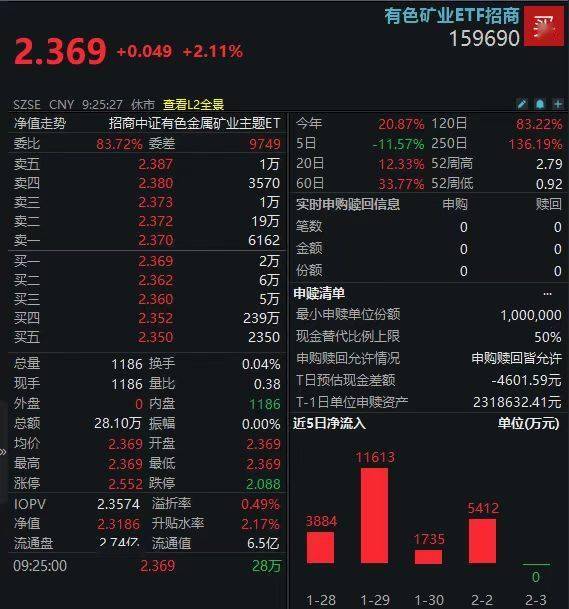
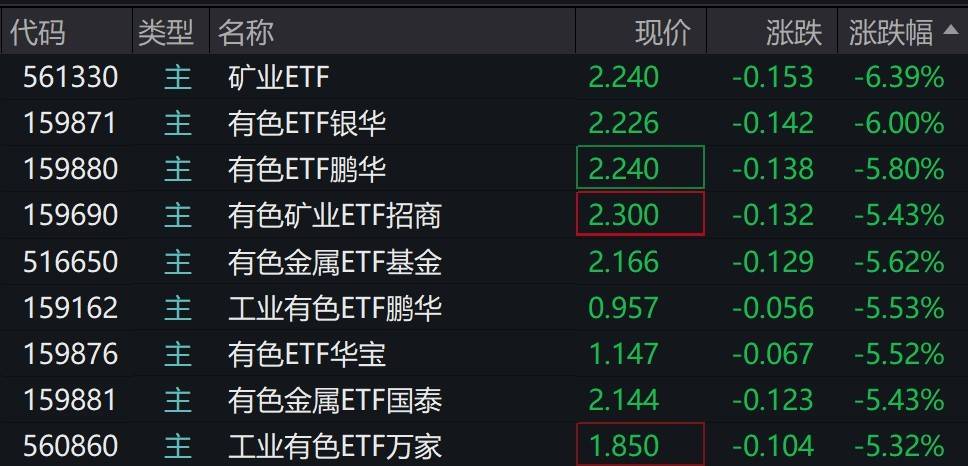
Group 1 - The core viewpoint of the news highlights a significant decline in the performance of non-ferrous metal stocks, with companies like Shandong Gold and Zhongjin Gold hitting the daily limit down, and Northern Rare Earth dropping over 5% [1] - Mining and non-ferrous related ETFs have also seen a decline of over 5% due to market influences [1] Group 2 - Recent reports indicate that not only precious metals like gold and silver have risen significantly, but industrial metals such as copper and aluminum, as well as energy metals like cobalt and lithium, have also shown good growth, with multiple metals reaching historical or phase highs [2] - The super cycle of non-ferrous metals is attributed to three main factors: the weakening trend of the dollar due to the Federal Reserve's interest rate cuts, supply-demand gaps caused by declining ore grades and rising marginal costs in major mines, and domestic policies aimed at optimizing excess capacity [2]






贵金属板块重挫,兴业银锡、白银有色等多股跌停,分析师:等待波动率回归正常
Xin Lang Cai Jing· 2026-01-30 04:37
Group 1 - The core viewpoint indicates that after a significant fluctuation in precious metals, gold and silver prices have declined again, with gold down over 1% and silver down over 2% as of January 30 [1][2] - The non-ferrous sector has experienced a broad pullback, with several stocks hitting the limit down, while Hunan Gold remains capped at the limit up. The non-ferrous mining ETF fell by 8.88%, with over 100 million yuan in trading volume and a net inflow of over 10 million yuan during the session [1][2] - Market perspectives suggest that the short-term drop in gold and silver prices is due to profit-taking by investors after prices reached new highs, with gold having risen for eight consecutive trading days and a cumulative increase of over 23% this month [3] Group 2 - Institutions remain optimistic about the resilience of gold in the medium to long term, with the World Gold Council indicating that strong demand for gold investment in China is expected to continue into Q1 2026, supported by consumer purchasing and gifting during the pre-Spring Festival period [4] - The report anticipates that geopolitical developments and economic uncertainties will maintain high levels of risk aversion, suggesting that gold investment may continue to show steady performance [4] - Huayuan Securities believes that the restructuring of the global monetary system will take a long time, and while the likelihood of significant selling of U.S. dollars and U.S. Treasuries as global reserve assets remains low in the short term, there is a trend towards increasing preference for gold and silver as alternatives [4]

有色金属概念股走低,多只有色相关ETF跌停
Sou Hu Cai Jing· 2026-01-30 02:36
Group 1 - The core viewpoint of the news is that non-ferrous metal stocks have declined significantly, with companies like Luoyang Molybdenum, Huayou Cobalt, China Aluminum, Shandong Gold, Yun Aluminum, and Zhongjin Gold hitting their daily limit down [1] - Affected by the market trend, many non-ferrous related ETFs also experienced limit down [1] Group 2 - Recent reports indicate that not only precious metals like gold and silver have seen significant increases, but industrial metals such as copper and aluminum, as well as energy metals like cobalt and lithium, have also performed well, with multiple metals reaching historical or phase highs [2] - The reasons for the super cycle in non-ferrous metals are primarily threefold: first, the Federal Reserve's interest rate cut cycle has led to a weakening dollar, which supports the rise in non-ferrous metal prices denominated in dollars; second, there is a supply-demand gap, with industrial metals like copper facing supply pressures due to declining ore grades, rising marginal costs, and previous reductions in mining capital expenditures, while demand is driven by AI, new energy, and infrastructure construction; third, domestic "anti-involution" policies are optimizing excess capacity, which helps promote supply-demand balance [2]
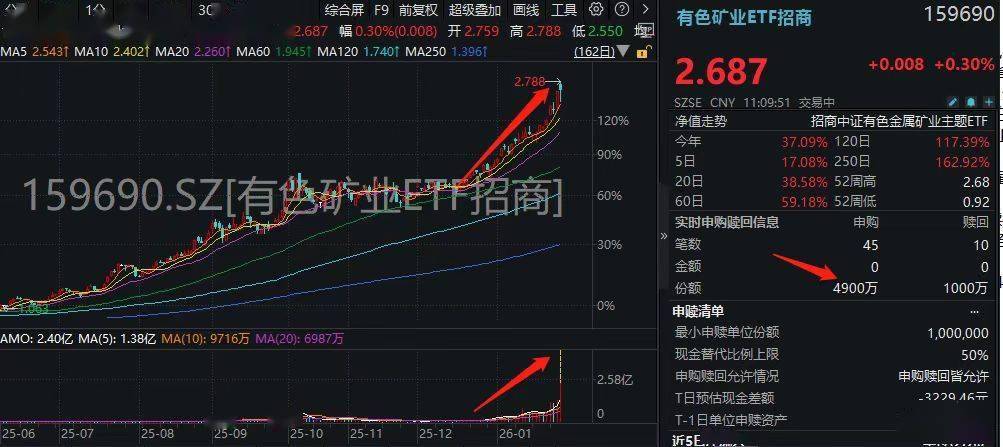
彻底按不住了!有色矿业ETF招商(159690)爆量翻红,成交环比放量超63%再创新高!
Sou Hu Cai Jing· 2026-01-29 03:33
Group 1 - The core viewpoint is that the non-ferrous metal sector is experiencing a rebound, with significant trading volume and price increases observed in related ETFs [1][3] - The non-ferrous metal sector is expected to enter a super cycle driven by the convergence of the "AI leap" and "century change," with historical patterns indicating that commodity cycles can last 25-30 years, with upward trends lasting 8-10 years [3] - Major non-ferrous metal ETFs, such as the one from China Merchants (159690), have a high concentration in key commodities like copper (31%), gold (14%), and aluminum (12%), which together account for nearly 60% of the portfolio [3] Group 2 - Analysts predict that by 2026, the non-ferrous metal industry may experience a bull market driven by a combination of monetary, demand, and supply factors [3] - The non-ferrous metal sector is characterized by a "leverage effect," where rising metal prices lead to significant profit increases for mining companies, resulting in a "Davis double play" scenario where net asset value increases multiple times compared to the commodity price itself [3]
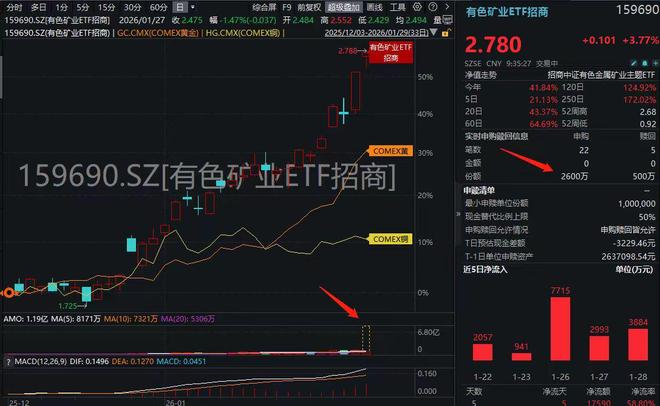
开盘猛怼!有色矿业ETF招商(159690)5分钟狂揽近6000万,湖南黄金、白银有色封板!
Jin Rong Jie· 2026-01-29 02:16
Group 1 - The core viewpoint of the news highlights a significant surge in the performance of the non-ferrous metals sector, particularly driven by the "Non-Ferrous Amplifier" ETF, which saw a 3.88% increase, with major players like Hunan Gold and Zhongjin Gold leading the gains [1] - The COMEX gold futures experienced a strong rally, closing at $5,411 per ounce, marking a 6.46% increase, following the Federal Reserve's decision to maintain interest rates, which has led to heightened expectations for future monetary easing [3] - The "Non-Ferrous Amplifier" ETF, which has a high concentration in leading upstream resource companies, benefits from a "Davis Double Play" scenario where rising metal prices significantly enhance profits, resulting in net asset value increases that can outpace the underlying commodity price movements [3]

有色金属板块掀涨停潮,有色矿业ETF招商、矿业ETF涨超7%
Ge Long Hui A P P· 2026-01-28 08:53
Core Viewpoint - The non-ferrous metal sector is experiencing a significant surge, with various companies such as China Aluminum and Yunnan Copper seeing substantial gains, driven by a favorable market environment and increasing demand for metals [1][4]. Group 1: Market Performance - The non-ferrous mining ETF has risen by 8.24% today and has a year-to-date increase of 36.68%, with an estimated scale of 458 million [2]. - The mining ETF managed by Guotai Fund has increased by 7.38% today and has a year-to-date increase of 36.25%, with an estimated scale of 3.161 billion [2]. - The non-ferrous mining index has seen a rise of over 34% since early 2026, outperforming other non-ferrous thematic indices [2]. Group 2: Price Drivers - The current macroeconomic and financial cycles, including the U.S. dollar credit cycle and global liquidity environment, are foundational to the pricing of non-ferrous metals, with expectations of interest rate cuts abroad and policy easing domestically [5]. - Structural changes in supply and demand are evident, with global mining capital expenditures being insufficient and new mine production cycles extending to 7-10 years, alongside increasing demand from sectors like renewable energy and AI [6]. Group 3: Strategic Importance - New materials such as rare earth permanent magnets and high-temperature alloys are becoming crucial for high-end manufacturing and defense technology [8]. - Historical patterns indicate that commodity market trends typically start with precious metals, followed by industrial metals, energy, and then agricultural products [8].

连续逼空!有色为何不回调?
Sou Hu Cai Jing· 2026-01-28 03:58
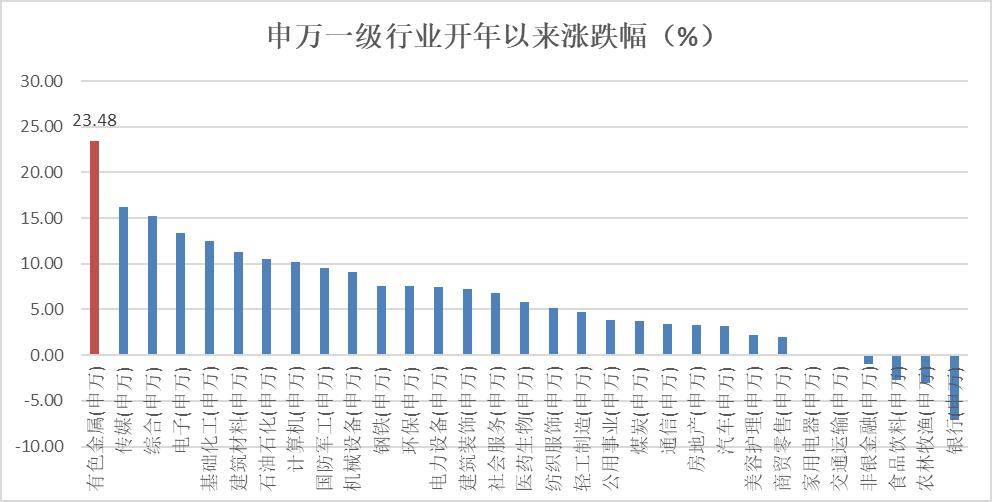
Group 1 - The core viewpoint of the article highlights the strong performance of the non-ferrous metals sector, which has been the "champion of growth" since the beginning of the year, with significant interest from investors [1][3] - The non-ferrous metals ETF (159690) has seen a year-to-date increase of 33.62% and a cumulative increase of over 156% in the past 250 days, indicating strong market confidence [1][3] - The current rally in the non-ferrous sector is driven by three main factors: expectations of global liquidity easing, rigid supply constraints for certain commodities, and long-term support from downstream demand in sectors like renewable energy [3][4] Group 2 - The supply chain vulnerabilities for copper and the entire non-ferrous sector remain significant, with global copper inventories at historically low levels and ongoing supply disruptions from South American mines [4] - The demand narrative is shifting from macroeconomic trends to micro-level confirmations, with more downstream companies engaging in hedging against future price increases, reflecting confidence in long-term demand [6] - The financial and commodity attributes of metals are rebalancing, with precious metals currently attracting investment due to risk aversion, but historical trends suggest a return to mean for the "gold-copper ratio" once macro conditions stabilize [6]