
殡葬

Search documents
最高法:切实加大知产保护力度 58案适用惩罚性赔偿 合计赔偿20.5亿元
Jing Ji Guan Cha Wang· 2026-01-28 02:40
Group 1 - The Supreme People's Court has established a specialized Intellectual Property Court since January 1, 2019, which has significantly improved the handling of intellectual property cases, with a total of 24,602 cases accepted and 23,069 cases concluded over the past seven years [1] - The court has adopted a principle of "reform over litigation," achieving a 20.9% retrial rate and a 37.7% withdrawal rate for civil cases related to infringement and ownership, both of which are notably higher than pre-reform levels [1] - Cases related to strategic emerging industries have increased from 17.6% in 2019 to 32.4% in 2025, with 6,745 cases accepted in total [1] Group 2 - The court has effectively increased the protection of intellectual property rights, with 58 cases applying punitive damages totaling 2.05 billion yuan, averaging over 35 million yuan per case [2] - A total of 203 antitrust cases have been concluded, with 66 cases recognized as constituting monopolies, impacting various sectors including pharmaceuticals, telecommunications, e-commerce, education, construction, and funeral services [2]
三部门联合印发通知 进一步完善殡葬服务收费政策
Xin Hua She· 2026-01-27 12:31
Core Viewpoint - The National Development and Reform Commission, along with the Ministry of Civil Affairs and the Ministry of Finance, has issued a notification to improve the funeral service pricing policy, aiming to reduce the financial burden on the public and enhance the public welfare aspect of the funeral industry [1][2]. Group 1: Policy Details - The notification includes six main components: strengthening the management of funeral service fees, clarifying the principles for setting funeral service fee standards, enhancing price guidance for funeral products, establishing a regular evaluation system, creating a comprehensive list of funeral service fees, and standardizing funeral service fee practices [1]. - The policy aims to categorize and improve fee structures through the establishment of three lists: a basic funeral service project list, a non-basic project list, and a fee directory list [1]. - It proposes three management methods: government-guided pricing, reference price ranges, and price differentials or rates, to ensure reasonable pricing and standardized fees in the funeral service sector [1]. Group 2: Implementation and Oversight - The development and reform departments will collaborate with civil affairs and finance departments to ensure the effective implementation of the notification through enhanced coordination, support, policy interpretation, and supervision [2]. - The focus will be on protecting the legitimate rights and interests of the public in the funeral service sector [2].
死亡不应成为一桩交易
Xin Lang Cai Jing· 2026-01-23 00:20
在这一灰色链条中,死亡被异化为可供交易的数据资源,冰冷的商业逻辑侵蚀着生命最后的尊严地带。 其中折射出的,不只是单起案件中的道德失范,更是系统内部某些环节长期存在的漏洞:对逝者信息的 权限管理不够严谨,对救护车显示屏上非必要信息随意暴露,对外包服务人员的行为约束过于薄弱…… 这些看似微小的疏忽,共同构成了一条隐秘而顺畅的信息流出通道。最终,少数丧失本心的从业人员, 得以"顺利"地将民众在最脆弱之际托付的个人信息当成牟取私利的"财路"。而每一次这样的交易,都是 对生者情感的二次伤害、对逝者安宁的无情践踏,更是对整个医疗行业艰难积累的社会信任的严重透 支。 面对如此触目惊心的信息失守,有效的治理与及时的纠偏至关重要。值得肯定的是,案件调查的同时, 当地卫健委已在检察机关督促下迅速展开整改,以技术屏障与制度栅栏堵塞漏洞。而最高检将此案列为 典型,其意义绝不仅仅在于惩处已发生的违法行为,更是向所有掌握类似权限的机构发出强烈警示—— 关于公众个人信息的保护,内部的风险防控必须提升至前所未有的高度。 逝者已矣,但其信息不但关联着生者的情感,更关乎社会对生命的基本尊重。它绝不能沦为被明码标价 的商品。唯有法律的监督、制度的 ...
以“公益属性”刚性约束管住“天价殡葬”
Xin Lang Cai Jing· 2026-01-09 00:11
Core Viewpoint - The revised "Funeral Management Regulations" emphasizes the public welfare nature of the funeral industry, aiming to transform it into a non-profit sector dedicated to promoting social welfare and benefiting the public [1][2]. Summary by Sections Regulatory Changes - The new regulations, effective from March 30, 2026, represent a comprehensive revision of the original regulations established in July 1997, focusing on clarifying management requirements, basic public services, and enhancing regulatory oversight [1]. Public Welfare Emphasis - The regulations explicitly state that the funeral industry should not be a domain for profit-making by a few individuals but should serve the public good, addressing issues such as high funeral costs and monopolistic practices [2]. Implementation Mechanisms - The regulations introduce a detailed system for managing funeral services, categorizing them into basic and non-basic projects, with the government setting prices for basic services to ensure affordability and dignity for all citizens [3]. Governance and Accountability - A clear governance framework is established, delineating responsibilities among various departments such as civil affairs, market regulation, and health, to avoid the previous issues of fragmented management and lack of accountability [3]. Execution and Local Adaptation - The success of the regulations relies on effective execution and the development of localized implementation plans and pricing standards to ensure that the principles of public welfare translate into actionable public services [4].
新修订的《殡葬管理条例》进一步完善顶层设计 切实减轻群众负担提升“民生温度”
Yang Shi Wang· 2026-01-08 03:54
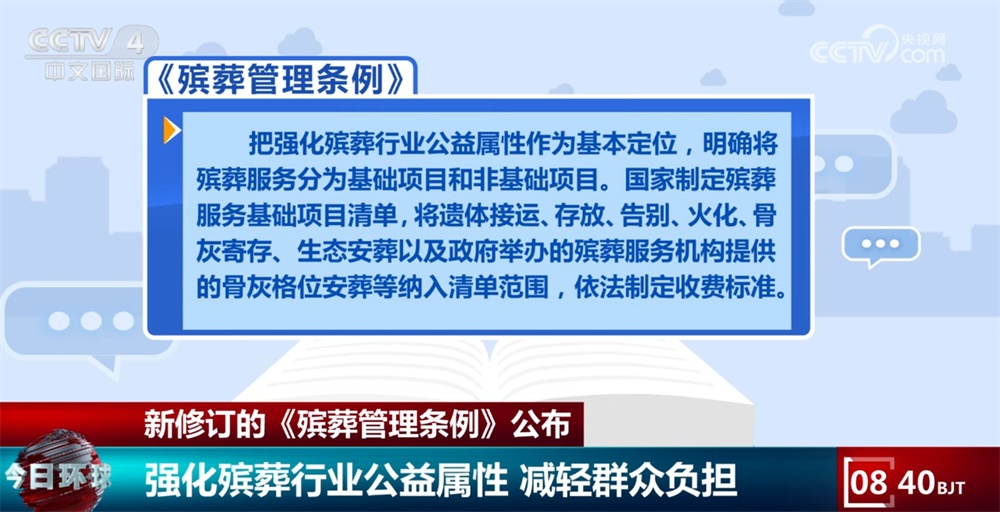
Core Viewpoint - The newly revised "Funeral Management Regulations" aim to enhance the public welfare attributes of the funeral industry and address emerging issues in the sector, effective from March 30 of this year [1]. Group 1: Public Welfare and Service Classification - The revised regulations classify funeral services into basic and non-basic projects, with a national list of basic funeral services including body transportation, storage, farewell ceremonies, cremation, ash storage, ecological burial, and government-provided burial services [2]. - All provinces have established lists for both basic and non-basic funeral service projects, with examples such as the Wuhan Wuchang Funeral Home offering 15 service items, including 6 basic services with fee exemptions for certain items [4]. Group 2: Non-Profit Structure and Land Use - The regulations prohibit the establishment of new profit-oriented funeral service institutions, mandating that new funeral service organizations be government-run and non-profit [5]. - New funeral facilities must acquire land use rights through allocation according to national regulations [5]. Group 3: Responsibilities and Service Provision - The regulations clarify the responsibilities of relevant departments in funeral management, stating that medical institutions' morgues cannot be outsourced and should only provide temporary storage for bodies [6][7]. - There is an emphasis on expanding ecological burial services, such as sea burials and tree burials, to meet the growing public demand for environmentally friendly options [9].

如何实现收费更透明、监管更到位、安葬更生态?——新修订的《殡葬管理条例》看点解析
Xin Hua She· 2026-01-08 02:10
Core Viewpoint - The newly revised "Funeral Management Regulations" aims to enhance transparency in fees, strengthen regulation, and promote ecological burial practices, effective from March 30, 2026, providing a legal framework for the funeral industry and addressing public concerns [1]. Group 1: Strengthening the Public Welfare Attribute of the Funeral Industry - The core principle of the revised regulations is to reinforce the public welfare attribute of the funeral industry, with multiple institutional designs to ensure its implementation [2]. - Over 6,000 public cemeteries have been established nationwide, covering over 80% of districts in 29 provinces, and 23,200 service fee items have been canceled [2]. - The regulations explicitly state the public welfare nature of the funeral industry, which was not clearly defined in the original regulations, thus providing a stronger legal basis for its enforcement [2]. Group 2: Enhancing Funeral Service Supply and Fee Management - The regulations categorize funeral services into basic and non-basic projects, with a national list defining essential services such as body transport, storage, and ecological burial [3]. - Local governments are authorized to adjust the list of basic services according to local needs, while non-basic service fees will be strictly regulated [3]. - The regulations aim to make funeral service fees more transparent, thereby reducing the financial burden on the public [3]. Group 3: Establishing a Comprehensive Regulatory System - The regulations emphasize a multi-departmental approach to regulation, clarifying the roles of various government departments involved in funeral management [6]. - A new chapter on "supervision and management" has been added, requiring local governments to create a comprehensive regulatory checklist for funeral activities [6]. - The introduction of credit regulation and social supervision mechanisms aims to enhance the regulatory framework and ensure compliance with the public welfare attribute [7]. Group 4: Promoting Civilized and Modern Funeral Practices - The regulations advocate for ecological burial practices and civilized memorial services, aligning with environmental trends and cultural values [8]. - The inclusion of ecological burial methods in the basic service list and the encouragement of green funeral products aim to reduce environmental impact [8]. - Local governments may provide subsidies for ecological burial practices, enhancing public acceptance and recognition of these methods [8]. Group 5: Addressing Challenges in Funeral Practices - The regulations highlight the role of community organizations in promoting civilized and frugal funeral practices, while also regulating excessive spending and commercialization in online memorial services [10]. - The emphasis on grassroots governance and the regulation of online platforms aims to ensure that funeral services adhere to cultural and ethical standards [10]. - The revised regulations are expected to have a profound impact on promoting spiritual and ecological civilization in the country [10].
如何实现收费更透明、监管更到位、安葬更生态?
Xin Lang Cai Jing· 2026-01-07 17:12
Core Viewpoint - The newly revised "Funeral Management Regulations" will take effect on March 30, 2026, marking a comprehensive update since the original regulations were enacted in 1997, aimed at protecting public rights, standardizing funeral activities, and promoting the healthy development of the funeral industry [1] Group 1: Strengthening the Public Welfare Attribute of the Funeral Industry - The core principle of the revised regulations is to enhance the public welfare attribute of the funeral industry, supported by multiple institutional designs [2] - Over 6,000 public cemeteries have been established nationwide, covering more than 80% of counties in 29 provinces, and 23,200 service fee items have been eliminated [2] - The regulations explicitly state the public welfare attribute as the primary legislative purpose, ensuring it is a guiding principle for subsequent management [2] Group 2: Enhancing Basic Funeral Service Supply - The regulations categorize funeral services into basic and non-basic projects, with a national list defining essential services such as body transportation, storage, farewell ceremonies, cremation, and ecological burial [3] - Local governments are authorized to adjust the list of basic services based on regional needs, while non-basic service fees will be strictly regulated [3] - This approach aims to extend basic services throughout the entire funeral process and accommodate diverse public needs [3] Group 3: Strengthening Funeral Service Fee Management - The regulations mandate that funeral service fee policies be formulated by relevant government departments, ensuring transparency and legal compliance in pricing [3] - It prohibits the establishment of fee items outside the defined list, promoting a transparent pricing structure [3] Group 4: Strengthening Funeral Facility Management - New funeral service institutions must be government-run and non-profit, preventing the establishment of for-profit funeral service providers [4] - The regulations emphasize the need for government support in land use, construction, and investment for funeral facilities [4] Group 5: Establishing a Comprehensive Regulatory System for the Funeral Industry - The regulations clarify the roles of various government departments in funeral management, establishing a comprehensive regulatory framework [5] - It introduces a chapter on "Supervision and Management," requiring local governments to create a regulatory checklist covering all aspects of funeral activities [6] - The regulations incorporate credit supervision, social oversight, and industry self-discipline to enhance regulatory effectiveness [6] Group 6: Strengthening Legal Responsibilities - The regulations enhance legal responsibilities, detailing administrative penalties and criminal sanctions to ensure compliance and protect public rights [7] - This multi-departmental collaboration aims to address enforcement challenges in funeral management [7] Group 7: Promoting Civilized and Modern Funeral Practices - The regulations advocate for ecological burial and civilized memorial practices, aligning with environmental trends and cultural values [8] - It includes provisions for promoting green burial methods and encourages local governments to provide subsidies for ecological burials [8] - The regulations aim to reduce land use and environmental impact associated with traditional burial practices [8] Group 8: Addressing Online Memorialization and Community Involvement - The regulations emphasize the role of community organizations in promoting civilized and frugal funeral practices, particularly in rural areas [9] - It sets clear guidelines to prevent extravagant funerals and ensures online memorial services adhere to legal and ethical standards [9] Group 9: Overall Impact - Experts believe the revised regulations will enhance public welfare in funeral services, promote environmentally friendly cemetery construction, and foster a cultural shift towards more respectful and sustainable funeral practices [10]
事关每个人的“身后事” 《殡葬管理条例》修订丨小铭切瓜
Xin Lang Cai Jing· 2026-01-07 15:06
Group 1 - The revised "Funeral Management Regulations" will take effect on March 30, 2026, emphasizing public welfare and reducing the financial burden on families regarding funeral services [1] - The government will establish non-profit funeral service institutions such as funeral homes, columbariums, and cemeteries, prohibiting the establishment of for-profit funeral service institutions [1] - The regulations require that columbariums and cemeteries provide burial spaces only with proper documentation, preventing the sale of "living graves" [1] Group 2 - The regulations address funeral costs, stating that funeral institutions will either not charge or charge a minimal fee for cremation urn spaces [2] - A list of basic funeral service items will be created to regulate costs, including body transportation, storage, and ecological burial services, with only designated municipal departments allowed to create additional service items [2] - The government will unify the regulation of funeral facilities and services, increasing penalties for illegal activities to prevent exploitation in the funeral industry [2]
受权发布丨殡葬管理条例
Xin Hua Wang· 2026-01-07 10:58
Core Viewpoint - The regulation aims to strengthen the public welfare nature of the funeral industry, enhance management, and promote reforms in the funeral sector to support the construction of socialist spiritual civilization [2]. Group 1: General Principles - The funeral management adheres to principles of public welfare, civilization, thrift, and ecological sustainability, while improving funeral services and promoting changes in customs [4]. - The State Council's civil affairs department is responsible for national funeral management, while local civil affairs departments oversee management within their jurisdictions [4][5]. Group 2: Funeral Services and Pricing - Funeral services are categorized into basic and non-basic projects, with pricing policies developed by relevant government departments [7]. - The state will gradually include eligible funeral service projects in the basic public service scope and adjust them dynamically [8]. Group 3: Funeral Facilities - Funeral facilities, including funeral homes, columbariums, and cemeteries, are essential to meet public demand, and new facilities must be non-profit and government-run [12]. - Local governments are required to integrate funeral facility construction into relevant planning and ensure compliance with local regulations [15]. Group 4: Burial Practices - The state promotes cremation and reforms burial practices to save land, with local governments tasked to expand cremation areas based on regional conditions [9]. - The regulation encourages eco-friendly burial methods and respects minority customs regarding burial practices [10]. Group 5: Supervision and Management - Local governments must establish a comprehensive regulatory framework covering all aspects of funeral activities and enhance inter-departmental cooperation [47]. - The regulation mandates that funeral service institutions submit annual reports and undergo regular inspections to ensure compliance [52]. Group 6: Legal Responsibilities - Violations of the regulations can result in warnings, fines, and other penalties, with specific consequences outlined for various infractions [41][42]. - The regulation emphasizes the importance of ethical conduct in the funeral industry, prohibiting practices that harm the rights of the bereaved [32].
修订后的《殡葬管理条例》自3月30日起施行,主要包括这五方面内容
Xin Lang Cai Jing· 2026-01-07 09:57
Core Viewpoint - The revised Funeral Management Regulations, effective from March 30, 2026, aim to enhance the public welfare aspect of the funeral industry, regulate funeral service fees, and improve overall management and service quality in the sector [1][2]. Group 1: Regulatory Framework - The new regulations emphasize public welfare, clarify investment mechanisms, strengthen facility supply, reduce the financial burden on the public, and enhance convenience in services [1]. - A basic project list will be established by the state to ensure essential funeral services, including body transportation, storage, farewell ceremonies, cremation, ash storage, ecological burials, and government-provided burial services [1]. Group 2: Facility Management - Local governments at the county level and above are required to build funeral homes based on population size and distribution, while considering existing land resources and ecological principles [1]. - The establishment of for-profit funeral service institutions is prohibited, and all funeral facilities and services will be subject to unified regulatory oversight [1]. Group 3: Service Standardization - The regulations specify normative requirements for body transportation, storage, and cremation, and mandate that burial services provide graves based on necessary documentation [2]. - It is prohibited to establish projects or charge fees outside the designated list, with relevant departments responsible for formulating pricing policies and monitoring compliance [2]. Group 4: Cultural Shift and Supervision - The regulations promote a culture of civility, frugality, and ecological sustainability throughout the funeral process, advocating for green burial practices and environmentally friendly funeral products [2]. - A comprehensive regulatory system covering all aspects of funeral activities will be established, with local governments responsible for oversight and regular inspections [2].