
低空经济等

Search documents
新一轮国资国企改革思路明确
第一财经· 2026-03-09 12:39
Core Viewpoint - The article emphasizes the ongoing reforms in state-owned enterprises (SOEs) in China, highlighting the government's commitment to optimizing the layout and structure of state capital and enterprises to enhance their core functions and competitiveness [3][4]. Group 1: Government Initiatives and Goals - The government work report acknowledges the positive outcomes of deepening SOE reforms and outlines plans for further reform in 2026, focusing on optimizing the layout and structure of state-owned capital [3]. - The report mentions the implementation of industrial innovation projects, encouraging SOEs to lead in emerging industries such as integrated circuits, aerospace, biomedicine, and low-altitude economy [3]. - The goal for the 14th Five-Year Plan period includes increasing the proportion of state capital returns and enhancing the core functions of state-owned enterprises [4]. Group 2: Achievements and Performance Metrics - During the 14th Five-Year Plan, the total assets of central enterprises have surpassed 90 trillion yuan, with a profit growth of 56.2% compared to the previous five years [4]. - The average annual labor productivity growth of 7% in central enterprises exceeds the national average by 1 percentage point, indicating both qualitative and quantitative improvements [4]. Group 3: Structural Optimization and Resource Allocation - The article discusses the need for optimizing the layout of state-owned capital, focusing on key industries and strategic emerging sectors to enhance the effectiveness of resource allocation [5]. - It highlights the importance of strategic restructuring and professional integration to address issues such as excessive breadth, lack of focus, and resource dispersion in the current state-owned economy [5]. Group 4: Enhancing Central Enterprises' Vitality and Efficiency - The article outlines plans to enhance the vitality and efficiency of central enterprises by establishing more effective incentive mechanisms, particularly in basic research and technology personnel [7]. - In 2022, central enterprises' investment in basic research exceeded 102.4 billion yuan, accounting for 9.4% of their total revenue, which is 2.4 percentage points higher than the national average [7]. Group 5: Regulatory Effectiveness and Oversight - The article emphasizes the need for improved regulatory effectiveness during the 15th Five-Year Plan, aiming for a balance between flexibility and effective management [9]. - It introduces a personalized assessment mechanism for central enterprises, where 76% of annual assessment indicators are tailored to individual enterprises, enhancing the effectiveness of oversight [9]. - The development of an intelligent, penetrating regulatory system is highlighted, which allows for real-time monitoring of enterprises' operations without interfering with their autonomy [10][11].

2026年泉州市民营经济发展大会召开
Sou Hu Cai Jing· 2026-02-24 18:58
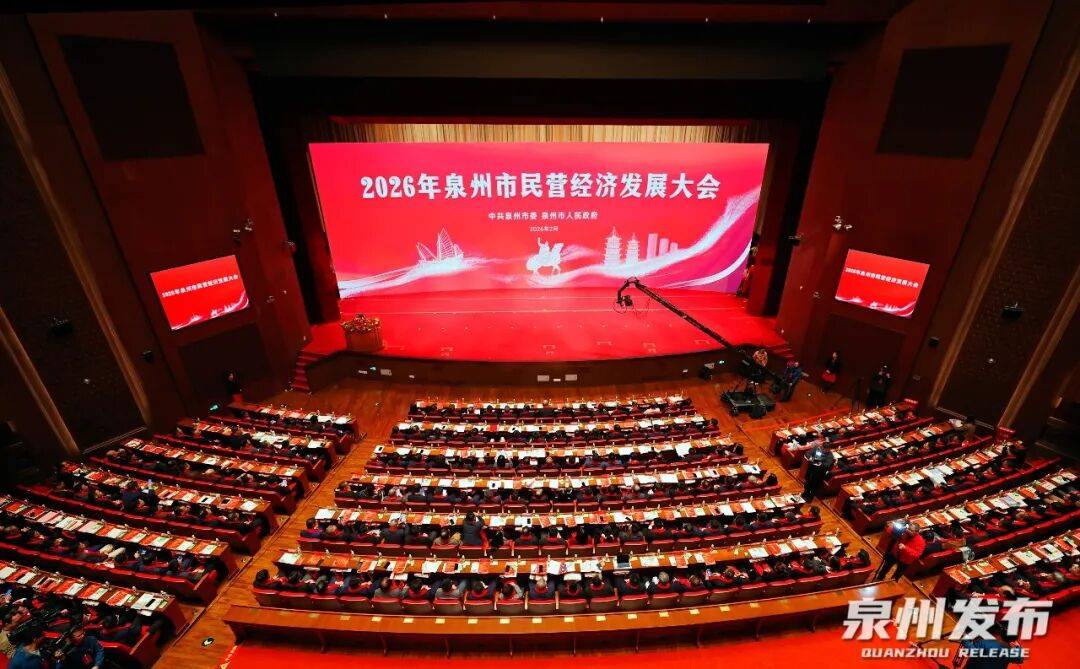
Core Viewpoint - The 2026 Quanzhou Private Economy Development Conference emphasizes the importance of inheriting and innovating the "Jinjiang experience" while deepening the market-oriented allocation of factors to invigorate the private economy [1][4] Group 1: Conference Highlights - The conference was attended by key officials including Quanzhou Municipal Party Secretary Zhang Yigong and Deputy Director of the National Development and Reform Commission Liu Min, focusing on policies to promote private economic development [2][3] - Zhang Yigong expressed gratitude to attendees and highlighted the contributions of entrepreneurs in strengthening the private economy, urging them to focus on technological updates and management innovations [4][5] Group 2: Policy Initiatives - The conference introduced a series of policies and case studies aimed at promoting market-oriented reforms and enhancing the private economy, including the "Top Ten Most Popular Policies for Enterprises" [3][5] - Emphasis was placed on optimizing the "policy finding enterprise" platform to transform enterprise needs into actionable policies, and promoting collaborative innovation among scientists, entrepreneurs, and investors [5][6] Group 3: Economic Development Goals - The conference outlined a vision for Quanzhou to strengthen its private economy by focusing on new materials, renewable energy, biomedicine, artificial intelligence, and low-altitude economy, aiming to create a modern industrial cluster [4][6] - The goal is to enhance the local economy by leveraging the "Jinjiang experience" and fostering a supportive environment for private enterprises to thrive [6][7] Group 4: Investment and Growth - The conference announced the signing of 30 major investment projects with a total investment exceeding 60 billion, showcasing the commitment to attracting investment and fostering economic growth [7] - The event also highlighted Quanzhou's recognition as a pilot for new consumption formats and models, indicating a focus on innovative economic practices [7][8]
中国AI再迎“Seedance时刻”,印证了一个重要趋势
Xin Lang Cai Jing· 2026-02-15 00:02
Group 1 - The AI video generation model Seedance 2.0 has gained significant popularity both domestically and internationally, utilizing a dual-branch diffusion transformer architecture to generate videos and audio simultaneously within 60 seconds from text or image inputs [1][3] - China's technological advancements in various fields, including energy, aerospace, and AI, have showcased the country's shift from "catching up" to "keeping pace" and even "leading," contributing to high-quality development [3][4] - The EAST nuclear fusion experiment achieved a world record by maintaining high-temperature plasma for a duration of 1000 seconds, marking a significant milestone in fusion energy research [3][6] Group 2 - The successful cultivation of the "Zhongke Fa 5" high-yield crop variety represents a shift in crop breeding from experience-based to precision design, laying a solid technological foundation for China's agricultural sector [6][8] - In the health sector, the TIMES system provides high-precision risk assessment for liver cancer recurrence, while a new treatment target for Parkinson's disease has been discovered, showcasing China's commitment to healthcare innovation [6][8] - The "Zuchongzhi No. 3" quantum computer has achieved international leadership in superconducting quantum systems, while the Jiangmen Underground Neutrino Observatory (JUNO) has significantly improved measurement precision in particle physics [8][10] Group 3 - The development of AI technologies, such as DeepSeek-R1, is breaking down barriers for small and medium enterprises and research institutions, promoting the democratization of AI [10][12] - China's space exploration efforts have advanced with the successful launch of the "Tianwen-2" probe and the "Chang'e 6" mission, which has provided insights into the Moon's evolution [14][16] - The achievements in 2025 reflect the results of increased R&D investment, improved innovation systems, and the cultivation of innovative talent, highlighting the vitality of China's independent innovation path [16]

上海市经信委:聚焦智能终端、商业航天等,再造万亿级产业新增量
Di Yi Cai Jing· 2026-02-07 06:21
Group 1 - Shanghai aims to create 25 billion-level segmented tracks tailored to local conditions as part of its "14th Five-Year Plan" and the establishment of a modern industrial system [1] - The city will focus on four main areas: implementing national strategies, accelerating industrial transformation, expanding industrial economic scale, and optimizing the industrial ecosystem [1] - Key industries such as integrated circuits and artificial intelligence will continue to maintain advantages, with manufacturing output expected to sustain double-digit growth [1] Group 2 - In the past year, Shanghai's industrial added value increased by 5.1%, with total output reaching 4.07 trillion yuan, marking a historical high [2] - The proportion of advanced manufacturing in Shanghai rose from 40% to 45%, while the share of three leading industries in manufacturing increased from 7.8% to 12.4% [2] - A new action plan aims to add 100 manufacturing enterprises with annual output value exceeding 1 billion yuan by 2028, contributing to the growth of the industrial chain [2]
光谷发布首批400项创新应用场景清单,打通创新成果转化“最后一公里”
Chang Jiang Ri Bao· 2026-02-06 01:02
Core Viewpoint - The East Lake High-tech Zone has officially released the first batch of 400 innovative application scenarios for 2026, aiming to bridge the gap in the transformation of innovative achievements and provide a platform for showcasing new technologies and products [1][2]. Group 1: Application Scenarios - The first batch of application scenarios covers five key areas: new fields and tracks, industrial transformation and upgrading, deep application in various industries, innovative social governance, and enriching people's livelihoods [2]. - The typical application scenario list includes 10 benchmark cases such as the Hubei humanoid robot innovation development application platform and the immersive smart cultural tourism project [2]. - The demand scenario list includes 120 opportunities for new technologies and products to be tested and validated in the East Lake area, focusing on system deployment and multi-party co-construction [2]. - The supply scenario list integrates regional innovation resources, featuring 270 capabilities such as semiconductor testing and robot interaction systems, promoting "excellent solutions" from the East Lake area [2]. Group 2: Implementation Measures - The East Lake High-tech Zone has introduced an implementation plan to enhance the scene innovation work system, proposing eight specific measures to address bottlenecks in scenario matching and innovation transformation [3]. - The plan includes annual selection of benchmark scenarios, with rewards for enterprises that successfully validate and promote their solutions to the national market [3]. - The policy aims to provide clear application entry points and market validation spaces for new products, addressing industry pain points effectively [3].
四川干部群众热议政府工作报告 以奋勇争先之姿,乘势而为
Si Chuan Ri Bao· 2026-02-06 00:23
Group 1 - The government work report highlights significant achievements during the "14th Five-Year Plan" period, including crossing two trillion yuan thresholds and exceeding 6 trillion yuan in economic output, marking a historic milestone for Sichuan [2] - The report emphasizes the importance of high-quality development and outlines key tasks for 2026, focusing on expanding domestic demand and promoting consumption and investment [2][3] - The report mentions the inclusion of Chengdu in the national pilot for market-oriented allocation of factors, which is expected to enhance the city's development in key sectors such as biomedicine and low-altitude economy [2] Group 2 - The report stresses the need for technological innovation and the integration of technology with industry, with a focus on fostering new growth drivers [3] - It highlights the importance of improving the quality of life for citizens, particularly in the area of elderly care, with a call for enhanced community-based services [3][4] - The report introduces the "Network Chain Sharing Plan," aimed at transforming educational resources into a collaborative and innovative teaching model, promoting balanced educational development across the region [4]
锚定高质量发展“后发先至” 聚力实现“十五五”良好开局
Xin Hua Ri Bao· 2026-02-04 00:52
Group 1 - The core focus for Lianyungang in 2026 is to implement high-quality development strategies aligned with the directives from Xi Jinping and the goals set by the provincial government [1] - The city aims to boost domestic demand and stabilize growth by launching consumption promotion initiatives and ensuring annual industrial investment reaches no less than 130 billion yuan [1] - Lianyungang plans to enhance innovation and strengthen industries by leveraging local research centers and focusing on key technologies, targeting an industrial output value of over 600 billion yuan [1] Group 2 - The city is committed to promoting reforms and expanding openness by developing key infrastructure projects and enhancing port operations, with a target of 5% growth in annual port throughput [2] - Efforts will be made to improve public welfare by increasing employment stability and expanding public services in education and healthcare, alongside urban renewal initiatives [2] - Lianyungang will prioritize risk prevention and safety management, addressing various risks in sectors such as finance and real estate to maintain social stability [3] Group 3 - The success of the 14th Five-Year Plan is heavily reliant on strong party leadership and the implementation of feedback from inspections, emphasizing the importance of a correct performance outlook among party members [3]
GDP首破6万亿元 福建锚定5%左右增速启“十五五”新程
Sou Hu Cai Jing· 2026-02-03 12:20
Core Insights - Fujian Province's GDP has officially surpassed 6 trillion yuan, with a target of approximately 5% annual growth over the next five years, aiming for per capita GDP to reach the level of moderately developed countries by 2030 [1][2][3] Economic Resilience - Fujian's GDP trajectory shows significant growth, crossing the 4 trillion yuan mark in 2020, 5 trillion yuan in 2022, and now entering the 6 trillion yuan club [2] - The province has demonstrated strong economic resilience despite complex international conditions and the impact of the pandemic, with the manufacturing sector contributing significantly to GDP and employment [2] Growth Target Justification - The 5% growth target is seen as both ambitious and realistic, taking into account global economic slowdowns and internal challenges such as the need for improved technological innovation and balanced regional development [3] - This target aligns with Fujian's strategic goals for the 14th Five-Year Plan, supporting the aim of reaching a per capita GDP comparable to that of moderately developed countries by 2030 [3] Multi-Dimensional Growth Support - Fujian's growth strategy includes a clear roadmap focusing on industrial development, digital economy, ecological transformation, and cross-strait integration [4] - The "555X" industrial cluster initiative aims to enhance traditional industries while fostering new sectors like renewable energy and intelligent technologies [4] - Digital transformation is emphasized, with plans to cultivate over 1,500 data enterprises and integrate advanced technologies across various sectors [4] Cross-Strait Integration - Fujian's unique advantage lies in its cross-strait integration, with plans to establish a demonstration zone for integrated development and enhance economic and cultural exchanges with Taiwan [5] - The province has consistently led in the establishment of Taiwanese enterprises and investment, which is expected to further invigorate the local economy [5] Social Welfare Focus - The growth target is closely linked to improving the well-being of residents, with a focus on employment, education, healthcare, and elderly care [6] - The planning includes initiatives to reduce disparities in income and regional development, aiming for a more equitable distribution of economic benefits [6] - The commitment to a comprehensive public service system reflects Fujian's determination to pursue common prosperity [6]
2025年深圳坪山主要经济指标两位数增长
Nan Fang Du Shi Bao· 2026-01-29 15:02
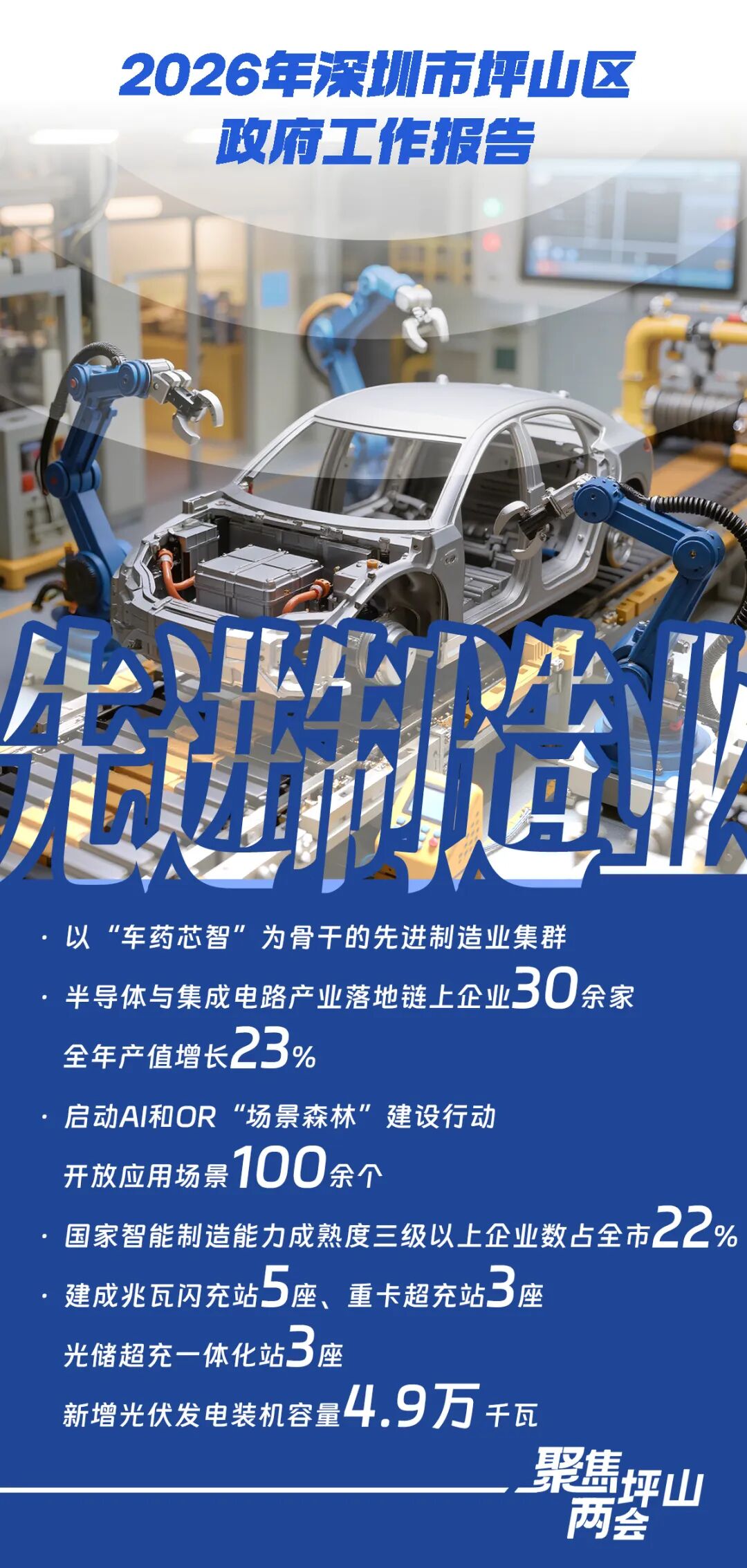
Group 1 - The overall output value increased by 5% [2] - New photovoltaic power generation capacity added was 49,000 kilowatts [3] - The cultural and entertainment industry revenue grew by 19% [6] Group 2 - Retail sales above designated size increased by 38% [7] - The low-altitude economy industry output value grew by 50% [7] - The software and information technology service industry revenue increased by 39% [7] Group 3 - The number of newly registered business entities ranked first in the city [10] - The total investment intention for introduced projects exceeded 30 billion yuan [10] - The area of industrial land prepared was 20 million square meters, releasing 1 square kilometer of industrial space [9] Group 4 - The number of PCT international patent applications increased by 37% [13] - The number of high-level talents grew by 13.6%, and the number of doctoral talents increased by 21.4% [13] - The establishment of the first national intellectual property operation center in the city was recognized [13] Group 5 - The comprehensive bonded zone's import and export total ranked first in the city [18] - The completion of the only national-level new pollutant treatment pilot task in the province was achieved [21] - The length of good-quality rivers increased to 98.5% [21] Group 6 - The upgrade of Pingshan High-speed Railway Station to a major transportation hub in eastern Shenzhen [30] - The construction of 20 roads and the successful opening of 4 dead-end roads [30] - More than 12,000 parking spaces were added [30]
人民网:瞄准3万亿!武汉挺起“大武汉”之“大”
Ren Min Wang· 2026-01-29 09:25
Core Viewpoint - Wuhan's GDP for 2025 is projected to be 22,147.35 billion yuan, reflecting a year-on-year growth of 5.6% at constant prices, positioning the city as a key driver for Hubei's development [1] Group 1: Competition - Wuhan aims to join the 30 trillion yuan GDP club by 2030, competing with cities like Shanghai, Beijing, and Shenzhen [2] - The city is focusing on building five centers: national economic center, national technology innovation center, national trade logistics center, international communication center, and regional financial center, which will collectively enhance its global competitiveness [2][4] - Key industries such as optoelectronics, automotive manufacturing, and biomedicine will be strengthened, while new industries like AI and quantum technology will be developed [2] Group 2: Progress - During the 14th Five-Year Plan, Wuhan's economy surpassed 2 trillion yuan, achieving stability and returning to the main growth track [5] - The city aims for structural optimization and enhanced capabilities, focusing on major technological infrastructure in strategic areas like optoelectronics and precision measurement [5] - Collaboration with neighboring cities like Changsha and Nanchang is essential for building industrial and innovation chains [5][6] Group 3: Spirit and Execution - The competition among cities is fundamentally about human resources, particularly the determination and execution capabilities of local officials [8] - A broad perspective is necessary for planning, emphasizing long-term benefits over short-term gains in investment and regional cooperation [8][9] - The city must maintain a focus on sustainable development, respecting scientific principles in innovation and urban renewal efforts [9]
