民用无人机

Search documents
晶采观察丨六部门划定三大万亿级消费赛道 带来哪些利好?
Yang Guang Wang· 2025-12-02 01:29
Core Viewpoint - The implementation plan aims to enhance the adaptability of supply and demand in the consumer goods sector to address pain points in consumption [1][2] Group 1: Goals and Targets - The plan sets a target to cultivate three trillion-level consumption sectors and ten hundred-billion-level consumption hotspots by 2027 [2] - The three trillion-level sectors include elderly products, smart connected vehicles, and consumer electronics [2] - The ten hundred-billion-level hotspots focus on specific categories such as baby products, smart wearable devices, cosmetics, fitness equipment, outdoor products, pet food, civilian drones, trendy toys, jewelry, and national trend clothing [2] Group 2: Targeted Consumer Groups - For the young demographic, the plan emphasizes "individual expression" and "fashion leadership," supporting the development of culturally rich and fashionable products like national trend clothing and designer collaborations [2][3] - In addressing the needs of infants and students, the plan promotes the integration of traditional toys and stationery with smart technology, aiming for products that facilitate personalized interaction and learning [3] - For the elderly, the focus is on practical convenience and quality of life, with plans to enhance the development of products like elderly care robots, suitable clothing, and easy-to-swallow foods [3] Group 3: Market Dynamics - The plan anticipates the creation of a new consumption market worth trillions in key sectors by 2027, driven by both "stock optimization" and "incremental creation" [3] - Stock optimization refers to the growing popularity of culturally significant domestic products, while incremental creation involves developing new products and services for emerging demographics and scenarios [3] Group 4: Economic Impact - The multi-faceted approach is expected to significantly enhance the resilience and vitality of the domestic consumer market, providing solid support for the construction of a new development pattern [4] - The goal is to achieve a dynamic balance of supply and demand at a higher level within approximately five years, allowing consumers to enjoy higher quality products and services [4]
增强消费品供需适配性 释放经济澎湃动力
Zheng Quan Ri Bao· 2025-11-30 16:22
Group 1 - The core viewpoint of the article emphasizes the implementation plan by six departments to enhance the adaptability of supply and demand in consumer goods, aiming for significant structural optimization by 2027 and a high-quality development pattern by 2030 [1][2] - The plan sets two main goals: to create three trillion-level consumption sectors and ten hundred-billion-level consumption hotspots by 2027, and to establish a mutually reinforcing interaction between supply and demand by 2030 [1][2] - The current consumer market in China is experiencing accelerated upgrades and faster segmentation, with diverse demands for personalized, high-quality, intelligent, and green products, while facing structural contradictions due to oversupply of homogeneous and low-end products [1] Group 2 - The plan focuses on the "silver economy" and children's products, targeting the growing elderly population and increasing birth rates as significant growth opportunities [2] - Key areas highlighted in the plan include smart connected vehicles, consumer electronics, smart wearables, and civilian drones, aligning with the development direction of new productive forces [2] - Cultural elements are integrated into products, with an emphasis on transforming traditional aesthetics and heritage skills into marketable goods, aiming to boost consumer confidence and drive consumption through cultural identity [2][3]
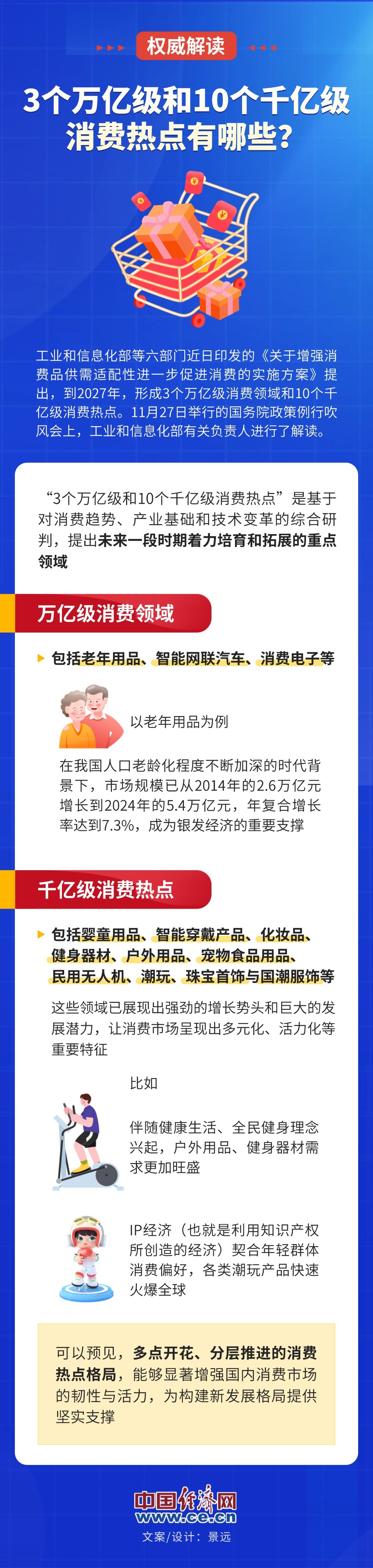
【图解】权威解读:3个万亿级和10个千亿级消费热点有哪些?
Zhong Guo Jing Ji Wang· 2025-11-29 01:34
Core Insights - The implementation plan by six departments, including the Ministry of Industry and Information Technology, aims to establish three trillion-level consumption sectors and ten hundred-billion-level consumption hotspots by 2027, based on comprehensive analysis of consumption trends, industrial foundations, and technological changes [3][4]. Trillion-Level Consumption Sectors - The three trillion-level consumption sectors identified include elderly products, smart connected vehicles, and consumer electronics. For instance, the market size for elderly products has grown from 2.6 trillion yuan in 2014 to an expected 5.4 trillion yuan by 2024, reflecting a compound annual growth rate of 7.3%, highlighting the significance of the silver economy [4]. Hundred-Billion-Level Consumption Hotspots - The ten hundred-billion-level consumption hotspots encompass a diverse range of products, including baby products, smart wearable devices, cosmetics, fitness equipment, outdoor goods, pet food, civilian drones, trendy toys, jewelry, and national trend clothing. These sectors are showing strong growth momentum and significant development potential, contributing to a diversified and vibrant consumer market [4][6]. Emerging Trends - The rise of health-conscious living and the concept of national fitness are driving increased demand for outdoor products and fitness equipment [6]. - The IP economy, which leverages intellectual property to create economic value, aligns with the consumption preferences of younger demographics, leading to a rapid global popularity of trendy toy products [8]. Market Resilience - The multi-faceted and layered approach to consumption hotspots is expected to significantly enhance the resilience and vitality of the domestic consumer market, providing solid support for the construction of a new development pattern [8].

推动供给与消费良性互动、相互促进
Ren Min Ri Bao· 2025-11-28 09:47
Core Insights - The Ministry of Industry and Information Technology, along with five other departments, has issued an implementation plan aimed at enhancing the adaptability of supply and demand in consumer goods, further promoting consumption [1] Group 1: Supply and Demand Transformation - The current supply of consumer goods in China has entered a new development stage characterized by high quality and price, but structural mismatches in supply and demand still exist in certain areas [2] - The implementation plan proposes five measures to address these mismatches, including expanding new product supply and accelerating the application of new technologies and models [2][3] Group 2: Market Segmentation and Consumer Needs - The plan emphasizes the need to cater to diverse consumer needs across different age groups, including initiatives for children's safety and elderly-friendly products [3][5] - It aims to create new consumption scenarios and business models, promoting platforms for product launches and exhibitions [3][6] Group 3: Economic Contribution and Growth - By 2027, the plan aims to create three trillion-yuan-level consumption sectors and ten hundred-billion-yuan-level consumption hotspots, including areas like elderly products and smart connected vehicles [4] - The contribution of consumption to economic growth is expected to steadily increase, with a goal of achieving a high-quality development pattern by 2030 [7] Group 4: Quality and Safety Standards - The National Development and Reform Commission plans to enhance supply quality by focusing on technology leadership and improving brand standards [8] - The State Administration for Market Regulation is set to strengthen the quality and safety of consumer goods, particularly for vulnerable groups such as the elderly and children [8]
六部门发文!“供需适配”政策将催生哪些消费
第一财经· 2025-11-28 06:59
Core Viewpoint - The article discusses the implementation plan issued by six departments, including the Ministry of Industry and Information Technology, aimed at enhancing the adaptability of supply and demand in consumer goods, promoting consumption, and stimulating the domestic market's potential [3][4]. Summary by Relevant Sections Key Tasks and Focus Areas - The plan outlines 19 key tasks focusing on expanding new consumption, tapping into existing markets, segmenting markets, empowering scenarios, and optimizing the environment [4]. - By 2027, the plan aims to create a new consumption market worth trillions in key areas through supply-side structural reforms [4]. Supply and Demand Dynamics - The concept of "adaptability" is emphasized, where the supply side actively responds to changing consumer trends, ensuring that products meet diverse consumer needs [4][5]. - China's consumer goods variety has reached 230 million, with over 100 categories, including home appliances and furniture, leading globally in production [4]. Growth in Specific Sectors - Data shows significant growth in sectors like smart drones (59.9% increase) and smart vehicle equipment (25.1% increase) in the first three quarters of 2025 [5]. - The penetration rate of new passenger cars with Level 2 driving assistance features reached 64%, indicating rapid technological adaptation [5]. Structural Optimization Goals - By 2027, the supply structure is expected to improve significantly, with three trillion-level consumption areas and ten hundred-billion-level consumption hotspots identified [6]. - The aging population is driving the market for elderly products, projected to grow from 2.6 trillion yuan in 2014 to 5.4 trillion yuan by 2024, with a compound annual growth rate of 7.3% [6]. Emerging Consumption Trends - The article highlights the emergence of new consumption trends, including health and fitness products, smart wearables, and pet supplies, reflecting a diverse and vibrant market [6][9]. - The shift in consumer focus from availability to quality is noted, with increasing demand for high-quality and diverse consumption scenarios [9]. Role of Technology and Innovation - The integration of artificial intelligence in consumer goods is emphasized, with a user base of 515 million for generative AI products as of mid-2023 [10]. - The plan promotes the development of intelligent products and applications, aiming to enhance manufacturing efficiency and brand upgrades through technology [10].
最大程度激发消费活力,促进经济循环畅通——《关于增强消费品供需适配性进一步促进消费的实施方案》解读
Ke Ji Ri Bao· 2025-11-28 05:37
Core Viewpoint - The recently issued "Implementation Plan for Enhancing the Adaptability of Supply and Demand for Consumer Goods" aims to transform production and consumption from quantity to quality, addressing resource misallocation and waste issues, and stimulating consumption potential through high-quality supply [1][2]. Group 1: Supply and Demand Adaptation - The plan emphasizes the need for a shift from producing more to producing better and more suitable products, which is expected to enhance overall consumption potential and promote economic circulation [1]. - The Ministry of Industry and Information Technology (MIIT) will collaborate with relevant departments to implement the plan, increasing resource investment and policy support to expand consumption and stabilize growth [1]. Group 2: Quality and Variety of Consumer Goods - China's consumer goods supply has entered a new stage characterized by high quality and competitive pricing, with a total of 230 million varieties of consumer goods available, leading in over 100 categories such as home appliances and furniture [2]. - Innovative products like smart home devices and wearable technology have seen significant growth, with the manufacturing value added for smart drones and smart vehicle equipment increasing by 59.9% and 25.1% respectively in the first three quarters of this year [2]. Group 3: Future Consumption Goals - The plan sets ambitious targets to establish three trillion-yuan-level consumption sectors and ten hundred-billion-yuan-level consumption hotspots by 2027, focusing on areas such as elderly products, smart connected vehicles, and consumer electronics [2][3]. - The identified hotspots include baby products, outdoor goods, and civilian drones, which are expected to show strong growth and development potential [3]. Group 4: Structural Reforms and Market Resilience - The plan focuses on supply-side structural reforms, enhancing brand leadership, upgrading standards, and applying new technologies to stimulate the domestic market's multiplier effect and structural dividends [3]. - The approach aims to create a multi-faceted and resilient domestic consumption market, providing solid support for the new development pattern [3]. Group 5: Integration of Artificial Intelligence - The plan highlights the integration of artificial intelligence (AI) as a catalyst for promoting consumption, with the user base for generative AI products reaching 515 million by mid-year [4][5]. - Future efforts will focus on product and scenario innovation, leveraging AI and big data to enhance the digital ecosystem across the entire industry chain [5]. Group 6: Application Scenarios and Consumer Experience - The government has promoted 213 application scenarios for digital technology to enhance product variety, quality, and branding, with plans to further explore AI solutions to address industry pain points and improve manufacturing efficiency [5]. - The initiative aims to develop smart products that connect seamlessly, such as health monitoring devices and rehabilitation aids, enhancing consumer experiences and stimulating new demand [5].
中国工信部详解3个万亿元级和10个千亿元级消费热点
Zhong Guo Xin Wen Wang· 2025-11-27 11:46
Core Insights - The Chinese government aims to create three trillion-yuan-level consumption sectors and ten hundred-billion-yuan-level consumption hotspots by 2027, focusing on supply-side structural reforms to stimulate domestic demand [1][2] Group 1: Trillion-Yuan Consumption Sectors - The three identified trillion-yuan consumption sectors are elderly products, smart connected vehicles, and consumer electronics, with the elderly products market expected to grow from 2.6 trillion yuan in 2014 to 5.4 trillion yuan by 2024, reflecting a compound annual growth rate of 7.3% [1] Group 2: Hundred-Billion-Yuan Consumption Hotspots - The ten hundred-billion-yuan consumption hotspots include baby products, smart wearable devices, cosmetics, fitness equipment, outdoor products, pet food, civilian drones, trendy toys, jewelry, and national trend clothing [1] Group 3: Market Trends and Consumer Preferences - There is a strong growth momentum in these sectors, driven by trends such as health consciousness and fitness, leading to increased demand for outdoor products and fitness equipment. The IP economy aligns with the consumption preferences of younger demographics, resulting in a rapid global rise of trendy products [2]
重磅部署!3个万亿级+10个千亿级,消费热点来了!6部门,联合发声
券商中国· 2025-11-27 09:35
Core Insights - The article discusses the implementation plan released on November 26, aimed at enhancing the adaptability of supply and demand in consumer goods to further promote consumption [1][3]. Group 1: Key Consumption Areas - Three trillion-level consumption areas identified include elderly products, smart connected vehicles, and consumer electronics [5]. - Ten billion-level consumption hotspots include baby products, smart wearable devices, cosmetics, fitness equipment, outdoor products, pet food supplies, civilian drones, trendy toys, jewelry, and national trend clothing [5][6]. - The elderly products market is projected to grow from 2.6 trillion yuan in 2014 to 5.4 trillion yuan by 2024, with a compound annual growth rate of 7.3% [5]. Group 2: Addressing Supply and Demand Mismatches - The core objective of the implementation plan is to transition production and consumption from quantity to quality, addressing mismatches in supply and demand that lead to resource waste [7]. - The plan includes measures to expand new technologies, enhance product supply, and create new consumption scenarios to better match diverse consumer needs [7][8]. Group 3: Consumer Trends and Innovations - The user base for generative artificial intelligence products reached 515 million by mid-2023, indicating a growing application in consumer goods [8]. - The promotion of old-for-new consumption policies has generated over 2.4 trillion yuan in sales, benefiting more than 360 million people in the first ten months of the year [9]. - Future initiatives will focus on expanding large-scale consumption, fostering new types of consumption, and creating an international consumption environment [9].

“3个万亿级和10个千亿级消费热点” 有哪些,工信部回应
2 1 Shi Ji Jing Ji Bao Dao· 2025-11-27 06:42
Core Insights - The document outlines a plan to enhance the adaptability of supply and demand in consumer goods, aiming for significant structural optimization by 2027, with the creation of three trillion-level consumption sectors and ten hundred-billion-level consumption hotspots [1][5]. Group 1: Trillion-Level Consumption Sectors - The three trillion-level consumption sectors identified include elderly products, smart connected vehicles, and consumer electronics, reflecting a comprehensive assessment of consumption trends, industrial foundations, and technological changes [1][2]. Group 2: Hundred-Billion-Level Consumption Hotspots - The ten hundred-billion-level consumption hotspots encompass baby and children's products, smart wearable devices, cosmetics, fitness equipment, outdoor products, pet food and supplies, civilian drones, trendy toys, jewelry, and national trend clothing, all showing strong growth momentum and significant development potential [2][4]. Group 3: Market Dynamics and Growth Potential - The elderly products market is projected to grow from 2.6 trillion yuan in 2014 to 5.4 trillion yuan by 2024, with a compound annual growth rate of 7.3%, highlighting the importance of the silver economy [1][2]. - The implementation plan aims to stimulate the domestic consumption market's resilience and vitality, potentially generating several trillion yuan in new consumption markets by 2027 through supply-side structural reforms [5]. - The strategy includes optimizing existing products by enhancing quality and cultural elements, as well as creating new products and services to meet emerging consumer needs, such as smart home ecosystems and solutions for the elderly [5].
“3个万亿级和10个千亿级消费热点”有哪些?工信部解释
Sou Hu Cai Jing· 2025-11-27 04:38
Core Viewpoint - The Ministry of Industry and Information Technology, along with five other departments, has issued an implementation plan aimed at enhancing the adaptability of supply and demand in consumer goods, targeting the formation of three trillion-level consumption sectors and ten hundred-billion-level consumption hotspots by 2027 [1][3]. Group 1: Trillion-Level Consumption Sectors - The three trillion-level consumption sectors identified include elderly products, smart connected vehicles, and consumer electronics [3]. - The market size for elderly products is projected to grow from 2.6 trillion yuan in 2014 to 5.4 trillion yuan by 2024, reflecting a compound annual growth rate (CAGR) of 7.3%, highlighting the significance of the silver economy [3]. Group 2: Hundred-Billion-Level Consumption Hotspots - The ten hundred-billion-level consumption hotspots encompass baby products, smart wearable devices, cosmetics, fitness equipment, outdoor products, pet food and supplies, civilian drones, trendy toys, jewelry, and national trend clothing [3]. - These sectors are showing strong growth momentum and significant development potential, contributing to a diversified and vibrant consumer market [3]. - The rise of health-conscious living and the concept of national fitness are driving increased demand for outdoor products and fitness equipment, while the IP economy aligns with the consumption preferences of younger demographics, leading to the rapid global popularity of trendy toy products [3]. Group 3: Market Resilience and Vitality - The multi-faceted and layered approach to cultivating consumption hotspots is expected to significantly enhance the resilience and vitality of the domestic consumer market, providing solid support for the construction of a new development pattern [3].