
水利管理业

Search documents
东吴证券:“雨带北移”或推动2026年水利相关投资录得较高增长
Sou Hu Cai Jing· 2026-01-29 00:03
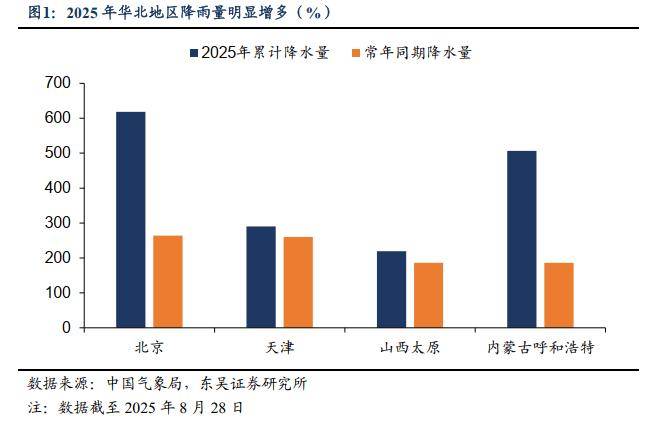
Core Viewpoint - Since 2021, the "northward shift of the rain belt" has significantly increased rainfall duration and volume in North China, leading to a rise in flood disasters and disruptions in project commencement. In this context, multiple departments have mentioned the need to accelerate the improvement of flood control and drainage infrastructure in North China by 2026, with water-related investments expected to see high growth in 2026. It is estimated that fixed asset investment in water, environment, and public facility management will increase by approximately 0.5 trillion yuan in 2026, driving infrastructure investment up by about 2.1 percentage points and overall fixed asset investment by about 1.1 percentage points, playing a crucial role in stabilizing investment [1][4][19]. Group 1: Objective Facts of the Northward Shift of the Rain Belt - From 2011 to 2020, the average duration of the rainy season in North China was only 27 days, but since 2021, it has significantly increased, with durations recorded at 59 days and 50 days in 2021 and 2022, respectively. The rainy season in 2025 reached a new high in both duration and precipitation [2][8]. - In 2025, the rainy season in North China began on July 5, 13 days earlier than the average, and ended on September 2, 16 days later than usual, resulting in a total duration of approximately 59 days, the longest since 1961 [9][10]. - The average national precipitation in 2025 was about 668 mm, 4.5% more than the average, with North China's rainy season precipitation reaching 356.6 mm, an increase of 161.1% compared to the norm [10]. Group 2: Economic Impact of the Northward Shift of the Rain Belt - The increase in extreme weather events, such as heavy rainfall, has led to a significant rise in flood disasters in North China. In July 2023, severe flooding in Beijing, Hebei, and Tianjin affected 5.512 million people, with direct economic losses reaching 165.79 billion yuan. In the first three quarters of 2025, flood disasters in North China caused direct economic losses of approximately 97.99 billion yuan, accounting for 59% of the national total [3][11]. - The increase in rainy days has also disrupted project commencement in North China. For instance, during the 2025 rainy season, the cement dispatch rate in North China dropped from 50% to 34%, significantly lower than the seasonal variation of 1.5% observed in the past five years. In Beijing, the dispatch rate fell from 57.5% on July 4, 2025, to 30% by August 29, 2025 [3][11]. Group 3: Potential Growth in Water Investment in 2026 - In response to the increased flood disasters and project disruptions caused by the northward shift of the rain belt, there has been a noticeable increase in policy emphasis on water-related investments in North China. The 2025 Central Economic Work Conference explicitly mentioned the need to address the shortcomings in flood control and drainage infrastructure, with expectations for high growth in water-related investments in 2026 [4][15]. - In the fourth quarter of 2023, China issued 1 trillion yuan in bonds to support post-disaster recovery and enhance disaster prevention and mitigation capabilities, leading to high growth in fixed asset investment in the water, environment, and public facility management sector in 2024. Assuming a similar growth rate in 2026, fixed asset investment in this sector is expected to increase by about 0.5 trillion yuan, contributing to a 2.1 percentage point rise in infrastructure investment and a 1.1 percentage point rise in overall fixed asset investment [19][4].


宏观深度报告:“雨带北移”或推动2026年水利相关投资录得较高增长
Soochow Securities· 2026-01-28 02:24
Group 1: Rain Belt Shift and Its Impact - Since 2021, the "northward shift of the rain belt" has significantly increased rainfall duration and volume in North China, leading to more frequent flooding disasters and disruptions in project commencement[1] - In 2025, the average rainfall in North China reached 356.6 mm, which is 161.1% higher than the historical average, contributing to a national average rainfall of 668 mm, 4.5% above normal[6] - Flood disasters in North China caused direct economic losses of approximately 979.9 billion yuan in the first three quarters of 2025, accounting for 59% of the national total[6] Group 2: Investment Projections for 2026 - In response to the increased flooding risks, the government plans to accelerate investments in flood control and drainage infrastructure in North China, with expectations for significant growth in water-related investments in 2026[1] - Assuming a 5% increase in fixed asset investment growth for water management and public facilities compared to the past five years, water-related investments in 2026 could increase by approximately 0.5 trillion yuan[6] - This increase in water-related investment is projected to boost overall fixed asset investment by about 1.1 percentage points, contributing to a stabilization in investment trends[6] Group 3: Policy and Infrastructure Focus - The 2025 Central Economic Work Conference emphasized the need to address the shortcomings in flood control infrastructure in North China, highlighting the importance of enhancing disaster response capabilities[6] - In the fourth quarter of 2023, the issuance of 1 trillion yuan in government bonds aimed at disaster recovery and infrastructure improvement is expected to lead to a 17.6% growth in fixed asset investment in water, environment, and public facilities management in North China[6] - The focus on improving flood control and drainage infrastructure is expected to remain a priority in national policy discussions leading into 2026[6] Group 4: Risks and Considerations - The sustainability of the rain belt shift remains uncertain, with potential for rainfall in 2026 to exceed expectations[6] - There is a risk that national investment stabilization policies may not meet expectations, leading to lower-than-anticipated growth in water-related investments[6] - Some data used for projections are based on historical estimates, which may contain inaccuracies[6]
河南省二〇二五年经济成绩单出炉
He Nan Ri Bao· 2026-01-21 23:37
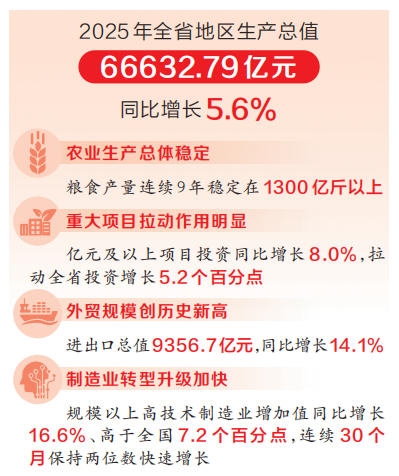
Economic Overview - In 2025, Henan's GDP reached 66,632.79 billion yuan, with a year-on-year growth of 5.6% [1] - The primary industry added value was 5,538.08 billion yuan, growing by 3.6%; the secondary industry added value was 24,926.80 billion yuan, increasing by 5.5%; and the tertiary industry added value was 36,167.92 billion yuan, rising by 6.0% [1] Agricultural Production - Agricultural production remained stable, with grain output reaching 1,350.97 billion jin, maintaining above 1,300 billion jin for nine consecutive years [3] - Vegetable and edible fungus production was 85.03 million tons, up by 2.9%, while fruit production was 15.69 million tons, increasing by 1.7% [3] Industrial Growth - Industrial production saw a rapid increase, with the added value of large-scale industries growing by 8.4% year-on-year, 0.3 percentage points faster than in 2024, and exceeding the national average by 2.5 percentage points [3] - The equipment manufacturing sector showed strong support, with a 13.6% increase in added value, contributing 44.1% to the growth of large-scale industries [3] Investment and Consumption - Fixed asset investment in Henan grew by 4.0%, surpassing the national average by 7.8 percentage points [4] - The retail sales of consumer goods reached 29,090.50 billion yuan, with a year-on-year growth of 5.6%, exceeding the national average by 1.9 percentage points [4] - The total import and export value reached 935.67 billion yuan, growing by 14.1% [4] Emerging Industries - High-tech manufacturing industries saw a significant increase, with added value growing by 16.6%, outpacing the national average by 7.2 percentage points [5] - The broadcasting, film, and recording industry experienced a revenue increase of 51.8%, while the multi-modal transport and business services sectors grew by 21.4% and 21.0%, respectively [6] Policy Impact - The "Two Heavy" and "Two New" policies have effectively stimulated investment, with industrial equipment investment increasing by 8.3% [7] - Key industrial chains showed robust growth, with added value increasing by 9.5%, contributing 70.4% to the growth of large-scale industries [7]
投资结构不断优化
Jing Ji Ri Bao· 2026-01-19 22:23
Group 1 - In 2025, fixed asset investment (excluding farmers) reached 48,518.6 billion yuan, driven by large-scale equipment upgrades and the replacement of consumer goods [1] - Industrial investment grew by 2.6% year-on-year, contributing 0.9 percentage points to overall investment growth, with mining investment up by 2.5%, manufacturing investment up by 0.6%, and electricity, heat, gas, and water production and supply investment up by 9.1% [1] - Infrastructure investment in key areas saw significant growth, with pipeline transportation investment increasing by 36.0%, internet and related services investment up by 23.8%, and multimodal transport and agency investment rising by 22.9% [1] Group 2 - Equipment and tool purchase investment grew by 11.8% year-on-year, contributing 1.8 percentage points to overall investment growth, and accounted for 18.0% of total investment, an increase of 2.5 percentage points from the previous year [1] - High-tech service industry investment increased by 3.5% year-on-year, representing 5.6% of total service industry investment, up by 0.6 percentage points from the previous year [2] Group 3 - Investment in forestry rose by 28.5%, fisheries investment increased by 12.4%, and investment in electricity and heat production and supply grew by 11.1% [3] - The investment in agricultural and sideline food processing increased by 9.2%, while wholesale and retail investment grew by 5.6%, and accommodation and catering investment rose by 5.5% [3]
国家统计局:2025年汽车制造业投资增长11.7%
Sou Hu Cai Jing· 2026-01-19 04:20
Core Viewpoint - The article discusses the trends and statistics of fixed asset investment in China for 2025, highlighting the focus on effective investment in key areas and the optimization of investment structure, despite an overall decline in fixed asset investment compared to the previous year. Group 1: Overall Investment Trends - In 2025, the total fixed asset investment (excluding rural households) reached 48,518.6 billion yuan, a decrease of 3.8% from the previous year [1] - Investment in the primary industry grew by 2.3%, while the secondary industry saw a growth of 2.5%. However, the tertiary industry experienced a decline of 7.4% [1] Group 2: Industrial Investment - Industrial investment in 2025 increased by 2.6%, contributing 0.9 percentage points to overall investment growth [2] - Mining investment rose by 2.5%, contributing 0.1 percentage points, while manufacturing investment grew by 0.6%, also contributing 0.1 percentage points [2] - Notable growth in specific manufacturing sectors included transportation equipment (17.5%), chemical fiber (12.3%), and automotive manufacturing (11.7%) [2] - Investment in electricity, heat, gas, and water production and supply increased by 9.1%, contributing 0.7 percentage points to overall investment growth [2] Group 3: Infrastructure Investment - Infrastructure investment in key areas saw significant growth, with pipeline transportation investment increasing by 36.0% [3] - Investment in internet and related services grew by 23.8%, while multimodal transport and logistics services increased by 22.9% [3] - Private investment in infrastructure rose by 1.7%, accounting for 21.0% of total infrastructure investment, an increase of 0.8 percentage points from the previous year [3] Group 4: Equipment Investment - Investment in equipment and tools saw a substantial increase of 11.8%, contributing 1.8 percentage points to overall investment growth [4] - This category accounted for 18.0% of total investment, an increase of 2.5 percentage points from the previous year [4] Group 5: High-Tech Service Investment - Investment in high-tech services grew by 3.5%, representing 5.6% of total service investment, an increase of 0.6 percentage points [5] - Information service investment surged by 28.4% [5] Group 6: Social Welfare Investment - In 2025, investments in social welfare sectors showed positive trends, with forestry investment increasing by 28.5% and fisheries investment by 12.4% [6] - Other sectors such as electricity and heat production (11.1%), agricultural processing (9.2%), and wholesale and retail (5.6%) also experienced growth [6] - The government aims to enhance investment effectiveness in 2026, focusing on major national strategies and the optimization of traditional industries while fostering emerging sectors [6]
虚拟“分身”为永定河治理添“智慧”
Xin Lang Cai Jing· 2026-01-14 19:42
如果说空间永定河是骨架,实况永定河就是遍布其上的"神经系统"。它接入了流域内23类共计1566个感 知设备的数据,从雨量、水位、水质到水工建筑的工控、变形等监测,构建了"天空地水工"一体化的监 测网络。海量数据汇入,是为了让风险被提前"看见"。邱颖解释,系统在关键工程上布设了密集的自动 化监测设备,例如在卢沟桥拦河闸闸门上安装能感知应力、振动的传感器;在17个配电室里,部署了自 主巡检的AI机器人等。这些设备24小时工作,监测着工程的"健康指标",一旦发现变形、渗流数据异 常,系统会立刻自动报警。"我们的目标是,不让任何一个安全隐患因为'没看见'或'发现晚'而演变成大 问题。"邱颖说。 决策永定河模块是一个高度集成的"调度决策驾驶舱"。它将防洪、水资源调度、工程运行各方面业务的 关键数据汇聚于统一平台。该模块可根据防汛会商、日常监控等不同场景,自由配置大屏显示内容,实 现"千人千面"的定制化视图。邱颖介绍,无论是防洪形势的实时研判,还是水资源调度的科学决策,抑 或工程运行状态的动态监测,都能在这个"驾驶舱"里一目了然。通过直观的图表、数据和动态模拟,决 策者可以迅速掌握流域的整体状况,及时发现潜在的风险和问题 ...
深圳清泉取得多介质耦合反硝化滤池运行控制专利
Sou Hu Cai Jing· 2026-01-09 08:05
Group 1 - Shenzhen Qingquan Water Industry Co., Ltd. and Shenzhen Qingquan Software Co., Ltd. have obtained a patent for a "Multi-Medium Coupled Denitrification Filter Pool Operation Control Method and System" with authorization number CN121044714B, applied on October 2025 [1] - Shenzhen Qingquan Water Industry Co., Ltd. was established in 1995, located in Shenzhen, primarily engaged in water management, with a registered capital of 35.428571 million RMB [1] - The company has invested in 6 enterprises, participated in 103 bidding projects, holds 9 trademark registrations, and has 79 patents, along with 18 administrative licenses [1] Group 2 - Shenzhen Qingquan Software Co., Ltd. was established in 2013, located in Shenzhen, primarily engaged in business services, with a registered capital of 1 million RMB [1] - The software company holds 3 patents and has 3 administrative licenses [1]
砚山方源绿色农业有限公司成立,注册资本1000万人民币
Sou Hu Cai Jing· 2026-01-06 16:33
天眼查显示,近日,砚山方源绿色农业有限公司成立,法定代表人为李燕,注册资本1000万人民币,由 砚山七乡城市运营管理有限公司全资持股。 来源:市场资讯 企业名称砚山方源绿色农业有限公司法定代表人李燕注册资本1000万人民币国标行业水利、环境和公共 设施管理业>水利管理业>其他水利管理业地址云南省文山壮族苗族自治州砚山县江那镇民族文化体育 中心文化传媒大楼14楼企业类型有限责任公司(法人独资)营业期限2026-1-6至无固定期限登记机关砚 山县市场监督管理局 序号股东名称持股比例1砚山七乡城市运营管理有限公司100% 经营范围含水土流失防治服务;水资源管理;水利相关咨询服务;防洪除涝设施管理;对外承包工程; 建筑工程用机械销售;灌溉服务;非常规水源利用技术研发;住宅水电安装维护服务;水文服务;水环 境污染防治服务;水利情报收集服务;水污染治理;污水处理及其再生利用;农业生产托管服务;农业 专业及辅助性活动;农业生产资料的购买、使用;与农业生产经营有关的技术、信息、设施建设运营等 服务;农作物秸秆处理及加工利用服务;农作物收割服务;农作物病虫害防治服务;农产品的生产、销 售、加工、运输、贮藏及其他相关服务。(除依 ...
南丰工创水利实业开发有限公司成立,注册资本10000万人民币
Sou Hu Cai Jing· 2025-12-25 16:26
来源:市场资讯 经营范围含水土流失防治服务,水环境污染防治服务,水利相关咨询服务,非居住房地产租赁,水资源 管理,污水处理及其再生利用,水污染治理,防洪除涝设施管理,灌溉服务,工程管理服务,农业专业 及辅助性活动,园区管理服务(除依法须经批准的项目外,凭营业执照依法自主开展经营活动) 企业名称南丰工创水利实业开发有限公司法定代表人吴晗馨注册资本10000万人民币国标行业水利、环 境和公共设施管理业>水利管理业>其他水利管理业地址江西省抚州市南丰县黄金工业园众创一期1号楼 企业类型有限责任公司(非自然人投资或控股的法人独资)营业期限2025-12-25至无固定期限登记机关 南丰县市场监督管理局 天眼查显示,近日,南丰工创水利实业开发有限公司成立,法定代表人为吴晗馨,注册资本10000万人 民币,由南丰县工业创新投资发展集团有限公司全资持股。 序号股东名称持股比例1南丰县工业创新投资发展集团有限公司100% ...
海报新闻:“点水成金”——看聊城如何破解水资源约束与高质量发展之题
Shui Li Bu Wang Zhan· 2025-12-22 01:45
Core Insights - The article highlights a "water revolution" in Liaocheng, Shandong, driven by technological innovation to address severe water scarcity issues [1] Group 1: Digital Twin Technology in Irrigation - The Weishan Irrigation District has implemented a digital twin platform that enhances water management efficiency by 11% through real-time monitoring of water levels, flow rates, and crop water needs [2] - The district covers an irrigation area of 5.18 million acres, accounting for 65% of Liaocheng's total arable land, and has supplied over 61 billion cubic meters of water since its inception [2][3] - The digital twin system includes a comprehensive sensing network with 1,182 water monitoring stations and 1,100 video surveillance points, ensuring full coverage and efficient data transmission [3] Group 2: Industrial Water Recycling - Liaocheng is developing a "second water source" through industrial water recycling, with a new facility in Guancheng capable of treating and reusing 70,000 cubic meters of water daily [4] - The facility's closed-loop system significantly reduces the extraction of fresh groundwater, with cost savings of approximately 270 million yuan annually for companies using recycled water [4][5] - The average groundwater depth in Guancheng has improved by 0.82 meters compared to the previous year, indicating positive environmental impacts from reduced groundwater extraction [6] Group 3: Agricultural Water Efficiency Innovations - The integration of irrigation, drainage, and fertilization through underground networks in Yanggu County reduces costs and land usage, with investments ranging from 400 to 800 yuan per acre [7] - The modern agricultural park in Chiping District employs precision drip irrigation and AI technology to optimize water usage, achieving a 66% reduction in water consumption per plant [8] - The park's fish farming operations utilize a closed-loop system that recycles water and nutrients, enhancing productivity significantly compared to traditional methods [8][9] Group 4: Overall Impact on Economic Development - Liaocheng's approach to water resource management through technology and systematic governance is transforming water constraints into drivers of high-quality economic development [9]