
物流地产

Search documents
京东产发向港交所递交A1招股书
Zhong Guo Jin Rong Xin Xi Wang· 2026-01-26 13:48
Core Viewpoint - JD Property has officially submitted its A1 application to the Hong Kong Stock Exchange, marking a significant step in its capital market strategy [1] Group 1: Company Overview - JD Property is a modern infrastructure development and management platform under JD Group, serving as a cornerstone of JD's supply chain ecosystem [1] - As of September 30, 2025, JD Property has developed, owned, or managed 285 modern infrastructure assets across 29 provincial-level administrative regions in China and 10 countries and regions abroad, with a total asset management scale of 121.5 billion yuan [1] Group 2: Market Implications - The initiation of JD Property's Hong Kong listing is expected to enhance capital efficiency and market competitiveness [1] - The listing aims to better support the infrastructure construction and industrial upgrading of China's real economy, while also providing robust support for cross-border merchants and Chinese enterprises in their globalization efforts [1] - This move is aligned with the goal of facilitating domestic and international dual circulation [1]
京东产发向港交所递交A1招股书 资产管理规模达到1215亿元
Zhi Tong Cai Jing· 2026-01-26 13:19
Core Viewpoint - JD Property has officially submitted its A1 application to the Hong Kong Stock Exchange, marking a significant step in its development as a modern infrastructure development and management platform under JD Group [1] Group 1: Company Overview - JD Property is a key component of JD Group's supply chain ecosystem, focusing on modern infrastructure development and management [1] - As of September 30, 2025, JD Property has developed, owned, or managed a total of 285 modern infrastructure assets across 29 provincial-level administrative regions in China and 10 countries and regions abroad [1] Group 2: Asset Management - The total gross floor area of the assets managed by JD Property is approximately 27.1 million square meters [1] - The total asset management scale amounts to 121.5 billion RMB [1] - The modern infrastructure assets include 259 logistics parks, 20 industrial parks, and 6 data center facilities [1]
JINGDONG Property, Inc.(H0355) - Application Proof (1st submission)
2026-01-25 16:00
Disclaimer Statement The Stock Exchange of Hong Kong Limited and the Securities and Futures Commission take no responsibility for the contents of this Application Proof, make no representation as to its accuracy or completeness and expressly disclaim any liability whatsoever for any loss howsoever arising from or in reliance upon the whole or any part of the contents of this Application Proof. Application Proof of JINGDONG Property, Inc. 京东智能产发股份有限公司 (the "Company") (incorporated in the Cayman Islands with ...
中企出海迈入“产城协同”时代 物流地产成海外投资新热点
Zhong Guo Jing Ying Bao· 2026-01-22 16:19
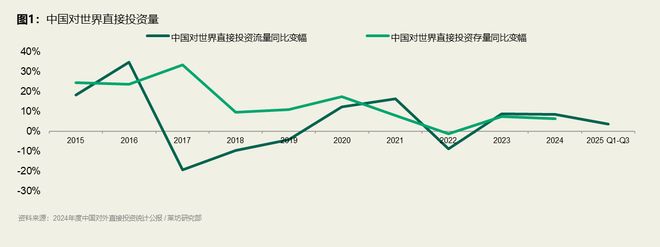
Group 1 - The core viewpoint of the article highlights the increasing trend of Chinese companies' overseas direct investment, driven by structural upgrades and policy guidance, with a focus on high-tech, green energy, and digital economy sectors [2][4] - By the first three quarters of 2025, China's total overseas direct investment flow reached $128.93 billion, a year-on-year increase of 3.6%, with non-financial direct investment accounting for over 85% [2] - As of June 2025, China's overseas direct investment stock reached $3.35 trillion, and by 2024, overseas revenue of Chinese listed companies is expected to exceed 10 trillion yuan, representing 13.8% of total revenue [2] Group 2 - The logistics real estate and industrial parks have become core sectors for real estate companies going overseas, focusing on providing industrial facilities and warehouses for manufacturing and new energy enterprises [3][7] - In 2024, the manufacturing sector saw an investment of $37.54 billion, a significant year-on-year increase of 37.3%, while the information transmission and software services sector experienced a dramatic growth of 205.5%, reaching $6.97 billion [4] - The ASEAN region attracted $34.36 billion in non-financial direct investment from China in 2024, marking a historical high, driven by manufacturing transfer demands [4] Group 3 - The article emphasizes the need for companies to establish a multi-dimensional compliance system to identify policy risks in target countries and to build a resilient supply chain [5][6] - Companies are advised to adopt a brand upgrade strategy, transitioning from a "cost-performance label" to a "technology brand + cultural recognition" approach to enhance global pricing power [6] - The demand for office space is becoming more rational, with a focus on asset preservation and operational efficiency, while green certification and sustainable development are becoming key competitive factors [7][8]

仓储物流巨头普洛斯中国迎来女CEO,创始成员赵明琪出任
Nan Fang Du Shi Bao· 2026-01-14 13:53
Core Viewpoint - GLP has appointed Zhao Mingqi as the new CEO of GLP China, marking a strategic move to enhance the integration of its new economy business platform in the Chinese market [1][4]. Group 1: Leadership Changes - Zhao Mingqi, a founding member of GLP and head of logistics and manufacturing infrastructure in China, will now lead logistics, industrial infrastructure, computing centers, new energy, and fund management in China [1][3]. - The previous head, Zhuge Wenjing, will continue as a member of the global executive committee and the board of GLP China, expanding her responsibilities in management, strategic planning, and decision-making at the group level [1][3]. Group 2: Zhao Mingqi's Background - Zhao Mingqi has over 20 years of experience in the real estate and infrastructure industry and has been with GLP since 2003, playing a key role in driving operational performance through data-driven strategies [3][4]. - From 2018 to 2025, she served as co-president of GLP Asset in China, overseeing nearly 50 million square meters of logistics and manufacturing infrastructure across 70 cities, serving over 2,500 clients [3][4]. Group 3: Strategic Importance of New Leadership - The appointment of Zhao Mingqi is seen as a significant strategic advancement for GLP in the Chinese market, particularly in the context of the new economy infrastructure sector, which is experiencing unprecedented opportunities [4][5]. - The focus on logistics parks, computing centers, and new energy facilities aligns with national strategies and industry trends towards digital economy and green energy transitions [4][5]. Group 4: Market Position and Future Outlook - GLP's services have evolved from primarily serving multinational companies to also include leading domestic enterprises, with nearly 90% of its operational space now catering to the domestic market [5]. - The logistics real estate sector has shifted from high-speed growth to a focus on high-quality development, emphasizing the importance of site selection and adaptability to economic cycles [5].

冲刺21亿机构间REITs,京东产发上市未果后的资本突围
Sou Hu Cai Jing· 2025-12-28 14:44
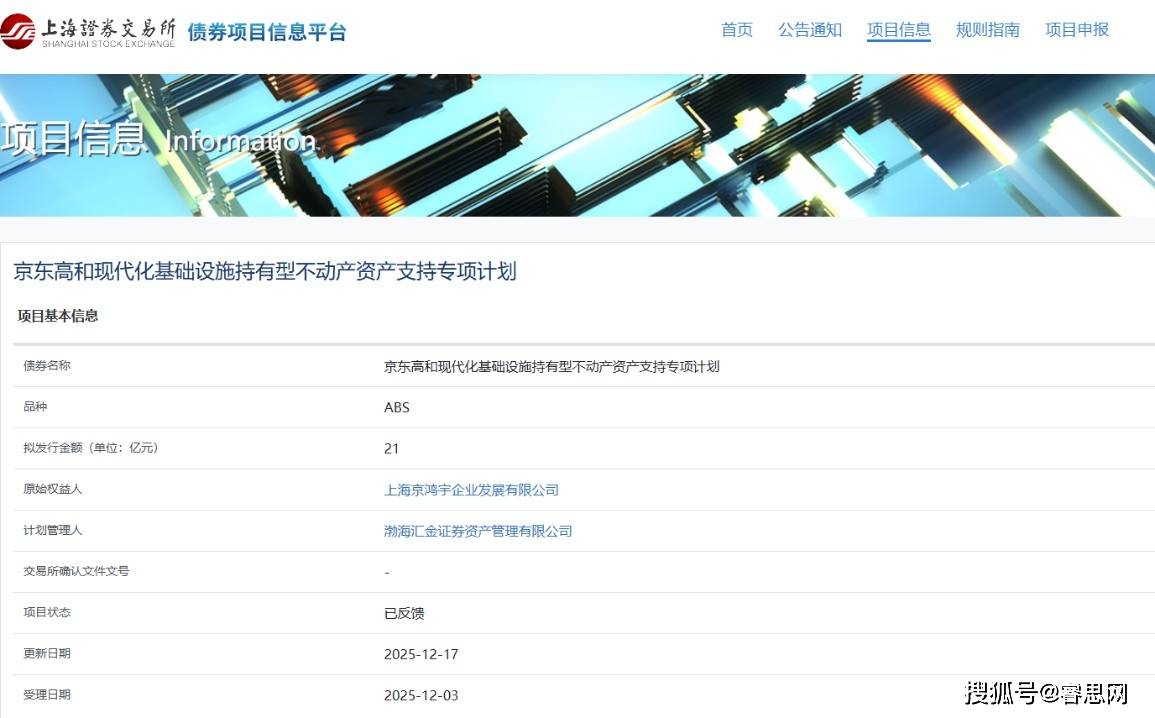
Group 1 - JD.com is advancing in the real estate securitization sector with the "JD High and Modern Infrastructure Holding Real Estate Asset-Backed Securities Plan," which is currently in the review process with a proposed issuance amount of 2.1 billion yuan [1][2] - This initiative follows JD.com's first public REIT issuance in February 2023 and marks a shift from public REITs to private placements, driven by policy guidance and the need to revitalize existing assets [1][3] - The original rights holder for the project is Shanghai Jinghongyu Enterprise Development Co., Ltd., with the actual controller being Liu Qiangdong [1][2] Group 2 - The project introduces a dual structure of "private equity fund + ABS," providing a more flexible operational path for asset revitalization [1] - As of early December 2025, the Shanghai Stock Exchange has received 50 applications for inter-institutional REITs, with a total application scale nearing 120 billion yuan and 20 projects successfully issued, totaling over 45 billion yuan [2] - The rise of inter-institutional REITs is seen as a response to the demand for asset revitalization and capital structure optimization from enterprises [3] Group 3 - JD.com’s application for inter-institutional REITs is part of a broader strategy by JD Industrial Development Group to manage its core asset operations and address funding pressures [4] - Since its independent operation began in 2018, JD Industrial Development has expanded its modern infrastructure assets to over 280, managing a total area of over 27 million square meters and an asset management scale exceeding 120 billion yuan [4] - The company faced significant cash flow challenges, with net cash used in investment activities reaching 34.5 billion yuan from 2020 to 2022, while cash generated from operations was only about 3 billion yuan [4] Group 4 - The planned IPO for JD Industrial Development was postponed due to unfavorable market conditions and challenges related to its heavy asset investment model [4] - Private equity funds and asset securitization have become key strategies for JD Industrial Development to alleviate funding pressures, with seven private equity funds established since 2019 [5] - The successful issuance of JD.com’s first public REIT in 2023 included logistics parks in Langfang, Wuhan, and Chongqing, totaling approximately 351,000 square meters [6]
普洛斯中国,选定港股IPO了?
Sou Hu Cai Jing· 2025-12-22 04:05
Core Viewpoint - GLP China is moving forward with its IPO plans in Hong Kong, potentially becoming one of the largest real estate and logistics infrastructure IPOs in Asia for 2026, with an estimated valuation around 200 billion RMB [3][4][7]. Group 1: IPO Details - GLP has selected a group of top international investment banks for its IPO, including Citigroup, Deutsche Bank, Jefferies, and Morgan Stanley, with the IPO expected in the first half of 2026 [4]. - The public offering is anticipated to raise between 3 to 5 billion USD, corresponding to a valuation range of approximately 25 to 30 billion USD (around 200 billion RMB) [6]. - If the upper limit of the valuation is achieved (over 210 billion RMB), it would rank among the top five new listings on the Hong Kong stock exchange in the past five years [7]. Group 2: Business Operations - The core asset package for the IPO will focus on GLP's operations in China, which includes around 450 logistics and industrial parks across 70 regional markets, with an operational area exceeding 55 million square meters and an occupancy rate between 83% and 90% [8]. - For the first three quarters of 2024, GLP reported revenues of 8.17 billion USD, an EBITDA of approximately 1.22 billion USD, and operating cash flow of 390 million USD, indicating a solid short-term liquidity position [8]. - GLP is also integrating data centers and renewable energy into its business model, with a total IT load of about 1,400 megawatts and solar installations generating 2 gigawatts of power, aligning with ESG funding trends [9]. Group 3: Historical Context - GLP China, originally part of ProLogis, had its first IPO in Singapore in 2010, raising approximately 3 billion USD, which was the largest real estate IPO at that time [13]. - After being privatized in 2018 by a consortium led by Hillhouse Capital, Vanke, and others, GLP has since adopted a dual strategy of mature park injection into REITs and maintaining a robust asset management approach [14]. - The potential IPO could signify a doubling of GLP's valuation since its privatization, providing substantial returns for its private equity investors [14].

南山控股(002314.SZ)控股子公司筹划华泰宝湾物流REIT新购入基础设施项目
智通财经网· 2025-12-15 09:12
Core Viewpoint - Nanshan Holdings (002314.SZ) announced that its subsidiary, Baowan Logistics Holdings Co., Ltd., is planning to develop new infrastructure projects for the Huatai Baowan Logistics REIT [1] Group 1: Infrastructure Projects - The infrastructure projects include the Chengdu Longquan Baowan International Logistics Center located at 999 Qichecheng Avenue, Chengdu Economic and Technological Development Zone, Sichuan Province [1] - Another project is the Xi'an Baowan International Logistics Center located at 289 Wufu Road, Modern Logistics Park, Lintong District, Xi'an, Shaanxi Province [1] - The Ningbo Baowan International Logistics Center is situated at 188 Hengfa Road, Fangqiao Street, Fenghua District, Ningbo City, Zhejiang Province [1] - The Qingdao Jiaozhou Baowan International Logistics Center is located at 1 Wuliu Avenue, Jiaozhou City, Qingdao [1]

在数千家企业中,寻找穿越周期的商业力量
Jing Ji Guan Cha Wang· 2025-11-26 14:45
Core Insights - The conference highlighted the importance of respected enterprises in driving China's economic growth and social progress, emphasizing innovation and long-term value creation [1][2][8] Group 1: Respected Enterprises - The "2024-2025 Respected Enterprises" and "Respected Leading Enterprises" were recognized based on extensive research across thousands of companies and key industries, focusing on operational quality, innovation, public trust, social contribution, and annual impact [1] - Notable companies recognized include Anta, BYD, Huawei, JD.com, Meituan, Qingdao Beer, Ping An, and China Feihe, among others [1] - The event underscored that respected enterprises must address social pain points and create social value while maintaining economic contributions [2] Group 2: Innovation and Quality - High-quality products and services are fundamental to the reputation of respected enterprises, reflecting the innovation management capabilities and ethical standards of their leaders [3] - The need for a supportive environment that encourages innovation and tolerates failure was emphasized, alongside the importance of strategic investments and a stable macro policy [3] - The role of AI in transforming the financial industry was discussed, with a focus on integrating AI technologies to enhance customer service and operational efficiency [4] Group 3: Market Dynamics and Compliance - Antitrust compliance is seen as a catalyst for improving product quality and advancing industries towards higher standards, countering low-quality competition [5][6] - The implementation of antitrust laws has effectively curtailed monopolistic practices, promoting fair competition and encouraging companies to focus on quality [6] Group 4: Future Outlook - The development of new productive forces through technological self-reliance and innovation is crucial for enterprise growth, with China's computing infrastructure being a key asset [7] - The emergence of AI and related technologies is expected to disrupt various industries, leading to new growth opportunities [7]




南山控股:华泰宝湾物流REIT自上市以来运营稳健
Zheng Quan Ri Bao Zhi Sheng· 2025-11-25 11:16
Core Viewpoint - Nanshan Holdings stated that Huatai Baowan Logistics REIT has demonstrated stable operations and excellent asset performance since its listing, serving as a positive model for the industry, and is expected to be recognized as "Outstanding Public REIT Project of the Year" in 2025 [1] Group 1 - The company emphasizes a balanced approach in its operations, focusing on enhancing its asset management capabilities across the entire lifecycle of assets, including fundraising, investment, construction, management, and exit [1] - Future issuance of asset securitization products will be aligned with policy requirements and the specific conditions of the assets, ensuring long-term and sustainable business development [1] - The company commits to strictly adhering to relevant laws and regulations for any future plans and will ensure timely information disclosure [1]