生物质发电

Search documents
中闽能源(600163):来风偏弱限制单季业绩,着眼成长无惧短期波动
Changjiang Securities· 2025-08-31 10:15
Investment Rating - The investment rating for the company is "Buy" and is maintained [9]. Core Views - The company's performance in the second quarter was impacted by weaker wind conditions in Fujian and increased power restriction rates in regions where its external units are located, leading to a year-on-year decrease in power generation by 18.08% [2][6]. - The company reported a revenue of 280 million yuan in the second quarter, a decrease of 20.58% year-on-year, and a net profit attributable to shareholders of 63 million yuan, down 51.11% year-on-year [2][6]. - Despite the short-term performance pressure, the company is focused on long-term growth opportunities, including potential asset injections from the group and ongoing project developments [6][12]. Summary by Sections Financial Performance - In the first half of 2025, the company achieved a total revenue of 794 million yuan, a decrease of 2.95% year-on-year, and a net profit of 314 million yuan, down 8.07% year-on-year [6]. - The total power generation for the first half was 1.405 billion kWh, a slight decrease of 0.89% year-on-year [12]. Operational Challenges - The second quarter saw a significant drop in power generation, with Fujian's wind power output at 445 million kWh, down 18.76% year-on-year, and external units in Heilongjiang experiencing a 19.59% decrease [12]. - The company's operating costs increased by 4.27% year-on-year in the second quarter, totaling 174 million yuan, which further pressured profit margins [12]. Growth Prospects - The company is expected to benefit from future asset injections, including projects like Yongtai Pumped Storage and various offshore wind assets, which could enhance earnings per share [12]. - The company is actively pursuing both internal development and quality project acquisitions, indicating significant growth potential in the coming years [12].

宁波能源: 宁波能源2025年半年度报告
Zheng Quan Zhi Xing· 2025-08-29 18:22
Core Viewpoint - Ningbo Energy Group Co., Ltd. reported a decrease in operating income for the first half of 2025, while net profit increased, indicating a mixed performance amid operational challenges [2][3]. Financial Performance - Operating income for the first half of 2025 was CNY 1,873,613,747.51, a decrease of 11.24% compared to CNY 2,110,931,254.45 in the same period last year [2]. - Total profit increased by 28.85% to CNY 197,417,931.86 from CNY 153,218,851.42 year-on-year [2]. - Net profit attributable to shareholders rose by 13.05% to CNY 140,528,113.49 from CNY 124,307,918.46 [2]. - The net cash flow from operating activities decreased by 55.45% to CNY 243,181,237.61 from CNY 545,843,107.17 [2][3]. Key Financial Indicators - Basic earnings per share increased by 8.85% to CNY 0.1218 from CNY 0.1119 [2]. - Diluted earnings per share rose by 9.83% to CNY 0.1218 from CNY 0.1109 [2]. - The weighted average return on equity increased to 3.09% from 2.94% [2]. Business Operations - The company primarily engages in cogeneration, biomass power generation, pumped storage, and comprehensive energy services [3]. - The cogeneration segment showed good operational performance, with significant user expansion in various subsidiaries [3]. - The green energy segment demonstrated a stable upward trend, with successful completion of solar project acquisitions [3]. Strategic Initiatives - The company is focused on enhancing internal management and promoting innovation to achieve sustainable high-quality development [3]. - Investment in research and development increased by 45.25%, reflecting a commitment to technological advancement [3]. - The company has established partnerships with universities and research institutions to develop key technologies in biomass gasification and energy systems optimization [6]. Risk Management and Governance - The company has strengthened its governance structure by eliminating the supervisory board and adjusting its governance policies [7]. - A comprehensive risk management framework has been implemented to identify and mitigate significant operational risks [7].

生物质发电、油气行业重大利好!CCER第三批方法学征求意见
2 1 Shi Ji Jing Ji Bao Dao· 2025-08-20 11:37
Core Viewpoint - The third batch of CCER methodologies emphasizes the policy direction of "promoting utilization through emission reduction," introducing new methodologies for biomass power generation and oil and gas methane recovery, thus enhancing the market supply capacity of CCER projects [1][2][3] Group 1: New Methodologies - The third batch includes four methodologies: biomass grid-connected power generation, offshore oilfield associated gas recovery, onshore gas field trial gas recovery, and onshore oilfield low gas volume associated gas recovery [1][2] - The total number of CCER methodologies has reached ten since the restart of CCER [2] Group 2: Policy and Market Implications - The new methodologies aim to reduce PM2.5 pollution and carbon emissions by utilizing agricultural and forestry waste, fulfilling international commitments, and improving the profitability of high-input, low-output industries [1][3] - The methodologies are expected to enhance the market supply capacity of CCER projects, particularly in agricultural provinces like Henan and Shandong, promoting the resource utilization of agricultural waste [2][3] Group 3: Biomass Power Generation - Biomass power generation currently accounts for about 3% of renewable energy capacity but is expected to increase annually [3] - By the end of 2023, biomass power generation projects are estimated to have a total installed capacity of approximately 16.88 million kilowatts, generating an annual emission reduction of about 15 million tons [3] Group 4: Economic Viability and Challenges - The economic viability of biomass power generation projects is a core issue, with many projects facing financial challenges due to high investment costs and low internal rates of return [8][9] - The methodologies exclude projects that do not fully connect to the grid or utilize specific types of waste, focusing instead on projects that use agricultural and forestry residues [6][7] Group 5: Oil and Gas Methane Recovery - The three methodologies related to methane recovery are significant for controlling non-CO2 greenhouse gas emissions, with China aiming to achieve zero routine flaring in oil and gas extraction by 2030 [11][12] - The methodologies target different scenarios in the oil and gas sector, including offshore oilfields, onshore oilfields, and trial gas recovery from natural gas wells, each with distinct project requirements [13][14]
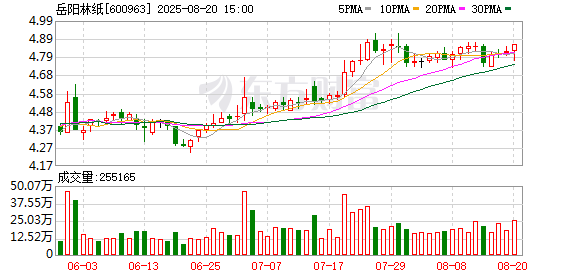
岳阳林纸碳汇业务有望迎来发展新契机
Zheng Quan Ri Bao· 2025-08-20 11:35
Group 1 - The Ministry of Ecology and Environment has released a notice for the third batch of CCER methodology, which will benefit the biomass power generation industry [2] - Yueyang Lin Paper's subsidiary, Hunan Juntai New Materials Technology Co., Ltd., has a biomass power generation project that fully complies with the new CCER methodology, enhancing the project's economic viability and promoting sustainable development in renewable energy [2] - Juntai Technology is expected to generate 540 million kWh of biomass power in 2024, becoming a key growth point for the company's revenue and cost reduction [2] Group 2 - Yueyang Lin Paper is looking to expand into international markets, leveraging its technical advantages and project experience in carbon sink development [3] - The company plans to engage in international carbon trading and project development, collaborating with advanced international enterprises to explore new pathways for carbon reduction [3] - This international expansion aims to enhance the company's competitiveness and serve as a bridge for China's carbon sink technology and standards to reach the global stage [3]


CCER机制将迎来第三批方法学
Zhong Guo Hua Gong Bao· 2025-08-20 02:09
Core Viewpoint - The Ministry of Ecology and Environment is expanding the voluntary greenhouse gas emission reduction methodologies to include biomass energy utilization and methane reduction in the oil and gas industry, indicating a shift towards more specialized and refined emission reduction mechanisms in China [2][3]. Group 1: New Methodologies - The Ministry of Ecology and Environment has opened public consultation on four new methodologies related to biomass power generation and methane recovery from oil and gas fields [2]. - The first batch of national voluntary greenhouse gas emission reduction trading market methodologies was released in October 2023, focusing on afforestation carbon sinks and renewable energy [2]. - The second batch, released in January 2025, included methodologies for energy-saving in tunnel lighting and low-concentration gas utilization in coal mines [2]. Group 2: Focus on Methane Emission Control - Methane is the second-largest greenhouse gas after carbon dioxide, and the new control plan emphasizes the comprehensive utilization of methane and the management of methane emissions from oil and gas fields [3]. - The third batch of methodologies aims to address "hard-to-reduce" sectors, enhancing the economic viability of methane recovery for oil and gas companies [3]. - The implementation of these new methodologies is expected to provide a clear pathway for biomass power projects to participate in the carbon market [3].
强泰环保发盈喜,预期上半年除税后溢利不少于1100万港元 同比扭亏为盈
Zhi Tong Cai Jing· 2025-08-18 13:58
Core Viewpoint - Strong Tai Environmental (01395) expects to achieve a post-tax profit of no less than HKD 11 million in the first half of 2025, contrasting with a post-tax loss of approximately HKD 10.1 million for the six months ending June 30, 2024 [1] Group 1 - The anticipated profit in the first half of 2025 is primarily attributed to increased business revenue from the company's subsidiaries compared to the same period in 2024 [1] - Revenue sources include the expansion project of the wastewater treatment facility by Jiangsu Hengfa Wastewater Treatment Co., Ltd., which commenced in November 2024 [1] - Additional revenue is expected from IT services provided by PT Rimba Palma Sejahtera Lestari, particularly from the biomass power generation supply business of PT Sentosa Jaya Purnama, which is set to commence full operations by the end of July 2024 [1]
强泰环保(01395)发盈喜,预期上半年除税后溢利不少于1100万港元 同比扭亏为盈
智通财经网· 2025-08-18 13:56
Core Viewpoint - Strong Tai Environmental (01395) expects to achieve a post-tax profit of no less than 11 million HKD in the first half of 2025, following a post-tax loss of approximately 10.1 million HKD for the six months ending June 30, 2024 [1] Group 1 - The anticipated profit in the first half of 2025 is primarily attributed to increased business revenue from the company's subsidiaries compared to the same period in 2024 [1] - Revenue sources include the expansion project of the wastewater treatment facility by Rugao Hengfa Wastewater Treatment Co., Ltd., which commenced construction in November 2024 [1] - Additional revenue is expected from IT services provided by PT Rimba Palma Sejahtera Lestari, particularly from the biomass power supply business of PT Sentosa Jaya Purnama, which is set to commence full operations at the end of July 2024 [1]
环境部将通过自愿减排交易机制,推进农林生物质能源化利用
Di Yi Cai Jing· 2025-08-16 05:35
Core Insights - The article discusses the potential of pure agricultural and forestry biomass grid-connected power generation and cogeneration projects to significantly reduce carbon dioxide emissions, with current annual reductions estimated at approximately 24 million tons, potentially increasing to around 50 million tons by 2030 [1][2] Group 1: Emission Reduction Potential - Current projects can produce an annual reduction of about 24 million tons of CO2, with projections to reach approximately 50 million tons by 2030 [1] - The Ministry of Ecology and Environment is planning to support the sustainable development of this sector through a voluntary greenhouse gas emission reduction trading mechanism [1][2] Group 2: Economic Viability Challenges - The investment and operational costs for these biomass projects are high, leading to poor economic viability, with internal rates of return below the electricity industry's benchmark rate of 8% [2][4] - The methodology being developed aims to simplify the process and support the industry through voluntary emission reduction trading, addressing the economic challenges faced by these projects [2][4] Group 3: Technological Approaches - There are two main technological routes for biomass energy utilization: direct combustion for power generation and cogeneration, and pyrolysis under low or no oxygen conditions to produce combustible gases [4][5] - Over 98% of biomass power generation projects in China utilize direct combustion technology, while pyrolysis projects primarily focus on heat generation [5] Group 4: Project Methodology and Guidelines - The methodology is specifically designed for projects using agricultural and forestry residues, excluding those that involve co-firing with animal manure or fossil fuels [5][6] - The default transportation distance for biomass raw materials is set at 200 kilometers, aligning with management policy requirements and actual project conditions [6]
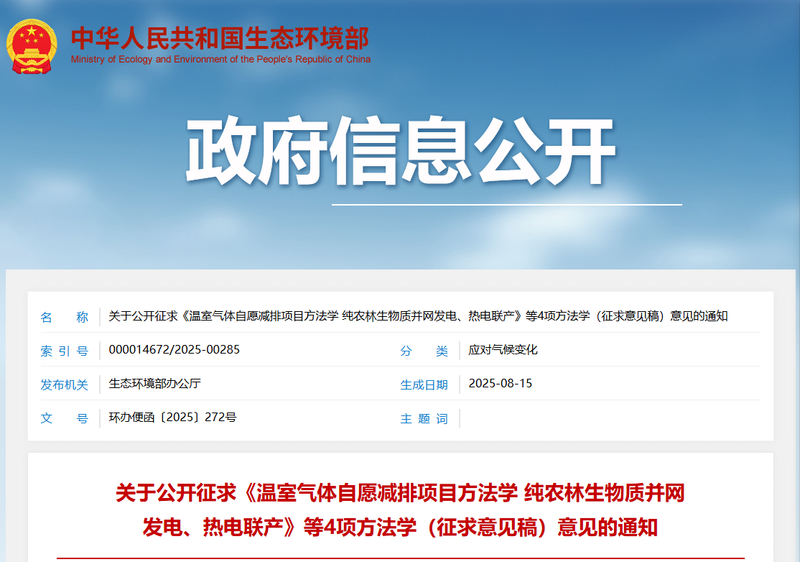
CCER即将迎来第三批方法学,瞄准生物质发电与油气伴生气回收
Xin Jing Bao· 2025-08-15 11:05
Group 1 - The third batch of CCER methodologies will expand the coverage of emission reduction projects, focusing on biomass energy utilization and methane reduction in the oil and gas industry, indicating a more refined and specialized direction for China's voluntary greenhouse gas reduction mechanism [2] - Compared to the first batch (carbon sinks, renewable energy) and the second batch (energy saving, gas utilization), the third batch of methodologies demonstrates increased technical complexity and industry specificity, reflecting the CCER mechanism's attention to "hard-to-abate" sectors [2] - The implementation of the new methodologies is expected to significantly enhance the economic viability of oil and gas companies in recovering associated gas, while also providing a clear pathway for biomass power generation projects to participate in the carbon market [2] Group 2 - The Ministry of Ecology and Environment has publicly solicited opinions on four new methodologies related to biomass grid-connected power generation, offshore oil field associated gas recovery, onshore gas field gas recovery, and onshore oil field low-volume associated gas recovery [1] - The first batch of CCER methodologies was released in October 2023, including four methodologies: afforestation carbon sinks, grid-connected solar thermal power generation, grid-connected offshore wind power generation, and mangrove restoration, which established specific requirements and processes for carbon sink project development [1] - The second batch of CCER methodologies was released on January 3, 2025, consisting of two methodologies: energy-saving in highway tunnel lighting systems and utilization of low-concentration gas from coal mines with methane volume concentration below 8% [1]
光大环境20250813
2025-08-13 14:53
Summary of the Conference Call for Guangda Environment Industry Overview - Guangda Environment operates in the waste incineration power generation sector, with a daily operational capacity of nearly 140,000 tons, leading the industry in scale [2][3] - The waste incineration power generation industry expanded rapidly from 2015 to 2020, reaching a national daily capacity of 1.1 million tons with a utilization rate of approximately 70% [2][6] Key Points and Arguments - **Financial Performance**: Guangda Environment is expected to achieve its first positive free cash flow since its listing in 2024, which may lead to an increase in dividend payout ratio [2][4] - **Capital Expenditure**: The company's capital expenditure has decreased from a peak of 20 billion to 5 billion in 2024, with further reductions anticipated, contributing to financial stability [2][6] - **Water Treatment Segment**: Guangda Water has a sewage treatment capacity exceeding 6 million tons per day, with treatment prices rising from 1.22 RMB to 1.70 RMB from 2017 to 2022. However, the collection rate has declined due to local government financial issues [2][7] - **Biomass Power Generation**: The biomass power generation projects benefit from national subsidies, with Guangdong province having allocated part of its owed funds, improving profitability [2][8] - **Accounts Receivable**: The company has high accounts receivable, primarily due to the high costs associated with biomass power generation, which relies on national subsidies. Slow reimbursement of these subsidies is a reason for the company's low valuation [2][10][11] Risks and Future Outlook - **Earnings Forecast**: The company anticipates a slight decline in mid-2025 earnings due to reduced construction revenue, impairment operations, and foreign exchange losses. However, cash flow is expected to improve [2][12] - **Asset Quality**: The company has over 10 billion in accounts receivable, with total liabilities nearing 100 billion, indicating pressure on absolute value metrics [2][10] - **Regional Distribution**: Guangda Environment's projects are concentrated in economically developed regions, with a capacity utilization rate exceeding 90%, close to 100% [2][14] Additional Insights - **International Expansion**: The company is actively expanding into overseas markets, securing two waste incineration projects in Vietnam and Uzbekistan, each with an investment of approximately 1 billion RMB [2][5] - **Government Support**: The central government has budgeted approximately 120 billion RMB for renewable energy subsidies, indicating ongoing support for the sector, although it may not fully meet all funding needs [2][20] - **Collaboration with Local Governments**: Guangda Environment is working with local governments in cities like Tianjin, Hangzhou, and Suzhou to promote collaborative projects between IDC and waste incineration, although progress may be slow [2][21]