钓具

Search documents
代工之城到品牌摇篮,威海钓具在拼多多上演「新质生产力」样本
雷峰网· 2025-09-30 10:44
Core Viewpoint - The article highlights the transformation of the Weihai fishing tackle industry from an "invisible OEM" model to a "brand breakout" model, driven by e-commerce platforms like Pinduoduo, which has enabled local manufacturers to innovate and establish their own brands while maintaining high-quality production [2][4][19]. Group 1: Industry Overview - Weihai, located on the eastern end of Shandong Peninsula, produces over 60% of the world's fishing rods, with an annual output value exceeding 10 billion yuan [2][3]. - The fishing tackle industry in Weihai has historically been characterized by a lack of branding, with many factories engaged in low-margin OEM production for international brands [2][3]. Group 2: E-commerce Impact - The entry of e-commerce, particularly Pinduoduo's "100 billion support" plan, has provided new opportunities for Weihai's fishing tackle businesses, allowing them to focus on product quality and innovation [3][4]. - Local brands like "Diao Mi" and "Chuang Wei" have successfully leveraged Pinduoduo's platform, achieving significant sales growth and brand recognition [5][7]. Group 3: Product Innovation - The rise of lure fishing among younger consumers has prompted a shift in product offerings, with a focus on high-quality, cost-effective fishing rods [10][12]. - The carbon fiber industry in China has seen a fivefold increase in production capacity from 2019 to 2023, enabling the production of lightweight and durable fishing rods at lower costs [12][13]. Group 4: Operational Efficiency - Weihai fishing tackle manufacturers are adopting process re-engineering and meticulous management to enhance operational efficiency and competitiveness [14][16]. - By categorizing products based on e-commerce logic, companies can better manage inventory and production schedules, significantly reducing lead times from 45 days to 15 days [16][17]. Group 5: Market Trends - The emergence of "small fish fishing" is reshaping the consumer demographic, attracting a broader audience, including women and children, which presents new market opportunities [18][19]. - Companies are responding by developing specialized products tailored to different fishing scenarios and consumer needs, thus redefining the fishing experience [18][19]. Group 6: Conclusion - The Weihai fishing tackle industry's evolution exemplifies the broader transformation of traditional manufacturing in China, showcasing the potential for innovation and brand creation through e-commerce platforms [19].


秋分丨钓鱼经济,“钓”动市场新活力
21世纪经济报道· 2025-09-23 04:28
Core Viewpoint - The article discusses the rising popularity of fishing among younger generations in China, highlighting its transformation into a vibrant economic sector with significant market potential and emotional appeal [1]. Group 1: Market Growth and Demographics - The fishing community in China has grown to approximately 140 million active anglers, with individuals aged 25 to 44 constituting 46% of this demographic [4][8]. - From 2018 to 2023, the number of fishing enthusiasts in China increased at a compound annual growth rate (CAGR) of 5.9% [4]. - As of September 9, there are 119,600 fishing-related enterprises in China, with 8,000 new registrations this year, indicating strong growth [4][6]. Group 2: Industry Dynamics - The fishing tackle market in China expanded from 23.4 billion yuan in 2018 to 31.8 billion yuan in 2023, achieving a CAGR of 6.3% [8]. - The market is expected to continue growing at a CAGR of 7.3% from 2023 to 2028 [8]. - The fishing equipment sector has diversified, offering products ranging from beginner kits to professional gear, catering to various fishing environments and conditions [8]. Group 3: Regional Distribution - The distribution of fishing-related enterprises in China is as follows: East China (36.68%), Central China (17.73%), North China (17.13%), South China (12.40%), Southwest (9.10%), Northwest (3.22%), and Northeast (3.74%) [6]. Group 4: Economic Impact and New Business Models - The fishing industry is evolving into a "fishing+" model, integrating various sectors such as tourism, events, and cultural experiences [12][21]. - Events like the China Shengzhong Lake International Fishing Competition have significantly boosted local economies, attracting over 400,000 tourists and generating substantial tourism revenue [16][21]. - The fishing economy encompasses diverse activities, including professional fishing, culinary experiences, competitive sports, and cultural tourism, indicating a broadening of market opportunities [21]. Group 5: Emotional and Social Aspects - Fishing has become a popular leisure activity for young people, providing a means of relaxation and emotional fulfillment amidst the pressures of urban life [18]. - The topic "The Joy of Fishing" on social media platform Xiaohongshu has garnered over 2.55 billion views, reflecting the cultural significance and community engagement surrounding fishing [18].

秋分·钓鱼经济“钓”动市场新活力|财经二十四节气
2 1 Shi Ji Jing Ji Bao Dao· 2025-09-23 01:19
Group 1 - The fishing economy is experiencing a surge in popularity among younger generations, transforming a traditionally middle-aged activity into a vibrant market opportunity [1][3] - As of September 2023, there are approximately 140 million active anglers in China, with individuals aged 25 to 44 constituting 46% of this demographic [3] - The fishing-related enterprise sector is booming, with nearly 119,600 companies registered in China, and over 8,000 new fishing-related businesses established this year alone [3] Group 2 - The fishing gear market in China has grown from 23.4 billion yuan in 2018 to 31.8 billion yuan in 2023, reflecting a compound annual growth rate (CAGR) of 6.3% [5] - The market for fishing gear is expected to continue expanding at a CAGR of 7.3% from 2023 to 2028, driven by diverse consumer demands and innovative product offerings [5] - Shandong Weihai is recognized as the "Fishing Gear Capital of China," with over 1,000 manufacturing and supporting enterprises, accounting for more than 60% of global sales in fishing rods [5] Group 3 - The fishing industry is evolving into a comprehensive consumption behavior that integrates equipment, content, and experience, moving beyond traditional perceptions [5][6] - The China Fishing Sports Association plans to host around 500 fishing competitions in 2024, attracting nearly 50,000 participants, which stimulates local economies through related industries [6] - The "Fishing+" model is emerging, combining fishing with tourism and events, enhancing economic vitality in regions like Sichuan Province, which has been designated as a national fishing city [6] Group 4 - Young people are increasingly drawn to fishing as a means of emotional and mental rejuvenation, providing a rare opportunity for relaxation and self-healing in fast-paced urban environments [8] - The topic "The Joy of Fishing" on the Xiaohongshu platform has garnered over 2.55 billion views, indicating a strong community engagement and interest in fishing experiences [9] - The fishing economy is expanding into various sectors, including professional angling, gourmet seafood, competitive sports, cultural experiences, and vacation accommodations [9]
宝藏小城何以创造“全球第一”?(“十四五”,我们见证这些“第一”⑩)
Ren Min Ri Bao Hai Wai Ban· 2025-08-19 22:55
Core Insights - The article highlights the emergence of small cities in China as global manufacturing hubs, showcasing their ability to leverage local advantages and meet international market demands. Group 1: Industry Overview - Jiangxi Province's Shangyou County hosts 195 fiberglass enterprises, generating over 15 billion yuan in sales last year, with products exported globally [2] - Jinzhong City in Shanxi Province, known as the "Capital of Glassware," produces 262,500 tons of glassware annually, exporting to over 80 countries [4] - Hunan's Linxiang is a key production area for fishing floats, supplying 80% of the national demand [6] Group 2: Notable Manufacturing Hubs - Xuchang in Henan Province is the world's largest wig distribution center, with over 4,100 wig companies and an annual export value of approximately 20 billion yuan [9] - Danyang in Jiangsu Province is the largest lens production base globally, producing over 400 million pairs of lenses annually, accounting for about 50% of global output [10][17] - Cixi in Zhejiang Province produces around 60% of the world's small home appliances, with several product categories leading in global output [10][17] Group 3: Economic Impact and Employment - The small city of Shaodong in Hunan has a booming lighter industry, achieving an output value of 14.8 billion yuan last year, with exports reaching 375 million USD [12] - Caoxian in Shandong Province has over 2,000 Hanfu enterprises, employing around 100,000 people, driven by the rising demand for traditional clothing [14] - The oral care and personal care industry in Hangji Town, Jiangsu, generates over 13 billion yuan annually, showcasing the economic potential of small towns [14] Group 4: Competitive Strategies - The article emphasizes the importance of market segmentation and digital transformation in enhancing competitiveness among small city industries [13] - Digitalization in Dawang has led to the production of over 900 million sweaters annually, with a significant portion of global supply originating from this small town [13] - The integration of local resources and global market needs has been crucial for the growth of these small city industries, allowing them to establish complete supply chains [10][11] Group 5: Global Influence - Small cities in China are reshaping the global industrial landscape, with their products influencing international pricing and standards [15] - The growth of these industries not only boosts local economies but also contributes to a more balanced urban-rural development [14][15]
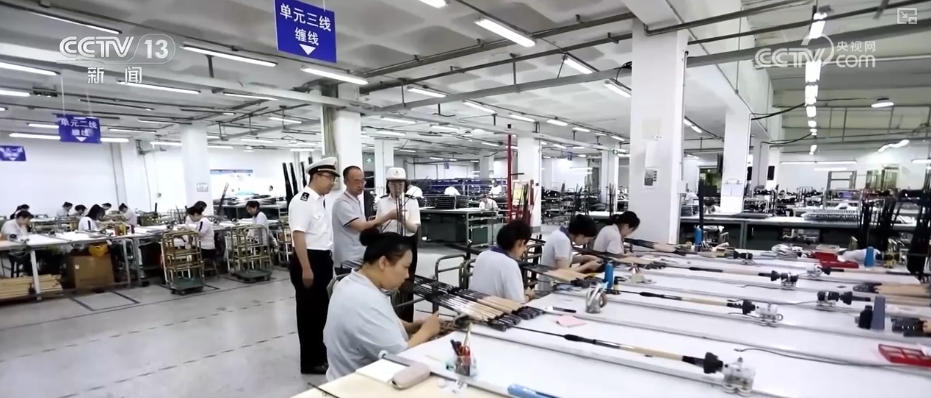
研判2025!中国钓具行业现行标准汇总、产业链图谱、市场规模、竞争格局及发展趋势分析:行业内90%以上为中小型民营企业,市场格局高度分散[图]
Chan Ye Xin Xi Wang· 2025-07-30 01:30
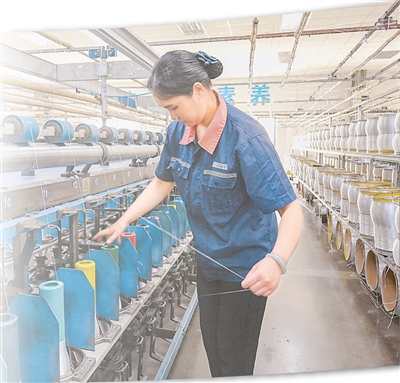
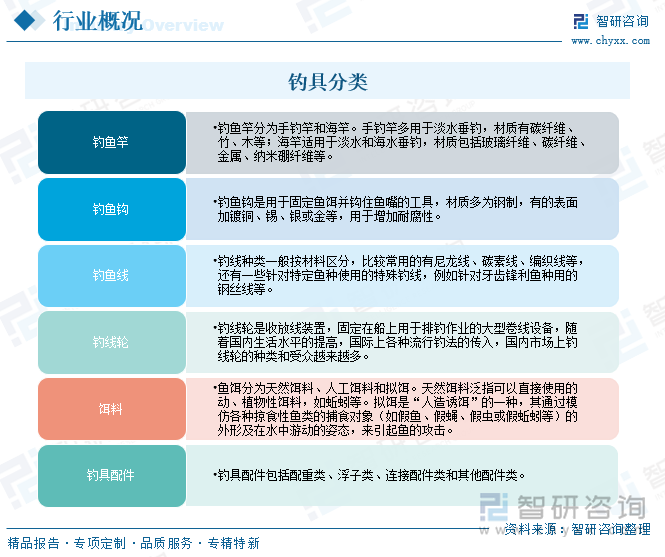
Industry Overview - The fishing tackle industry in China is experiencing growth due to rising living standards and health awareness, with fishing becoming a popular leisure activity among the youth and retirees [1][9] - The market size of the fishing tackle industry is projected to reach 31.4 billion yuan in 2024, representing a year-on-year growth of 3.0%, with fishing rods accounting for approximately 28%, fishing reels for 18%, baits for 15%, and fishing lines and hooks for 13% [1][9] Industry Chain - The upstream of the fishing tackle industry includes suppliers of raw materials such as carbon fiber, fiberglass, stainless steel, high carbon steel, plastics, rubber, and synthetic fibers, as well as component suppliers like guides, gears, and axles [5] - The midstream involves research, design, and production of fishing tackle, while the downstream consists of sales channels including specialized fishing stores, outdoor goods stores, and e-commerce platforms, targeting both recreational and competitive anglers [5] Consumer Demographics - The primary consumer demographic for fishing tackle in China is the 25-44 age group, which constitutes 46% of the market, driven by their economic capability and leisure needs [7] - Consumers aged 45 and above account for approximately 32% of the market, focusing on practicality and cost-effectiveness [7] Competitive Landscape - The fishing tackle industry in China is characterized by a low entry barrier, resulting in a large number of companies, with over 90% being small to medium-sized enterprises, leading to a highly fragmented market [12] - Notable companies include Weihai Guangwei Outdoor Equipment Co., Shandong Handing Sports Goods Co., Ningbo Haiber Group, and others, showcasing innovative products at industry events [12][14] Company Profiles - Weihai Guangwei Outdoor Equipment Co. integrates R&D, production, and sales of fishing rods, reels, baits, and related products, with an annual production capacity of 10 million fishing rods and 10 million reels [15] - Shandong Handing Sports Goods Co. has rapidly grown to become one of the most influential brands in the Chinese fishing tackle industry, maintaining a leading position in online sales and operating over 2,000 franchise stores [16] Development Trends - Future trends in the fishing tackle industry include the proliferation of smart fishing rods, electronic floats, and automatic fishing machines, which utilize sensors and IoT technology to enhance fishing efficiency [19] - There will be a focus on personalized design, such as reducing weight and improving comfort, to meet consumer demands for high-quality living [19] - Chinese fishing tackle companies are expected to emphasize brand building and international expansion, with some capable firms targeting high-end markets to compete with international brands [19]

“轻垂钓”走俏激发新消费 助力各地文旅富民
Zhong Guo Xin Wen Wang· 2025-07-24 12:09
Core Viewpoint - The rise of "light fishing" is stimulating new consumption trends and contributing to the development of local cultural and tourism industries in China [1][2]. Group 1: Market Trends - There are approximately 140 million active anglers in China, with a trend towards younger demographics and lightweight equipment [1]. - The lightweight fishing equipment market is projected to reach 9.6 billion RMB in 2024 and grow to 25.4 billion RMB by 2029 [2]. - Popularity of short-section fishing rods is evident, with over 335,000 units sold annually on platforms like Pinduoduo [2]. Group 2: Consumer Preferences - Consumers are increasingly prioritizing the portability, functionality, and lightweight nature of fishing gear [2]. - Fishing equipment featuring "dopamine colors," stylization, and DIY options are appealing to younger consumers [2]. Group 3: Economic Impact - The establishment of dedicated fishing areas in suburban and scenic locations is enhancing leisure consumption and boosting local tourism industries [2]. - For instance, the Wangguanjicun Fishing Culture Creative Industry Park in Jiangsu has created 1,100 jobs, while the international fishing competitions in Sichuan have generated over 2.8 billion RMB in tourism revenue [2]. - The Lushan Xihai Scenic Area is leveraging its rich fish resources to attract tourists, integrating fishing with other activities like hot springs and homestays [2][3].
浙江大哥卖钓鱼装备:年入5.73亿,港股上市,全球第一
3 6 Ke· 2025-07-02 12:24
Company Overview - Lexin Outdoor International Co., Ltd. is seeking to list on the Hong Kong Stock Exchange, aiming to become the "first fishing stock" in the market [2] - The company specializes in fishing equipment, including rods, reels, lines, baits, and various fishing accessories [2] - Lexin Outdoor is based in Hangzhou and is a subsidiary of Zhejiang Taipusen Holdings, the largest leisure manufacturing and export enterprise in China [2] Market Position - Lexin Outdoor is the largest fishing equipment manufacturer in China with a market share of 25.4% and the largest globally with a market share of 20.4% [3] - The company's revenue model is primarily based on OEM (Original Equipment Manufacturer), with over 90% of its revenue coming from clients like Decathlon and Pure Fishing [3][12] Financial Performance - Revenue figures for Lexin Outdoor from 2022 to the first four months of 2025 are as follows: RMB 818 million, RMB 463 million, RMB 573 million, and RMB 223 million, with a compound annual growth rate (CAGR) of -16.29% [3] - Gross profit for the same periods was approximately RMB 190 million, RMB 123 million, RMB 153 million, and RMB 47 million, with a CAGR of -10.39% [3] - Net profit figures were RMB 114 million, RMB 49 million, RMB 59 million, and RMB 20 million, with a CAGR of -27.77% [4] Industry Trends - The global fishing tackle market is projected to grow from RMB 137.8 billion in 2023 to RMB 181.9 billion by 2028, with a CAGR of 5.7% [9] - The number of fishing participants globally exceeds 200 million, with approximately 140 million in China [9] - The North American fishing tackle market is the largest, with an estimated sales figure of USD 8.78 billion in 2023 [9][10] Competitive Landscape - Shimano is the largest fishing tackle brand globally, with a market capitalization of JPY 1.8 trillion (approximately RMB 895 billion) and a revenue of JPY 105 billion (approximately RMB 52.2 billion) in 2024 [5] - Other notable competitors include Guangwei Composite Materials, which is recognized for its carbon fiber fishing rods and had a revenue of RMB 2.45 billion in 2024 [8]

山东威海钓具“钓”起百亿元产业
Zhong Guo Chan Ye Jing Ji Xin Xi Wang· 2025-06-08 22:20
Core Insights - The fishing tackle industry in Weihai, known as the "Fishing Tackle Capital of China," has over 1,000 production and supporting enterprises, employing nearly 50,000 people, with an annual output value exceeding 10 billion yuan [1][3] - Weihai's fishing tackle industry has established a complete industrial chain covering raw materials, manufacturing equipment, components, and finished products, making it a global hub for fishing tackle research and manufacturing [1][3] - Continuous innovation is a key factor driving the industry, with companies like Weihai Guangwei Outdoor Equipment Co., Ltd. focusing on personalized customization and allocating 5% of sales revenue to R&D annually [1][2] Industry Transformation - The Weihai fishing tackle industry is undergoing a "smart manufacturing revolution," transitioning from labor-intensive production to automated processes, significantly improving efficiency and product quality [2] - Automation in production has led to a 20% improvement in product quality and a reduction of labor costs by two-thirds, as demonstrated by companies like Shandong Handing Sports Goods Co., Ltd. [2] - The use of advanced technology in components, such as high-precision digital printing for fishing lures, has resulted in a 50% increase in sales volume in the first quarter compared to the same period in 2024 [2] Global Market Position - Weihai Guangwei Outdoor Equipment Co., Ltd. holds an 1/8 share of the global fishing tackle market, exporting 8.6 million fishing rods last year, with an export value growth of 18.7% [3] - The city produces 40 million fishing rods annually, accounting for over 60% of the global market share, with more than 700 local companies exporting products worldwide [3] - Weihai Customs has implemented policies to facilitate exports, resulting in a 16.9% year-on-year increase in product exports, reaching 3.54 billion yuan last year, with a 21.2% increase in the first quarter of this year [3]
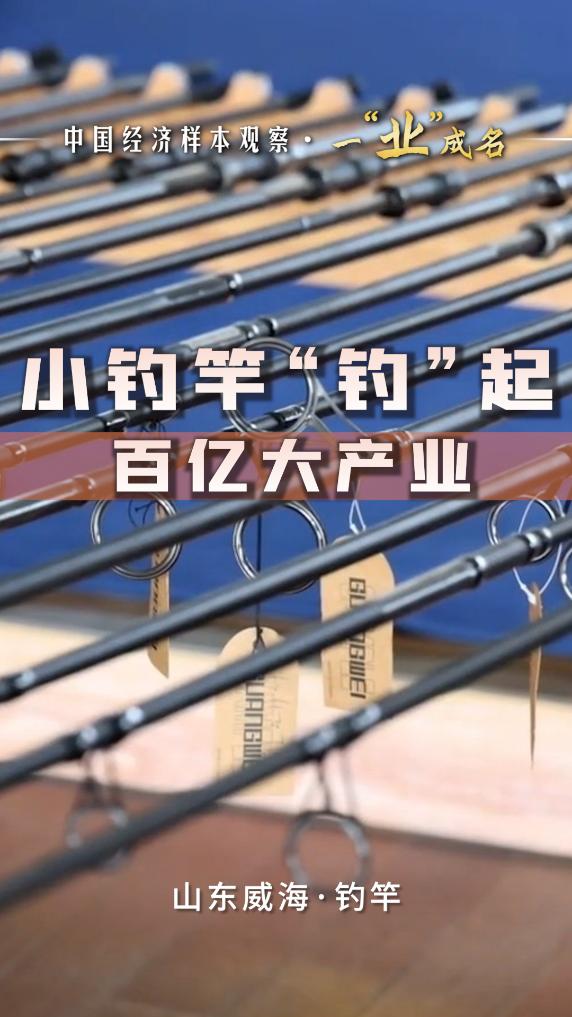
中国经济样本观察·一“业”成名|小钓竿“钓”起百亿元大产业
Xin Hua She· 2025-06-07 06:22
Core Insights - The fishing industry in Weihai, Shandong, has transformed from a niche market to a significant sector, generating over 10 billion yuan in annual output value [2][3] - Weihai is recognized as the "Fishing Tackle Capital of China," with more than 1,400 fishing tackle production and supporting enterprises, employing nearly 50,000 people [2] - The local industry has developed a complete supply chain, including raw materials, manufacturing equipment, components, and finished products, establishing itself as a global hub for fishing tackle research and manufacturing [2] Industry Development - The fishing rod industry in Weihai has evolved from simple production techniques to advanced manufacturing, with local companies now independently developing carbon fiber materials previously reliant on imports [2] - Weihai's fishing tackle brands have gained significant recognition, leading the domestic market and exporting products to over 60 countries and regions, capturing more than 60% of the global fishing rod market share [3] - Continuous innovation in product design, such as lightweight and balanced fishing rods, has contributed to the industry's growth and competitiveness [2]
坚实制造业基础推动进出口持续增长 外贸企业以“新”为“帆”加速“出海”
Yang Shi Wang· 2025-05-23 02:24
Group 1 - The Yellow River Basin's import and export volume reached 2.05 trillion yuan in the first four months of 2025, marking an 8.8% year-on-year increase [1] - Shandong province, a major foreign trade province in the basin, exported agricultural products worth 53.07 billion yuan, maintaining its position as the top exporter of agricultural products in the country [1] - The manufacturing base in Shandong, including various industrial clusters such as marine engineering equipment and smart home appliances, has significantly contributed to the growth of imports and exports [1] Group 2 - The fishing tackle industry in Weihai, Shandong, is notable for its scale, with nearly 5,000 companies capturing 60% of the global fishing rod market share [4] - Weihai's fishing tackle enterprises exported products worth 1.38 billion yuan in the first four months of 2025, reflecting a 19.6% year-on-year growth [6] - The fishing tackle industry has developed a complete industrial chain, including fishing rods, reels, guides, and baits, enhancing the competitiveness of local companies in international markets [7] Group 3 - The high-end manufacturing sector in Jining, Shandong, has adopted a "cloud command + ground execution" model, which has reduced diesel consumption by 35% and labor costs by 40% in mining operations [10] - The export of engineering machinery and its components from Shandong reached approximately 19.19 billion yuan in the first four months of 2025, with a year-on-year growth of over 18% [10] - The Yellow River Basin's growth rate outpaced the national average by 6.4 percentage points, driven by contributions from provinces like Sichuan and significant growth in Qinghai, Gansu, and Henan [12]