Optical Communication

Search documents
未知机构:国联民生通信硅光和CPO产业趋势分析及当前的投资建议会议纪要-20260210
未知机构· 2026-02-10 02:20
Summary of Conference Call on Silicon Photonics and CPO Industry Trends Industry Overview - The conference focuses on the trends in the Silicon Photonics (SiPh) and Co-Packaged Optics (CPO) industries, particularly the advancements in CPO technology and its implications for the optical module market [1][2]. Key Points and Arguments CPO Technology Development - NVIDIA has updated its CPO switches to a 200G platform, indicating that the CPO replacement will not deepen at the 100G platform, with future penetration rates centered around 1.6T optical modules [1][2]. - By 2026, NVIDIA aims to promote CPO applications in scale-out scenarios, while scale-up replacements face higher barriers such as SerDes rates and CoWoS industry collaboration [1][2]. CPO's Impact on Optical Modules - Two high-power CW light sources can replace one 1.6T optical module. For instance, NVIDIA's Quantum switch, which has a capacity of 51.2T, originally required 72 1.6T optical modules but can now operate with only 144 CW light sources, resulting in a fourfold reduction in laser requirements [1][6]. Competitive Landscape - Lumentum and Coherent predict that pluggable optical modules will remain the main product from 2026 to 2027, covering rates of 1.6T and 3.2T. CPO's advantages will only manifest in specific scenarios, such as AI supercomputers with over 100,000 GPUs [2][3]. Optical Module Industry Fundamentals - Lumentum has initiated 6-inch wafer production for EML, quadrupling output and halving costs, which is expected to alleviate concerns regarding 1.6T optical module capacity by 2026 [2]. - Major tech companies like Amazon, Google, Microsoft, and Meta are projected to have capital expenditures of $260 billion in 2026, a 60% year-on-year increase, ensuring short-term demand for optical modules [2][11]. Investment Logic and Valuation - Leading companies like Xuchuang and Xinyi have not reached a strong consensus on profit forecasts related to 1.6T optical module deliveries, leading to attractive valuations. Signals of upstream EML capacity expansion are expected to shift market sentiment from capacity concerns to demand optimism [2][11]. CPO/OCS Technical Progress - CPO technology is advancing in scale-out scenarios, with NVIDIA's 200G platform already having products available. However, the TCO advantage of CPO is only significant in ideal scenarios with large-scale clusters [3][10]. - The scale-up scenario is seen as the core direction for CPO, but it requires advancements in 400G SerDes and CoWoS packaging, with no clear product forms currently available [3][10]. Industry Chain and Investment Strategy - Key players in the CPO/OCS industry include NVIDIA's partners such as Broadcom, Corning, and TSMC. Investment strategies should focus on core players within the industry chain [4][5]. - The investment strategy suggests focusing on confirmed targets within the CPO/OCS sector, avoiding high-risk investments, and capitalizing on market fluctuations through strategic positioning [5][7]. Market Sentiment and Future Outlook - The sentiment around CPO is currently weak, impacting the demand and long-term valuation of optical modules. However, the expected capital expenditures from leading tech companies provide a solid foundation for short-term demand [11][12]. - The market is expected to experience high volatility as new technologies progress, and investors are advised to remain cautious and strategic in their approach to CPO and optical module investments [12][13]. Additional Important Insights - Discussions around the potential use of CPO in the RubinUltra L2 layer remain speculative, with no official confirmation. If implemented, it would not affect the demand for external scale-out optical modules [8][9]. - The NPO technology is progressing rapidly, with manufacturers pushing for samples and advancements, potentially offering competitive advantages over CPO in terms of production feasibility and cost [10].

新易盛(300502.SZ):1.6T光模块已进入持续放量阶段,相关产线产能稳步释放,产能利用率高
Ge Long Hui· 2026-02-05 08:47
Core Viewpoint - The company has entered a phase of continuous growth for its 1.6T optical modules, with production capacity steadily being released and high utilization rates expected to increase revenue contribution by 2026 [1] Group 1 - The 1.6T optical module has reached a stage of sustained volume growth [1] - Production lines for the 1.6T optical modules are steadily releasing capacity [1] - The utilization rate of production capacity is high [1] Group 2 - Revenue contribution from 1.6T optical module products is expected to further increase by 2026 [1]

紫光股份(000938.SZ):公司高度重视高速率光通信产品的研发
Ge Long Hui A P P· 2026-02-04 07:47
Core Viewpoint - The company emphasizes the importance of developing high-speed optical communication products and is focused on enhancing the performance and cost advantages of its 1.6T high-performance optical modules [1] Group 1: Product Development - The company is actively improving the performance and cost efficiency of its 1.6T high-performance optical modules [1] - Continuous efforts are being made to enhance the certification and testing system for optical modules [1] Group 2: Industry Collaboration - The company is collaborating with industry partners to promote the large-scale commercial use of LPO in intelligent computing centers and internet data centers [1]

未知机构:中信通信薄膜铌酸锂单波400G必选项受益32TCPO关注安孚天通-20260204
未知机构· 2026-02-04 01:55
Summary of Conference Call on Thin Film Lithium Niobate (TFLN) and Related Companies Industry Overview - The thin film lithium niobate (TFLN) is identified as a crucial component for achieving single-wave 400G technology, as the silicon photonics path has reached its physical limits [1] - TFLN is recognized for its high electro-optic coefficient and bandwidth capabilities, with laboratory tests achieving over 260Gbaud [1] Key Points on TFLN and Its Applications - The "silicon photonics + TFLN" heterogeneous integration scheme is essential for 3.2T optical modules, balancing cost control with performance enhancement [1] - TFLN is expected to see significant usage in CPO (Co-Packaged Optics) and OIO (Optical Interconnects) scenarios [1] Technical Implementation - The integration process involves slicing TFLN, using Dieto Wafer or Wafer to Wafer techniques, and bonding it to SOI (Silicon On Insulator) wafers to produce high-speed modulator chips [3] - The TFLN serves as the modulation core, while the silicon photonics part handles passive functions like routing and coupling, leveraging CMOS technology for cost efficiency [3] Company Insights Anfu Technology - Anfu Technology has a stake in Yilong Micro, which successfully completed tri-party testing of the world's first single-wave 400Gbps heterogeneous integrated chip in Q2 2025 [3] - The company is set to launch a pilot production line with an annual capacity of 500,000 chips in Q3 2025, focusing on TFLN modulator integration [3] - The expected price for a single heterogeneous integrated modulator for a 3.2T module is projected to reach $200, indicating high margins and significant market potential [3][4] Tiantong Co., Ltd. - Tiantong holds over 50% of the domestic market share for TFLN chips and serves as a supplier to companies like Anfu [4] - The value of products corresponding to each optical module is estimated to be several hundred RMB, with net profit margins exceeding 40% [4] Competitive Landscape - The thin film lithium niobate industry in China is noted for its completeness, providing a significant advantage for domestic manufacturers compared to the indium phosphide industry, which is primarily based in the US and Japan [2] Financial Outlook - Anfu's main business, Nanfu Battery, is projected to generate a profit of 1 billion RMB, contributing to a market valuation of 20 billion RMB [3][4] - The optical communication business is also expected to add another 20 billion RMB in market value [4]


中际旭创-2025 财年初步业绩(中点值)超我们预期_速评
2026-02-03 02:06
Summary of Zhongji InnoLight and Optical Transceiver Industry Conference Call Company Overview - **Company**: Zhongji InnoLight (300308.SZ) - **Sector**: Technology - **Ticker**: 300308 CH - **Current Price**: CNY 649.00 (as of January 30, 2026) - **Rating**: Buy - **Target Price**: CNY 799.00 Key Points from Zhongji InnoLight's FY25 Preliminary Results - **Earnings Guidance**: Earnings attributable to the parent company are projected to be between CNY 9.8 billion and CNY 11.8 billion, representing a year-on-year increase of 89.5% to 128.17% [1] - **Mid-Point Earnings**: The mid-point of CNY 10.8 billion exceeds the analyst's estimate of CNY 10.3 billion by 5% [1] - **Optical Transceiver Segment**: This segment is expected to generate a net profit of CNY 10.8 billion to CNY 13.1 billion, reflecting a year-on-year growth of 90.8% to 131.4% before share incentive costs [1] - **4Q25 Earnings Guidance**: Projected earnings for 4Q25 are between CNY 2.67 billion and CNY 4.67 billion, indicating a year-on-year growth of 88% to 229% and a quarter-on-quarter growth of -15% to +49% [1] - **Quarterly Growth**: The mid-point estimate of CNY 3.67 billion suggests a 17% quarter-on-quarter growth, which is 16% higher than the analyst's forecast for 4Q25 [1] - **Market Demand**: Growth is attributed to increased demand for 800G and 1.6T transceivers, with the company expected to maintain a leading market position in a supply-constrained environment [1] Industry Insights - **Adoption of 1.6T Transceivers**: The accelerated adoption of 1.6T transceivers and Silicon Photonic migration is anticipated to support sustainable growth and margin expansion for the company [2] - **Supply Chain Bottlenecks**: Potential bottlenecks in the supply chain for components like isolators and Faraday rotators may arise due to tight supply from key suppliers [2] - **Competitor Performance**: Eoptolink (300502 CH), another optical transceiver supplier, reported FY25 preliminary results with a net profit guidance of CNY 9.4 billion to CNY 9.9 billion, indicating a year-on-year increase of 231.2% to 248.9% [3] - **Market Concerns**: The re-acceleration of earnings growth in Eoptolink for 4Q25 may alleviate market concerns regarding slowing demand in the optical transceivers market [3] Financial Metrics - **Target Price Justification**: The target price of CNY 799 is based on a 35x FY26F EPS of CNY 22.8, aligning with the median P/E range of China's A/H optical communication sector [2] - **Current Valuation**: The stock is currently trading at 28.5x FY26F EPS [2] Risks - **Demand Risks**: Risks include weaker-than-expected demand for high-end optical modules in datacom and telecom markets [12] - **Competition**: Intense competition in the 400G and 800G optical modules segments may impact performance [12] - **Product Upgrade Delays**: Slower-than-expected product upgrades could hinder growth [12] - **Price Wars**: Escalated price wars may affect the company's export capabilities [12] This summary encapsulates the key insights and financial metrics from the conference call, highlighting both the company's performance and the broader industry context.

光连接专家交流-CPO-NPO-LPO-AOC技术进展-客户订单-价值量及拆分-供应商
2026-02-03 02:05
Summary of Conference Call Notes Industry Overview - The conference discusses advancements in optical connection technologies, specifically AOC (Active Optical Cable), LPO (Linear Photonic Module), and NPO (Network Photonic Module) technologies, along with customer orders and market dynamics in the optical module industry [1][2][20]. Key Points AOC Technology - AOC is primarily used for in-cabinet and scale-out first-layer network connections, with transmission distances of 30-50 meters [4]. - The industry is expected to ship approximately 10 million AOC units by 2025, with 3 million units being 800G products and 5 million units being 400G products [6]. - Pricing for AOC products: 800G AOC (30 meters) is priced above $1,000, while 400G AOC (10-30 meters) ranges from $500 to $600 [7]. LPO Technology - LPO differs from traditional optical modules by omitting the DSP (Digital Signal Processor), allowing for shared BOM (Bill of Materials) [11]. - LPO currently supports transmission distances of up to 500 meters and is primarily based on silicon photonics [11]. - Google is expected to require approximately 2 million LPO units in 2027, initially supplied by Acacia [2][13]. - The LPO market in North America is projected to reach 3-4 million units in 2027, potentially doubling by 2028 due to increased demand from other clients like Amazon and Microsoft [14]. NPO Technology - NPO is compact, low-power, and does not require DSP, making it suitable for GPU applications [22]. - NPO can be used for both Scale Up and Scale Out applications, offering lower power consumption and cost compared to traditional optical modules [29]. - Major domestic players like XunChuang and XinSheng are advancing their NPL projects, with sample deliveries expected in the first half of 2027 [30]. Market Dynamics - The market for AOC and LPO products is becoming increasingly concentrated, with established players like Coherent dominating the North American market [20]. - The transition to LPO and AOC products is not expected to significantly disrupt existing optical module companies, as the market structure is largely established [20]. Supplier Landscape - Major suppliers in North America include Acacia and NewEase, while domestic suppliers like BoChuang and TangXingSheng have significant shipments to clients like Alibaba and Tencent [10]. - Google plans to mass-produce single-mode 200G LC products by 2027 using silicon photonics technology [9]. Future Developments - The 1.6T LPM module is still in development and is expected to take another 2-3 years to mature [2][17]. - The industry is facing challenges in achieving 1.6T speeds due to the immaturity of existing technologies and the need for further breakthroughs [8]. Pricing and Cost Considerations - LPO modules are priced at approximately 60% of DSP module prices [16]. - NPO solutions are significantly cheaper than AEC (Active Electrical Cable) solutions, which have high costs and power consumption [36]. Additional Insights - The conference highlighted the importance of partnerships, with Acacia and Google having a close collaboration on LPO technology [12]. - The transition from traditional optical modules to newer technologies like LPO and NPO is expected to enhance performance while reducing costs [20]. This summary encapsulates the key insights and projections from the conference call, providing a comprehensive overview of the current state and future outlook of the optical module industry.

未知机构:天风通信AI光互联依旧坚定为最硬主线季报预告后行情更值期待-20260202
未知机构· 2026-02-02 02:05
Summary of the Conference Call Transcript Industry Overview - The focus is on the AI optical interconnection sector, which is expected to remain a strong investment theme moving forward. The companies mentioned include 易中天 (Yizhongtian), 东山 (Dongshan), 华懋 (Huamao), 剑桥 (Cambridge), and 汇绿 (Huilv) among others [1][1]. Core Insights and Arguments 1. **Performance and Order Certainty**: The optical module market is showing strong performance despite challenges such as currency exchange pressures and material shortages. Key companies are expected to report significant year-over-year growth in Q4, with projections as follows: - 旭创 (Xuchuang): +110% - 新易盛 (Xinyi): +205% - 天孚 (Tianfu): +50% - 源杰 (Yuanjie): turning a profit of 84 million - 博创 (BoChuang): +171% - 蘅东光 (Hengdong): +40% [1][1]. 2. **Industry Logic**: - **Demand Side**: The core issue remains demand, with a projected 1.5 times growth in 1.6T optical module demand in 2027 and stable growth in 800G modules. The industry is expected to maintain high visibility for growth due to these factors. - **Supply Side**: There is a tight supply of optical chips, optical fibers, and other components, leading to price increases. Companies that benefit from price hikes and have a secure supply chain are positioned favorably. - **Market Structure**: Leading companies are expected to see improved profitability as the share of silicon photonics and 1.6T modules increases. The rapid iteration of new technologies is likely to raise industry barriers and profitability, clarifying the market structure [3][3]. 3. **Market Dynamics**: - The previous concerns regarding ETFs and performance have been alleviated as key companies like 旭创 and 新易盛 exceeded expectations. This has led to renewed interest in the sector, with secondary companies also achieving new highs. - The market is shifting focus back to the undervalued optical interconnection sector, especially in light of adjustments in commercial aerospace and precious metals. - Upcoming catalysts include earnings reports from US companies in February, the NVIDIA GTC conference in March, the North American OFC exhibition in early April, and various tenders and orders [4][4]. Additional Important Points - The valuation outlook for 2027 suggests that 旭创 could see a valuation exceeding 10 times, while 新易盛 is projected at 8-9 times, indicating significant potential for earnings elasticity and valuation improvement [1][1].
涨价潮来袭!光缆行业已是“一日一价”?烽火通信:属实
2 1 Shi Ji Jing Ji Bao Dao· 2026-01-30 04:16
Core Viewpoint - The leading optical communication company, FiberHome, is experiencing price adjustments in its optical cable products due to significant fluctuations in raw material costs, leading to a "daily effective pricing" model in the industry [1] Company Summary - FiberHome's stock price was reported at 39.22 yuan per share, with a decline of 0.96% [1] - The company confirmed that the price adjustments for outdoor and indoor optical cable products are now valid only for the day of order placement, requiring re-verification for any delayed orders [1] - The optical cable business accounts for approximately 20% of FiberHome's total revenue, and the price increases are expected to have a positive impact on the company's performance, although the extent will depend on future price trends and sales volume [1] Industry Summary - The optical fiber and cable industry has begun a gradual price increase since the second half of 2025, with a more significant rise expected in January 2026 [1] - The current pricing model in the industry has shifted to a "one price per day" system, reflecting the volatility in raw material costs [1]

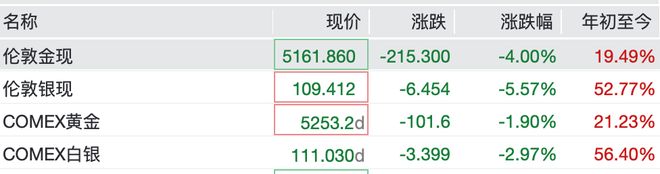
黄金跌破5200美元,加密货币集体下挫,超27万人被爆仓,美元指数反弹
2 1 Shi Ji Jing Ji Bao Dao· 2026-01-30 04:03
Market Overview - Global markets experienced volatility with major indices such as Nikkei 225, Hong Kong stocks, and US futures all showing declines [1] - A-shares showed mixed performance, with the Shanghai Composite Index regaining the 4100-point mark while the ChiNext Index rebounded after a dip [1] Commodity Performance - Precious metals and industrial metals faced significant declines, with over 20 stocks hitting the daily limit down, including Nanshan Aluminum and Tongling Nonferrous Metals [2] - International precious metals saw a sharp drop, with spot gold falling by 4% to below $5200 per ounce, and spot silver dropping over 5% [2] Specific Stock Movements - CPO and optical communication stocks surged, with LianTe Technology and Tianfu Communication rising over 11%, while Changfei Optical Fiber hit the daily limit [2] - The education sector saw gains, with China Spring rising over 64% and New Oriental increasing by over 5% [3] Cryptocurrency Market - Major cryptocurrencies continued to decline, with Bitcoin dropping over 6% to below $82,300, and Ethereum and SOL falling over 7% [4] - Over 270,000 individuals were liquidated in the cryptocurrency market, with total liquidation amounts nearing $1.7 billion [4] Dollar Index - The US dollar index rebounded, increasing by 0.44% to 96.58 [5] Geopolitical Factors - Ongoing tensions in the Middle East are impacting global markets, with reports of US President Trump planning to engage in dialogue with Iran [6] - The upcoming announcement of the next Federal Reserve Chair is also a focal point for global markets [7]

一文看懂光模块
半导体芯闻· 2026-01-29 10:10
Core Viewpoint - The article provides a comprehensive overview of optical transceiver terminology and standards, particularly focusing on the IEEE 802.3 standards that define the electrical and optical specifications for physical layer (PHY) communications. It aims to equip readers with the knowledge to understand optical transceiver product specifications like an industry expert [3][39]. Group 1: Optical Transceiver Basics - The naming convention for optical transceivers is derived from the IEEE Ethernet Working Group, which defines various standards under IEEE 802.3, including the upcoming 802.3dj standard that will support data rates of 200 Gbps to 1.6 Tbps [3][4]. - The optical interconnect definition typically follows a format that includes connector size, base speed, transmission distance, channel count, modulation scheme, multiplexing method, fiber mode, and additional information [3][4]. Group 2: Form Factors and Data Rates - The first part of the product name indicates the size specification of the pluggable connector, with QSFP representing a quad-channel small form-factor pluggable connector widely used in 400G networks [4][6]. - The maximum data rates for various form factors are outlined, with QSFP-DD supporting up to 400 Gbps and OSFP supporting up to 800 Gbps, indicating a trend towards higher data rates in optical communications [8][9]. Group 3: Effective Distance and Parallel Channels - Optical communication technologies are categorized into nine distance levels, from very short range (VSR) to long-distance (ZR), with the effective distance influenced by data rate, modulation method, and fiber quality [12][14]. - The example product operates with four parallel optical connections to achieve a total bandwidth of 400 Gbps, meaning each channel runs at 100 Gbps [15]. Group 4: Multiplexing and Modulation Schemes - Multiplexing methods, such as CWDM4, allow data from independent parallel channels to be combined into a single aggregated connection, enhancing bandwidth efficiency [18][20]. - Modulation schemes, including PAM4, are essential for converting electrical signals into optical signals, especially at higher data rates where signal distortion becomes a concern [21][24]. Group 5: Fiber Modes and Additional Information - Two main types of fiber are used in optical networks: single-mode fiber (SMF) and multi-mode fiber (MMF), with SMF being more suitable for long-distance and high-speed applications [31][36]. - Additional information in optical transceiver specifications may include reach, connector types, and the need for digital signal processing (DSP) to maintain signal integrity over longer distances [37][39].