医药研发

Search documents
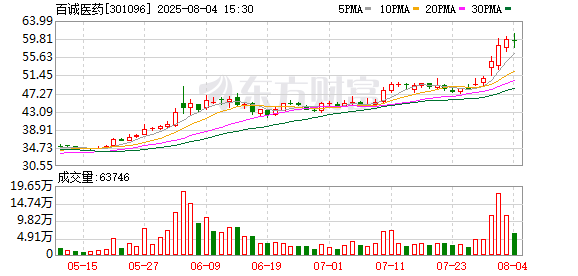
百诚医药: 国金证券股份有限公司关于杭州百诚医药科技股份有限公司部分超募资金永久补充流动资金的核查意见
Zheng Quan Zhi Xing· 2025-08-04 16:22
一、募集资金的情况 经中国证券监督管理委员会《关于同意杭州百诚医药科技股份有限公司首次 公开发行股票注册的批复》(证监许可[2021]3566 号)核准,公司首次公开发行 人民币普通股(A 股)股票 27,041,667 股,每股面值 1 元,每股发行价格为人民 币 79.60 元,募集资金总额为人民币 2,152,516,693.20 元,扣除本次发行费用人 民币 289,086,604.79 元后,实际募集资金净额为人民币 1,863,430,088.41 元。募 集资金已于 2021 年 12 月 15 日划至公司指定账户。 经天健会计师事务所(特殊普通合伙)审验并出具"天健验[2021]738 号" 《验资报告》。公司已开设了募集资金专项账户,对募集资金采取了专户存储, 并与开户银行、保荐机构签订了《募集资金三方监管协议》。 国金证券股份有限公司 关于杭州百诚医药科技股份有限公司 部分超募资金永久补充流动资金的核查意见 国金证券股份有限公司(以下简称"保荐机构")为杭州百诚医药科技股份 有限公司(以下简称"百诚医药"或"公司")首次公开发行股票并在创业板上 市的保荐机构,根据《证券发行上市保荐业务管理 ...

百诚医药:第四届董事会第三次会议决议公告
Zheng Quan Ri Bao· 2025-08-04 14:07
(文章来源:证券日报) 证券日报网讯 8月4日晚间,百诚医药发布公告称,公司第四届董事会第三次会议审议通过了《关于部 分超募资金永久补充流动资金的议案》《关于提请召开2025年第二次临时股东大会的议案》。 ...

机械设备板块走高,医药股回调
Zhong Guo Ji Jin Bao· 2025-08-04 05:16
【导读】机械设备板块走高,医药股回调 中国基金报记者 晨曦 大家好!来一起关注上午的市场行情和最新资讯~ 8月4日上午,A股市场走势分化,沪指盘中拉升翻红。截至午间收盘,上证指数涨0.2%,深证成指跌 0.28%,创业板指跌0.49%。 | more of 3567.02 | 10960.75 | more in | 2311.27 | House | | --- | --- | --- | --- | --- | | 上证指数 +0.20% | 深证成指 -0.28% | | 创业板指 -0.49% | | 全市场半日成交额为9323亿元,较上日小幅缩量;全市场近2800只个股上涨。 盘面上,航天军工、贵金属、纺织服饰、银行、机械设备等板块走高,军工信息化、黄金珠宝、工业母 机等概念股活跃;医药股回调,零售、通信、教育等板块不振。 | | | Wind热门概念指数 | | | --- | --- | --- | --- | | 军工信息化 3.70% | 商业航天 2.96% | 军民融合 2.95% | 大飞机 2.92% | | 航母 2.90% | 黄金珠宝 2.66% | 培育钻石 2.33% | ...

利好突袭,涨停!
Zhong Guo Ji Jin Bao· 2025-08-04 05:11
Market Overview - On August 4, the A-share market showed mixed performance, with the Shanghai Composite Index rising by 0.2% while the Shenzhen Component Index and the ChiNext Index fell by 0.28% and 0.49% respectively [1] - The total trading volume for the market was 932.3 billion yuan, a slight decrease from the previous day, with nearly 2800 stocks rising [2] Sector Performance - The aerospace and military, precious metals, textile and apparel, banking, and machinery sectors performed well, with active stocks in military information technology, gold and jewelry, and industrial mother machines [3] - The Hong Kong market was positive, with the Hang Seng Index up by 0.49%, the Hang Seng China Enterprises Index up by 0.51%, and the Hang Seng Technology Index up by 0.93% [3][4] - Notable gainers in the Hong Kong market included Huahong Semiconductor, which rose over 6% [3] Machinery Sector Insights - The machinery sector saw significant gains, with stocks like Dongjie Intelligent hitting the daily limit up, and several others such as Bidetech and Shanhua Intelligent also reaching their daily limits [5] - The China Machinery Industry Federation reported that the machinery industry's export value maintained double-digit growth in the first half of the year, with exports to Belt and Road countries increasing by 23.9% and to RCEP countries by 16.7% [6][7] Gaming and Media Stocks - Gaming stocks showed positive performance, with Giant Network reaching its daily limit and Shenzhou Taiyue rising by 8% [7] - Media stocks were also active, with Jishi Media hitting the daily limit and Guangxi Media rising over 5% [7][8] Pharmaceutical Sector Decline - The pharmaceutical and biotechnology sector experienced a downturn, with stocks like Aoxiang Pharmaceutical and Saily Medical hitting the daily limit down, and others like Sinovac Biotech falling nearly 11% [9][10] Retail Sector Weakness - The retail sector faced declines, with Dalian Friendship hitting the daily limit down and other stocks like Maoye Commercial and Kairuide dropping over 6% [11] InnoTech's Market Position - InnoTech saw a significant rise in its stock price, reaching a peak of 65.6 HKD per share, up nearly 14% after announcing a partnership with NVIDIA to promote 800 VDC power architecture in AI data centers [12] - InnoTech holds a 31% market share in the global GaN power device market, maintaining its leading position, and plans to expand its monthly production capacity from 13,000 wafers to 20,000 by the end of 2025, with a long-term goal of reaching 70,000 wafers [12]

北京阳光诺和药物研究股份有限公司关于公司诉讼事项进展暨提起新诉讼的公告
Shang Hai Zheng Quan Bao· 2025-08-01 19:45
Core Viewpoint - Beijing Sunshine Nuohuo Pharmaceutical Research Co., Ltd. is currently involved in litigation with Hunan Hengsheng Pharmaceutical Co., Ltd., with the total amount in dispute reaching approximately 48 million yuan, but the company does not expect this to negatively impact its profits due to prior provisions made for bad debts [2][10]. Group 1: Litigation Details - The case is currently in the first-instance stage, with the company acting as both a counterclaim plaintiff and a new lawsuit plaintiff [2]. - The total amount involved in the litigation includes a counterclaim amount of 7,407,283.51 yuan and a new lawsuit amount of 40,670,942.46 yuan, totaling 48,078,225.97 yuan [2]. - The company has filed a counterclaim against Hengsheng Pharmaceutical, asserting that the latter has failed to pay the agreed research fees as per their contract [5][6]. Group 2: Contractual Obligations - The counterclaim is based on a technical development contract signed on March 28, 2018, where the company assisted Hengsheng in developing a drug and was to be compensated accordingly [5][6]. - The company has also initiated a new lawsuit regarding 24 other technical development contracts, citing Hengsheng's failure to pay the agreed fees [7][8]. Group 3: Financial Impact - The company has fully provisioned for bad debts related to Hengsheng's accounts receivable and contract assets, indicating that the litigation will not adversely affect current or future profits [10]. - The company will continue to monitor the litigation's progress and fulfill its disclosure obligations to investors [10].

乐普医疗参股成立华夏致远创业投资基金(北京)合伙企业(有限合伙),持股比例57.14%
Zheng Quan Zhi Xing· 2025-07-31 00:36
证券之星消息,根据天眼查APP数据整理,近日,华夏致远创业投资基金(北京)合伙企业(有限合伙)成 立,法定代表人为华夏股权投资基金管理(北京)有限公司,注册资本3500万元,经营范围包含:一般项 目:创业投资(限投资未上市企业);以私募基金从事股权投资、投资管理、资产管理等活动(须在中国证 券投资基金业协会完成登记备案后方可从事经营活动)。(除依法须经批准的项目外,凭营业执照依法自 主开展经营活动)(不得从事国家和本市产业政策禁止和限制类项目的经营活动。)。天眼查APP股权穿透 显示,该公司由乐普医疗、华夏股权投资基金管理(北京)有限公司、北京昭衍新药研究中心股份有限公 司共同持股。 数据来源:天眼查APP ...


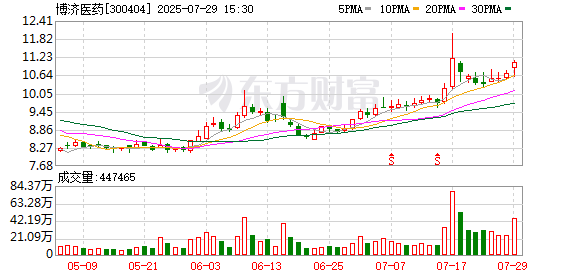
博济医药:公司有多个处于不同阶段的自研项目
Zheng Quan Ri Bao· 2025-07-29 11:39
证券日报网讯博济医药7月29日在互动平台回答投资者提问时表示,公司有多个处于不同阶段的自研项 目,该类项目由公司自主立项,拥有自主知识产权,例如用于治疗慢性心力衰竭的中药1.2类品种"CRA (原料)"及"CRA片(制剂)",目前已获得国家药品监督管理局核准签发的《药物临床试验批准通知 书》。 (文章来源:证券日报) ...

恒指收涨173点,科指连跌三日
Guodu Securities Hongkong· 2025-07-29 02:25
Group 1: Market Overview - The Hang Seng Index closed up by 173 points, or 0.7%, at 25,562, while the Tech Index fell by 0.2% to 5,664 [3][4] - The total trading volume for the day was 250.3 billion, with net inflows from northbound trading reaching 9.25 billion [3] - Hong Kong's stock market showed resilience with a rebound after a previous decline, although it did not surpass the previous week's high of 25,735 [4] Group 2: Economic Indicators - Hong Kong's exports in June increased by 11.9% year-on-year, marking the 16th consecutive month of growth, but fell short of market expectations of 16.2% [7] - Imports also rose by 11.1% in June, below the anticipated 14.7%, resulting in a tangible trade deficit of 58.9 billion, equivalent to 12.4% of the import value [7] - For the first half of the year, total export value rose by 12.5%, while import value increased by 12.6%, leading to a trade deficit of 183.6 billion [7] Group 3: Company News - WuXi AppTec reported a 95% increase in net profit for the first half of the year, with earnings reaching 8.287 billion RMB, and raised its full-year revenue outlook to between 42.5 billion and 43.5 billion RMB [13] - SameSource Health announced a placement of 92.3 million new H shares at a discount of approximately 19%, aiming to raise about 1.57 billion for R&D and operational purposes [12] - AUB Holdings is acquiring a property in Hengqin for 724.2 million RMB, which will be converted into a three-star hotel to diversify its business and attract budget-conscious travelers [14] Group 4: Industry Developments - The Ministry of Industry and Information Technology emphasized the need to consolidate the results of competition regulation in the new energy vehicle sector and enhance management of battery recycling [10] - The Hong Kong Monetary Authority is working on enhancing data infrastructure and connectivity with customs to improve loan approvals related to imports and exports [8][9]
人工智能催生药物研发和治疗新模式
Zhong Guo Zheng Quan Bao· 2025-07-28 21:05
Core Insights - Artificial intelligence (AI) is transforming the biopharmaceutical industry by enhancing drug development models and clinical treatment innovations, while also facing challenges in data, technology, and collaboration [1] Group 1: AI-Driven Innovations in Drug Development - AI is expected to evolve from a supportive tool to a collaborative partner in drug development, enabling breakthroughs in clinical diagnostics and personalized treatment plans [1][2] - AI can predict treatment effects and potential safety issues, significantly reducing the workload for safety assessments and optimizing drug administration [2] - AI's ability to analyze complex tumor microenvironments and assist in clinical decision-making represents a significant advancement in oncology [2][3] Group 2: Cost Reduction and Innovation Acceleration - AI demonstrates substantial potential in reducing innovation costs through high-fidelity data compression techniques, which can compress data by hundreds or thousands of times without quality loss [3][4] - The use of AI can accelerate innovation cycles by automating certain tasks, achieving expert-level accuracy in crystal structure analysis, and improving efficiency in neuroscience data analysis [3][4] - AI has been shown to generate innovative research ideas, simulating discussions among experts to inspire new directions in biopharmaceutical research [4] Group 3: Challenges in AI Application - The primary challenge in applying AI in biopharmaceutical research is the rapid integration of the latest AI technologies into drug development processes [5] - Issues such as structural data gaps, difficulties in data sharing, and biases in AI model results hinder effective data utilization in pharmaceutical companies [5] - Data integration remains a complex task, requiring the management of diverse data sources while addressing privacy and standardization issues [5]
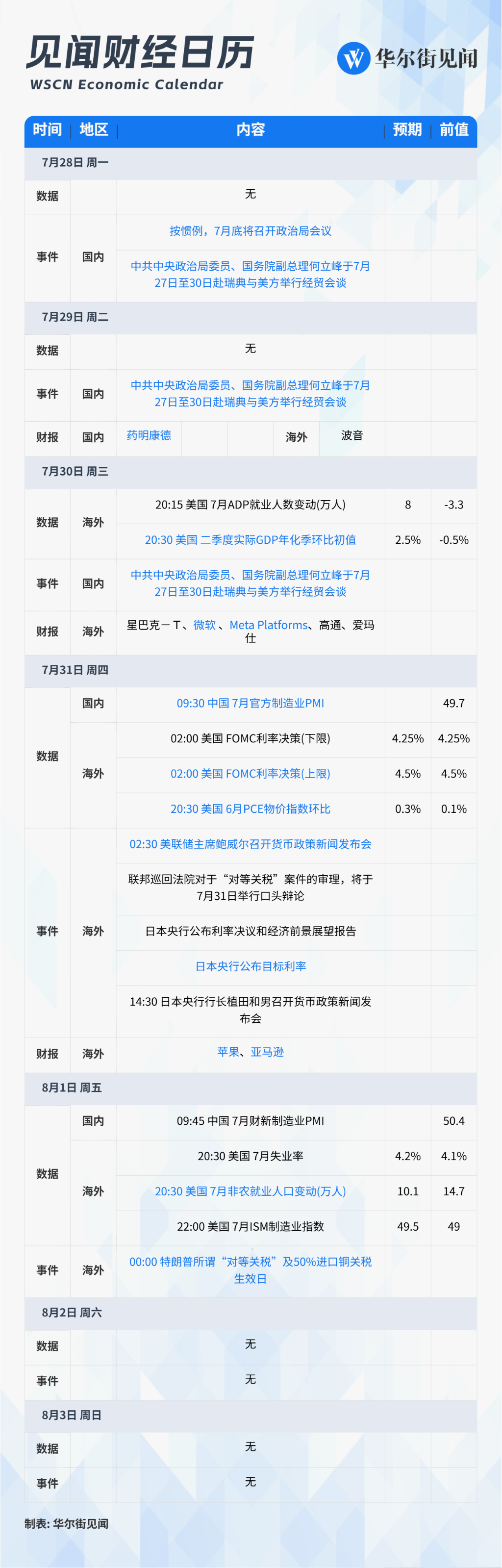
来了!中美大事扎堆的一周
Hua Er Jie Jian Wen· 2025-07-27 06:02
Group 1 - The focus of the upcoming week includes the China-US trade negotiations and the tariff deadline on August 1, which will significantly impact global trade dynamics [5][7] - The Federal Reserve's interest rate decision is highly anticipated, with a strong likelihood of maintaining current rates [15][17] - Key economic data releases include US non-farm payrolls, GDP, and PCE data, as well as China's official manufacturing PMI [5][18][22] Group 2 - Major companies reporting earnings include Microsoft, Meta, Apple, Amazon, Qualcomm, Boeing, and Starbucks, indicating a peak earnings season for US stocks [6][25] - Microsoft is expected to show strong performance driven by its AI investments and operational efficiency, with a target price of $530 [26] - Meta's Q2 revenue is projected at $44.71 billion, reflecting a 14% year-over-year increase, with a strong history of exceeding market expectations [27] - Apple is anticipated to report revenues of $90.7 billion, a 5.8% increase from the previous year, primarily due to strong iPhone sales [28] - Amazon's revenue is expected to reach $162 billion, driven by growth in AWS and retail operations [29][30] - Qualcomm is in the process of acquiring Alphawave for approximately $2.4 billion, pending regulatory approval [31] - Boeing forecasts a significant increase in earnings and revenue, with a long-term demand outlook for commercial aircraft remaining positive [32] - Starbucks is introducing free study rooms in select locations in China to boost customer traffic amid increasing competition [32] - WuXi AppTec's stock has reached a 60-day high, with strong institutional support and a focus on innovative healthcare solutions [33]