半导体材料

Search documents
露笑科技子公司8英寸导电型碳化硅衬底取得重大突破
Zheng Quan Ri Bao Zhi Sheng· 2026-01-18 12:40
Core Insights - Company LuXiao Technology has made significant breakthroughs in the research and industrialization of 8-inch conductive silicon carbide substrates, achieving advanced industry-level core technical indicators [1][2] Group 1: Technological Advancements - Hefei LuXiao Semiconductor Materials Co., Ltd. has mastered the growth process parameters for 8-inch conductive silicon carbide crystals, successfully producing high-quality crystals with stable crystal quality and controlled morphology [1] - Key parameters such as micro-pipe density, surface roughness, dislocation density, and uniformity of resistivity distribution have met or exceeded mainstream industry standards, providing a solid foundation for downstream customers to manufacture high-performance silicon carbide power devices [1] Group 2: Strategic Planning - Based on the breakthroughs in 8-inch conductive silicon carbide substrates, the company has developed a clear strategic plan, focusing on the construction of production lines for 8-inch silicon carbide substrates to meet the growing market demand in sectors like new energy vehicles, photovoltaic power generation, energy storage, and industrial control [2] - The company will continue to increase R&D investment to optimize production processes for 8-inch conductive silicon carbide, aiming to enhance product performance while reducing manufacturing costs [2] Group 3: Market and Collaboration - As the 8-inch silicon carbide substrate products mature, the company plans to engage in deep collaborations and product validations with well-known power device manufacturers and end-user clients, enhancing upstream and downstream strategic synergy [2] - Industry experts view 8-inch silicon carbide substrates as a crucial direction for the large-scale application and cost optimization of third-generation semiconductors, with the company's achievements providing strong support for domestic innovation in semiconductor materials [2]

中东局势不确定性加大,油价短期震荡偏强
Ping An Securities· 2026-01-18 12:08
Investment Rating - The report maintains a "Strong Buy" rating for the oil and petrochemical sector [1]. Core Viewpoints - The uncertainty in the Middle East has increased, leading to a short-term strong fluctuation in oil prices. WTI crude futures closed up by 1.02% and Brent oil futures by 1.87% during the week of January 9 to January 16, 2026 [6]. - Geopolitical tensions, particularly involving Iran and the U.S., are significant factors affecting oil prices. Iran's oil inventory has reached record levels, equivalent to about 50 days of production, due to Western sanctions [6]. - The fluorochemical sector is expected to maintain high prosperity due to supply quota constraints and favorable demand driven by policy support. The production quota for HFCs in 2026 has increased by 5,963 tons year-on-year [6]. Summary by Sections Oil and Petrochemical - The report highlights the increased uncertainty in the Middle East, which is likely to impact oil prices in the short term. The geopolitical situation, including U.S. sanctions and military movements, is a critical factor [6][7]. - The report notes that domestic oil companies are diversifying their oil sources and integrating upstream and downstream operations to mitigate the impact of volatile international oil prices [7]. Fluorochemical - The fluorochemical sector is experiencing a favorable environment due to supply constraints and policy-driven demand. The production quotas for HFCs have been adjusted, with significant increases in specific categories [6][7]. - The report indicates that the demand for refrigerants is expected to grow, supported by national subsidy policies, with production of household air conditioners projected to increase by 11% year-on-year in January 2026 [6]. Semiconductor Materials - The semiconductor materials sector is on an upward cycle, with improving fundamentals and domestic substitution trends. The report suggests that there is potential for further price increases in this sector [7].





工信部透露“国产光刻胶最新进展” ,2026年相关行业国产替代或大提速
仪器信息网· 2026-01-18 09:01
Core Viewpoint - The article highlights significant advancements in China's photolithography resin industry, emphasizing the reduction of reliance on foreign imports and the successful development of domestic products [1][2]. Group 1: Industry Developments - The Minister of Industry and Information Technology announced the successful development of a glass bottle for photolithography resin, which prevents contamination during transportation and storage, marking a shift from nearly 100% foreign dependency [1]. - Domestic companies have overcome 23 key technologies related to ArF photolithography resin, achieving a stable product yield of over 92% [2]. - The self-sufficiency rate of KrF photolithography resin in the domestic market is approaching 50% [2]. Group 2: Market Dynamics - The demand for photolithography resin is driven by the expansion plans of domestic wafer fabs, with an estimated consumption of about 5 tons of photolithography resin for every 10,000 12-inch wafers produced [2]. - By 2025, the domestic production capacity for 12-inch wafers is expected to reach 1.2 million pieces per month, leading to a projected demand for over 6,000 tons of photolithography resin [2]. - The market anticipates a significant acceleration in the domestic photolithography resin replacement process, with 2026 expected to be a breakout year for domestic products [2]. Group 3: Government Support - The National Integrated Circuit Industry Investment Fund's third phase has a scale of 160 billion yuan, with approximately 18% of the funds allocated to photolithography resin and semiconductor materials [1]. - Local governments, such as Shanghai, have implemented targeted subsidy policies, offering a 10% subsidy for wafer fabs purchasing domestic photolithography resin [1].


日本专家直言:中国永远造不出合格光刻胶?国产突破正在改写规则
Sou Hu Cai Jing· 2026-01-18 05:20
Core Viewpoint - The debate surrounding high-end photoresists highlights the ongoing competition between China and Japan in the semiconductor materials sector, emphasizing the importance of domestic industry discourse and technological independence [1][5]. Group 1: Market Dynamics - Japanese companies dominate over 90% of the global high-end photoresist market, with major players like Tokyo Ohka Kogyo, Shin-Etsu Chemical, JSR, and Fujifilm controlling essential materials for processes from ArF to EUV [3]. - The long-standing technological advantage of Japan in photoresist production is attributed to nearly 60 years of continuous innovation in chemical synthesis, molecular design, and process optimization [3]. - China's photoresist industry has historically faced significant challenges, with a domestic production rate of less than 5% and a complete reliance on Japanese imports for high-end materials, particularly EUV photoresists used in advanced processes [3]. Group 2: China's Response - In response to technological barriers, China has adopted a dual approach of targeted breakthroughs and systematic development, prioritizing photoresists as a key area for semiconductor material innovation [4]. - Local companies such as Nanda Optoelectronics, Rongda Photosensitive, and Tongcheng New Materials have made significant progress, achieving mass production of KrF photoresists and validating ArF photoresists for small-scale sales, with domestic production rates exceeding 30% in the KrF market and double-digit growth in the ArF market [4]. - Notably, Chinese-developed EUV photoresists have entered pilot testing, achieving international advanced levels in critical metrics such as linewidth control and sensitivity optimization [4]. Group 3: Strategic Implications - The competition over photoresists transcends mere technological rivalry, as Japan seeks to stifle China's semiconductor industry growth through material monopolization, while China aims to reconstruct a self-sufficient industrial ecosystem [5]. - Despite the existing performance gaps in stability, supply capacity, and process compatibility, China's substantial market demand, ongoing research investment, and agile engineering capabilities are gradually dismantling Japan's perceived irreplaceability [5]. - The journey from laboratory innovations to large-scale commercialization for Chinese photoresists is expected to be lengthy, requiring extensive process refinement and market validation [5]. Group 4: Future Outlook - The successful validation of Chinese photoresists on a global scale would mark a significant milestone for China's semiconductor industry, symbolizing a robust response to technological hegemony [6].
装光刻胶的瓶子,中国终于造出来了
是说芯语· 2026-01-18 04:04
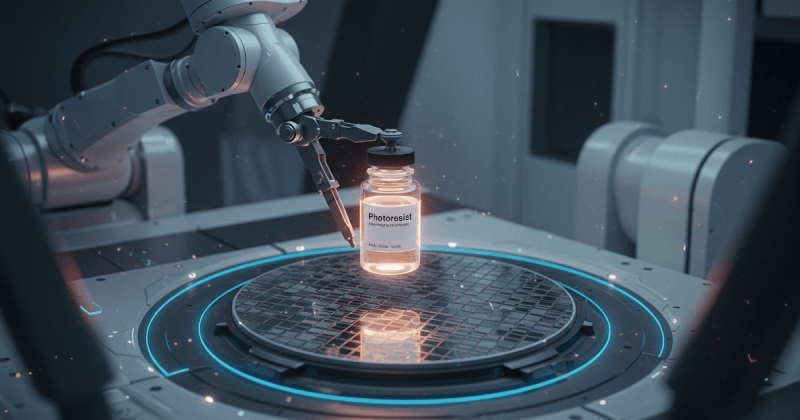
Core Viewpoint - The article discusses the successful development of specialized glass bottles for photoresist, marking the end of China's 100% reliance on imports for this technology, which is crucial for semiconductor manufacturing [6][27]. Group 1: Importance of Photoresist - Photoresist is essential for the chip manufacturing process, as it allows for the precise etching of circuit patterns onto silicon wafers [8][12]. - The characteristics of photoresist, such as high sensitivity and purity, directly influence the precision of photolithography machines [12]. Group 2: Specialized Glass Bottles - The specialized glass bottles for photoresist are designed to block UV light and maintain the chemical stability of the photoresist inside [18]. - These bottles are made from high-purity borosilicate glass, which minimizes contamination from metal ions, and feature advanced sealing mechanisms to prevent oxidation and hydrolysis [20][21]. Group 3: Challenges in Domestic Production - The production of specialized glass bottles involves high technical barriers, with the top three global manufacturers controlling 75% of the market [23]. - The market for these bottles is limited, and they are closely integrated with photoresist formulations and semiconductor manufacturing processes, creating significant entry barriers for new players [26]. Group 4: Implications of Domestic Production - The domestic production of specialized bottles resolves the issue of "having photoresist but no bottles," providing a stable return expectation for local companies [27]. - This development signifies a positive cycle for China's semiconductor industry, moving from isolated breakthroughs to systemic advancements [28].

半导体材料概念取得开门红 机构预测高增长半导体材料概念股梳理
Zheng Quan Shi Bao Wang· 2026-01-17 10:29
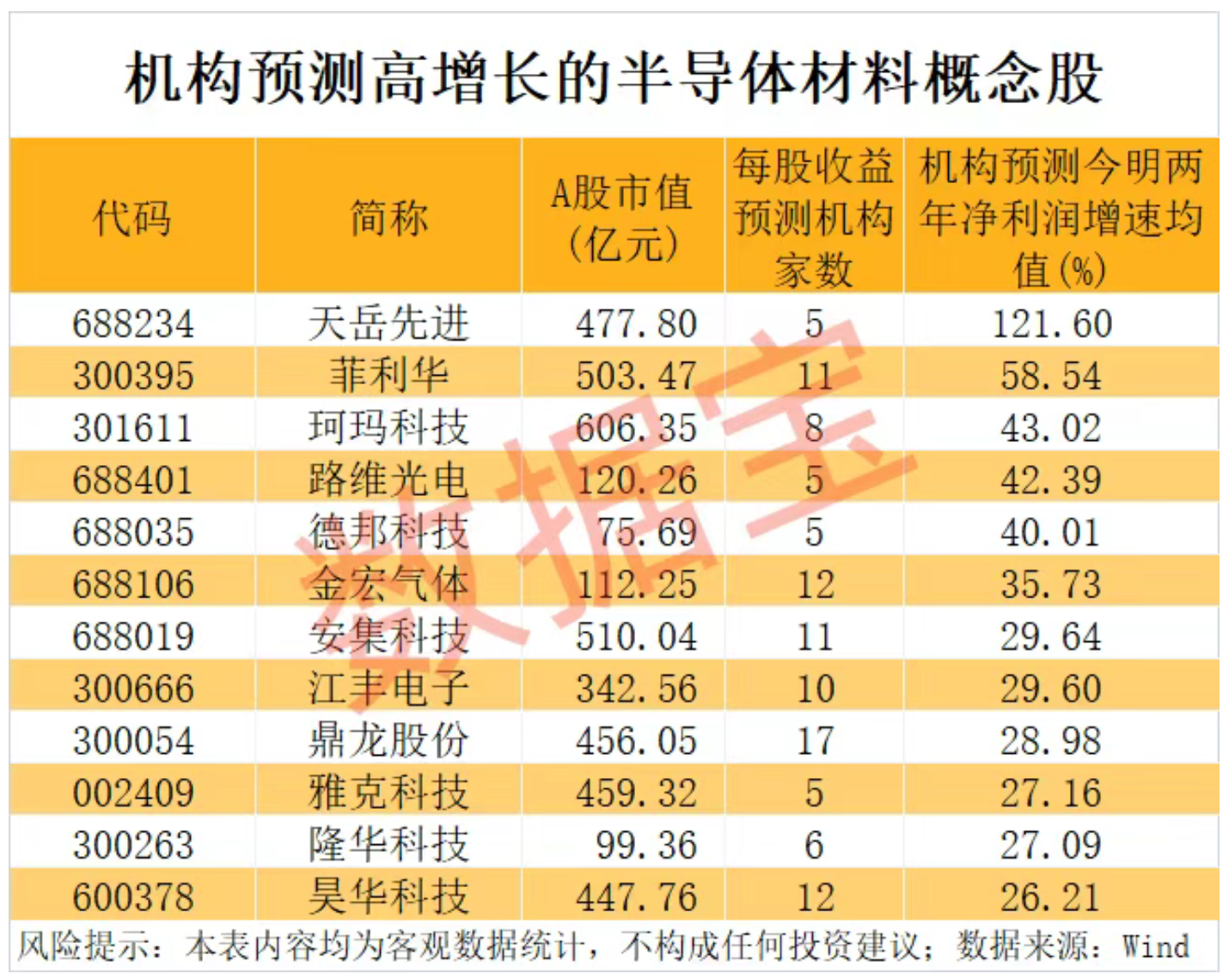
转自:证券时报 人民财讯1月17日电,半导体材料概念取得开门红。二级市场方面,2026年以来,半导体材料相关个股走势强劲。据证券时报·数据宝统计,截至1月16日收 盘,半导体材料概念股今年以来平均上涨21.15%,大幅跑赢同期上证指数、创业板指数、科创50指数等。 据数据宝统计,根据5家及以上机构一致预测,2026年、2027年净利润增速均有望超20%的半导体材料概念股有12只。 这12股当中,以1月16日收盘价与机构一致预测目标价相比,德邦科技、昊华科技上涨空间均逾10%,分别达到39.21%、10.86%。 当前正值年报业绩预告披露期,业绩成为投资者关注焦点。在AI算力、数据中心、智能驾驶等赛道加速扩张的背景下,哪些半导体材料概念股具备高增长 潜力? | | | 机构预测高增长的半导体材料材 | | | --- | --- | --- | --- | | 代码 | 简称 | A股市值 | 每股收益 村 म 预测机构 | | | | (亿元) | 家数 | | 688234 | 天岳先进 | 477.80 | 5 | | 300395 | 菲利华 | 503. 47 | 11 | | 301611 | 珂玛 ...
兴福电子:电子级磷酸等产品已供应法国、德国等欧洲国家的部分半导体客户
Zheng Quan Ri Bao Wang· 2026-01-16 15:14
证券日报网讯1月16日,兴福电子在互动平台回答投资者提问时表示,公司电子级磷酸等产品已供应法 国、德国等欧洲国家的部分半导体客户。 ...
全球市占率27%,光伏导电浆料龙头聚和材料冲刺“A+H”
Zhi Tong Cai Jing· 2026-01-16 12:45
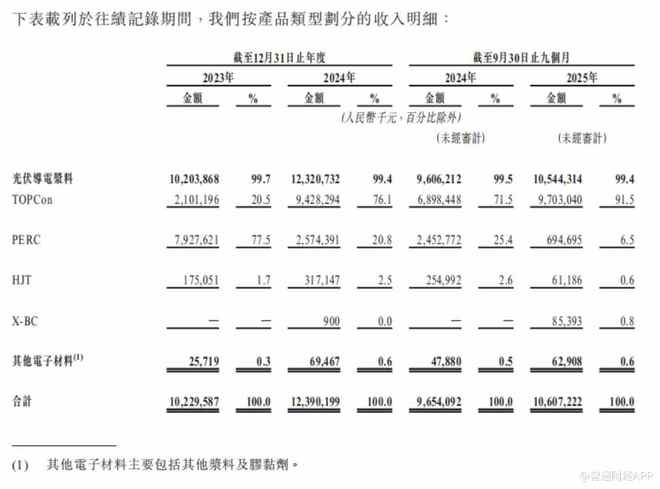
Core Viewpoint - The photovoltaic industry is undergoing a structural shift from a "silicon-centric" model to a "silver-reduction" approach, with domestic semiconductor material substitution entering a critical phase, presenting advanced material companies with opportunities for business upgrades and cross-industry breakthroughs [1] Group 1: Company Overview - Jiangsu Juhua New Materials Co., Ltd. (Juhua Materials) is a leading global manufacturer of photovoltaic conductive silver paste, established in 2015, focusing on R&D-driven advanced materials [2] - The company has developed a comprehensive product matrix covering mainstream routes such as TOPCon, PERC, HJT, and X-BC, with its TOPCon series accounting for 91.5% of revenue by September 2025 [2][3] - Juhua Materials holds the largest market share in the global photovoltaic conductive paste market at 27% as of September 30, 2025, with sales revenue ranking first among all manufacturers [2] Group 2: Financial Performance - Revenue for the fiscal years ending December 31, 2023, 2024, and the nine months ending September 30, 2025, were approximately RMB 10.23 billion, RMB 12.39 billion, and RMB 10.61 billion respectively, driven by increased demand for TOPCon paste and rising silver prices [11] - The company's gross profit margins have shown a declining trend, with margins of 9.2%, 7.8%, and 6.5% for the respective periods, while net profit margin decreased from 4.3% in 2023 to 2.2% in the nine months of 2025 [14] - Operating cash flow has been negative due to the industry's unique settlement model, with net cash flows of -RMB 2.67 billion, -RMB 0.9 billion, and -RMB 1.31 billion for the respective periods [17] Group 3: Market Potential - The global photovoltaic conductive paste market is projected to grow from RMB 14.7 billion in 2020 to RMB 50.4 billion in 2024, with a compound annual growth rate (CAGR) of 16.2% expected from 2025 to 2029 [6] - The market for blank mask plates in China is expected to reach RMB 2.9 billion in 2024 and RMB 7.6 billion by 2029, with a CAGR of 25.1% from 2025 to 2029 [8] Group 4: Strategic Initiatives - Juhua Materials is expanding into the semiconductor materials sector through strategic acquisitions, including a planned acquisition of SK Enpulse Co., Ltd.'s blank mask plate business for approximately RMB 3.45 billion [7] - The acquisition aims to enhance the company's position in the semiconductor materials market and support the national strategy for semiconductor self-sufficiency [7] - The company is also focusing on reducing silver content in its products and has achieved mass production of copper paste, which is expected to improve cost control and profitability [5][19]

新股前瞻|全球市占率27%,光伏导电浆料龙头聚和材料冲刺“A+H”
Zhi Tong Cai Jing· 2026-01-16 12:28
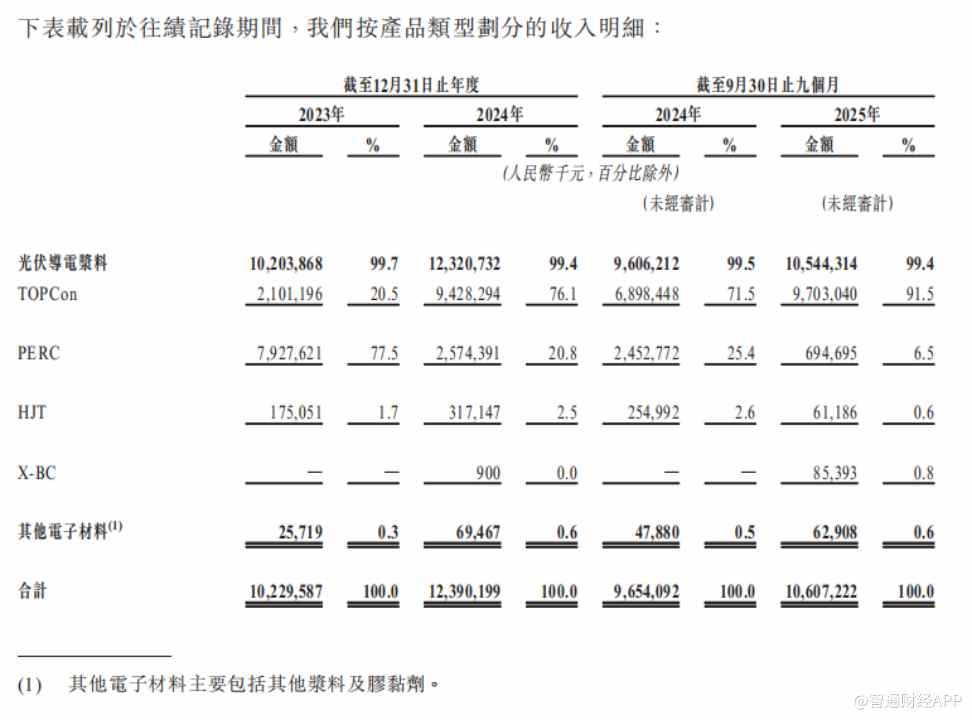
Core Viewpoint - The photovoltaic industry is undergoing a structural shift from "silicon dominance" to "silver reduction," with domestic semiconductor material substitution entering a critical phase, presenting advanced material companies with opportunities for business upgrades and cross-industry breakthroughs [1] Group 1: Company Overview - Jiangsu Juhua New Materials Co., Ltd. (Juhua Materials) submitted its listing application to the Hong Kong Stock Exchange, aiming to strengthen its photovoltaic business and accumulate resources for its semiconductor material expansion [1] - Established in 2015, Juhua Materials is a research-driven advanced materials company, primarily producing photovoltaic conductive materials and other electronic materials, with a product matrix covering all mainstream routes [2] Group 2: Market Position and Financial Performance - As of September 30, 2025, Juhua Materials ranked first globally in photovoltaic conductive paste sales, holding a market share of 27% [2] - The company's revenue for the fiscal years ending December 31, 2023, 2024, and the nine months ending September 30, 2025, were approximately RMB 10.23 billion, RMB 12.39 billion, and RMB 10.61 billion, respectively, driven by increased demand for TOPCon paste and rising silver prices [12][14] Group 3: Research and Development - Juhua Materials has a strong R&D capability, with 236 R&D personnel, accounting for 32% of its workforce, and has invested over RMB 2 billion in R&D from 2023 to September 2025 [5] - The company has developed low-silver and silver-free technologies, achieving mass production of silver-coated copper conductive paste and advancing research on ultra-low-temperature curing paste for perovskite batteries [5] Group 4: Industry Growth Potential - The global photovoltaic conductive paste market is projected to grow from RMB 14.7 billion in 2020 to RMB 50.4 billion in 2024, with a compound annual growth rate (CAGR) of 16.2% expected from 2025 to 2029 [6] - The market for blank mask plates in China is expected to reach RMB 2.9 billion in 2024 and RMB 7.6 billion by 2029, with a CAGR of 25.1% from 2025 to 2029 [9] Group 5: Strategic Expansion - Juhua Materials is expanding into the semiconductor materials sector through strategic acquisitions, including a planned acquisition of SK Enpulse's blank mask plate business for approximately RMB 3.45 billion [8] - The acquisition aims to enhance the company's position in the semiconductor materials market and support domestic production capabilities [8] Group 6: Financial Challenges - Despite steady revenue growth, the company faces profit pressure, with gross margins declining from 9.2% in 2023 to 6.5% in the nine months ending September 30, 2025, primarily due to rising silver prices and intensified industry competition [14] - The company has experienced negative cash flow from operating activities, necessitating financing through bank acceptance bills to cover working capital gaps [17]
新股前瞻|全球市占率27%,光伏导电浆料龙头聚和材料(688503.SH)冲刺“A+H”
Zhi Tong Cai Jing· 2026-01-16 12:25
Core Viewpoint - The photovoltaic industry is undergoing a structural shift from "silicon dominance" to "silver reduction," with domestic semiconductor material substitution entering a critical phase. Advanced material companies are facing dual challenges of upgrading their main business and cross-industry breakthroughs. Jiangsu Juhua New Materials Co., Ltd. (Juhua Materials) has submitted a listing application to the Hong Kong Stock Exchange to strengthen its photovoltaic business and accumulate momentum for its semiconductor material layout [1]. Group 1: Company Overview - Juhua Materials, established in 2015, is a research-driven advanced materials company focusing on photovoltaic conductive materials and other electronic materials. The company has developed a product matrix covering all mainstream routes, including TOPCon, PERC, HJT, and X-BC, aligning its product structure with industry trends [2]. - As of September 30, 2025, Juhua Materials ranked first globally in photovoltaic conductive paste sales, with a market share of 27% [2]. Group 2: Financial Performance - The company reported revenues of approximately 10.23 billion RMB, 12.39 billion RMB, and 10.61 billion RMB for the years ending December 31, 2023, 2024, and the first nine months of 2025, respectively. The growth was primarily driven by increased demand for TOPCon paste and rising silver prices [11]. - However, profit margins are under pressure, with gross margins of 9.2%, 7.8%, and 6.5% for the respective periods, and net profit margins declining from 4.3% in 2023 to 2.2% in the first nine months of 2025 [11][13]. Group 3: Market Dynamics - The global photovoltaic conductive paste market is projected to grow from 14.7 billion RMB in 2020 to 50.4 billion RMB in 2024, with an expected compound annual growth rate (CAGR) of 16.2% from 2025 to 2029. The overseas market is anticipated to expand significantly, particularly in Southeast Asia, the Middle East, and India [5]. - The market for blank mask plates in China is expected to reach 2.9 billion RMB in 2024 and grow to 7.6 billion RMB by 2029, with a CAGR of 25.1% from 2025 to 2029 [9]. Group 4: Strategic Initiatives - Juhua Materials is pursuing a dual growth strategy by expanding into the semiconductor materials sector through strategic acquisitions. The company plans to acquire the blank mask plate business from South Korea's SK Enpulse for 34.5 billion RMB, aiming to enhance its semiconductor material capabilities [7]. - The acquisition is expected to facilitate domestic production of high-end semiconductor materials and contribute to the localization of the supply chain, addressing key bottlenecks in the industry [7][8]. Group 5: Challenges and Opportunities - The company faces challenges related to cash flow and liquidity, with negative operating cash flows reported for the years 2023 to 2025. The reliance on bank acceptance bills for financing highlights the liquidity pressure [15]. - Despite these challenges, the company maintains a competitive edge through its research and development capabilities, with over 20 billion RMB invested in R&D and a strong patent portfolio [3].