Home Appliances

Search documents
GE Profile™ Unveils Game-Changing Smart Refrigerator with Kitchen Assistant™, Revolutionizing Grocery Shopping and Meal Planning
Businesswire· 2026-01-02 15:00
Core Insights - GE Profile has introduced a new 27.9 Cu. Ft. Smart 4-Door French-Door Refrigerator with Kitchen Assistant ahead of CES 2026, marking a significant innovation in kitchen appliances [1] - This refrigerator aims to transform the traditional role of a refrigerator into an intelligent hub, enhancing grocery shopping, meal planning, and reducing food waste [1] Product Features - The new refrigerator features advanced technology that assists consumers in grocery shopping and meal planning, indicating a shift towards smart home appliances [1] - The design includes four doors, which may improve accessibility and organization of food items [1]


2026国补落地群众消费热情高涨
Xin Lang Cai Jing· 2026-01-02 13:18
【#2026国补落地群众消费热情高涨#】2026年1月1日,新一轮国补与南京汽车以旧换新补贴同步启动。 数码智能产品方面,手机、平板等 4 类产品按售价 15% 补贴,单件至高 500 元,智能眼镜首次纳入补 贴;6 类 1 级能效家电同样补贴 15%,单件最高 1500 元。江苏 120 家京东系门店已全面启动国补立 减,叠加店补和签到红包,消费者购车成本进一步降低。首日销售数据显示,手机、彩电成最受欢迎单 品,消费热情高涨。国补申领流程便捷,通过建行生活 APP 或云闪付 APP 即可领取资格。汽车以旧换 新方面,报废旧车购新能源车最高补 2 万元,购燃油车最高补 1.5 万元。@南京零距离 转自:荔枝新闻 (来源:荔枝新闻) ...
国补新政来袭!这些变化影响你买单→
Xin Lang Cai Jing· 2026-01-02 04:04
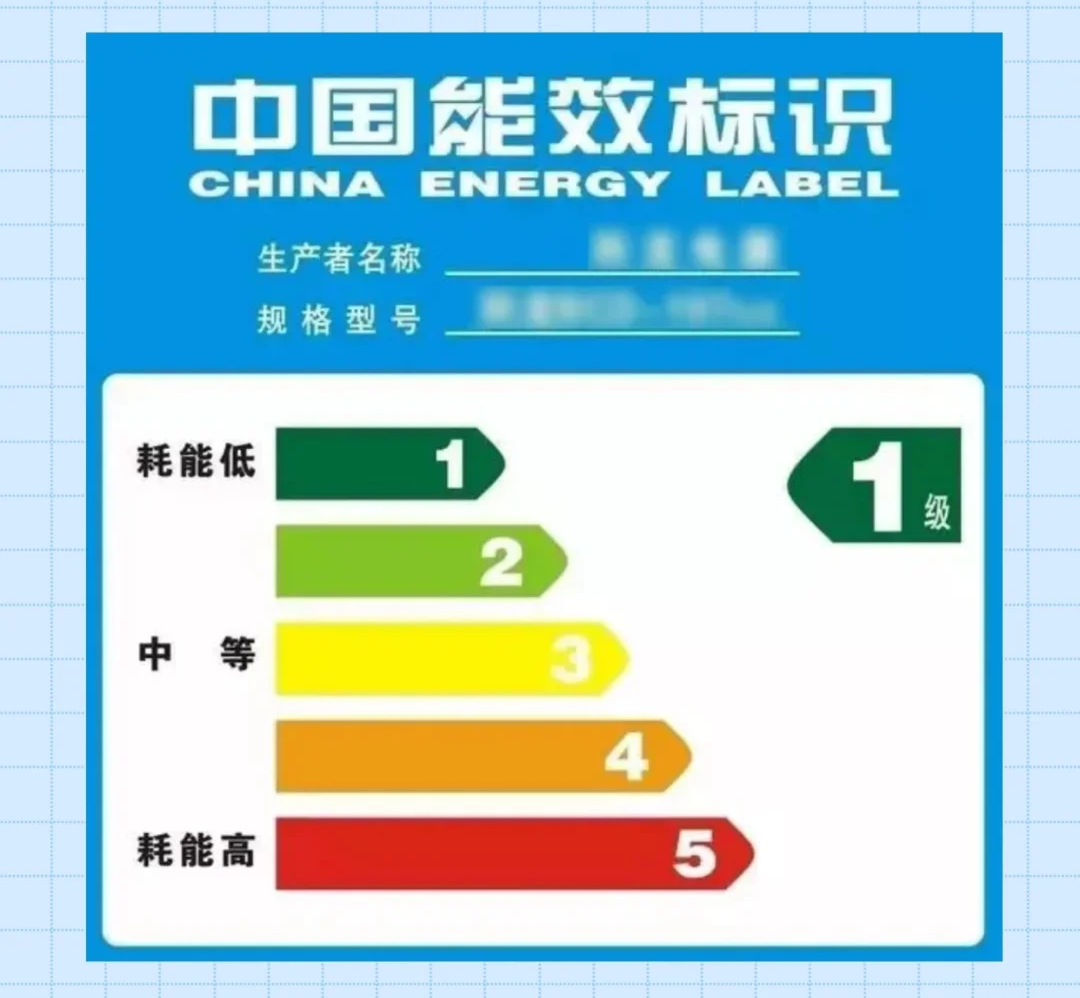
Core Viewpoint - The new round of "National Subsidy" has officially begun, with a total of 625 billion yuan allocated for 2026, focusing on consumer goods replacement and increased support for equipment updates [1]. Group 1: Digital and Smart Products - Digital and smart products will continue to receive a 15% subsidy, with a maximum of 500 yuan per item, maintaining the same standards as in 2025. The product categories have been expanded to include smart glasses alongside existing items like smartphones and smart home products [1][2]. Group 2: Home Appliances - Subsidies for home appliances will focus solely on products that meet 1st-level energy efficiency or water efficiency standards. Categories eligible for subsidies include refrigerators, washing machines, televisions, air conditioners, computers, and water heaters, with a maximum subsidy of 1500 yuan per item [3][5]. Group 3: Automotive Subsidies - The automotive subsidy program has been adjusted to provide a fixed percentage of the new car sales price as a subsidy, with a maximum of 20,000 yuan for eligible vehicles. The criteria for old vehicle registration dates have been clarified to expand the support range [5][6][7]. Group 4: Equipment Updates - The support for equipment updates will generally continue the scope established in 2025, with additional focus on areas such as old community elevator installations, equipment updates for elderly care institutions, and safety equipment [8][12]. Group 5: Application Process - Consumers can apply for subsidies through designated platforms for different product categories, including automotive and home appliances, ensuring a streamlined process for accessing the benefits [10][13]. Group 6: Fraud Prevention - The implementation of the 2026 "National Subsidy" policy will include measures to combat fraud and ensure that the subsidy benefits reach a broad consumer base, enhancing the effectiveness of the program [15].
2026年河北“国补”政策来了!
Xin Lang Cai Jing· 2026-01-01 12:37
Core Viewpoint - Hebei Province will implement a large-scale consumer goods trade-in policy in 2026 to enhance the quality of life for residents and stimulate consumption [1] Group 1: Policy Implementation - The trade-in program will officially start on January 1, 2026, and end on December 31, 2026 [1] - The program aims to meet the high-quality living needs of the public as per national directives [1] Group 2: Scope of Policy - **Automobile Scrapping and Replacement**: - Subsidies will be provided for scrapping gasoline vehicles registered before June 30, 2013, diesel vehicles before June 30, 2015, and new energy vehicles before December 31, 2019 [2] - A subsidy of 12% of the new car price (up to 20,000 yuan) for scrapping eligible old cars and purchasing new energy vehicles, and 10% (up to 15,000 yuan) for fuel vehicles with an engine size of 2.0 liters or less [2] - **Automobile Trade-in**: - Subsidies for selling personal vehicles and purchasing new energy or fuel-efficient vehicles [3] - 8% subsidy (up to 15,000 yuan) for new energy vehicles and 6% (up to 13,000 yuan) for fuel vehicles [3] - **Home Appliances Trade-in**: - Consumers purchasing energy-efficient home appliances will receive a 15% subsidy on the final sales price, capped at 1,500 yuan per item [4] - **Digital and Smart Products**: - A 15% subsidy on the final sales price for purchasing eligible digital products, capped at 500 yuan per item [4] Group 3: Funding Rules - The subsidy funds will be controlled by annual total amounts and allocated monthly, with a "first come, first served" mechanism for each month [6] Group 4: Additional Information - The specific implementation plan will be released later, and any discrepancies with national guidelines will defer to the national documents [7] - A unified consultation service platform will be established for consumer inquiries regarding the trade-in policy [8]
今起实施!2026年浙江消费品以旧换新,操作指引来了
Xin Lang Cai Jing· 2026-01-01 07:30
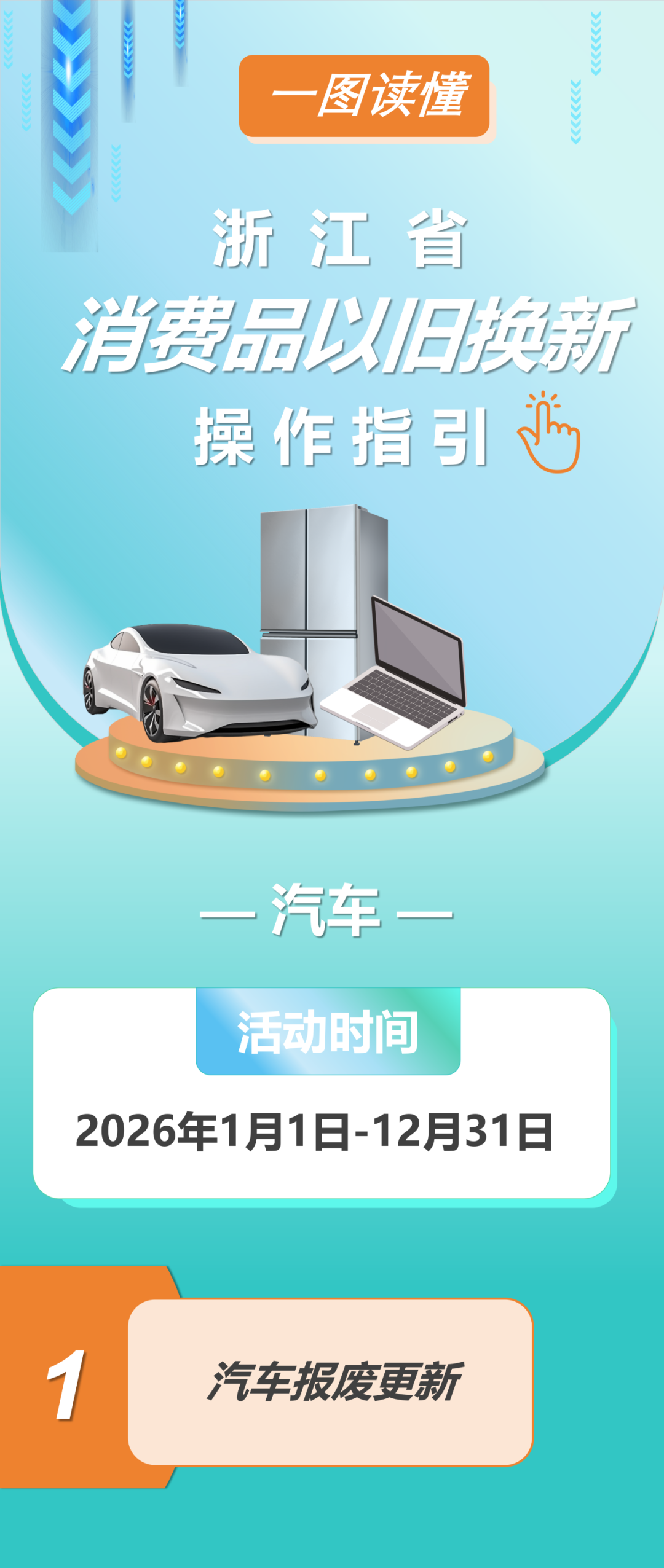
Group 1: Core Points - The Zhejiang province will implement a vehicle trade-in program from January 1, 2026, to December 31, 2026 [1][25] - The program aims to encourage consumers to replace old vehicles with new ones, providing subsidies for eligible purchases [3][18] Group 2: Subsidy Details - For scrapping and updating vehicles, personal consumers can receive a subsidy of 12% of the vehicle price, with a maximum subsidy of 20,000 yuan for new energy vehicles and 15,000 yuan for fuel vehicles [7][9][19] - The eligibility for the subsidy requires that the old vehicle must be registered in the applicant's name before January 8, 2025, and the new vehicle must be purchased within the program period [13][21] Group 3: Application Process - Consumers can apply for subsidies through platforms like Alipay and WeChat by searching for the "Zhejiang Auto Trade-in" mini-program [17][22] - Required documents for application include the scrapping certificate, vehicle deregistration certificate, sales invoice, and vehicle registration certificate, all of which must be obtained after January 1, 2026 [13][21] Group 4: Additional Consumer Products - The program also includes subsidies for household appliances such as televisions, refrigerators, washing machines, air conditioners, computers, and water heaters, with a subsidy of 15% of the actual sales price and a maximum of 1,500 yuan per item [30][31] - Consumers can participate in both online and offline activities to claim these subsidies, with specific guidelines for each method [32][43]
海尔智家(600690)重大事项点评:服务体系数字化获行业认可 经营表现延续稳健
Xin Lang Cai Jing· 2026-01-01 02:29
Core Viewpoint - Haier Smart Home has received multiple industry recognitions at the National After-Sales Service Conference, affirming its service capabilities and standardization through a digital platform that extends its offline service system online and overseas [1][2] Group 1: Service System and Operational Performance - The digitalization of the service system has been recognized by the industry, enhancing user engagement and service response efficiency, which supports channel operation quality and brand reputation [2] - In Q3 2025, the company achieved revenue of 77.56 billion yuan, a year-on-year increase of 9.51%, maintaining a growth rate of 10.2% from H1 2025 [2] - Domestic business revenue in Q3 2025 grew by 10.8%, with air conditioning revenue increasing by over 30% [2] - Market share for Haier's air conditioners, refrigerators, and washing machines increased by 3.7, -0.3, and 2.8 percentage points year-on-year, respectively [2] - The strong performance in air conditioning is attributed to high temperatures in northern China and the company's traditional market advantages, alongside operational model reforms and digital marketing efforts [2] Group 2: Profitability and Financial Performance - In Q3 2025, the net profit attributable to shareholders was 5.34 billion yuan, a year-on-year increase of 12.7% [3] - The improvement in product structure and operational efficiency in Europe positively impacted profitability [3] - The expense ratios for sales, management, R&D, and financial costs were stable, with slight year-on-year changes [3] - The gross margin for Q3 2025 was 27.9%, up by 0.1 percentage points, driven by product upgrades and supply chain optimization [3] - Operating cash flow for Q3 2025 was 6.352 billion yuan, a year-on-year increase of 0.295 billion yuan, representing 1.2 times the net profit attributable to shareholders [3] Group 3: Future Outlook and Investment Recommendations - Future growth momentum is expected to extend, with potential benefits from a recovery in the U.S. market due to anticipated interest rate cuts [3] - The company is projected to achieve double-digit profit growth in 2026, with high profitability quality supporting shareholder returns [3] - The EPS forecasts for 2025, 2026, and 2027 have been slightly adjusted to 2.29, 2.52, and 2.78 yuan, respectively, with corresponding PE ratios of 11.6, 10.5, and 9.5 times [4] - A target price of 33.8 yuan has been set, corresponding to a 13.4 times PE for 2026, maintaining a "strong buy" rating [4]

中国工业 - 消费补贴方案带来小幅积极影响-China Industrials Slightly Positive Implication From Consumption Subsidy Scheme
2025-12-31 16:02
Summary of Conference Call Notes on China Industrials Industry Overview - The conference call discusses the **China Industrials** sector, focusing on the implications of the **2026 Consumption Subsidy Scheme** announced by the National Development and Reform Commission (NDRC) [1] Key Points Consumption Subsidy Scheme - The **2026 subsidy program** has a budget of **US$8.9 billion**, significantly lower than the **Rmb300 billion (approx. US$41.8 billion)** allocated for 2025 [1] - The expected positive impact on corporate earnings for 2026 is anticipated to be less than in 2025 due to the reduced budget [1] - Major sectors covered include **home appliances, auto, digital consumer products, and upgrading equipment** [1] Specific Subsidy Details - **Digital and smart products** will be included in the 2026 scheme, offering a **15% rebate** on items like smartphones and smartwatches, capped at **Rmb 500** each [2] - For home appliances, a **15% subsidy** is available for six categories, capped at **Rmb 1,500** per item [2] - In the auto sector, scrapping old cars can yield subsidies of **12%** of the purchase price for new energy vehicles (NEVs), capped at **Rmb 20,000** [2] Equipment Upgrade Program - The equipment-upgrade program will expand to include sectors such as **elevators in old residential blocks, elderly-care facilities, and fire-and-rescue systems** [3] Company Insights Preferred Companies - **Shengyi Tech**, **Han's CNC**, **Shennan Circuit**, and **KB Laminate** are highlighted for their sales exposure and AI-related business opportunities [1] - **Hengli Hydraulic** is favored in the automation space due to potential re-rating linked to humanoid robots [1] Company Valuations and Risks - **Han's CNC**: Target price of **Rmb 140** based on a **50x 2026E P/E**, with a **98% earnings CAGR** expected for 2025-26E [7] - Risks include weaker AI PCB equipment demand and rising component costs [8] - **Hengli Hydraulic**: Target price of **Rmb 135** based on a **52x 2026E P/E** [9] - Risks include weaker demand for components and lower-than-expected gross profit margins [10] - **Kingboard Laminates Holdings**: Target price of **HK$20.5** based on a **19-20x P/E** for 2026E, reflecting potential earnings upgrades [11] - Risks include slower customer certification and macroeconomic conditions [12] - **Shengyi Technology**: Target price of **Rmb 83** based on a **44x 2026E P/E**, with a strong growth outlook due to AI-CCL revenue [13] - Risks include lower-than-expected demand for AI-CCL orders and subdued consumption [14] - **Shennan Circuit**: Target price of **Rmb 281** based on a **48x forward 2026E P/E**, with significant exposure to AI and auto segments [16] - Risks include slower-than-expected demand in the AI server market and higher laminate cost inflation [17] Additional Insights - The report emphasizes the importance of the **2026 subsidy program** in shaping the earnings outlook for various companies within the industrial sector [1][2][3] - The anticipated lower budget for the subsidy program may lead to a more cautious investment environment compared to 2025 [1] - Companies with strong positions in AI and digital products are expected to benefit more from the subsidy scheme [1][2]
中国硬件 - 2026 年新补贴政策的影响-China Hardware Implications of Newly Announced 2026 Subsidies
2025-12-31 16:02
Summary of Conference Call Notes on China Hardware Industry Industry Overview - The conference call discusses the implications of newly announced subsidies for the China hardware industry, particularly focusing on digital products, home appliances, and new energy vehicles (NEVs) [1][2]. Key Points and Arguments Digital Products - The National Development and Reform Commission (NDRC) has maintained subsidies for handsets, tablets, and smartwatches, while adding smart glasses to the list. - The maximum selling price cap for these products is set at Rmb6,000, with a maximum subsidy amount of Rmb500, which is 15% of the selling price [1][2]. Home Appliances - The number of eligible home appliance categories has been reduced from 12 to 6. - The maximum subsidy amount for home appliances is now Rmb1,500, down from Rmb2,000, with the subsidy percentage remaining at 15% of the selling price [1][2]. New Energy Vehicles (NEVs) - For NEVs, the maximum subsidy amount remains at Rmb20,000. - New caps have been introduced: 12% of the selling price for scrapping old vehicles and Rmb15,000 or 8% for vehicle replacements [1][2]. Market Sentiment - The inclusion of handset subsidies is viewed positively, alleviating investor concerns about their potential removal in 2026. - The reduction in home appliance subsidies is expected to have a limited impact on the smartphone supply chain, but overall market sentiment may improve due to the reaffirmation of subsidies and the upcoming CES 2026 event [1][2]. Additional Important Information - The report emphasizes that the changes in subsidies could influence consumer behavior and market dynamics in the hardware sector. - The analysts express a cautious optimism regarding the potential for market sentiment to bottom out, driven by the subsidy announcements and upcoming industry events [1][2].
@北京消费者,家电、数码以旧换新补贴元旦开领
Xin Lang Cai Jing· 2025-12-31 13:47
Core Viewpoint - Beijing will implement a subsidy program for the replacement of old household appliances and digital products starting January 1, 2026, aimed at encouraging consumer spending in these sectors [1]. Subsidy Details - The subsidy will apply to six categories of household appliances (refrigerators, washing machines, televisions, air conditioners, water heaters, and computers) and four categories of digital products (mobile phones, tablets, smartwatches, and smart glasses) [1][10]. - The subsidy amount will be 15% of the final sales price after discounts, with a maximum of 1,500 yuan for household appliances and 500 yuan for digital products per item [1][10]. Qualification Process - Consumers can obtain subsidy qualifications through the "Jingtong" mini-program starting at 8 AM daily, with qualifications valid for the month of issuance [1][4]. - The program allows for both online and offline redemption, with specific platforms and stores designated for each [4][12][13]. Redemption Guidelines - For online purchases, consumers must complete the qualification process in the mini-program and then use the generated code on designated e-commerce platforms [6][7]. - For offline purchases, consumers must show the qualification QR code to participating retailers for verification [7]. Additional Information - The program includes a mechanism for reissuing qualifications if they expire without use, allowing consumers to reapply [1][4][16]. - The initiative is part of a broader effort to stimulate economic activity in the consumer electronics sector [1].

2026年国补来了!1月1日起淘宝天猫开放领取使用
Xin Lang Cai Jing· 2025-12-31 05:31
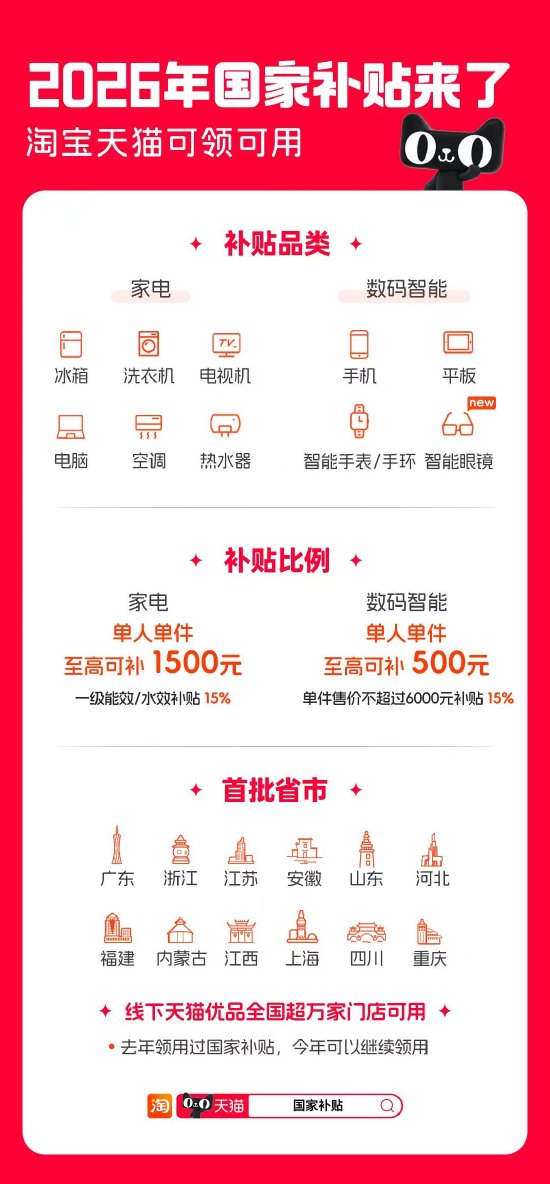
Core Viewpoint - The new round of national subsidies for 2026 is officially launched, effective from January 1, allowing consumers to claim subsidies on platforms like Taobao and Tmall, as well as in over ten thousand offline Tmall stores nationwide [1][5]. Group 1: Subsidy Details - The 2026 national subsidy covers ten categories: refrigerators, washing machines, televisions, air conditioners, computers, water heaters, mobile phones, tablets, smartwatches, and smart glasses, with smart glasses being a new addition for this year [4][7]. - The subsidy rate is set at 15%, with a maximum subsidy of 1500 yuan for energy/water-efficient home appliances and a maximum of 500 yuan for digital and smart products priced under 6000 yuan [4][7]. Group 2: Implementation and Promotions - The subsidy program is initially available in provinces such as Guangdong, Zhejiang, Jiangsu, Anhui, Fujian, Inner Mongolia, Jiangxi, Shanghai, Sichuan, Shandong, Hebei, and Chongqing, accessible through the 'National Subsidy' channel on the Taobao app [4][7]. - From January 1 to 3, Tmall will collaborate with brands like Haier, Midea, Huawei, and Siemens to host the "National Subsidy Renewal Season" event, offering additional discounts and vouchers, with household appliances available at up to 50% off [4][7]. - In 2025, over 3000 categories, more than 10,000 brands, and 500,000 products are expected to participate in the national subsidy program, attracting an average of over 150 million daily visits to the subsidy section on Taobao [4][7].