工业机器人

Search documents
构建“场景+机器人+数据+AI”闭环 拓斯达冲刺港股IPO
Zheng Quan Shi Bao Wang· 2026-01-20 02:25
Group 1 - The core viewpoint of the news is that Tuosda has submitted its IPO prospectus to the Hong Kong Stock Exchange, marking a significant step towards its public listing [1] - According to Frost & Sullivan, Tuosda ranks first in the domestic industrial robot solutions market based on the shipment volume of light-load industrial robots and light industrial robots as of the end of 2024 [1] - The company has developed a comprehensive autonomous layout in core components, robot bodies, and automation application systems, which has contributed to its leading position in the market [1] Group 2 - Tuosda is building a commercial closed loop based on the logic of "scenario + robot + data + AI" [2] - The market size for domestic industrial robot solutions is expected to reach 159.3 billion yuan by 2029, with a compound annual growth rate (CAGR) of 14.4% from 2024 to 2029 [2] - The global market for embodied intelligent robots is projected to grow from 104.3 billion yuan in 2025 to 707.5 billion yuan by 2030, with a CAGR of 46.7% [2] Group 3 - The domestic market for embodied intelligent robots is expected to reach 268.8 billion yuan by 2030, accounting for 38.0% of the global market, with a CAGR of 48.7% [2] - Tuosda is actively pursuing a globalization strategy, with its overseas sales network covering over 50 countries and regions by the third quarter of 2025 [2] - The revenue from overseas sales has increased from 11.0% to 25.0% of the company's total revenue [2]


新股前瞻|埃斯顿二次递表港交所:海外扩张“加速跑”,盈利风险何去何从?
智通财经网· 2026-01-20 02:05
Core Viewpoint - Estun, a leading Chinese industrial robotics company, is accelerating its global expansion by applying for a secondary listing in Hong Kong, aiming to leverage the AI and robotics wave for growth [2][3]. Company Overview - Estun has seen its market value increase by over 2.7 times since its A-share listing in 2015, with a current focus on becoming a global brand in robotics [3]. - The company offers a range of products including industrial robots, smart manufacturing systems, and automation core components, supported by strategic acquisitions and in-house R&D [2][3]. Market Position - According to Frost & Sullivan, Estun ranks first among domestic companies in China's industrial robot solution market and sixth globally, with market shares of 1.7% and 2.0% respectively [2]. - The company has maintained a strong presence in the industrial robotics sector, with a balanced revenue contribution from industrial robots and smart manufacturing systems [3]. Financial Performance - Estun's revenue has shown volatility over the past three years, with growth rates of 19.9%, -13.8%, and 12.87% for 2023 to 2025, while net profits fluctuated significantly [2][8]. - The company reported a gross margin decline from 32.9% in 2022 to 28.2% in 2025, primarily due to lower margins in its core business segments [8][11]. Product and Sales Dynamics - Estun's product matrix includes 96 models of general and specialized industrial robots, with sales increasing from 11,852 units in 2022 to 24,884 units in 2025 [4]. - The company has a stable order volume for its smart manufacturing systems, with a notable increase in revenue contribution from this segment [6]. Customer Base and Geographic Distribution - The majority of Estun's revenue comes from China, accounting for 70.6% in 2025, while overseas markets, primarily Germany and the USA, contribute 12.3% and 4.7% respectively [7]. - The company operates seven manufacturing bases, with plans for a new facility in Poland to meet overseas demand [7]. Industry Growth Potential - The global industrial robotics market is projected to grow at a compound annual growth rate (CAGR) of 14.6%, reaching $25.4 billion by 2024, with China expected to grow at 16.5% [12][14]. - Estun is well-positioned to benefit from this growth, leveraging its digital platform technology and AI integration in robotics [12][14]. Challenges and Risks - The company faces challenges with profitability, as its operating cash flow has been inconsistent, and it has significant goodwill and intangible asset impairment risks [9][11][15]. - Despite these challenges, Estun's direct sales model and expanding customer base provide a stable foundation for future growth [6][15].



新股前瞻|埃斯顿(002747.SZ)二次递表港交所:海外扩张“加速跑”,盈利风险何去何从?
智通财经网· 2026-01-20 01:31
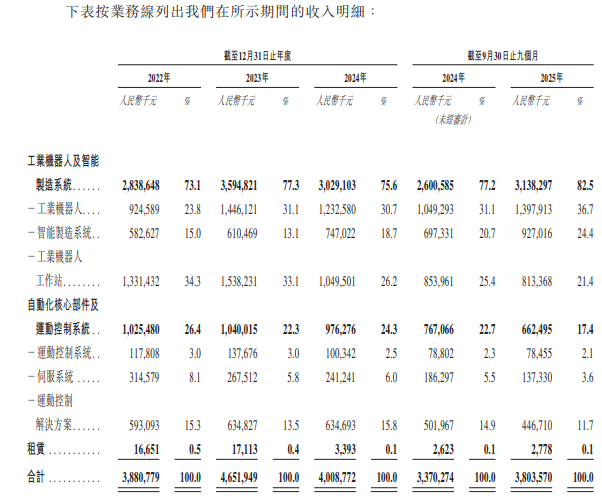
Core Viewpoint - Estun, a leading Chinese industrial robotics company, is accelerating its global expansion by applying for a secondary listing in Hong Kong, aiming to leverage the AI and robotics wave for growth [1][2]. Company Overview - Estun has seen its market value increase by over 2.7 times since its A-share listing in 2015, with a current focus on becoming a global brand in robotics [2]. - The company offers a range of products including industrial robots, smart manufacturing systems, and core automation components, supported by strategic acquisitions and in-house R&D [1][2]. Market Position - Estun ranks first among domestic companies in China's industrial robot shipment volume and sixth globally, with market shares of 1.7% and 2.0% respectively [1]. - The company has a balanced revenue contribution from its core business segments, with industrial robots and smart manufacturing systems accounting for 73.1% to 82.5% of total revenue from 2022 to 2025 [2][3]. Sales and Production - Estun's industrial robot product matrix includes 96 models, with sales increasing from 11,852 units in 2022 to 24,884 units in 2025 [3]. - The company has a strong production capacity with seven manufacturing bases, including five in China and two in Germany, and plans to open a new base in Poland by mid-2026 [7]. Financial Performance - The company's revenue has shown volatility, with growth rates of 19.9%, -13.8%, and 12.87% from 2023 to 2025, and net profits fluctuating significantly [1][8]. - Gross margins have declined from 32.9% in 2022 to 28.2% in 2025, primarily due to lower margins in industrial robots and smart manufacturing systems [8]. R&D and Innovation - Estun maintains a stable R&D investment, with 30.9% of its workforce dedicated to R&D and a portfolio of 614 patents [9]. - The company has developed advanced digital platforms and AI architectures, enhancing operational efficiency and reducing costs in manufacturing [12]. Industry Growth Potential - The global industrial robotics market is projected to grow at a compound annual growth rate (CAGR) of 14.6%, reaching $25.4 billion by 2024, with China as a key market [12][15]. - Estun is well-positioned to benefit from this growth, particularly in the automotive and electronics sectors, which are expected to dominate the market [15]. Challenges and Risks - The company faces challenges with profitability, as its operating cash flow has been inconsistent, and it has significant goodwill that poses a risk of impairment [9][11]. - Despite these challenges, Estun's direct sales model and expanding customer base, particularly in the automotive sector, provide a stable revenue foundation [6][16].
科大智能递表港交所 华泰国际、国元国际为联席保荐人
Zheng Quan Shi Bao Wang· 2026-01-20 00:29
Company Overview - The company has submitted a listing application to the Hong Kong Stock Exchange, with Huatai International and Guoyuan International as joint sponsors [1] - It is a leading Chinese technology enterprise driven by digital energy and intelligent robotics, aiming to promote the digital and intelligent upgrade of China's energy systems and industrial manufacturing through the integration of artificial intelligence technology [1] - The company is one of the earliest entrants into the distribution automation field in China, with products and solutions deployed in all 31 provincial power grids across the country [1] Market Position - According to Frost & Sullivan, the company ranks second in the integrated circuit breaker market, fifth in the ring main unit market, first in the feeder terminal unit (FTU) market, and third in the distribution terminal unit (DTU) market based on national revenue projections for 2024 [1] - The company is expected to be among the top ten in China for commercial and industrial energy storage system shipments in 2024, ranking in the top three in high-energy consumption segments [1] Technological Advancements - The company has successfully developed a grid-friendly energy storage system and constructed power trading and intelligent microgrid management systems for high-energy users [1] - It is one of the few industrial robot manufacturers with advanced technology and large-scale, multi-scenario implementation capabilities [1] - From 2020 to 2024, the company is projected to have the highest cumulative revenue from industrial robotic arms in China, while its storage and retrieval stacker (SRM stacker) is expected to lead in cumulative revenue within the lithium battery industry during the same period [1] Industry Growth Projections - The global digital energy market is expected to reach RMB 15.15 trillion by 2029, with a compound annual growth rate (CAGR) of 8.7% from 2024 to 2029 [2] - The overall scale of China's digital energy industry is projected to grow to RMB 657.7 billion by 2029, with a CAGR of 10.0% from 2024 to 2029 [2] - The market size of China's industrial intelligent robotics industry is expected to reach RMB 166.3 billion by 2029, with a CAGR of 14.6% from 2024 to 2029 [2]

科大智能递表港交所 2024年工商业储能系统出货量位居中国前三
Zhi Tong Cai Jing· 2026-01-19 23:35
Company Overview - Keda Intelligent Technology Co., Ltd. is a leading Chinese technology enterprise driven by digital energy and intelligent robotics, focusing on the integration of AI technology to promote the digital and intelligent upgrade of China's energy system [4] - The company is one of the earliest entrants in the distribution automation sector in China, with its products deployed in power grids across 31 provincial-level administrative regions [4] - Keda Intelligent ranks second in the market for integrated circuit breakers, fifth for ring main units, first for feeder terminal units (FTU), and third for distribution terminal units (DTU) based on projected national revenue for 2024 [4] Product and Market Position - In 2024, Keda Intelligent's commercial and industrial energy storage system shipment volume is expected to rank among the top ten in China, and within high-energy consumption sectors, it is projected to be in the top three [5] - The company has developed grid-friendly energy storage systems and AI-integrated power trading and smart microgrid management systems for high-energy users in industries such as steel, non-ferrous metals, and oil [5] - Keda Intelligent is also a leading industrial robot manufacturer, with cumulative revenue from industrial robotic arms ranking first in China from 2020 to 2024 [5] Financial Performance - Keda Intelligent reported revenues of approximately RMB 3.025 billion for the fiscal year 2023, with projected revenues of RMB 2.687 billion for 2024 and RMB 1.882 billion for the nine months ending September 30, 2024 [8] - The company experienced a loss of approximately RMB 1.71 billion in 2024, with a projected profit of RMB 615.68 million for the nine months ending September 30, 2024 [8] - The gross profit margin for 2023 was 20.8%, which is expected to increase to 23.8% in 2024 [9] Industry Overview - The global digital energy market is projected to grow from RMB 733.2 billion in 2020 to RMB 993.5 billion in 2024, with a compound annual growth rate (CAGR) of 7.9% [10] - The Chinese digital energy industry is expected to expand from RMB 292.6 billion in 2020 to RMB 408.7 billion in 2024, with a CAGR of 8.7% [13] - The industrial robotics market in China is anticipated to grow from RMB 45 billion in 2020 to RMB 84 billion in 2024, with a CAGR of 16.9% [16]
140万亿元! 中国经济再上新台阶
Xin Lang Cai Jing· 2026-01-19 18:12
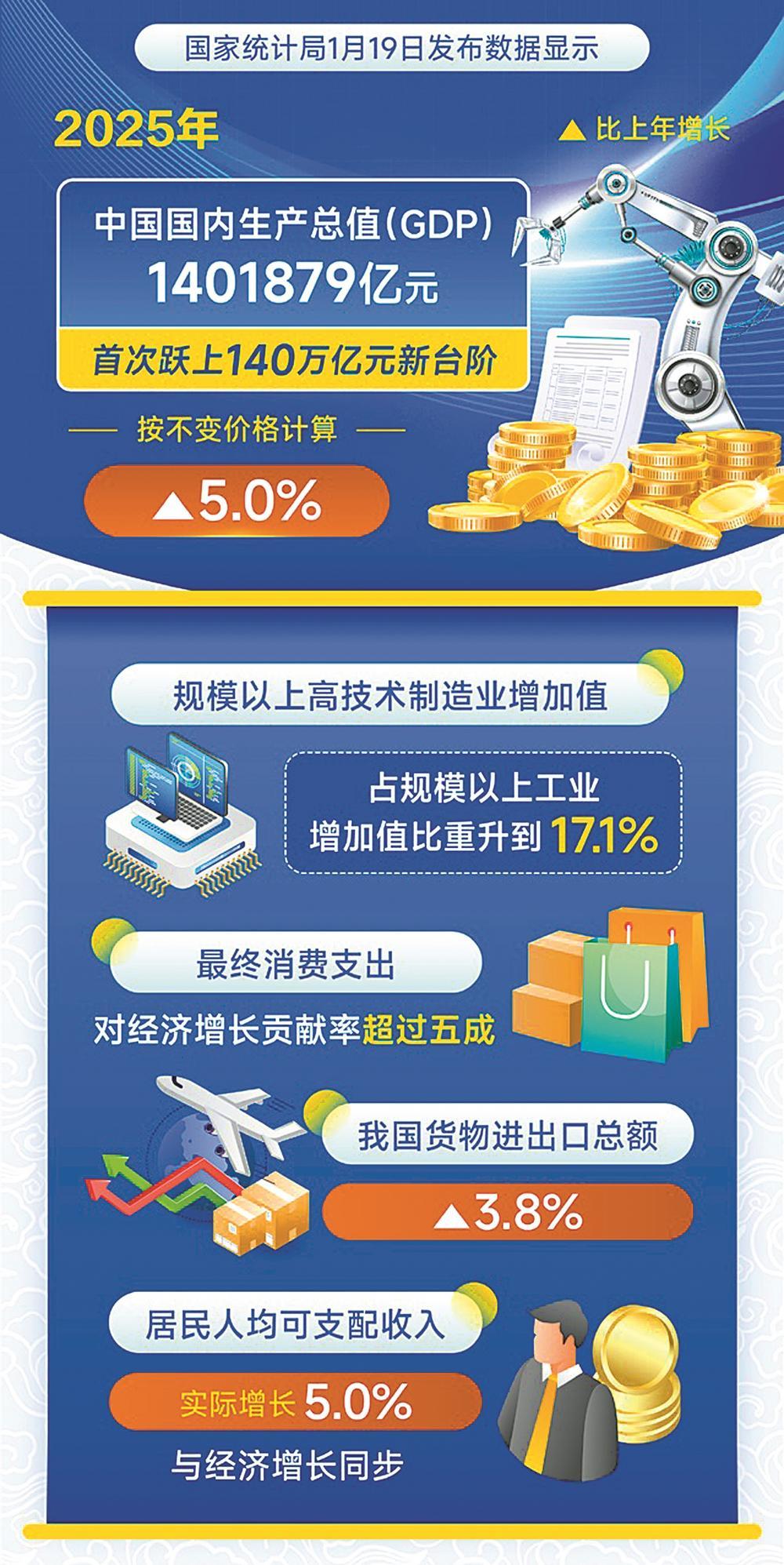
Economic Growth - China's GDP reached 140 trillion yuan in 2025, marking a significant milestone with a year-on-year growth of 5.0% at constant prices, achieving a "four consecutive jumps" during the 14th Five-Year Plan period [4] - The contribution rate of China to global economic growth is expected to be around 30%, making it the most stable and reliable source of global economic growth [4] Production and Industry - China's grain production has stabilized at 1.4 trillion jin for two consecutive years, and the manufacturing value added has remained the highest in the world for 16 years [5] - The service sector's value added has increased to 57.7% of GDP, supported by the world's largest and most comprehensive network infrastructure [5] - During the 14th Five-Year Plan period, China's average annual economic growth is projected to be 5.4%, significantly surpassing the global average [5] Innovation and Technology - China has entered the top ten in global innovation index rankings, with R&D expenditure intensity reaching 2.8%, exceeding the OECD average for the first time [5] - Significant technological advancements include successful launches of the "Nine Sky" drone and the Tianwen-2 mission, as well as the commissioning of the first electromagnetic aircraft carrier [5] Emerging Industries - New energy vehicles accounted for over 50% of domestic new car sales, with production of civilian drones and industrial robots increasing by 37.3% and 28% respectively [6] - Continuous investment and expansion in high-end equipment, green energy, and smart manufacturing are driving the integration of technological and industrial innovation [6] Consumer Market - The total retail sales of consumer goods surpassed 50 trillion yuan, with a year-on-year growth of 3.7%, reflecting new retail experiences and the integration of digital technologies [7] - The per capita disposable income of residents increased by 5.0%, and the urbanization rate reached 67.89%, indicating positive progress in social welfare sectors [7]
一图解码:港股IPO一周回顾 29家公司递表 兆易创新首挂涨45%
Sou Hu Cai Jing· 2026-01-19 12:13
Group 1: IPO Market Overview - In the past week (January 12-18, 2026), a total of 29 companies submitted IPO applications in the Hong Kong market, including Qian Dama, Yuanji Food, and others [5][6] - Three companies passed the hearing at the Hong Kong Stock Exchange: Guoen Co., Dongpeng Beverage, and Muyuan Foods, all of which are already listed on A-shares [5][10] - Only one company, Longqi Technology, initiated its IPO process, with a global offering of 52.2591 million shares at a maximum price of HKD 31 per share [5][13] Group 2: Companies Going Public - Four companies officially listed on the Hong Kong Stock Exchange: Haowei Group, BBSB International, Zhaoyi Innovation, and Hongxing Cold Chain [5][14] - Yuanji Food is the largest Chinese and global Chinese fast-food enterprise, with a revenue of RMB 1.982 billion, up 11.0% year-on-year, and a net profit of RMB 142 million, up 18.8% [8][9] - Estun, a leading industrial robot company, reported a revenue of RMB 3.804 billion, up 12.9% year-on-year, and a net profit of RMB 25.372 million, recovering from a loss in the previous year [10][11] Group 3: Company Highlights - Guoen Co. focuses on chemical new materials and reported a revenue of RMB 17.444 billion, up 10.0% year-on-year, with a net profit of RMB 713 million, up 40.2% [11] - Muyuan Foods, a leader in the pork industry, achieved a revenue of RMB 111.79 billion, up 15.5% year-on-year, and a net profit of RMB 15.112 billion, up 34.4% [12] - Longqi Technology is a global leader in smart products and services, with its IPO set to launch on January 14, 2026, and expected to list on January 22, 2026 [13][14]


140万亿元!中国经济再上新台阶
Xin Hua Wang· 2026-01-19 10:42
Economic Growth - China's GDP is projected to exceed 140 trillion yuan by 2025, marking a significant milestone in the "14th Five-Year Plan" period with a series of economic achievements [1] - The contribution rate of China to global economic growth is expected to reach around 30%, positioning it as a stable and reliable driver of the world economy [1] Economic Resilience - China's agricultural output has stabilized at 1.4 trillion jin for two consecutive years, and the manufacturing value-added has maintained the world's top position for 16 years [2] - The service sector's contribution to GDP has increased to 57.7%, showcasing a robust economic foundation [2] - China is projected to maintain its status as the world's largest goods trading nation, with total import and export value expected to surpass 45 trillion yuan by 2025 [2] Innovation and Technology - China has entered the top ten in global innovation index rankings, with R&D expenditure intensity reaching 2.8%, surpassing the OECD average for the first time [3] - Significant advancements in technology are evident, with notable achievements in various sectors, including the successful launch of the "Tianwen-1" mission and the introduction of the first electromagnetic aircraft carrier [3] - The domestic sales of new energy vehicles have exceeded 50%, and production of civilian drones and industrial robots has increased by 37.3% and 28%, respectively [3] Consumer Market Dynamics - The total retail sales of consumer goods have surpassed 50 trillion yuan, reflecting a 3.7% increase from the previous year, with new retail models experiencing double-digit growth [4] - The per capita disposable income of residents has increased by 5.0%, and the urbanization rate has reached 67.89%, indicating positive progress in public services and living standards [4] - The economic foundation remains strong, with long-term positive trends expected to continue, demonstrating resilience against economic challenges [4]
埃斯顿冲刺港股工业机器人第一股 剑指全球高端市场
Zheng Quan Shi Bao Wang· 2026-01-19 10:21
Core Viewpoint - Estun is resuming its IPO process in Hong Kong, aiming to become the first industrial robot stock in the Hong Kong market, enhancing its global competitiveness and brand recognition through an "A+H" dual capital platform [1][5]. Group 1: Company Overview - Estun is a leading Chinese industrial robot manufacturer, covering the entire industry chain from automation core components to intelligent manufacturing systems, with a strong market presence in sectors like new energy, 3C electronics, and automotive [1]. - The company has ranked first in domestic industrial robot shipments for several consecutive years and is positioned sixth globally among manufacturers [1]. Group 2: Technological Innovation - Estun invests around 10% of its revenue in R&D, employing over 1,000 researchers and holding 614 patents, including 250 invention patents [2]. - The company is integrating AI with robotics, enhancing its adaptability and self-evolution capabilities, and has developed a proprietary AI control system architecture [2]. Group 3: Digital Solutions - Estun has launched an innovative industrial internet platform, E-Care, for remote maintenance and smart management, and E-Noesis for quality detection and fault analysis, showcasing its commitment to driving automation upgrades [3]. Group 4: Global Expansion - The company is accelerating its global layout and targeting high-end markets, having received international safety certifications and expanding its product matrix through acquisitions [4]. - Estun's overseas revenue reached 1.118 billion yuan, accounting for 29.4% of total revenue in the first three quarters of 2025 [4]. Group 5: Market Trends - The global industrial robot market is projected to grow at a CAGR of 11.2%, driven by increasing demand for automation and AI integration [6]. - Estun is well-positioned to benefit from the dual drivers of market expansion and domestic brand emergence, with a comprehensive product matrix covering various load capacities [6]. Group 6: Application Scenarios - The company is expanding its applications in automotive manufacturing, metal processing, and battery production, with notable achievements in delivering high-load robots and integrated solutions [7]. - Estun has introduced the iER series robots and iER.OS system, enhancing its capabilities in intelligent analysis and decision-making [7]. Group 7: Future Outlook - With the support of the "A+H" dual capital platform, Estun is expected to drive breakthroughs in high-end products and global layout, contributing to the intelligent upgrade of global manufacturing [8].
图解2025中国经济数据
市值风云· 2026-01-19 10:09
Core Viewpoint - The national economy is showing positive growth with a GDP exceeding 140 trillion yuan, achieving a 5.0% increase compared to the previous year, meeting expectations [3]. Group 1: Economic Performance - The industrial production is growing rapidly, with the added value of industrial enterprises above designated size increasing by 5.9% [3]. - The service industry is steadily growing at a rate of 5.4% [4]. - The total retail sales of consumer goods increased by 3.7%, indicating an expansion in consumption scale [4]. Group 2: Sector-Specific Growth - The production of 3D printing equipment, industrial robots, and new energy vehicles has seen significant year-on-year growth of 52.5%, 28.0%, and 25.1% respectively [3]. - Despite a decline in fixed asset investment by 3.8% due to decreased real estate development investment, manufacturing investment continues to grow [4]. - The import and export of goods have stabilized with a growth rate of 3.8% [4]. Group 3: Employment and Demographics - Overall employment and prices remain stable, with continuous growth in residents' income [4]. - There is a slight decrease in the total population, while the urbanization rate continues to increase [4].