支付

Search documents
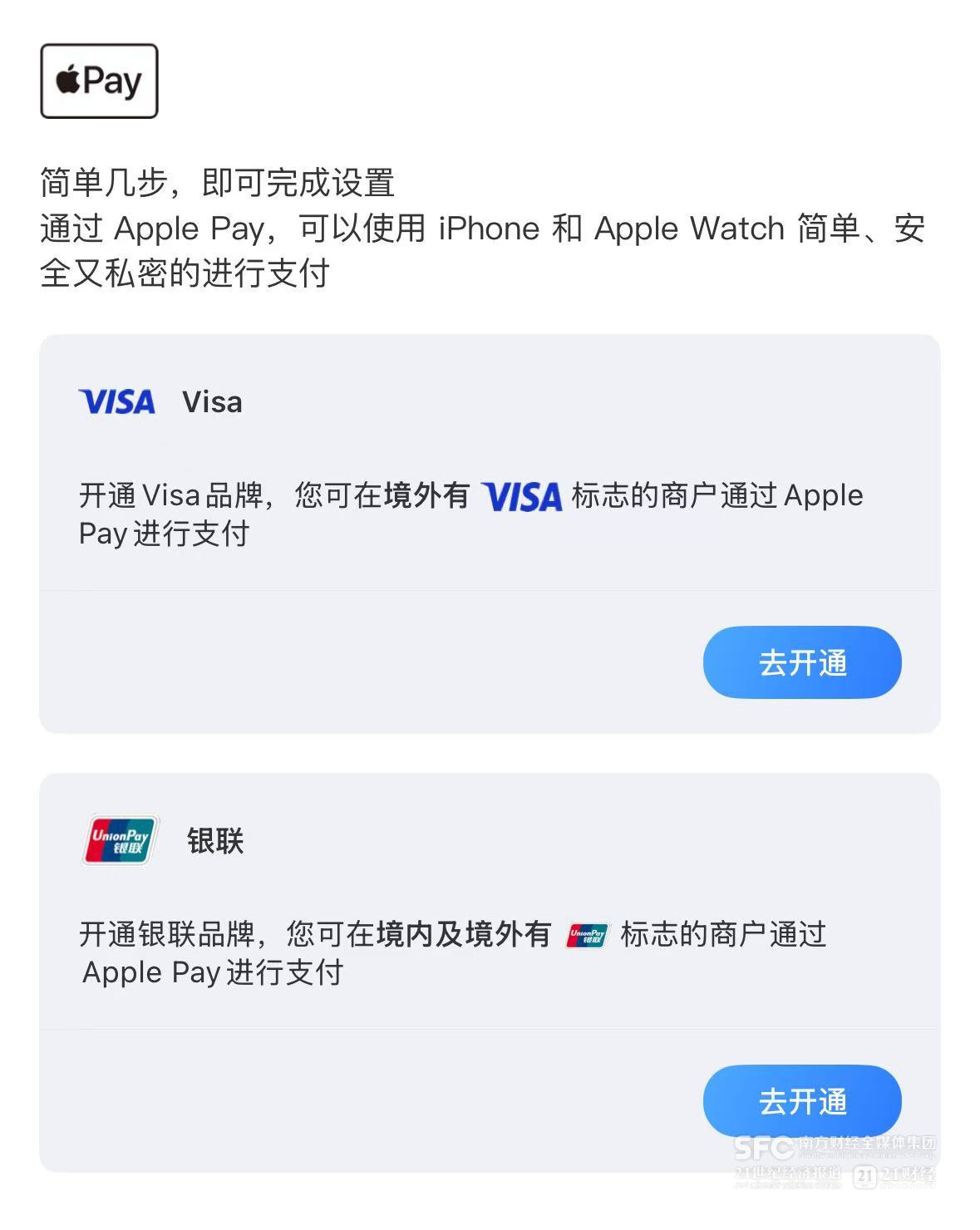
Apple Pay支持绑定Visa卡!有银行“即办即绑即用”
2 1 Shi Ji Jing Ji Bao Dao· 2026-01-15 05:50
Core Insights - Apple and Visa announced support for Visa cards issued in mainland China to be linked to Apple Pay, enhancing mobile payment options for users [1] - The initiative aims to address the mobile payment needs of existing cardholders, particularly for cross-border transactions and frequent travelers [2] Group 1: Market Context - The current mobile payment landscape in China is dominated by QR code payments, with lower acceptance of "tap-to-pay" methods like Apple Pay [3] - Visa reported that 79% of global offline transactions come from "tap-to-pay" solutions, indicating a significant gap in domestic adoption compared to international markets [2] Group 2: User Experience and Security - When a credit card is linked to Apple Pay, the actual card number is not stored on the device or Apple's servers, enhancing security through tokenization [3] - The system generates a unique device account number that is encrypted and stored securely, ensuring safe transactions for users [3] Group 3: Operational Details - Users can add their Visa cards to Apple Pay via the Wallet app or directly through their bank's app, enabling immediate use on compatible devices [4] - Some banks, like China Merchants Bank, are innovating with an "instant activation" process, allowing users to apply for and use Visa cards without waiting for physical cards [4] Group 4: Future Outlook - The support for Visa card linking is expected to attract new user groups and increase usage scenarios for Apple Pay, contingent on the growth of Apple's user base and outbound consumption demand [5] - Future integration of more international payment networks is anticipated, with existing technological infrastructure supporting such developments, although regulatory compliance remains a key challenge [5]







8家银行首批上线,Visa支持中国消费者Apple Pay绑卡
Bei Jing Shang Bao· 2026-01-15 03:40
Core Insights - Visa announced a partnership with Apple to support Chinese cardholders in linking Visa cards to Apple Pay for payments in various scenarios abroad, including at physical merchants, mobile apps, and online websites [1] - Currently, 79% of global offline transactions are conducted through contactless payment methods [1] Group 1: Payment Features - Consumers can make contactless payments using Apple Pay by double-clicking the side button on their iPhone or Apple Watch, allowing for seamless transactions without opening any other apps [1] - Each Apple Pay transaction requires security verification through Face ID, Touch ID, or device password, with the verification result sent to the issuing bank in encrypted form [1] - Apple Pay allows users to make faster payments in overseas mobile apps or online websites without the need to create accounts or repeatedly enter personal and payment information [1] Group 2: Supported Banks - The initial banks supporting this feature include Industrial and Commercial Bank of China, Bank of China, Agricultural Bank of China, Bank of Communications, China Merchants Bank, CITIC Bank, Ping An Bank, and Industrial Bank [1] - Visa is collaborating closely with additional banks such as Shanghai Pudong Development Bank, China Construction Bank, Minsheng Bank, and China Everbright Bank to roll out these features in the future [1][2] Group 3: Additional Support - On January 15, CITIC Bank announced support for linking its Visa credit and debit cards to Apple Pay, enabling cardholders to make payments anywhere abroad where merchants accept Visa contactless payments [2]
Visa支持中国消费者Apple Pay绑卡
Xin Lang Cai Jing· 2026-01-15 02:55
1月15日金融一线消息,Visa今日宣布支持中国持卡人 ApplePay绑卡。Visa将与Apple一起,支持中国持 卡人将Visa卡绑定至ApplePay,并在境外的线下商户、移动app或线上网站等多种场景进行支付。目 前,全球79%的线下交易来自"一拍即付"。 Visa中国区总裁尹小龙表示:"全球数字支付飞速发展的同时,消费者对基于手机的、互联互通的移动 支付方式的需求也与日俱增。一直以来,Visa致力于为中国持卡人提供多元的支付选择,让他们无论身 处何地,都能安心自在地畅享支付之旅。此次,Visa秉持着对中国市场和持卡人长期不变的承诺,在数 据安全与支付安全领域加大投入,推出支付标记化服务并率先实现其在跨境场景的应用。我们很高兴与 Apple及金融机构携手,率先为中国持卡人带来更安全、更便捷的移动支付新体验。" 首批支持的发卡银行包括:中国工商银行、中国银行、中国农业银行、交通银行、招商银行、中信银 行、平安银行及兴业银行。Visa和Apple正在与包括上海浦东发展银行、中国建设银行、中国民生银 行、中国光大银行在内的更多银行伙伴紧密合作,相关功能将于未来陆续上线。 责任编辑:王馨茹 Visa中国区总裁 ...




国内Apple Pay支持绑定Visa信用卡 为出境游和留学生带来更多便利
Xin Lang Cai Jing· 2026-01-15 01:47
Core Viewpoint - Apple has officially announced that users in mainland China can now link Visa credit cards to Apple Pay, enabling overseas payments through the service [1]. Group 1: Apple Pay Expansion - The new feature allows for a more convenient and secure global payment experience for tourists and overseas students [4]. - Previously, Apple Pay in China only supported dual-currency cards with UnionPay, limiting international payment options [4]. - The integration of Visa credit cards will simplify cross-border transactions for users traveling abroad [8]. Group 2: Supported Banks and Cards - Users can add Visa credit cards issued by several banks, including Industrial and Commercial Bank of China, Bank of China, Agricultural Bank of China, and others, to their Apple Wallet [4]. - Additional banks, such as Shanghai Pudong Development Bank and China Construction Bank, will gradually support this feature in the coming months [4]. Group 3: User Experience and Security - Apple Pay maintains its user-friendly setup, allowing users to add Visa cards via their bank's app, with a requirement for device updates to iOS 17 or higher [7]. - The service emphasizes security, using encrypted device account numbers instead of real card numbers, and requires dual authentication for transactions [8]. - Apple aims to enhance the travel experience by providing a reliable payment method for users globally [7].

Visa与BVNK合作推出稳定币支付服务
Xin Lang Cai Jing· 2026-01-14 13:25
Core Viewpoint - Visa has partnered with stablecoin payment infrastructure company BVNK to integrate stablecoin functionality into its Visa Direct real-time payment network, enabling businesses in specific markets to fund payments in stablecoins and directly disburse funds to recipients' digital wallets [1] Group 1: Partnership Details - The collaboration allows businesses to pre-fund payments using stablecoins, enhancing the efficiency of transactions [1] - BVNK will provide the underlying infrastructure to process and settle these stablecoin transactions, indicating a significant role in the payment ecosystem [1] Group 2: Financial Metrics - BVNK currently processes over $30 billion in stablecoin payments annually, showcasing its substantial market presence [1] - Visa made a strategic investment in BVNK through its venture capital arm in May 2025, followed by a strategic investment from Citigroup, highlighting the confidence in BVNK's capabilities [1]
拉卡拉主业下滑,2025年靠“炒股”大赚8个亿?
Guo Ji Jin Rong Bao· 2026-01-14 13:07
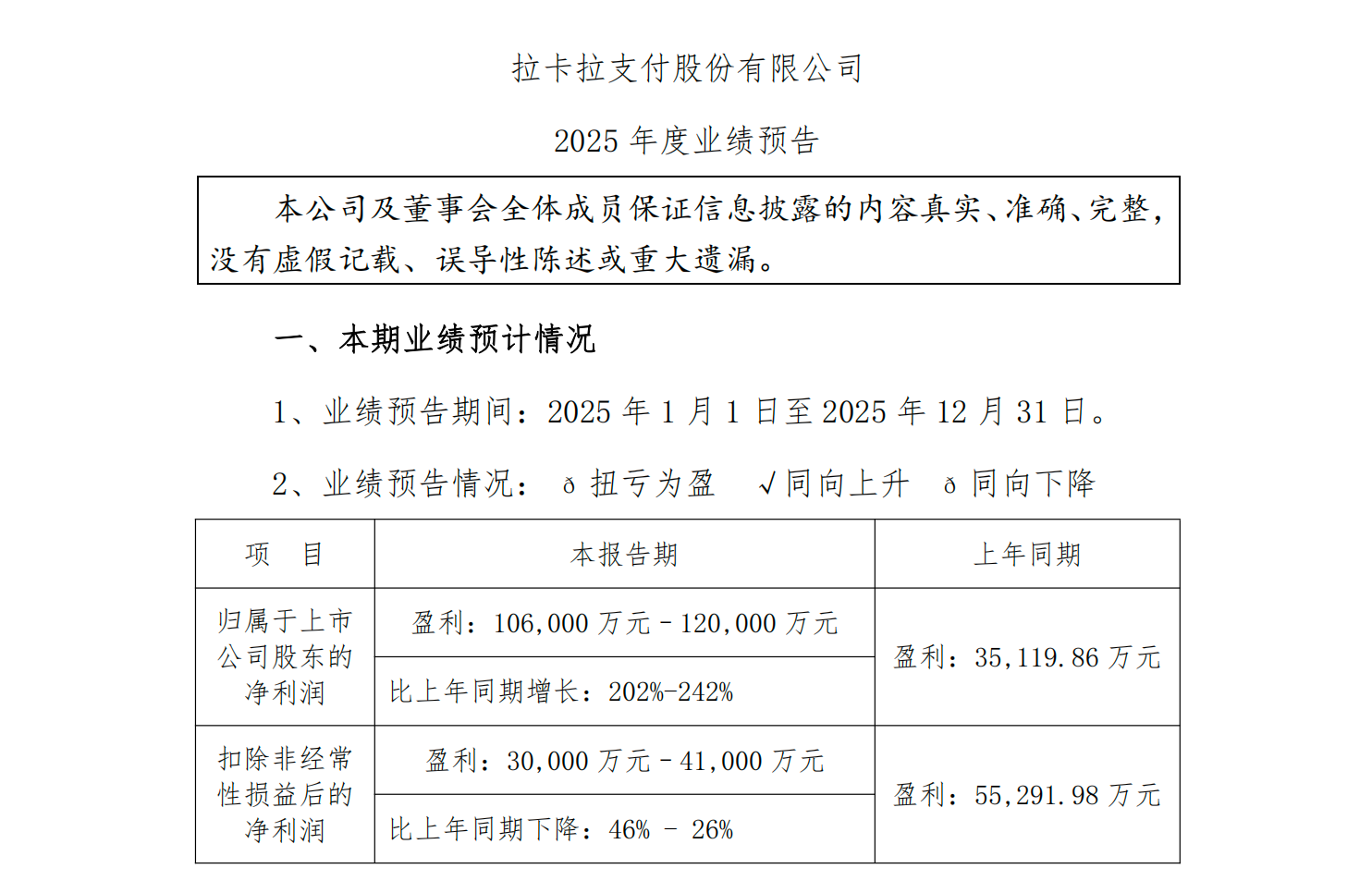
Group 1 - The core viewpoint of the article indicates that Lakala's net profit attributable to shareholders is expected to grow by 202% to 242% in 2025, primarily due to a significant increase in non-recurring gains, estimated at approximately 814 million yuan [3] - The increase in non-recurring gains is mainly attributed to the fair value changes of listed company stock assets held by Lakala and substantial investment income from the sale of some of these stocks [3] - Excluding non-recurring gains, Lakala's net profit is projected to decline by 46% to 26% compared to the same period last year, primarily due to a decrease in the scale of bank card payment transactions [3][4] Group 2 - The analysis by industry expert Wang Pengbo highlights that a significant portion of Lakala's 2025 net profit is derived from non-recurring gains related to stock investments, which indicates a lack of sustainability in this profit structure [3] - The core issue leading to the decline in net profit after excluding non-recurring items is the pressure on the bank card acquiring business, which is a common challenge faced by institutions focusing on offline acquiring in special scenarios [4] - The bank card acquiring market is contracting due to ongoing regulatory impacts, while new business areas like cross-border payments and digital payments are growing rapidly but currently contribute insufficient revenue to offset the decline in the main business [4]

异动盘点0114 | 餐饮股涨幅居前,阿里健康再涨超14%;比特币概念股走高,支付概念板块延续昨日跌势
贝塔投资智库· 2026-01-14 04:01
Group 1 - The stock of Tongdao Liepin (06100) rose by 10.17%, reflecting market recognition of its "AI recruitment strategy" and "financial stability" [1] - The restaurant sector saw significant gains, with Haidilao (06862) up 7.7%, Jiumaojiu (09922) up 5.38%, and Helens (09869) up 6.67%, driven by demand recovery since early 2023 [1] - Voice Technology (02495) surged over 10% after announcing a share issuance of 6.73 million shares at HKD 46.3 each, with approximately 50% of the proceeds allocated for R&D [1] Group 2 - Alibaba-W (09988) increased by nearly 5%, following announcements at the 2025 Cloud Summit regarding changes to hardware infrastructure in response to new market demands [1] - Hua Hong Semiconductor (01347) rose over 5.3% after announcing a plan to acquire approximately 97.5% of Huali Micro for CNY 8.268 billion [2] - Jiufang Zhitu Holdings (09636) saw an increase of nearly 8%, attributed to active market trading with a daily turnover reaching CNY 3.6 trillion [2] Group 3 - Jingtai Holdings (02228) rose over 5.5%, with a month-to-date increase of nearly 50%, following the successful dual approval of its incubated company ReviR's innovative drug RTX-117 [2] - Xun Ce (03317) briefly rose over 6%, reaching a new high of HKD 68, due to a strategic cooperation framework agreement with Jinyong Investment [2] - Alibaba Health (00241) surged over 14.2%, with a month-to-date increase exceeding 30%, following the announcement of a milestone solution in the infant vascular tumor treatment field [3] Group 4 - Bitcoin rose over 2.5%, reaching USD 93,500, with Bitcoin-related stocks also increasing, including MSTR up 6.63% and COIN up 4% [4] - GCDT, a green decarbonization technology company, saw its stock price surge 25% after its IPO, which aims to raise approximately USD 10 million for factory construction and debt repayment [4] - Lithium giant Albemarle (ALB.US) rose 4.46%, with analysts noting a reduction in concerns over its balance sheet as it achieves leverage optimization [4] Group 5 - Gold concept stocks showed mixed performance, with AngloGold Ashanti (AU.US) up 1.11% and Barrick Mining (B.US) up 1.39%, while some others declined [5] - Google (GOOGL.US) increased by 1.24% following a significant partnership with Apple to advance AI technology, with Google's Gemini model becoming a core support for future Apple devices [5] - Payment concept stocks continued to decline, with major banks also falling, amid concerns over potential impacts from proposed credit card interest rate caps [6] Group 6 - Intel (INTC.US) and AMD (AMD.US) saw initial gains of 7.33% and 6.39%, respectively, after KeyBanc Capital Markets upgraded their ratings to "overweight" [6] - Rezolve AI (RZLV.US) fell 9.23% despite raising its long-term revenue forecast, indicating significant commercialization progress [7] - Satellogic (SATL.US) declined 1.11% after a previous surge, following the announcement of a contract for two high-resolution satellites [7]


高利网贷被“封喉”!层层“马甲”防不胜防,部分支付机构砍掉所有网贷
Bei Jing Shang Bao· 2026-01-14 01:56
Core Viewpoint - The payment industry is tightening controls on high-interest online lending, with many institutions halting cooperation with platforms charging annual interest rates above 24%, aiming to cut off the payment channels for high-interest loans [1][3][6]. Group 1: Regulatory Actions - Multiple payment institutions are conducting urgent inspections and have begun to terminate all collaborations with online lending platforms, particularly those with interest rates exceeding 24% [3][6]. - The tightening measures were prompted by a specific incident involving a payment institution that faced regulatory scrutiny, leading to a directive for special inspections across the industry [3][7]. - Some regions, particularly in East China, are implementing stricter regulatory measures compared to others, reflecting a disparity in enforcement standards [3][6]. Group 2: Compliance Challenges - Despite the swift actions taken, challenges remain, including the presence of non-compliant platforms using disguised operations such as product installment plans to evade detection [1][8]. - The complexity of multi-layered cooperation chains makes it difficult to trace the flow of funds, complicating compliance efforts for smaller institutions [1][10]. - Payment institutions are facing a dilemma between compliance costs and potential profits from high-risk lending partnerships, which may deter proactive compliance measures [11][12]. Group 3: Market Reactions - Some payment companies have reported that the impact of cutting off online lending partnerships is minimal, as these collaborations contributed low profit margins but high risks [12]. - There is a concern that smaller payment platforms may seize the opportunity to engage in high-risk lending as larger institutions withdraw from the market [12][13]. - The industry anticipates a shift towards a "dual compliance" model, where reputable payment institutions collaborate with compliant online lending platforms, while smaller, non-compliant entities may face elimination or forced transformation [12][13].

拉卡拉1月13日获融资买入3.22亿元,融资余额13.88亿元
Xin Lang Zheng Quan· 2026-01-14 01:32
Group 1 - On January 13, Lakala's stock fell by 6.54%, with a trading volume of 2.471 billion yuan [1] - The margin trading data showed that on the same day, Lakala had a financing purchase amount of 322 million yuan and a financing repayment of 364 million yuan, resulting in a net financing outflow of 41.96 million yuan [1] - As of January 13, the total margin trading balance for Lakala was 1.392 billion yuan, with the financing balance of 1.388 billion yuan accounting for 6.69% of the circulating market value, indicating a high level compared to the past year [1] Group 2 - As of September 30, Lakala had 104,400 shareholders, a decrease of 26.11% from the previous period, while the average circulating shares per person increased by 35.37% to 7,038 shares [2] - For the period from January to September 2025, Lakala reported an operating income of 4.068 billion yuan, a year-on-year decrease of 7.32%, and a net profit attributable to shareholders of 339 million yuan, down 33.90% year-on-year [2] - Since its A-share listing, Lakala has distributed a total of 2.615 billion yuan in dividends, with 1.035 billion yuan distributed over the past three years [2]
高利网贷被“封喉”!层层马甲难防,有支付机构砍掉所有网贷
Xin Lang Cai Jing· 2026-01-14 01:09
Core Viewpoint - The payment industry is tightening controls on high-interest online lending, with many institutions halting cooperation with platforms charging annual interest rates above 24%, aiming to cut off the payment channels for high-interest loans [1][19]. Group 1: Urgent Investigations - Multiple payment institutions are tightening cooperation with high-interest online lending platforms, focusing on shutting down access for those with annual interest rates above 24% [3][21]. - The tightening measures were prompted by a regulatory incident involving a payment institution, leading to heightened scrutiny from regulatory authorities [3][21]. - Some payment companies have adopted a "one-size-fits-all" approach, terminating all cooperation with online lending businesses [3][21]. Group 2: Regulatory Focus - The regulatory emphasis is on eliminating unlicensed high-interest lending platforms, with payment institutions conducting urgent investigations related to recent high-interest online lending issues [6][27]. - Regulatory guidance has led to the cessation of new entries and the cleaning up of existing business for small loan and assistance institutions [27][28]. - The tightening of payment channels is part of a broader effort to comply with upcoming regulations, including the "Assisted Lending New Regulations" set to take effect in October 2025 [28]. Group 3: Challenges in Compliance - The industry faces challenges in compliance due to the hidden operations of some platforms, which use deceptive practices to evade detection [12][30]. - Many platforms disguise high-interest loans under the guise of product installment plans, complicating the identification of actual lending practices [12][30]. - Payment institutions struggle to monitor and penetrate the actual financing costs due to the complex and layered nature of these operations [33][36]. Group 4: Market Dynamics - Despite the challenges, there is still demand for high-interest lending, and some smaller payment platforms may attempt to fill the gap left by larger institutions [16][34]. - The impact of halting cooperation with online lending businesses is perceived as manageable for some payment companies, as this segment contributes little to overall profitability [34][36]. - The future of compliance in the payment and lending sectors may evolve into a "dual compliance" model, where only compliant platforms are allowed to operate [36][37].