蔬菜种植

Search documents
广西打造优质蔬菜生产基地
Jing Ji Ri Bao· 2025-12-22 00:07
Core Insights - Guangxi has been actively promoting the "vegetable basket" project to stabilize production and enhance quality, establishing itself as a major vegetable production base in China [1][2] - The region's vegetable planting area and production have shown consistent growth, with a 2.4% increase in planting area and a 4.0% increase in production year-on-year as of September [1] - Guangxi is focusing on green and standardized vegetable production, achieving over 98% compliance in pesticide residue monitoring [2] Group 1: Production and Infrastructure - Guangxi's vegetable planting area reached 19.51 million acres, with a production volume of 33.58 million tons as of September, marking a year-on-year increase of 2.4% and 4.0% respectively [1] - The area for facility vegetables is projected to grow by 17.49% to 843,600 acres by 2024, indicating a rapid enhancement in vegetable facilities [1] - The region has developed four major vegetable industry belts and established key production areas for various types of vegetables, creating a diversified production landscape [1] Group 2: Quality and Branding - Guangxi has 238 valid green and geographical indication agricultural products, with a goal to recognize 79 "Gui" brand vegetables by 2025, valued at over 60 billion yuan [2] - The region has implemented measures to address pesticide residue issues, achieving a monitoring compliance rate of over 98% [2] - Notable regional brands such as Baise tomatoes and Lipu taro have emerged, contributing to the local agricultural brand landscape [2] Group 3: Logistics and Marketing - Guangxi has established 20 cold chain logistics centers to enhance the agricultural product supply chain, with a cold storage capacity of approximately 11 million cubic meters [2] - The region supports nearly 100 marketing events annually and has built a comprehensive marketing network, including exhibition centers in major cities [2]
常年外调蔬菜超千万吨 广西打造优质蔬菜生产基地
Jing Ji Ri Bao· 2025-12-21 22:52
Core Insights - Guangxi has been actively promoting the "vegetable basket" project to stabilize production and enhance quality, establishing itself as a major production base for autumn and winter vegetables in China [1][2] Group 1: Production and Scale - Guangxi's vegetable planting area reached 19.51 million acres by the end of September, a year-on-year increase of 2.4% [1] - The total vegetable output was 33.58 million tons, reflecting a 4.0% year-on-year growth [1] - The area for facility vegetables (including small arch sheds) is projected to reach 840,000 acres by 2024, marking a 17.49% increase [1] Group 2: Product Diversity and Regional Development - Guangxi has developed four major vegetable production belts: Beibu Gulf, Xianggui Corridor, Xijiang River Basin, and Youjiang River Basin, creating a diverse production structure [1] - The annual output of leafy vegetables exceeds 10 million tons, with other categories like cabbage, root vegetables, melons, and nightshades each exceeding 5 million tons [1] Group 3: Quality and Branding - Guangxi has 238 green and geographical indication agricultural products, with a pesticide residue monitoring compliance rate of over 98% [2] - By 2025, a total of 79 "Gui" branded agricultural products are expected to be recognized, with a total brand value exceeding 60 billion yuan [2] Group 4: Logistics and Marketing - Guangxi has established 20 cold chain logistics centers, with a cold storage capacity of approximately 11 million cubic meters and a storage capability of around 2.2 million tons [2] - The region has built marketing networks by establishing exhibition centers in major cities and organizing numerous supply and demand matching events annually [2]
宿州埇桥区:“埇桥莴苣”销售旺
Xin Lang Cai Jing· 2025-12-21 16:36
星报讯 12月15日,宿州埇桥区顺河镇王垅村,村民在收获莴苣,以每公斤1.5元的价格销售给客商。进 入12月以来,国家地理标识农产品"埇桥莴苣"逐渐进入销售旺季,村民及时采收成熟的莴苣,丰富居民 冬日菜篮子,日销售量在10万公斤以上,远销长三角及京津冀市场,亩收入在6000元左右。据了解,埇 桥莴苣年种植面积在30万亩以上,从11月底开始上市,直至清明节前后都可供应市场,莴苣种植已经成 为部分镇村乡村振兴的主导产业之一。 (来源:市场星报) ...

特色兴产
Jing Ji Ri Bao· 2025-12-20 06:03
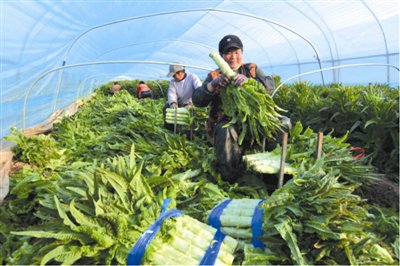
Group 1 - The flower farmers in Luoyang, Henan Province are utilizing online platforms for live streaming sales of催花牡丹 (forced blooming peonies) [2] - In Yichun City, Jiangxi Province, local villagers are drying sweet potatoes, pumpkins, and ginger, as the county extends the industrial chain of local specialties to increase farmers' income [4] - In Yichang City, Hubei Province, a new development model combining "e-commerce + supply chain + farmers" is being promoted to expand the sales channels for navel oranges [6] - The crab farming industry in Weishan County, Shandong Province, has an annual output value of nearly 2 billion yuan, supported by ecological farming methods such as mixed farming of crabs and shrimp [6] - In Lianyungang City, Jiangsu Province, there is a strong focus on developing green leisure bases centered around tomato picking and tasting, along with related industries [8] - A vegetable garden in Dianjiang County, Chongqing, employs advanced technologies like temperature control, drip irrigation, and smart monitoring, supplying an average of 5,000 jin of fresh vegetables daily [10]

乡村振兴齐鲁新实践:片区推进,协同共赢
Xin Hua Wang· 2025-12-20 02:40
Core Viewpoint - The article discusses the transformation of rural areas in Shandong Province, China, through the establishment of integrated rural revitalization zones that leverage local resources and promote industrial development, resulting in significant economic growth and improved living standards for residents [1][3][12]. Group 1: Industrial Development - Shandong has established 2,070 rural revitalization zones, covering approximately one-third of its administrative villages, creating a "Qilu model" for rural revitalization [3][11]. - The integration of industries, such as the "colorful tomato" initiative in Shouguang, has led to increased market bargaining power and significant sales growth, with one village achieving a transaction volume exceeding 60 million yuan from 500,000 jin of tomatoes [2][3]. - The development of specialized agricultural zones has resulted in substantial income increases for farmers, with average annual incomes in some villages rising from less than 50,000 yuan to over 200,000 yuan [2][3]. Group 2: Resource Optimization - The article highlights the importance of resource integration across villages to enhance efficiency and service delivery, with examples of successful collaborations leading to increased collective income [6][7]. - The establishment of cooperative models, such as the "rural revitalization partner" initiative, has facilitated the development of new business ventures and job creation in rural areas [10][11]. - The integration of cultural and natural resources in areas like Yangjiashan has attracted significant tourism, generating over 100 million yuan in annual revenue [5][11]. Group 3: Policy and Governance - Shandong's government has implemented policies to support the development of rural revitalization zones, including financial incentives and a structured policy framework to guide local initiatives [11][12]. - The establishment of a "development community" model aims to create self-sustaining rural economies by fostering collaboration among neighboring villages [11][12]. - The focus on coordinated development within rural revitalization zones addresses challenges related to infrastructure, public services, and resource management, promoting a holistic approach to rural growth [11][12].
新农人兴农
Xin Lang Cai Jing· 2025-12-19 22:32
Core Insights - The article highlights the transformation of agricultural practices in Yifengdian Town, where local farmers leverage digital tools and live streaming to enhance vegetable sales and agricultural knowledge sharing [1][2][3]. Group 1: Digital Transformation in Agriculture - Wang Guangfeng, a village party secretary, utilizes live streaming to sell over 25 million pounds of vegetables annually, significantly increasing village collective income by over 800,000 yuan [1]. - Zhu Dianyue, a planting expert, has created over 3,000 agricultural science videos, helping more than 2,000 farmers solve planting issues through "cloud consultations" [2]. - The town has nearly 60,000 acres of vegetable planting area and 26 seed companies, with annual seed sales exceeding 800 million yuan [2]. Group 2: Smart Agricultural Practices - The introduction of smart greenhouses allows real-time monitoring and control of key growth factors, improving seedling emergence rates from 70% to over 95% [2]. - Automation in farming is exemplified by the use of a tractor equipped with a Beidou navigation system, which enhances operational efficiency and accuracy in planting [3]. - The "Jiang Dajie" brand, led by Jiang Bo, has achieved annual vegetable sales exceeding 10,000 tons, with exports to countries like South Korea, Malaysia, and Singapore [3].
宁夏原州:专家田间地头送技术 帮扶实效暖民心
Xin Lang Cai Jing· 2025-12-19 14:23
Group 1 - The core idea of the news is the effective implementation of expert-led assistance in agriculture and healthcare in Yuanzhou District, enhancing local industry and medical services [1][2][3] Group 2 - In Yuanzhou District, experts have directly engaged with farmers, providing hands-on guidance in identifying pests and diseases, as well as teaching cultivation techniques [2] - The livestock sector has seen significant growth, with the number of beef cattle reaching 271,100 and generating a value of 986 million yuan, while the area for cool-season vegetable cultivation remains stable at 250,000 acres [2] - The "leading enterprises + cooperatives + farmers" model has enabled 24,000 farmers to achieve an average income increase of 13,000 yuan [2] Group 3 - Medical experts have improved local healthcare access, reducing the need for patients to travel long distances for surgeries, with 43 medical experts collaborating with 110 local professionals [2] - The establishment of five emergency centers and the introduction of 29 new diagnostic devices have enhanced local medical services, increasing the number of treatable conditions from 1,182 to 1,325 [3] - Patient satisfaction has risen to 95.3%, reflecting the positive impact of the expert assistance on healthcare delivery [3]
(乡村行·看振兴)山西忻州:大棚蔬菜采收忙 “芹”劳致富有奔头
Zhong Guo Xin Wen Wang· 2025-12-18 07:04
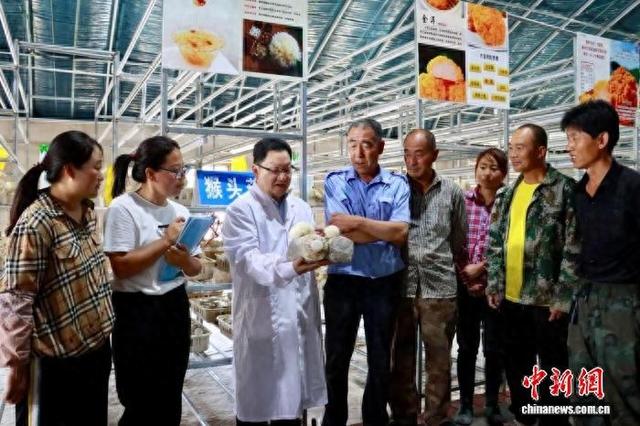
(乡村行·看振兴)山西忻州:大棚蔬菜采收忙 "芹"劳致富有奔头 中新网忻州12月18日电 (杨佩佩 张媛)冬日时节,山西省忻州市忻府区忻口镇高城村的蔬菜大棚里生机 盎然,成排的芹菜长势喜人。工人们正俯身弯腰,利落地将一株株芹菜从根部割断,再迅速摘除老叶, 整理捆扎,整齐地码放进塑料筐。 "这茬芹菜已经收了半个月,再过十来天就全部收完了。"正在捆扎芹菜的工人张红丽告诉记者,今年的 芹菜行情不错,品相也好,叶片翠绿鲜嫩,几乎没什么病害。"我们在这干活按小时计酬,补贴家用正 好。棚里暖和,干活不遭罪,比在家闲着强。" 眼下,越冬芹菜迎来采收旺季,鲜嫩的芹菜正被一筐筐送往市场。"今年种了30亩芹菜,亩产差不多一 万斤,这几天地头价一块二三。"种植户刘欣武说,今年选用的西芹品种,口感脆嫩,颇受市场欢迎。 山西省忻州市忻府区忻口镇高城村的蔬菜大棚里,芹菜茎秆挺拔,叶片鲜亮。 张媛 摄 刘欣武介绍,棚内还采用了智能恒温系统,白天温度保持在二十七摄氏度左右,夜间维持在十摄氏度左 右,芹菜在这样稳定的环境里长势特别好。"等这批芹菜收完,紧接着就要开始培育辣椒苗,为下一季 的种植做准备。" 棚内采收正忙,棚外十分热闹。来自本地商 ...
安徽蒙城:冬管蔬菜 保供应
Ren Min Wang· 2025-12-18 02:18
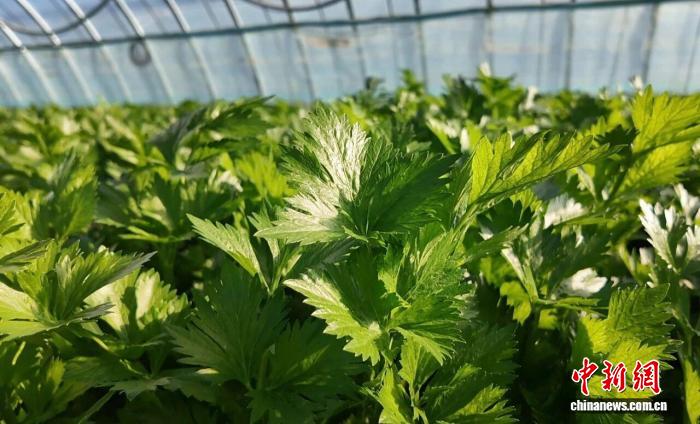
Core Viewpoint - The article discusses the efforts in Mengcheng, Anhui Province to ensure a stable supply of winter vegetables through effective management and cultivation practices [1][2][3][4][5][7] Group 1: Supply Management - The local government is implementing strategies to enhance the production of winter vegetables to meet the demand during the colder months [1][2] - Farmers are encouraged to adopt winter cultivation techniques to increase yield and ensure a steady supply of fresh produce [3][4] - The initiative aims to stabilize vegetable prices and prevent shortages in the market during winter [5][7] Group 2: Agricultural Practices - The article highlights the importance of using advanced agricultural practices and technologies to improve the efficiency of winter vegetable farming [1][3] - Training programs are being organized for farmers to educate them on best practices for winter crop management [2][4] - The focus is on sustainable farming methods that can withstand the challenges posed by winter weather conditions [5][7]
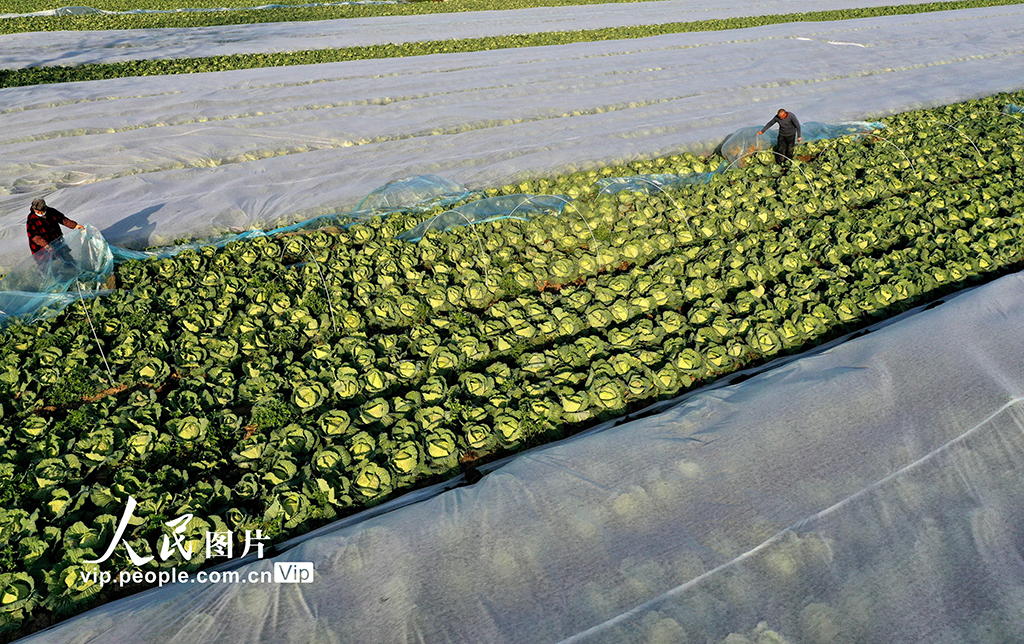
精细化服务助力寒潮下蔬菜稳产保供 保障农民收益
Yang Shi Wang· 2025-12-14 05:30
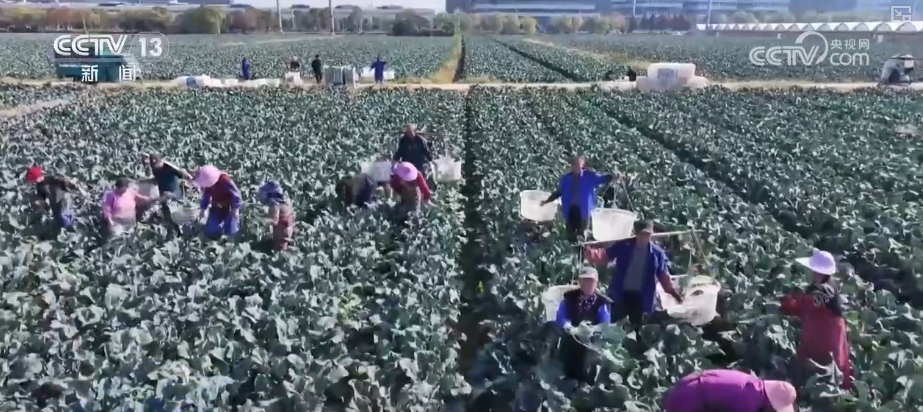
Group 1 - The article highlights the stability of broccoli production in the face of cold weather, with a peak harvest period occurring despite low temperatures [1][5] - Taizhou, Zhejiang, is identified as a major base for broccoli cultivation, with over 70,000 acres planted and an annual output of nearly 100,000 tons [5] - The local supply chain for broccoli includes comprehensive support from agricultural companies and cooperatives, ensuring quality from seed supply to cultivation and post-harvest processing [7][11] Group 2 - Post-harvest services such as sorting, cold chain logistics, and storage have been established to maintain the quality of broccoli and prevent damage from cold weather [11] - The local broccoli not only serves the domestic market but is also exported to international markets, including Singapore and South Korea, providing farmers with diversified income sources [13]