农产品贸易

Search documents
重庆与东盟国家集中签约21个合作项目
Zhong Guo Xin Wen Wang· 2025-11-12 13:11
Core Points - Chongqing signed 21 cooperation projects with ASEAN countries during the 2025 China (Chongqing)-ASEAN Logistics Industry Cooperation Conference, focusing on the entire supply chain from agricultural product planting to cross-border transportation and market marketing [1][2] - The projects include the establishment of a logistics base for ASEAN agricultural products and international bulk trade at Chongqing's port, enhancing trade cooperation with countries like Malaysia and Indonesia [1] - The Philippines aims to leverage Chongqing as a hub to build a global transit network, facilitating efficient access for Philippine products to international markets [1] Group 1 - Chongqing has become a key hub for the Western Land-Sea New Corridor, with cross-border truck services covering the entire Southeast Asian Peninsula and extending to Central and South Asia [2] - From January to October 2025, cross-border truck shipments from Chongqing exceeded 11,000 trips, with a total value surpassing 15 billion RMB, marking a year-on-year increase of 200% and 450% respectively [2] - Future plans include developing an international road transport system that connects ASEAN, Central Asia, and Europe, providing efficient "door-to-door" services [2]
黑水县川西红谷农产品商贸有限公司成立 注册资本2万人民币
Sou Hu Cai Jing· 2025-11-12 11:19
Core Viewpoint - A new company, Heishui County Chuanxi Honggu Agricultural Products Trading Co., Ltd., has been established with a registered capital of 20,000 RMB, focusing on various agricultural and food-related sales and services [1] Company Summary - The legal representative of the newly established company is Ge Erma [1] - The company is authorized to engage in food sales, liquor business, and retail of tobacco products, subject to necessary approvals [1] - The general business scope includes wholesale and retail of food products, agricultural products, and various other goods, indicating a broad market focus [1] Industry Summary - The company operates in the agricultural and food trading sector, which includes activities such as primary agricultural product acquisition, processing, and sales [1] - The business model encompasses both online and offline sales channels, reflecting a modern approach to agricultural product distribution [1] - The range of products includes fresh fruits, vegetables, meat, eggs, and various daily necessities, highlighting the company's diverse offerings in the agricultural market [1]

庆阳昊一元商贸有限公司成立 注册资本20万人民币
Sou Hu Cai Jing· 2025-11-11 13:47
Core Insights - A new company, Qingyang Haoyi Yuan Trading Co., Ltd., has been established with a registered capital of 200,000 RMB [1] Company Overview - The legal representative of the company is Yuan Yi [1] - The company's business scope includes various food-related activities such as food sales, grain processing, and food production [1] - The company is authorized to operate in both licensed and general projects, indicating a broad range of operational capabilities [1] Business Activities - Licensed projects include food sales, grain processing food production, and food small workshop operations, which require approval from relevant authorities [1] - General projects encompass a wide array of activities such as: - Sales of pre-packaged food and edible agricultural products [1] - Food internet sales and grain oil storage services [1] - Retail and wholesale of agricultural products [1] - Supply chain management and logistics services [1] - Sales of various goods including daily necessities and advertising services [1]
农产品:子公司获得回迁物业 预计将增加税前利润约1.3亿元
Zheng Quan Shi Bao Wang· 2025-11-11 12:14
Core Viewpoint - The company announced that its wholly-owned subsidiary, Shenzhen Guocai Trading Co., Ltd., has received properties as part of an urban renewal project, which is expected to significantly increase its pre-tax profit in 2025 [1] Group 1: Company Announcement - The company’s subsidiary, Guocai Company, has been included in an urban renewal project in Shenzhen [1] - A relocation compensation agreement was signed in April 2019 with the project implementer, Hengli Company, allowing Guocai Company to receive properties in exchange for its original property [1] - The urban renewal project has been completed, and Guocai Company has received multiple units in Huali Plaza, totaling 3,840.23 square meters, along with 16 parking space usage rights [1] Group 2: Financial Impact - The total assessed value of the received properties is approximately 133 million yuan [1] - The accounting treatment of the received properties is expected to increase the company's pre-tax profit by about 130 million yuan in 2025 [1]
买完大豆又买小麦,中国重启美国农产品采购,关税暂停一年留后手
Sou Hu Cai Jing· 2025-11-11 12:11
Core Points - The article discusses the recent agricultural trade dynamics between China and the United States, highlighting a significant purchase of 120,000 tons of U.S. wheat and a $5.2 billion agricultural deal, which reflects China's willingness to cooperate despite underlying tensions [1][44]. - It emphasizes the contradictory nature of U.S. policies, particularly Trump's call for nuclear disarmament while simultaneously ordering nuclear tests, revealing a strategic inconsistency [5][7][22]. - The article points out that China's agricultural imports from the U.S. are no longer irreplaceable, with Brazil dominating 85% of China's soybean imports, indicating a shift in supply chain dynamics [10][32]. Trade Dynamics - China's recent agricultural purchases are seen as a strategic choice rather than a dependency, maintaining the option for alternative sources in its procurement list [12][33]. - The U.S. agricultural sector has benefited from renewed orders, with Chicago futures prices rising after a period of low prices due to trade tensions [18][20]. - The article notes that while the U.S. seeks to maintain trade ties, it simultaneously imposes restrictions on Chinese companies, creating a paradox in its trade strategy [24][26]. Strategic Implications - The article argues that the U.S. approach to China is marked by a duality of wanting to benefit from China's economic growth while attempting to contain its rise, leading to a lack of credibility in U.S. policies [22][26]. - China's response to U.S. nuclear disarmament proposals is characterized by a firm stance, emphasizing that it will not engage in an arms race or take on responsibilities that do not belong to it [38]. - The article concludes that the future of U.S.-China relations hinges on genuine cooperation rather than political posturing, with China's actions reflecting a commitment to stability and strategic autonomy [46][52].

农产品:果菜公司获得回迁物业 预计将增加2025年度税前利润总额约1.3亿元
Zhi Tong Cai Jing· 2025-11-11 11:56
Core Viewpoint - The company has successfully completed a property exchange as part of an urban renewal project, which is expected to positively impact its financial performance in the upcoming fiscal year [1][2]. Group 1: Property Exchange Details - The company's wholly-owned subsidiary, Shenzhen Guocai Trading Co., Ltd., had a property in Shenzhen that was included in an urban renewal project, with an original land area of 3,000.97 square meters and a building area of 3,486.53 square meters designated for industrial use [1]. - The company signed a relocation compensation agreement with the project implementer, Shenzhen Hengli Technology Co., Ltd., in April 2019, allowing for a property exchange to receive new premises [1]. Group 2: New Property Assessment - The urban renewal project has been completed, and the company received new properties in Huali Plaza, totaling a building area of 3,840.23 square meters, including 16 parking space usage rights [2]. - An asset evaluation report from Shenzhen Lixin Asset Appraisal Real Estate Valuation Co., Ltd. valued the new properties at 132.872 million yuan [2]. - Based on this evaluation, the company anticipates an increase in its pre-tax profit by approximately 130.4 million yuan for the fiscal year 2025 [2].
农产品(000061.SZ):果菜公司获得回迁物业 预计将增加2025年度税前利润总额约1.3亿元
智通财经网· 2025-11-11 11:51
Core Viewpoint - The company has successfully completed a property exchange as part of an urban renewal project, which is expected to positively impact its financial performance in 2025 [1][2]. Group 1: Property Exchange Details - The company's wholly-owned subsidiary, Shenzhen Guocai Trading Co., Ltd., had a property in Shenzhen that was included in an urban renewal project, originally covering an area of 3,000.97 square meters with a building area of 3,486.53 square meters [1]. - The company signed a relocation compensation agreement with Shenzhen Hengli Kechuang Industrial Co., Ltd. in April 2019, allowing for a property exchange to receive new premises [1]. Group 2: New Property Assessment - The urban renewal project has been completed, and the company received new properties at Huali Plaza with a total building area of 3,840.23 square meters, including 16 parking space usage rights [2]. - An asset evaluation report from Shenzhen Lixin Asset Appraisal Real Estate Valuation Co., Ltd. valued the new properties at 132.872 million yuan [2]. - The company anticipates an increase in its pre-tax profit by approximately 130.4 million yuan for the fiscal year 2025 based on the asset evaluation results [2].
泰国大幅扩大饲料玉米进口配额 关税降至零以履行对美贸易承诺
Xin Lang Cai Jing· 2025-11-11 11:39
Core Viewpoint - Thailand plans to eliminate tariffs on feed corn and significantly increase import quotas as part of concessions in trade negotiations with the United States [1] Group 1: Policy Changes - The Thai government will raise the annual import quota for feed corn from 54,700 tons to 1 million tons [1] - The existing 20% tariff on the quota will be reduced to zero, enhancing competitiveness for U.S. corn [1] Group 2: Trade Implications - This move is aimed at fulfilling Thailand's commitment to purchase more U.S. agricultural products in exchange for lower tariffs on its exports [1] - The elimination of import tariffs will make U.S. corn, the largest supply source globally, more competitive compared to Southeast Asian producers who currently benefit from duty-free access under regional trade agreements [1]
美国高粱出口提速,大豆出口低迷,中国新增巴西20船订单
Sou Hu Cai Jing· 2025-11-11 05:11
Core Insights - The article discusses the impact of tariff adjustments on the U.S. soybean market, highlighting the decline in China's tariff from 34% to 13% but noting that this has not yet translated into increased purchases from U.S. farmers [1][8] - The resumption of qualifications for three U.S. companies by Chinese customs is seen as a potential opportunity, yet the market remains competitive with Brazilian exports continuing to rise [3][4] - The article emphasizes the ongoing challenges faced by U.S. soybean farmers, including high inventory levels and limited processing capacity, which are exacerbated by low market prices [5][8] Tariff Adjustments - China's reduction of tariffs on U.S. soybeans from 34% to 13% has created a ripple effect in the market, but actual buying activity has not yet materialized [1][8] - The resumption of qualifications for U.S. companies CHS, Louis Dreyfus, and EGT by Chinese customs is a significant development, potentially opening new avenues for trade [3][4] Market Dynamics - Brazilian soybean exports are increasing, with statistics showing higher export volumes compared to the previous year, indicating strong competition for U.S. soybeans [3][5] - The price differential between U.S. and Brazilian soybeans is a critical factor in determining market orders, with U.S. prices still holding a premium [4][7] Supply Chain Challenges - U.S. soybean farmers are facing pressure from high inventory levels, with processing capacity having increased by 14%, yet the market is unable to absorb the excess supply [3][5] - The demand for soybean products like biodiesel has not kept pace with production increases, leading to a supply-side constraint [5][8] Information Asymmetry - There is a notable disconnect between optimistic reports from U.S. media regarding Chinese purchases and the lack of confirmation from Chinese buyers, creating uncertainty in the market [7][8] - The article highlights the complexities of global supply chains, where pricing and timing are critical in determining market outcomes [8]
卖特朗普一个人情?会晤前一天中粮突然出手,买美国18万吨大豆
Sou Hu Cai Jing· 2025-11-10 10:18
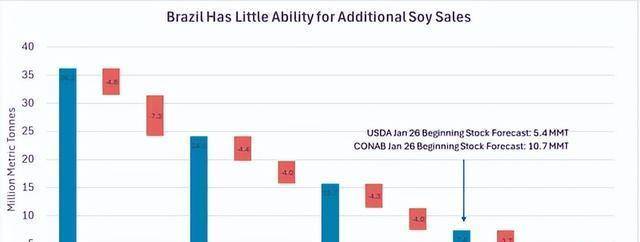
Core Insights - COFCO's decision to purchase 180,000 tons of U.S. soybeans on October 29, just before the U.S.-China summit, signals a strategic maneuver rather than a mere trade transaction [1][8][19] - The purchase comes after a five-month period where China imported no U.S. soybeans, indicating a shift in the dynamics of U.S.-China trade relations [1][6][19] Group 1: Market Reactions - The announcement led to a significant increase in soybean futures prices on the Chicago Mercantile Exchange, with November contracts rising by 11 cents and January contracts surpassing $11, reaching the highest level since July 2024 [3] - The market interprets this purchase as a signal of ongoing negotiations rather than a simple trade agreement, suggesting that both parties are still engaged in discussions [3][16] Group 2: U.S. Farmers' Situation - U.S. soybean farmers have faced financial difficulties due to rising costs and oversupply, with last year's exports to China amounting to 16.8 million tons, making the recent purchase seem minor in comparison [5][19] - The loss of the Chinese market for five months has been critical for U.S. farmers, highlighting the importance of restoring trade relations [5][19] Group 3: China's Supply Chain Strategy - China has diversified its soybean supply sources, with Brazilian exports exceeding 100 million tons in 2025, of which 79.9% were imported by China [6][14] - The shift towards Latin American suppliers indicates that China is no longer solely dependent on U.S. soybeans, giving it leverage in negotiations [6][11][14] Group 4: Negotiation Dynamics - The upcoming U.S.-China summit will address various critical issues, including fentanyl, tariffs, and trade barriers, which are interconnected with soybean purchases [9][19] - The purchase of soybeans is seen as a gesture of goodwill, but it does not imply concessions from China, which is focused on maintaining its core interests [11][21] Group 5: Future Outlook - Speculation exists that if the summit goes well, China may increase its soybean purchases by 5 to 10 million tons in the coming weeks, although this optimism may be overly ambitious given existing tensions [13][21] - The dynamics of U.S.-China trade relations are evolving, with the need for genuine trade commitments from the U.S. to regain China's market [17][19]