
在线音乐

Search documents
中金:维持腾讯音乐-SW跑赢行业评级 上调目标价至114.5港元
Zhi Tong Cai Jing· 2025-08-13 04:22
Core Viewpoint - The report from CICC indicates that Tencent Music's non-subscription business has outperformed expectations, leading to an upward revision of Non-IFRS net profit forecasts for 2025 and 2026 by 6.8% and 13.0% to 9.46 billion and 11.21 billion yuan respectively [1] Group 1: Financial Performance - In Q2 2025, Tencent Music reported revenue of 8.44 billion yuan, a year-on-year increase of 17.9%, surpassing CICC's expectation of 8 billion yuan and the consensus estimate of 7.99 billion yuan [2] - The Non-IFRS net profit for Q2 2025 was 2.57 billion yuan, reflecting a 37.4% year-on-year growth, exceeding both CICC's forecast of 2.26 billion yuan and the consensus estimate of 2.27 billion yuan [2] - The gross margin for Q2 2025 increased by 0.3 percentage points to 44.4%, while sales and management expenses remained relatively stable [4] Group 2: Revenue Breakdown - Online music revenue in Q2 2025 reached 6.85 billion yuan, a 26.4% year-on-year increase, with subscription revenue growing by 17% to 4.38 billion yuan and the number of paying users increasing by 1.5 million to 124 million [3] - The non-subscription business saw a remarkable growth of 47% year-on-year, generating 2.47 billion yuan, driven by advertising, concerts, and artist-related merchandise [3] - Social entertainment revenue for Q2 2025 was 1.59 billion yuan, with expectations for stabilization in Q3 and Q4 2025 [3] Group 3: Strategic Initiatives - The company is enhancing its upstream and user platform capabilities through a "one body, two wings" strategy, deepening collaborations with record labels to enrich content offerings [5] - Tencent Music is hosting concerts for top Korean artists and planning to invite popular Chinese artists to engage users, which is expected to drive SVIP conversion [5] - The potential acquisition of Ximalaya is anticipated to create significant collaboration opportunities in subscription and advertising, further solidifying the company's market position [5]
中金:维持腾讯音乐-SW(01698)跑赢行业评级 上调目标价至114.5港元
智通财经网· 2025-08-13 03:48
Core Viewpoint - The report from CICC indicates that Tencent Music's non-subscription business has exceeded expectations, leading to an upward revision of Non-IFRS net profit forecasts for 2025 and 2026 by 6.8% and 13.0% to 9.46 billion and 11.21 billion yuan respectively [1] Financial Performance - In Q2 2025, Tencent Music reported revenue of 8.44 billion yuan, a year-on-year increase of 17.9%, surpassing both CICC's expectation of 8 billion yuan and the consensus estimate of 7.99 billion yuan [2] - The Non-IFRS net profit for Q2 2025 was 2.57 billion yuan, reflecting a 37.4% year-on-year growth, also exceeding CICC's forecast of 2.26 billion yuan and the consensus estimate of 2.27 billion yuan [2] Revenue Breakdown - Online music revenue in Q2 2025 reached 6.85 billion yuan, up 26.4% year-on-year [3] - Subscription revenue increased by 17% to 4.38 billion yuan, with paid user count rising by 1.5 million to 124 million and ARPPU increasing by 9.3% to 11.7 yuan/month [3] - Non-subscription revenue grew by 47% to 2.47 billion yuan, driven by advertising, concerts, and artist-related products, with an expected annual growth of 30% [3] - Social entertainment revenue for Q2 2025 was 1.59 billion yuan, with expectations for stabilization in Q3 and Q4 2025 [3] Profitability and Cost Management - The gross margin for Q2 2025 improved by 0.3 percentage points to 44.4%, while sales and management expenses remained relatively stable [4] - Effective cost control is anticipated to support continued healthy growth in Non-IFRS net profit for 2025 [4] Strategic Initiatives - The company is enhancing its upstream and user platform capabilities, focusing on a "one body, two wings" strategy to deepen collaborations with record labels and enrich content offerings [5] - Initiatives include hosting concerts for top Korean artists and introducing interactive community features on QQ Music, which allow users to engage with popular artists [5] - The company is also exploring potential synergies with a possible acquisition of Ximalaya, which could enhance subscription and advertising opportunities [5]
腾讯音乐-SW(01698):多元内容生态下凸显强劲变现能力
HTSC· 2025-08-13 03:41
Investment Rating - The report maintains a "Buy" rating for Tencent Music Entertainment Group (TME) [5][7] Core Views - TME's Q2 2025 performance exceeded expectations with revenues of 8.44 billion RMB, a year-on-year increase of 17.9%, and adjusted net profit of 2.64 billion RMB, up 33% year-on-year, driven by the rapid growth of super members and strong performance in non-subscription businesses [1][2] - The company is expanding its content advantages in K-POP and film and television variety shows, and plans to acquire 100% of Ximalaya, which is expected to enhance its content ecosystem and support long-term growth [1][3] - TME's gross margin improved to 44.4% in Q2 2025, with expectations of continued upward trends in long-term profitability despite potential seasonal fluctuations in gross margin due to changes in revenue structure [4][5] Summary by Sections Financial Performance - In Q2 2025, online music revenue grew by 26.4% to 6.85 billion RMB, with subscription revenue increasing by 17.1% to 4.38 billion RMB and non-subscription revenue rising by 46.9% [2] - The number of paid users reached 124.4 million, with ARPPU slightly increasing to 11.7 RMB [2] Strategic Developments - TME acquired approximately 9.66% of SM Entertainment, becoming its second-largest shareholder, which is expected to strengthen TME's position in the K-POP market [3] - The planned acquisition of Ximalaya is anticipated to enhance user engagement and conversion rates, solidifying TME's leading position in the online music and audio market [3] Profitability Outlook - The report projects adjusted net profit for 2025-2027 to be 9.46 billion RMB, 10.61 billion RMB, and 12.22 billion RMB respectively, reflecting increases of 6.5%, 4.1%, and 9.5% [5][11] - The target price is set at 29.30 USD or 117.49 HKD, based on a 35x PE ratio for 2025 [5][11]
腾讯音乐2025年中报:营收157.98亿元,毛利率升至44.25%,净资产收益率降至8.83%引关注
Jin Rong Jie· 2025-08-13 03:26
腾讯音乐2025年中报显示业绩持续增长,但流动性指标出现下滑趋势。公司2025年上半年总营业额达到 157.98亿元,股东应占溢利为67.00亿元,同比增长0.84%。毛利率提升至44.25%,较2024年的42.34%有 所改善,显示出公司在成本控制和盈利能力方面的持续优化。 公司管理层在业绩回顾中表示,坚定践行高质量增长策略,本季度继续取得亮眼的业绩表现,其中收入 增长强劲,盈利保持稳健。依托于坚实的业务基础、日益丰富多元的音乐生态以及健康的财务状况,公 司有信心从容应对国际局势的不确定性。 财务指标显示增长放缓但盈利稳健 从主要财务数据来看,腾讯音乐2025年中报总营业额157.98亿元,相比2024年全年284.01亿元的营收规 模,上半年业绩表现基本符合预期。每股营业额为5.10元,每股营业利润达到2.52元,显示出较为稳定 的盈利水平。 资产负债表数据显示,腾讯音乐的财务结构继续保持稳健态势。2025年中报总资产达到1078.73亿元, 较2024年底的904.44亿元增长19.3%。其中,投资项目大幅增加至364.21亿元,相比2024年底的194.76亿 元几乎翻倍,反映出公司在战略投资方面的 ...


港股异动|腾讯音乐早盘大涨17%,二季度业绩超预期
Mei Ri Jing Ji Xin Wen· 2025-08-13 02:44
Group 1 - The core viewpoint of the articles highlights the strong performance of Tencent Music's Q2 2025 earnings, with total revenue increasing by 17.9% year-on-year to 8.44 billion yuan and adjusted net profit rising by 33% to 2.64 billion yuan [1][2] - Tencent Music's online music service revenue grew by 26.4% to 6.85 billion yuan, with the number of paid users increasing by 6.3% to 124.4 million, and the average monthly revenue per paid user rising from 10.7 yuan to 11.7 yuan [1] - Citigroup noted that Tencent Music's total revenue and adjusted net profit exceeded market expectations by 5.5% and 5.7%, respectively, driven by a 17% increase in subscription revenue and a 47% increase in non-subscription online music revenue [2] Group 2 - The article mentions that southbound capital has seen a net inflow of over 910 billion HKD this year, primarily flowing into core assets in AI and new consumption sectors, indicating a trend towards emerging industries [2] - The Hang Seng Technology Index ETF (513180) includes 30 leading Hong Kong tech stocks, focusing on the AI industry chain, with companies like Alibaba, Tencent, Xiaomi, Meituan, SMIC, and BYD expected to become the "seven giants" of Chinese tech stocks [2] - Investors without a Hong Kong Stock Connect account can access Chinese AI core assets through the Hang Seng Technology Index ETF (513180) [2]
港股进入业绩披露高峰期,腾讯音乐绩后飙涨17%!机构建议聚焦港股中报行情
Mei Ri Jing Ji Xin Wen· 2025-08-13 02:33
南向资金年内净流入超9100亿港元,主要流向人工智能和新消费等核心资产。AI、新消费这两大赛道 体现出新兴产业的发展趋势和一定的稀缺性,有望进一步吸引资金加码,助推港股行情持续向好。公开 信息显示,恒生科技指数ETF(513180)标的指数囊括30家港股科技龙头,软硬科技兼备,成分股深度 聚焦AI产业链的上中下游,其中阿里、腾讯、小米、美团、中芯国际、比亚迪(002594)等有望成为 中国科技股"七巨头"。没有港股通账户的投资者或可通过恒生科技指数ETF(513180)一键布局中国AI 核心资产。(场外联接A/C:013402/013403)。 港股市场即将迎来中期业绩预告密集披露期。8月12日,腾讯音乐公布最新业绩,二季度总收入增长 17.9%,调整后净利润增长33%,超市场预期,13日开盘后一度涨超17%。据此前披露,腾讯控股将在8 月13日公布中报,网易和京东集团计划于8月14日公布中报。 中泰国际指出,市场风险偏好持续走强,推动大盘高位震荡。7月中国出口韧性超预期,进口同比增速 创一年多新高,下游物价温和修复,上游降价压力仍存,基本面整体延续温和改善,叠加市场预期政策 聚焦结构性发力,港股整体仍有上升 ...

港股异动 | 腾讯音乐早盘大涨17%,二季度业绩超预期
Mei Ri Jing Ji Xin Wen· 2025-08-13 02:16
Core Viewpoint - Tencent Music reported better-than-expected Q2 2025 earnings, with total revenue and adjusted net profit exceeding market expectations by 5.5% and 18% respectively, driven by strong subscription and non-subscription online music revenue growth [1][2]. Group 1: Tencent Music Financial Performance - In Q2 2025, Tencent Music's total revenue reached 8.44 billion yuan, a year-on-year increase of 17.9% [1]. - Adjusted net profit for the same period grew by 33% to 2.64 billion yuan [1]. - Online music service revenue increased by 26.4% to 6.85 billion yuan, with paid user numbers rising by 6.3% to 124.4 million [1]. Group 2: Market Reactions and Trends - The Hang Seng Index opened 0.83% higher, with the Hang Seng Tech Index up 0.94%, reflecting positive market sentiment following Tencent Music's earnings report [1]. - Southbound capital inflow exceeded 910 billion HKD this year, primarily directed towards AI and new consumption sectors, indicating a trend towards emerging industries [2]. - The Hang Seng Tech Index ETF (513180) includes 30 leading Hong Kong tech stocks, focusing on the AI industry chain, with major players like Alibaba, Tencent, and Xiaomi expected to drive growth [2].
港股异动丨腾讯音乐涨超17%创历史新高,Q2净利同比增43.22%
Ge Long Hui· 2025-08-13 02:12
Core Viewpoint - Tencent Music's stock price surged over 17%, reaching a historical high of 104 HKD following the release of its Q2 earnings report, indicating strong financial performance and investor confidence [1] Financial Performance - Total revenue for Q2 reached 8.442 billion RMB, representing a year-on-year increase of 17.91% [1] - Shareholder profit amounted to 2.409 billion RMB, showing a year-on-year growth of 43.22% [1] - Adjusted profit for Q2 was 2.574 billion RMB, reflecting a year-on-year increase of 37.43% [1] Year-to-Date Performance - For the first half of the year, shareholder profit reached 6.7 billion RMB, which is a year-on-year increase of 116% [1] - Adjusted profit for the first half was 4.698 billion RMB, marking a rise of 31.34% compared to the previous year [1]
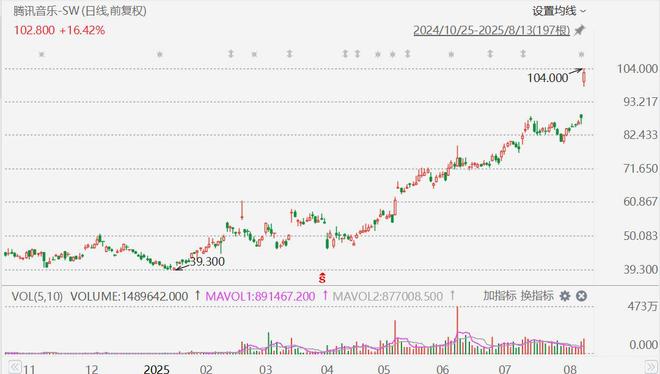
港股异动 腾讯音乐-SW(01698)高开近13% 二季度调整后净利同比增三成 在线音乐业务高质量增长
Jin Rong Jie· 2025-08-13 02:00
Group 1 - Tencent Music's stock opened nearly 13% higher and is currently up 12.8%, trading at HKD 99.6 with a transaction volume of HKD 10.448 million [1] - The company released its unaudited financial performance report for the second quarter ending June 30, 2025, showing a total revenue increase of 17.9% year-on-year to RMB 8.44 billion [1] - Adjusted net profit for the second quarter increased by 33.0% year-on-year to RMB 2.64 billion [1] Group 2 - Online music business continues to show high-quality growth, with online music service revenue increasing by 26.4% year-on-year to RMB 6.85 billion [1] - Online music subscription revenue grew by 17.1% year-on-year to RMB 4.38 billion [1] - The number of paid online music users increased by 6.3% year-on-year to 124.4 million, with ARPPU rising to RMB 11.7 [1]
腾讯音乐大涨15%,再创新高
Mei Ri Jing Ji Xin Wen· 2025-08-13 01:56
每经AI快讯,腾讯音乐-SW短线拉升,涨幅扩大至15%,报102.1港元,再创新高。 ...