桥梁建设

Search documents
“航天科技+超级工程”捷报频传 “硬核”实力彰显中国力量
Yang Shi Wang· 2025-09-28 07:03
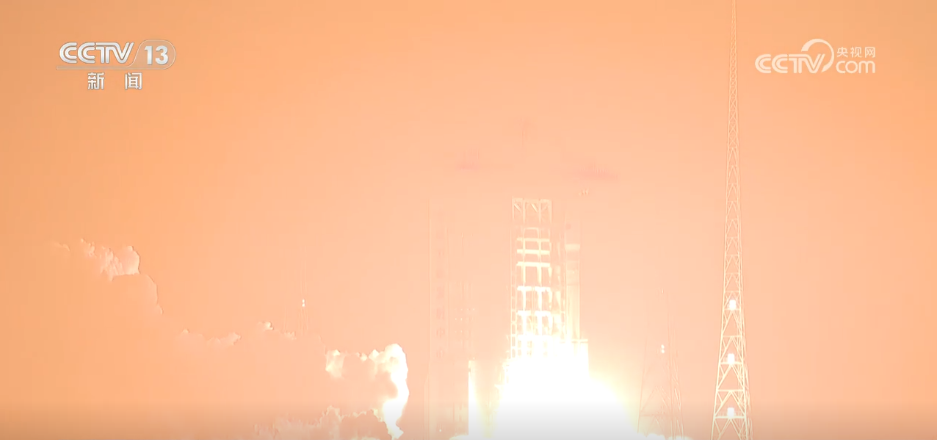
Group 1: Satellite Launch and Pipeline Development - China successfully launched 11 low-orbit satellite internet satellites using the Long March 6 carrier rocket, marking the 597th flight of the Long March series [1] - The total length of China's underwater oil and gas pipelines has surpassed 10,000 kilometers, positioning the country among the world's leaders in this sector [2] - The construction of underwater pipelines in China has achieved multiple breakthroughs this year, with the completion of two underwater pipelines in the Hainan Island Yinggehai area [4] Group 2: Pipeline Network Density and Future Plans - The Bohai Sea pipeline network density has reached over 4 kilometers of pipeline per 100 square kilometers of sea area, with nearly 200 kilometers of new underwater oil and gas pipelines built this year [6] - By 2030, China's underwater pipeline total length is expected to exceed 13,000 kilometers, enhancing the marine energy transportation network and supporting the transition to clean energy [8] Group 3: Infrastructure Development - The Huajiang Grand Canyon Bridge in Guizhou officially opened on September 28, becoming a key project for the Liuzhi to Anlong Expressway, with a total length of 2,890 meters and a main span of 1,420 meters [9] - The travel time between Guizhou's Guanyin County and Zhenfeng County has been reduced from 2 hours to approximately 2 minutes due to the bridge's opening [11]


新华鲜报|“横竖”都是世界第一!贵州花江峡谷大桥正式通车
Xin Hua She· 2025-09-28 05:49
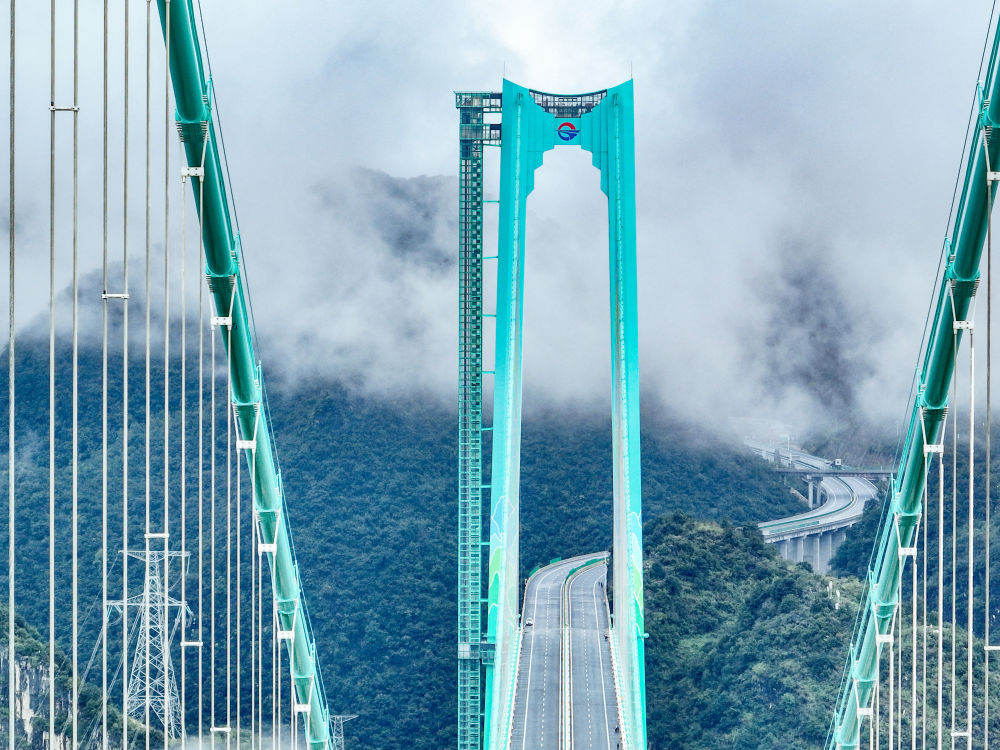
Core Points - The Guizhou Huajiang Grand Canyon Bridge officially opened on September 28, becoming the world's highest bridge at a height of 625 meters above water, surpassing the Beipanjiang First Bridge by nearly 60 meters [1] - The bridge features a main span of 1420 meters, making it the longest span for mountain bridges globally, significantly reducing travel time across the canyon from over two hours to approximately two minutes [1] - Construction of this "super project" took just over three years, showcasing China's rapid infrastructure development capabilities [1] Construction and Engineering Innovations - The bridge's construction faced significant challenges due to complex terrain and extreme weather conditions, including wind speeds reaching typhoon levels [3] - The construction team utilized advanced technologies such as a "smart cableway hoisting system" and a Doppler laser radar wind measurement system to ensure precision and safety during the building process [3] - The project achieved multiple technical breakthroughs in wind resistance design and high-altitude construction, resulting in 21 patented technologies and contributions to national bridge construction standards [3] Significance and Recognition - The completion of the Huajiang Grand Canyon Bridge is seen as a benchmark for China's innovative capabilities in bridge construction, particularly in challenging environments [5] - Guizhou province, known for its mountainous terrain, has constructed over 32,000 bridges, dominating the global rankings for the highest bridges [5] - The province has received the Gustave Lindenthal Medal, often referred to as the Nobel Prize of bridge engineering, four times, highlighting its leadership in the field [5]
“横竖”都是世界第一!贵州花江峡谷大桥正式通车
Xin Hua She· 2025-09-28 02:59
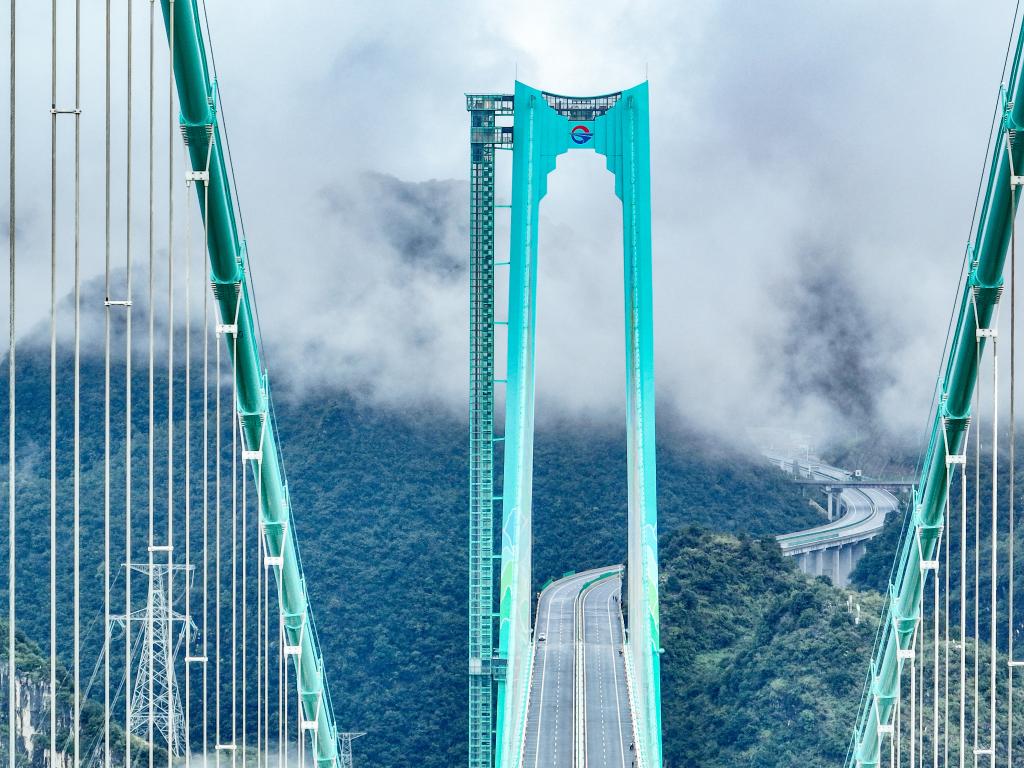
Core Viewpoint - The completion of the Huajiang Grand Canyon Bridge marks a significant achievement in bridge construction, showcasing China's innovative capabilities and setting new world records in height and span for mountain bridges [1][2][4]. Group 1: Bridge Specifications and Achievements - The Huajiang Grand Canyon Bridge has a deck height of 625 meters, surpassing the previous record holder by nearly 60 meters, making it the tallest bridge in the world [1]. - The main span of the bridge measures 1420 meters, establishing it as the longest span for mountain bridges globally [1]. - The total length of the bridge is 2890 meters, significantly reducing travel time across the canyon from over two hours to approximately two minutes [1]. Group 2: Construction and Innovation - The bridge construction took just over three years, demonstrating the "China speed" in infrastructure development [1]. - The construction involved 93 segments of steel truss beams, weighing a total of 21,000 tons, with precision assembly achieved at heights exceeding 600 meters [1]. - The construction team utilized a "smart cable hoisting system" to complete the installation in just 73 days and finished the bridge deck in over a month [1][2]. Group 3: Technical Challenges and Solutions - The primary challenge during construction was combating strong winds in the canyon, with wind speeds reaching up to level 14, equivalent to a strong typhoon [1]. - To understand wind patterns, the construction team conducted physical wind tunnel tests and implemented a Doppler laser radar wind measurement system for continuous data collection [2]. - The bridge's design includes multiple technical breakthroughs in wind resistance and high-altitude construction, resulting in 21 authorized patents and contributions to national bridge construction standards [2][4]. Group 4: Regional Impact and Recognition - The bridge is part of a broader network of over 32,000 bridges in Guizhou, which has become a leader in high bridge construction, holding multiple records in the world [4]. - Guizhou has received the Gustave Lindenthal Award, often referred to as the Nobel Prize of bridge engineering, four times, highlighting its prominence in the field [4].
新华鲜报 | “横竖”都是世界第一!贵州花江峡谷大桥正式通车
Xin Hua She· 2025-09-28 02:56
Group 1 - The Huajiang Grand Canyon Bridge officially opened on September 28, 2023, becoming the world's highest bridge at a height of 625 meters above the water surface and the longest span in mountainous areas at 1420 meters [1][2] - The bridge is a key project of the Guizhou Liuzhi to Anlong Expressway, significantly reducing travel time from over two hours to approximately two minutes [1][2] - The construction of this "super project" took just over three years, showcasing China's rapid infrastructure development capabilities [2] Group 2 - The construction faced significant challenges due to complex terrain and extreme weather conditions, including wind speeds reaching typhoon levels [2][3] - Innovative technologies were employed, such as a "smart cableway hoisting system" and a Doppler laser radar wind measurement system, which contributed to the successful completion of the bridge [2] - The bridge's completion marks a significant achievement in bridge construction technology in karst canyon areas, with Guizhou province leading globally in this field [3]
浙江海盐:世界最长跨海铁路桥顺利上梁
Zhong Guo Xin Wen Wang· 2025-09-28 02:56
Core Viewpoint - The successful installation of the first 80-meter precast concrete box girder marks a significant milestone in the construction of the Hangzhou Bay Cross-Sea Railway Bridge, entering a new phase of superstructure construction [1][2] Group 1: Project Milestones - The first 80-meter precast concrete box girder, weighing 2800 tons, has been successfully erected, setting a new world record for the largest span of precast concrete box girders [1] - The bridge construction is progressing as planned, with the main bridge structure expected to be completed by the end of 2026 and the entire project to be operational by the end of 2027 [2] Group 2: Engineering Challenges - The construction site presents complex challenges due to strong tidal currents, typhoons, and unstable seabed conditions, with a maximum tidal range of 8.96 meters and a maximum flow velocity of 5.3 m/s [1] - The "Tianyi" vessel, designed specifically for this project, has a maximum lifting capacity of 3600 tons and integrates the entire process of lifting, transporting, and erecting the girders [2] Group 3: Technological Innovations - The "Tianyi" vessel employs advanced technology, including 85 sets of smart sensors for real-time monitoring of vessel status, structural stress, and lifting actions, ensuring precise control during the construction process [2] - The construction team utilizes precise tidal calculations to optimize the timing of lifting and transporting girders, achieving millimeter-level accuracy in the installation process [2] Group 4: Strategic Importance - The Hangzhou Bay Cross-Sea Railway Bridge, with a total length of 29.2 kilometers and a design speed of 350 kilometers per hour, is set to enhance the transportation network in the Yangtze River Delta region, contributing to high-quality integrated development [2]
崇启公铁长江大桥南引桥高铁线跨长岛大道连续梁合拢
Yang Zi Wan Bao Wang· 2025-09-28 02:12
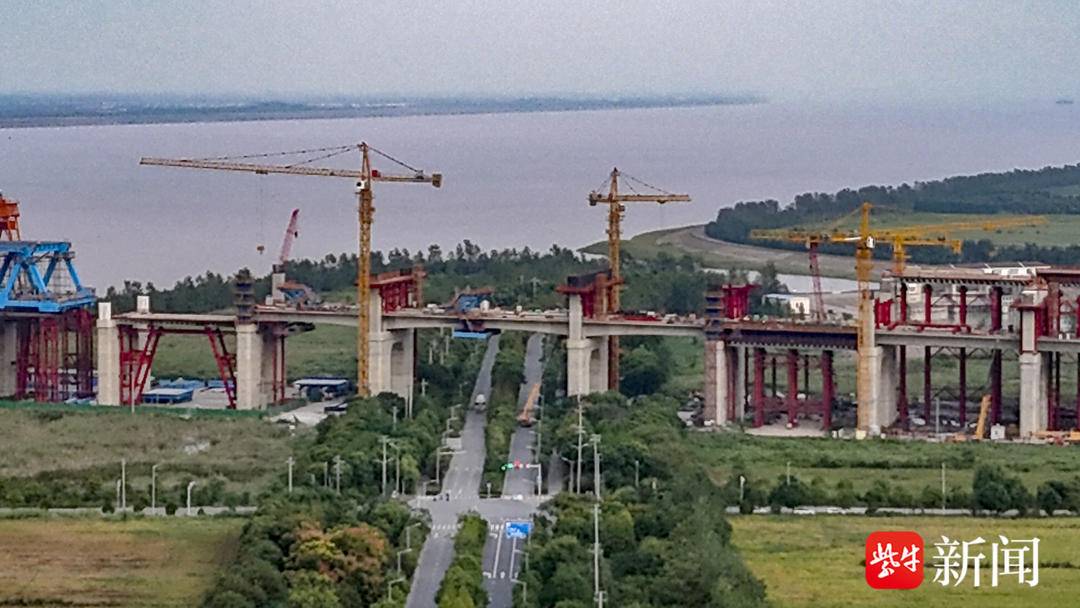
Core Viewpoint - The successful completion of the continuous beam for the high-speed rail line at the southern approach of the Chongqi Railway and Highway Yangtze River Bridge marks a significant milestone in the construction of this critical infrastructure project, which is expected to enhance connectivity in the Yangtze River Delta region [1][4][7]. Group 1: Project Details - The Chongqi Railway and Highway Yangtze River Bridge is located in Qidong City, Jiangsu Province, featuring an upper layer for highways and a lower layer for high-speed and intercity rail lines, with a total length of 830.05 meters and 19 piers [4]. - The continuous beam that has successfully completed spans the Long Island Avenue, with dimensions of (36.625 + 56 + 36.625) meters, utilizing a variable cross-section prestressed concrete design [4]. - The bridge's box girder has a top width of 12.6 meters, a bottom width of 6.7 meters, and varying heights, with the central section reaching 4.335 meters [4]. Group 2: Strategic Importance - The Chongqi Railway and Highway Yangtze River Bridge is a key node in the high-speed rail network connecting Shanghai, Nanjing, and Hefei, with a total length of 4.09 kilometers [7]. - Upon completion, the bridge will establish a rapid new corridor between the Shanghai metropolitan area, Nanjing metropolitan area, and Hefei metropolitan area, significantly optimizing the railway network layout along the Yangtze River [7]. - The project is expected to facilitate the coordinated development of the Yangtze Economic Belt and promote high-quality integration in the Yangtze River Delta region [7].
轻量化索鞍给新的世界第一高桥减负31%,以尖端工艺扛起万吨桥身
Xin Hua She· 2025-09-27 08:15
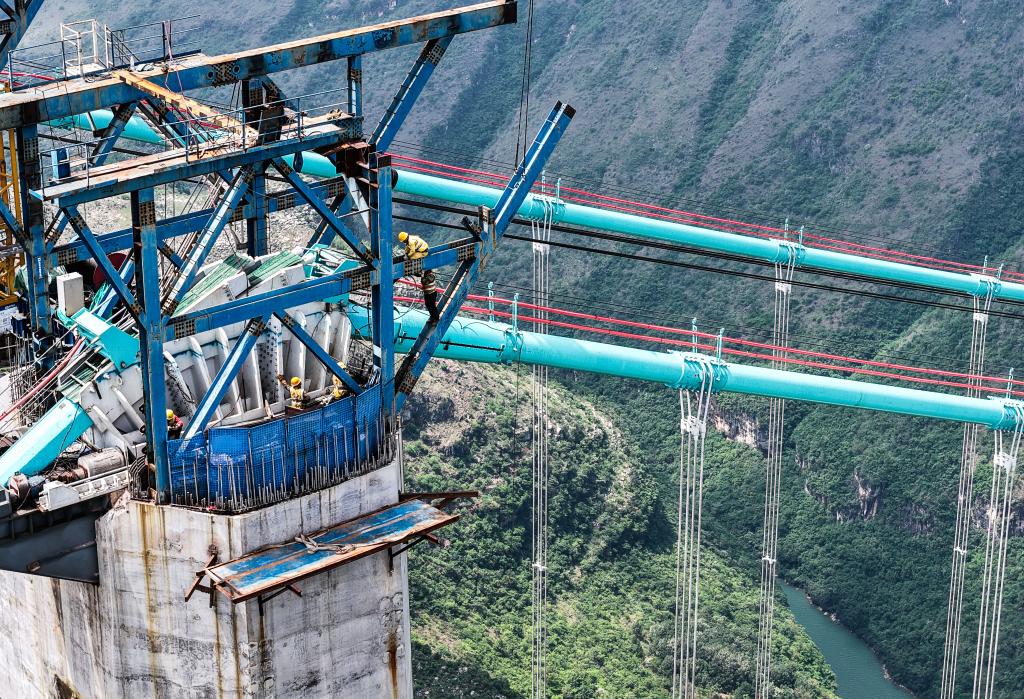
新华社贵阳9月27日电(记者 周芷若)索鞍是放置在悬索桥主塔顶部的部件,它"扛起"主缆,作为关键传力枢纽,其性能直接关系到桥梁安 全性和使用寿命。 位于贵州山区的花江峡谷大桥是一座大跨径钢桁梁悬索桥。传统铸造工艺生产的索鞍,单件重量达到上百吨,若将其吊装到距水面近800米高 的主塔顶部,需要动用超大吨位的吊装设备。 "要是在大江大河上的话,万吨浮吊可以说是想吊哪里就可以吊哪里,但在绵延不绝的山区、悬崖峭壁之间,大吨位的设备或材料运输极为不 便。"花江峡谷大桥项目总工程师刘豪说。 桥梁跨径越大,索鞍所承受的重量越大,花江峡谷大桥的索鞍,需兼顾轻量化与高性能,因此,更轻、更强的索鞍成为技术突破要点。 建设团队首创了一种"高性能锻焊组合式索鞍"。这种锻造工艺的索鞍,与传统铸造索鞍相比,不仅在用料上减少了31%的用钢量,力学性能 和稳定性还有很大提升。"这是我们'被逼出来的技术'。"刘豪说。 6月6日,工人在贵州花江峡谷大桥桥塔顶上施工(无人机照片)。新华社记者 杨文斌 摄 他介绍,行业内最多进行厚度为200毫米的锻件焊接,而在此次建设中,为了一次成功焊接好厚度近500毫米的锻件,建设团队发明了一种自 动焊接设备,不 ...
中国人自己设计的现代化大桥,为何通车89天即被炸毁?
Bei Jing Ri Bao Ke Hu Duan· 2025-09-26 09:31
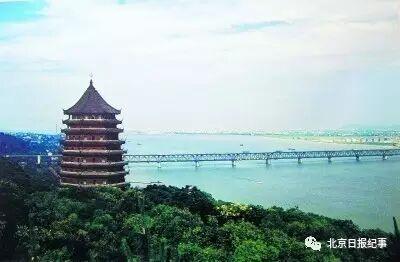
Core Viewpoint - The article reflects on the historical significance and engineering challenges of the Qiantang River Bridge, emphasizing its role in Chinese history and the sacrifices made during its construction amid wartime conditions [1][3][36]. Group 1: Historical Context - The Qiantang River Bridge was the first modern bridge in China designed and constructed entirely by Chinese engineers, symbolizing national pride and technological advancement [3][4]. - The bridge was completed in 1937 but was destroyed shortly after its completion to prevent it from being used by invading Japanese forces, highlighting the tragic circumstances of wartime [1][37]. Group 2: Engineering Challenges - The construction faced numerous difficulties, including the unique geological conditions of the Qiantang River, characterized by deep layers of quicksand and strong tidal forces [11][13][26]. - Innovative techniques, such as the "water jet method" for pile driving, were developed to address the challenges posed by the river's conditions, significantly improving construction efficiency [27][28]. Group 3: Financial and Political Aspects - The funding for the bridge was a significant challenge, requiring collaboration between various banks and government entities to secure the necessary capital [16][17][18]. - Political tensions and the involvement of multiple stakeholders, including the Ministry of Railways, complicated the financing and construction process [18][19]. Group 4: Personal Sacrifices and Leadership - The lead engineer, Ma Yisheng, demonstrated exceptional commitment and leadership throughout the project, often working under extreme pressure and facing personal risks [30][32]. - The emotional toll of having to destroy the bridge he had worked so hard to build was profound for Ma, reflecting the deep connection engineers have with their creations [37][38].
世界第三高桥!贵州安盘高速公路天门特大桥合龙
Yang Shi Xin Wen· 2025-09-26 00:25
转自:央视新闻 据了解,天门特大桥预计于2026年上半年通过验收。大桥连接水城区花戛乡吴王村至野钟乡发射村,通 车后两地通行时间将从3小时缩短至15分钟,可大幅改善区域交通条件。 安盘高速公路是沪昆国家高速贵州段扩容工程,连接贵州安顺和盘州两地,采用双向六车道标准,全长 约174公里,预计将在2027年上半年建成通车。(总台记者 史超杰 胡波) 9月23日上午,随着最后一节钢梁精准就位,贵州安盘高速公路天门特大桥顺利实现合龙。大桥横跨北 盘江,桥面距江面高度560米,全长1553米,主跨820米,建成后将成为世界第三高桥及全球最高双向六 车道钢桁梁悬索桥。 ...
“桦加沙”过境珠江,能扛17级台风的超级工程怎样了
2 1 Shi Ji Jing Ji Bao Dao· 2025-09-24 14:07
Core Viewpoint - The construction of major infrastructure projects in the Guangdong-Hong Kong-Macao Greater Bay Area is significantly enhancing connectivity, but these projects face challenges related to typhoon resistance and stability under extreme weather conditions [1][2]. Group 1: Infrastructure Projects - The Huangmaohai Cross-Sea Channel, which began construction in June 2020 and is set to open in December 2024, spans approximately 31 kilometers, with a 14-kilometer sea crossing [2][4]. - The Shenzhen-Zhongshan Link, which includes the world's largest span offshore steel box girder suspension bridge, is noted for its complex construction challenges due to frequent typhoons in the region [4][5]. - The Lion Rock Channel is another significant project, featuring the world's first double-deck suspension bridge exceeding 2000 meters in span [5][6]. Group 2: Engineering Innovations - Engineers are employing advanced technologies to enhance the wind resistance of these bridges, including the development of a new combination dynamic structure for the Shenzhen-Zhongshan Link that improves its critical wind speed to 88 m/s, allowing it to withstand a typhoon of level 17 [5][6]. - The Huangmaohai Cross-Sea Channel has implemented wind tunnel tests to optimize its design, achieving performance that exceeds international comfort standards for wind-induced vibrations [4][5]. - The projects involve collaboration with multiple prestigious universities to conduct extensive wind tunnel experiments, leading to the selection of optimal cable and beam designs that enhance stability against wind-induced vibrations [6][7]. Group 3: Typhoon Preparedness - The approach to typhoon preparedness includes deploying thousands of personnel for inspections and safety checks across various construction sites, with significant resources allocated for emergency response [7][8]. - During the impact of Typhoon "Hagupit," the Hong Kong-Zhuhai-Macao Bridge was temporarily closed, and extensive monitoring was conducted to ensure safety [7][8]. - The monitoring systems for bridges like the Humen Bridge have been intensified to ensure rapid response to any sudden changes in conditions [9].