
数字贸易

Search documents
2025服贸会|176个国家和地区投资、外向度跃升至35%,海南自由贸易港建设提速
Bei Jing Shang Bao· 2025-09-10 13:26
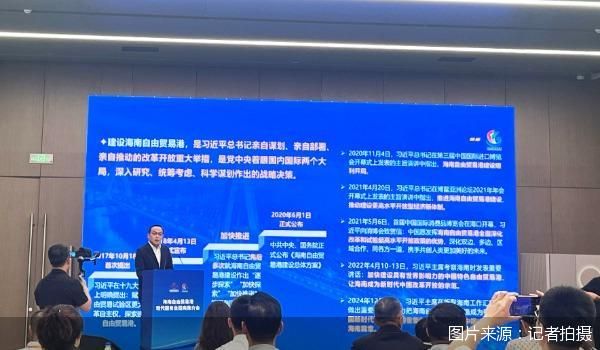
为吸引更多优质企业在海南自由贸易港落地,各个地区也提供优质配套。以海口江东新区为例,这里已 建成10.7万平方米的租赁住房、建成超5所国际学校、建成15分钟基层医疗服务圈。江东新区还推出了 江东企业专属管家服务,可提供协调企业注册代办、自贸港政策专业咨询、税务筹划服务。数据显示, 目前海口江东新区已有43家世界500强企业。 按照海南自由贸易港发展规划,到2035年,要全面实现贸易自由便利、投资自由便利、跨境资金流动自 由便利、人员进出自由便利、运输来往自由便利和数据安全有序流动,成为中国开放型经济新高地。 数据显示,截至目前176个国家和地区在海南投资,海南经济外向度由2018年的17.3%提高到2024年的 35%,货物贸易、服务贸易年均增长均超过20%,实际使用外资年均增速36%。海南方面表示,海南自 由贸易港已落地实施"零关税"清单、15%企业和个人所得税、加工增值30%内销免关税、"中国洋浦 港"船籍港、离岛免税新政、境外理工农医类高等教育机构独立办学等一批自由贸易港政策。 据了解,2020年1月1日—2027年12月31日期间,对注册在海南自由贸易港并实质性运营的鼓励类产业企 业,减按15%税率征 ...

第八届杭州国际日开幕
Hang Zhou Ri Bao· 2025-09-08 02:45
Group 1 - The eighth Hangzhou International Day opened on September 5, gathering representatives from over 30 countries and regions to discuss friendship, cooperation, and development [1] - Hangzhou aims to enhance international economic and cultural exchanges, promoting high-quality economic and social development and increasing the city's internationalization level [1][2] - The city is committed to building a high-level innovative city, attracting global talent and investment by providing an excellent business environment and innovation ecosystem [2] Group 2 - Hangzhou is focused on becoming a core area for global digital trade, leading high-level opening-up through institutional reforms and deepening practices in cross-border e-commerce [2] - The city is working to establish itself as an important international communication center, hosting international forums and events to promote cultural exchanges and global dialogue [2] - During the opening ceremony, significant announcements included the launch of AI Hangzhou 2.0 and the signing of cooperation agreements with international partners [3]
扩区五年,浙江自贸试验区外贸总额破万亿
2 1 Shi Ji Jing Ji Bao Dao· 2025-09-06 09:48
Core Insights - The Zhejiang Free Trade Zone has achieved significant growth in trade and investment, with total import and export volume expected to exceed 1 trillion yuan in 2024, up from approximately 480 billion yuan in 2020 [1][2] - The zone has introduced 690 institutional innovations, including 193 national firsts, and attracted over 17,000 registered enterprises, with more than 3,000 being foreign-funded [2] Group 1: Economic Performance - The Zhejiang Free Trade Zone contributed 19.2% of the province's foreign trade, 17.6% of foreign investment, and 8.9% of tax revenue, despite occupying less than 1/400 of the province's area [1] - The Ningbo area has seen a 25.5% year-on-year increase in offshore trade revenue, reaching 6.8 billion USD in the first half of the year [3] Group 2: Sectoral Highlights - The Zhoushan area has become one of the fastest-growing cities in the Yangtze River Delta, with an average GDP growth of 8.4% since its establishment [2] - The Jinhua area has achieved a significant milestone with the output value of new energy vehicles and key components surpassing 100 billion yuan for the first time in 2024 [3] Group 3: Technological Advancements - Hangzhou has seven companies in the artificial intelligence sector with revenues exceeding 10 billion yuan, and its computing power ranks second in the country [4][5] - The city has also established itself as a national pilot zone for cross-border e-commerce, with exports reaching 38.74 billion yuan in the first half of the year, a 37.9% increase year-on-year [5]
浙江自贸试验区扩区五年进出口总额实现翻番
Zhong Guo Xin Wen Wang· 2025-09-05 09:52
Core Insights - The Zhejiang Free Trade Zone has achieved significant growth in trade and investment, contributing 19.2% of the province's foreign trade, 17.6% of foreign investment, and 8.9% of tax revenue despite occupying less than 1/400 of the province's area [1] Group 1: Trade and Investment Growth - The total import and export volume of the Zhejiang Free Trade Zone increased from approximately 480 billion RMB in 2020 to over 1 trillion RMB in 2024, effectively doubling [1] - The number of registered enterprises in the zone exceeded 170,000, including over 3,000 foreign-funded enterprises [1] Group 2: Institutional Innovations and Projects - The Zhejiang Free Trade Zone has developed 690 notable institutional innovation achievements over the past five years [1] - Major projects in the Zhoushan area include the integration of refining and chemical processes and the establishment of an LNG receiving station, in collaboration with leading international oil and gas companies [1] Group 3: Regional Developments - The Ningbo area is focused on becoming China's first hub for bulk commodity resource allocation and has completed Asia's largest underground propane storage facility [2] - The Hangzhou area has leveraged its digital innovation capabilities, hosting three global digital trade expos with a total investment signing amount of 430 billion RMB [2] - The Jinyi area has utilized the advantages of the Yiwu market, innovating trade models that resulted in a market procurement trade export of 298.4 billion RMB in the first half of the year, a year-on-year increase of 28.2% [2]
2025年1-7月河南省贸易统计分析:河南省进出口总额为4833.8亿元,同比增长22.3%
Chan Ye Xin Xi Wang· 2025-09-05 03:14
Group 1 - The core viewpoint of the article highlights the significant growth in Henan Province's import and export activities, with a total import and export value of 483.38 billion yuan from January to July 2025, representing a year-on-year increase of 22.3% [1] - Exports during the same period reached 324.306 billion yuan, showing a robust year-on-year growth of 32.8%, while imports amounted to 159.072 billion yuan, with a more modest growth of 5.4% [1] - The trade surplus for Henan Province during this period was recorded at 165.234 billion yuan, indicating a strong positive balance in trade [1] Group 2 - The article references a report by Zhiyan Consulting titled "2025-2031 China Digital Trade Industry Competition Strategy Research and Future Outlook," which provides insights into the competitive landscape and future prospects of the digital trade industry in China [1] - A list of publicly listed companies related to the industry is provided, including Zhongcheng Co., Ltd. (000151), Yuanda Holdings (000626), and Xiamen Xinda (000701), among others [1] - Zhiyan Consulting is described as a leading industry consulting firm in China, specializing in in-depth industry research reports, business plans, feasibility studies, and customized services [1]

服贸会13场高水平主题论坛汇聚全球智慧
Zhong Guo Jing Ji Wang· 2025-09-05 00:41
Group 1 - The 2025 Service Trade Fair will feature 13 high-level thematic forums aimed at fostering global cooperation and building an open world economy [1] - The forums will highlight China's innovative achievements in service trade and its international cooperation capabilities, providing wisdom and practical paths for global service trade development [2] - Key reports such as the "China Service Trade Development Report 2024" and "Digital Trade Development and Cooperation Report 2025" will be released, offering a "Chinese perspective" on global service trade [2] Group 2 - The integration of digital technology and the real economy will be prominently showcased, with international cooperation projects in satellite communication and AI being signed at the event [3] - The international participation at the fair will reach new heights, with high-level officials and experts from various countries discussing cooperation in service trade [4] - The fair will also focus on how service trade can benefit people's lives, with discussions on health coverage, patient safety, and youth employment [5]
服贸会13场主题论坛汇聚全球智慧
Bei Jing Ri Bao Ke Hu Duan· 2025-08-30 01:07
Group 1 - The 2025 Service Trade Fair will feature 13 high-level thematic forums aimed at fostering global cooperation and building an open world economy [1][2] - Key reports such as the "China Service Trade Development Report 2024" and "Digital Trade Development and Cooperation Report 2025" will be released by authoritative institutions, providing insights from a Chinese perspective [1][2] - The thematic forums will showcase the integration of digital technology with the real economy, highlighting projects in satellite communication and AI, as well as discussions on e-commerce trends [2][3] Group 2 - The fair will emphasize the benefits of service trade for people's lives, with discussions on health coverage, digital consumption, and youth employment [3] - International participation is at an all-time high, with officials and industry leaders from multiple countries discussing practical cooperation in areas such as healthcare innovation and digital projects [2][3] - The thematic forums will reflect China's commitment to inclusive and cooperative development, showcasing the resilience and potential of the service trade sector [3]
AI驱动电商新机遇,今年服贸会主题论坛将聚焦前沿趋势
Di Yi Cai Jing· 2025-08-29 08:26
Group 1 - The 2025 China International Service Trade Fair (CIFT) will feature 13 high-level thematic forums aimed at providing wisdom support and practical paths for global service trade development [1] - The "E-commerce Conference" will focus on AI empowerment in consumption and industrial internet, exploring new trends in e-commerce development [1] - Key topics at the conference will include instant retail, live-streaming e-commerce, cross-border e-commerce, and industrial digitization, with participation from major platforms like JD, Alibaba, Amazon, and Meituan [1] Group 2 - The "World Frontier Technology Conference" will highlight the release of cutting-edge technology achievements, with over 10 projects and standards set to be promoted, amounting to 5 billion RMB [2] - The conference will also feature the "Xiong'an New Area Digital Trade Innovation Development Conference," marking the first thematic forum held outside Beijing, focusing on digital technology, AI, and cross-border trade [2] - Approximately 300 key enterprises and 600 attendees are expected at the conference, showcasing over 140 digital trade achievements [2] Group 3 - A series of activities including special releases, digital product manuals, and small-scale negotiations will be organized to enhance transaction functions, transforming the display from a "showcase" to a "transaction hub" [3]
多方紧密部署 服务贸易系列政策加快“落子
Shang Hai Zheng Quan Bao· 2025-08-28 12:16
Core Viewpoint - The Chinese government is accelerating the implementation of policies to support service trade, indicating a positive growth trend in this sector [1][2]. Group 1: Policy Initiatives - The State Council's recent study emphasizes the need to enhance the international competitiveness of service exports, focusing on areas such as research, consulting, e-commerce, and digital service trade [2]. - The Ministry of Commerce plans to introduce a series of measures to promote service exports, including optimizing zero tax rate declaration procedures and increasing export credit insurance support [2][5]. - The government aims to leverage the effects of visa-free policies to attract more foreign tourists, thereby boosting travel service exports [2][3]. Group 2: Service Trade Growth - The global service export is projected to grow by 4% by 2025, with major economies showing robust growth in service trade during the first half of the year [1]. - In the first half of the year, transportation service exports reached 418.5 billion yuan, growing by 23.9%, while travel service exports surged to 174.87 billion yuan, marking a 68.7% increase [2][5]. Group 3: Digital Service Trade - The development of digital service trade is prioritized, with a focus on cross-border e-commerce and the digital transformation of trade processes [3]. - The Ministry of Commerce is set to promote and regulate cross-border data flow, which is crucial for many multinational companies [3]. Group 4: Negative List Management - The reduction of the negative list for cross-border service trade is a key strategy for expanding service imports [3][4]. - The government is actively monitoring the implementation of the negative list and addressing any challenges that arise [4]. Group 5: Future Outlook - The next phase is expected to see increased support from fiscal, tax, financial, and regulatory measures for service trade, particularly service exports [5]. - Overall, service trade is anticipated to maintain growth throughout the year, with an ongoing optimization of trade structure [5].
天津提出19项重点任务 推动数字贸易创新发展
Zhong Guo Chan Ye Jing Ji Xin Xi Wang· 2025-08-25 23:39
Core Viewpoint - The Tianjin Municipal Government has issued the "Implementation Plan for Promoting the Innovative Development of Digital Trade," aiming to integrate the real economy with the digital economy and enhance foreign trade dynamics by setting five key areas and 19 tasks [1]. Group 1: Goals and Objectives - By 2029, the proportion of digitally deliverable service trade in Tianjin's total service trade is targeted to exceed 45%, with further increases in cross-border e-commerce transaction scale and its share of total goods trade [1]. - The plan emphasizes improving digital trade infrastructure, enhancing the level of openness in the digital sector, and aligning with international high-standard economic and trade rules [1]. Group 2: Development of Digital Trade Sectors - The plan includes developing "digital+" service trade application scenarios, promoting innovations in digital finance, online education, remote healthcare, and specialized digital services [2]. - It aims to accelerate the digital transformation of service outsourcing and cultivate new digital service business models such as "data processing" and "data knowledge factories" [2]. Group 3: Strengthening Digital Trade Entities - The plan focuses on leveraging incubators like Tianjin Kaikai Higher Education Science and Technology Park to nurture high-quality digital trade enterprises and potential companies [2]. - It encourages e-commerce platforms and service providers to grow stronger and aims to establish national service trade innovation development demonstration zones and digital trade demonstration zones [2]. Group 4: Enhancing Open Governance in Digital Trade - Tianjin will relax market access in the digital sector, promoting orderly expansion in telecommunications, internet, and cultural fields [3]. - The plan seeks to deepen international cooperation in digital trade, optimize cross-border e-commerce services, and establish efficient and secure mechanisms for cross-border data flow while ensuring data and personal information security [3].