电力

Search documents
古巴一周内第二次全国停电
中国能源报· 2026-03-22 04:22
Core Viewpoint - Cuba experienced a nationwide blackout on March 21, occurring less than a week after a similar event on March 16, highlighting ongoing issues with the country's power supply system [1][3]. Group 1: Blackout Details - The Cuban Electric Union reported that the national power system completely shut down at 18:38 local time on March 21, later updating the time to 18:32 [3]. - The Ministry of Energy and Mines announced that restoration efforts had begun but did not provide a reason for the blackout [3]. Group 2: Underlying Issues - Cuba has faced long-standing challenges in importing fuel and necessary equipment for maintaining aging power plants due to U.S. sanctions, leading to a tight national power supply [3]. - Since October 2024, Cuba has experienced multiple nationwide blackouts due to power facility failures and hurricanes [3].


转债建议优先关注主线核心资产
Soochow Securities· 2026-03-22 01:27
1. Report Industry Investment Rating No relevant content provided. 2. Core Viewpoints of the Report - Last week (0316 - 0320), the global stock, bond, and gold markets continued to experience a triple - kill, with geopolitical situations intensifying and strong market risk - aversion. The market continued to price in the stagflation expectations caused by the blockade of the Strait of Hormuz, and concerns about the sustainability of loose liquidity deepened. The report still accepts last week's observations and believes that the geopolitical conflict will trigger global energy security and energy autonomy narratives in the long - term. The market may start to distinguish between "conflict continuation" and "strait blockade", "strait opening" and "supply recovery" [1][41]. - In the domestic market, the performance is similar, with equity markets mainly in a回调 phase. The CSI Convertible Bond Index had four consecutive negative days, and the decline marginally increased. The report previously believed that the root cause of the high - valuation correction in 2026 could only come from liquidity. Due to significant changes in the geopolitical pattern, liquidity expectations have been significantly adjusted. It is recommended to shift from long - term allocation to reducing and controlling positions and short - term trading of core assets, while paying attention to the inflection point of market narrative evolution [1][41]. 3. Summary by Directory 3.1. Weekly Market Review 3.1.1. Overall Decline in the Equity Market - From March 9th to March 13th, the equity market generally declined. The Shanghai Composite Index fell 3.38% to 3957.05 points, the Shenzhen Component Index fell 2.90% to 13866.20 points, the ChiNext Index rose 1.26% to 3352.10 points, and the CSI 300 fell 2.19% to 4567.02 points. From March 16th to March 20th, the daily average trading volume of the two markets increased by about 2615.81 billion yuan to 30365.33 billion yuan, a week - on - week increase of 9.43%. The performance of the three major indexes on each trading day varied, and in terms of industries, only 2 out of 31 Shenwan first - level industries rose, with communication and agriculture, forestry, animal husbandry, and fishery leading the gains, while non - ferrous metals, basic chemicals, and steel leading the losses [6][9][13]. 3.1.2. Overall Decline in the Convertible Bond Market - From March 16th to March 20th, the CSI Convertible Bond Index fell 3.60%. Only 2 out of 29 Shenwan first - level industries rose, with communication and agriculture, forestry, animal husbandry, and fishery leading the gains, and non - ferrous metals, basic chemicals, and steel leading the losses. The average daily trading volume of the convertible bond market was 669.67 billion yuan, a significant contraction with a week - on - week change of - 8.88%. The average daily trading volume of the underlying stock market was 1407.51 billion yuan, with a week - on - week change of - 4.60%. Approximately 9.49% of convertible bond issues rose, showing an obvious weak structure. The overall market conversion premium rate increased, and the conversion parity of some industries changed [16][21][33]. 3.1.3. Comparison of Stock and Bond Market Sentiments - From March 16th to March 20th, the weekly weighted average and median of the convertible bond and underlying stock markets were negative, and the underlying stocks had a larger weekly decline. In terms of trading volume, the trading volume of the convertible bond market decreased by - 8.88% week - on - week, at the 58.50% quantile level since 2022, while the trading volume of the underlying stock market decreased by 4.60%, at the 85.70% quantile level since 2022. Approximately 9.49% of convertible bonds and 21.52% of underlying stocks rose. About 52.53% of convertible bonds had a larger increase or decrease than the underlying stocks. Overall, the trading sentiment in the convertible bond market was better [36]. 3.2. Future Outlook and Investment Strategy - The report suggests shifting from long - term allocation to reducing and controlling positions and short - term trading of core assets, while paying attention to the inflection point of market narrative evolution. Specifically, after excluding quasi - forced redemption (counting progress > 30%), low - rated (weaker than AA -), and quasi - near - maturity (remaining term < 2 years) targets, ten medium - and low - priced (< 145 yuan) targets with large potential expected differences and benefiting from the above narratives are recommended, including Shunbo Alloy/Shunbo Convertible Bond, Xinneng Technology/Xinneng Convertible Bond, etc. The top ten high - rated, medium - and low - priced convertible bonds with the greatest potential for parity premium rate repair next week are Hengyi Convertible Bond, China Southern Airlines Convertible Bond, etc. [1][41][42].
八张图读懂基建口径调整
Guolian Minsheng Securities· 2026-03-21 12:50
Group 1: Infrastructure Adjustment Insights - The National Bureau of Statistics has adjusted the infrastructure investment reporting from a narrow to a broad scope, revealing a more comprehensive view of infrastructure investment[11] - After the adjustment, the investment growth rate for broad infrastructure has slightly increased, with a year-on-year growth rate of 11.4% for January-February 2026, compared to a range of 7.0% to 8.7% for narrow infrastructure[22] - The adjustment includes the removal of the warehousing industry and the addition of telecommunications and internet services, leading to a more refined calculation method for broad infrastructure[16] Group 2: Economic Overview and Events - The economic landscape at the start of 2026 shows a robust industrial sector, with industrial value-added growth at 6.3% year-on-year for January-February, alongside a stable consumer market with retail sales growth of 2.8%[46] - Key upcoming events include the Boao Forum from March 24 to 27, focusing on global governance and economic integration, with discussions on how to address global uncertainties[34] - The fiscal data for January-February indicates a stable overall budget revenue growth of 0.7% and a notable increase in budget expenditure by 3.6%, reflecting a proactive fiscal stance[42]
绿色债券周度数据跟踪-20260321
Soochow Securities· 2026-03-21 12:25
1. Report Industry Investment Rating No information provided in the content. 2. Core View of the Report - This week (20260316 - 20260320), 28 new green bonds were issued in the inter - bank and exchange markets, with a total issuance scale of about 1.7129 billion yuan, a decrease of 1.1476 billion yuan from last week. The issuance period is mainly short - to medium - term (less than 5 years). The issuers include local state - owned enterprises, central enterprise subsidiaries, central financial enterprises, Sino - foreign joint - ventures, and private enterprises. The issuer regions are in multiple provinces in China and overseas. The bond types are diverse [1]. - This week, the total turnover of green bonds was 7.04 billion yuan, an increase of 1.06 billion yuan from last week. Non - financial corporate credit bonds, financial institutional bonds, and interest - rate bonds had the highest trading volumes. Green bonds with a maturity of less than 3 years had the highest trading volume, accounting for about 86.70%. The top three industries in terms of trading volume are finance, public utilities, and transportation equipment. The top three regions in terms of trading volume are Beijing, Guangdong, and Shanghai [2]. - This week, the overall deviation of the weekly average trading price valuation of green bonds was not large. The discount trading amplitude was greater than the premium trading, and the discount trading ratio was less than the premium trading. The top three discount bonds and premium bonds are listed, along with their subject industries, implicit ratings, and regional distributions [3]. 3. Summary by Relevant Catalogs 3.1 Primary Market Issuance - 28 new green bonds were issued, with a total scale of about 1.7129 billion yuan, a decrease of 1.1476 billion yuan from last week [1]. - The issuance period is mainly short - to medium - term (less than 5 years) [1]. - Issuers include local state - owned enterprises, central enterprise subsidiaries, central financial enterprises, Sino - foreign joint - ventures, and private enterprises [1]. - The issuer regions are Anhui, Beijing, Guangdong, Tianjin, Henan, Hubei, Jiangsu, Jiangxi, Shandong, Zhejiang, Sichuan, and overseas [1]. - Bond types include ultra - short - term financing bills, directional instruments, short - term financing bills, ABNs of the NAFMII, enterprise ABS, general corporate bonds, China Agricultural Development Bank bonds, and medium - term notes [1]. 3.2 Secondary Market Transaction - The total turnover of green bonds was 7.04 billion yuan, an increase of 1.06 billion yuan from last week [2]. - By bond type, non - financial corporate credit bonds, financial institutional bonds, and interest - rate bonds had the highest trading volumes, which were 3.25 billion yuan, 2.95 billion yuan, and 0.62 billion yuan respectively [2]. - By issuance period, green bonds with a maturity of less than 3 years had the highest trading volume, accounting for about 86.70% [2]. - By issuer industry, the top three industries in terms of trading volume are finance (3.26 billion yuan), public utilities (1.2 billion yuan), and transportation equipment (0.24 billion yuan) [2]. - By issuer region, the top three regions in terms of trading volume are Beijing (2.37 billion yuan), Guangdong (0.76 billion yuan), and Shanghai (0.57 billion yuan) [2]. 3.3 Valuation Deviation of the Top 30 Individual Bonds - **Discount Bonds**: The top three discount bonds are 25 Jishui 1B (- 1.0091%), 25 Puzhi G3 (- 0.8010%), and 26LXGK1 (- 0.7724%). The subject industries are mainly construction, real estate, and finance. The implicit ratings are mainly AA +, AA, and AA-. The regions are mainly Guangdong, Henan, and Shandong [3]. - **Premium Bonds**: The top three premium bonds are 23 Bank of Communications Green Bond 01 (0.5717%), 23 Industrial and Commercial Bank of China Green Bond 03 (0.5589%), and 23 Industrial and Commercial Bank of China Green Financial Bond 02 (0.5584%). The subject industries are mainly finance, energy, and public utilities. The implicit ratings are mainly AAA, AAA-, and AA +. The regions are mainly Beijing, Shanghai, and Jiangsu [3].
我国首台,正式投产发电!
中国能源报· 2026-03-21 11:45
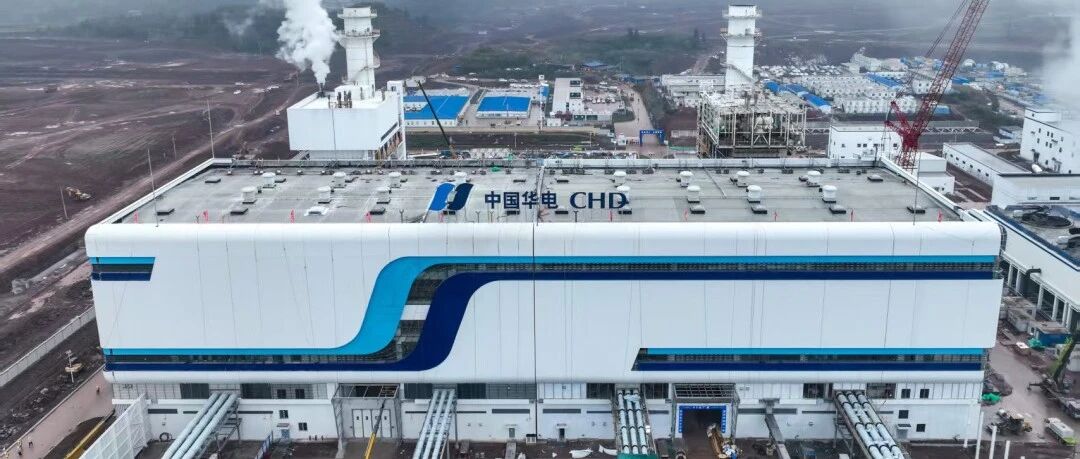
Core Viewpoint - The commissioning of China's first 550 MW F-class gas turbine unit at the Huadian Chongqing Tongnan project marks a significant breakthrough in the application of large-capacity, high-efficiency clean energy equipment in the country [2] Group 1: Project Overview - The project is located in Tongnan District, Chongqing, with a total installed capacity of 1,100,240 kW and a combined cycle efficiency of 61.66%, making it the largest and most efficient F-class heavy-duty gas turbine unit in China [2] - The project is expected to generate approximately 2.1 billion kWh of electricity annually, which can meet the annual electricity needs of 1.75 million households, while saving 200,000 tons of standard coal and reducing carbon dioxide emissions by about 860,000 tons each year [4] Group 2: Technological Advancements - The gas turbine plant operates with high efficiency, utilizing a single fuel input for two rounds of power generation, achieving an efficiency that exceeds traditional coal-fired units by over 15 percentage points [5] - The core rotor of the unit weighs 132 tons and operates at a speed of 3,000 RPM, demonstrating advanced engineering capabilities [7] Group 3: Environmental Impact - The plant's emissions are significantly lower, with no visible smoke from the chimney, indicating compliance with environmental standards. Real-time data on emissions is collected and transmitted to environmental authorities for monitoring [9] - The gas turbine unit is designed to support the integration of renewable energy sources, providing a reliable backup during fluctuations in wind and solar power generation [12] Group 4: Strategic Importance - The commissioning of this gas turbine unit is seen as a key component in China's new energy system, complementing renewable energy sources and enhancing energy security and stability [10][12] - The project aligns with China's goals for carbon peak and neutrality, contributing to the optimization of the energy structure and promoting a green and low-carbon transition [12]

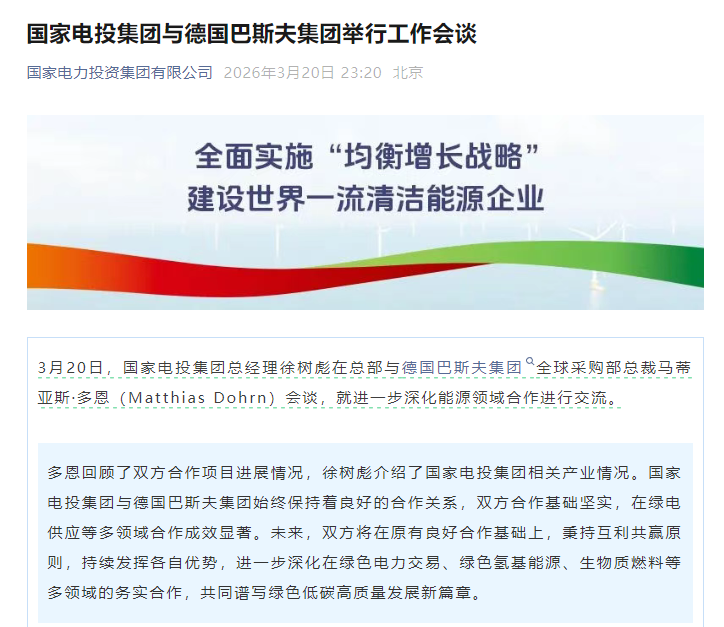
国家电投集团与德国巴斯夫集团举行工作会谈
Mei Ri Jing Ji Xin Wen· 2026-03-21 09:18
Group 1 - The core message is about the meeting between the General Manager of State Power Investment Corporation, Xu Shubiao, and Matthias Dohrn, the President of Global Procurement at BASF, focusing on deepening cooperation in the energy sector [1] - The collaboration will include practical cooperation in areas such as green power trading, green hydrogen energy, and biomass fuel [1]


1-2月全社会用电量同比增长6.1%,规上工业天然气产量同比增长2.9%
Xinda Securities· 2026-03-21 08:51
Investment Rating - The investment rating for the utility sector is "Positive" [2] Core Insights - The total electricity consumption in the first two months increased by 6.1% year-on-year, with industrial natural gas production rising by 2.9% [4] - The utility sector outperformed the broader market, with a decline of 2.4% compared to the Shanghai Composite Index's 2.2% drop [3][11] - The report highlights a potential improvement in profitability and value reassessment for the electricity sector due to ongoing supply-demand tensions and market reforms [4] Summary by Sections Market Performance - As of March 20, the utility sector declined by 2.4%, while the electricity sector fell by 2.45% and the gas sector by 1.42% [3][11] - Key companies in the electricity sector showed varied performance, with some gaining significantly while others faced declines [16] Electricity Industry Data Tracking - The price of Qinhuangdao port thermal coal (Q5500) remained stable at 731 CNY/ton as of March 20 [3][21] - Coal inventory at Qinhuangdao port increased by 580,000 tons week-on-week, totaling 7.18 million tons [27] - Daily coal consumption in inland provinces decreased by 2.79% week-on-week, with a total of 3.026 million tons [29] Natural Gas Industry Data Tracking - Domestic natural gas production in January-February reached 44.64 billion cubic meters, a year-on-year increase of 3.1% [4] - The average LNG ex-factory price in Shanghai was 4,868 CNY/ton, reflecting a year-on-year increase of 6.61% [55] - The European TTF spot price rose by 51.3% year-on-year, while the US HH spot price decreased by 22.8% [58] Key Industry News - The report notes significant growth in electricity consumption across various sectors, with the first industry seeing a 7.4% increase and the third industry 8.3% [4] - The report emphasizes the importance of ongoing reforms in the electricity market, which are expected to lead to a gradual increase in electricity prices [4] Investment Recommendations - The report suggests focusing on leading coal-fired power companies and regional leaders in electricity supply, as well as water power operators and equipment manufacturers benefiting from the new coal power cycle [4] - In the natural gas sector, companies with low-cost long-term gas sources and receiving station assets are expected to benefit from market conditions [4]
华润电力(00836):25年年报点评:业绩稳健增长,电价短期承压,不改长期价值
CMS· 2026-03-21 07:33
Investment Rating - The report maintains a "Buy" rating for China Resources Power (00836.HK) [4] Core Insights - The company reported a stable growth in performance with a total revenue of HKD 102.01 billion for 2025, a decrease of 3.1% year-on-year, while the net profit attributable to shareholders was HKD 14.52 billion, an increase of 0.9% year-on-year [1][8] - Core profit increased by 9.9% year-on-year to HKD 15.24 billion, primarily driven by improved profitability in thermal power due to coal cost optimization [8] - The company plans to distribute a final dividend of HKD 0.771 per share, with a total annual dividend of HKD 1.127 per share, resulting in a payout ratio of 40.2%, up by 0.2 percentage points year-on-year [8] Financial Performance - The company achieved a thermal power sales volume of 157.79 billion kWh in 2025, a year-on-year increase of 1.3%, despite a 6.7% decrease in the on-grid electricity price for coal power [8] - The unit fuel cost for coal-fired power plants decreased by 14% year-on-year to HKD 237.5 per MWh, contributing to a significant increase in core profit from pure thermal power, which rose by 79.8% year-on-year [8] - New energy installations increased significantly, with a total of 13.63 million kW of wind and solar capacity added, although the profitability per kWh for renewable energy faced pressure due to market price declines [8] Earnings Forecast and Valuation - The company is expected to see a contraction in thermal power performance in 2026 due to anticipated declines in long-term contract prices and limited further decreases in coal prices [8] - Projected net profits for 2026-2028 are HKD 11.90 billion, HKD 12.33 billion, and HKD 12.85 billion, reflecting year-on-year growth rates of -18%, 4%, and 4% respectively [9] - The current stock price corresponds to a price-to-earnings (PE) ratio of 8.3x for 2026, 8.0x for 2027, and 7.7x for 2028, indicating a favorable valuation outlook [8][9]

CEMIG(CIG) - 2025 Q4 - Earnings Call Transcript
2026-03-20 15:00
Financial Data and Key Metrics Changes - Recurring EBITDA reached BRL 7.3 billion, while total EBITDA including non-recurring items was BRL 8.3 billion, indicating strong cash generation to support a record investment program [3][13] - The company reported a recurring net profit of BRL 4.2 billion and a non-recurring net profit of BRL 4.9 billion, influenced by adjustments in post-employment liabilities [14][25] - The company achieved a credit rating upgrade to triple A from Moody's, reflecting significant improvement in credit quality [5] Business Line Data and Key Metrics Changes - Investments in distribution amounted to BRL 6.6 billion, with 23 new substations and over 12,000 km of low and medium voltage networks added [11][12] - In generation, BRL 411 million was invested in expansion and maintenance, while transmission saw investments of BRL 410 million focused on reinforcements and improvements [11][12] - Gasmig's Centro-Oeste project received BRL 217 million in investments, and Cemig SIM added 19 new solar plants with a total installed capacity of 68 MW [12] Market Data and Key Metrics Changes - The company experienced a 1.4% reduction in market share due to some clients migrating to the base network [26][31] - The hydrological risk management led to increased energy purchases at higher prices, impacting financial results [25][27] Company Strategy and Development Direction - The company aims to extend all its concessions, successfully securing extensions for Irapé, Queimado, and Pai Joaquim [9] - A focus on regulated sectors with guaranteed profitability supports the investment strategy, with a significant portion of investments aimed at stable revenue generation [4][9] Management's Comments on Operating Environment and Future Outlook - Management expressed confidence in the company's resilience and ability to generate sustainable results, emphasizing the importance of investments for future growth [10][24] - The company anticipates no actuarial risk from the healthcare plan for retirees, transitioning to a financial debt model [6][16] Other Important Information - The company maintained a dividend policy of distributing 50% of net profit, resulting in BRL 3.5 billion paid in dividends [7][8] - Cemig received multiple sustainability awards, including recognition in the Dow Jones Sustainability Index for 25 consecutive years [32][33] Q&A Session Summary Question: About the trading result in the fourth quarter - The trading result was positive at BRL 97 million, with plans to close positions for 2026 and 2027, aiming for future price increases starting in 2029 [35][36] Question: What is the ideal level of leverage for the company? - The current leverage is 2.3, expected to increase during the investment cycle, with a target to remain below 3.5 for credit rating evaluations [37][38] Question: Are there any plans to pay bonuses to shareholders in 2026? - Bonuses will be considered if profit reserves exceed capital stock, with evaluations ongoing throughout the year [40]

中国电力(02380.HK)年度权益持有人应占利润跌11.85%至34.04亿元 末期息每股0.168元
Ge Long Hui· 2026-03-20 14:57
Core Viewpoint - China Power (02380.HK) reported a decline in annual performance for 2025, with total revenue decreasing by 9.56% year-on-year, primarily due to reduced profit contributions from the renewable energy sector [1] Group 1: Financial Performance - The company's revenue for 2025 was RMB 49.029 billion, down 9.56% year-on-year [1] - Profit attributable to equity holders was RMB 3.404 billion, a decrease of 11.85% compared to the previous year [1] - Basic earnings per share were RMB 0.24, with a proposed final dividend of RMB 0.168 per share [1] Group 2: Sector Performance - The decline in annual profit of approximately 9.51% was mainly due to decreased profit contributions from the renewable energy sector, including hydropower, wind, and solar power [1] - Revenue from wind and solar power increased by approximately 7.78% and 3.25%, respectively, driven by several acquisition projects and new power generation units coming into commercial operation [1] - The implementation of the Chinese government's market-oriented pricing policy for renewable energy led to adjustments in average grid connection prices, negatively impacting profits in this sector [1] - The hydropower segment experienced a decline in revenue and profit due to reduced rainfall in operational areas [1] Group 3: Thermal Power Performance - Revenue from the thermal power segment decreased by approximately 19.65% following the partial divestment of equity in a coal-fired power subsidiary, which was reclassified as an associate company [1] - Despite the revenue decline, the thermal power segment's profit increased by approximately 45.76% due to lower fuel costs and effective coal procurement measures, partially offsetting the profit decline in the renewable energy sector [1] Group 4: Capacity Metrics - As of December 31, 2025, the company's consolidated installed capacity reached 54,753.7 MW, representing a year-on-year growth of 10.86% [2] - Clean energy installed capacity was 44,933.7 MW, accounting for approximately 82.07% of the total installed capacity [2]