
酒业

Search documents
酒业遇冷并不奇怪, “老天爷赏饭”的时代该换玩法了
Sou Hu Cai Jing· 2025-11-24 07:37
Core Insights - The Chinese liquor industry is undergoing significant transformation due to structural contradictions that have emerged, particularly in the context of high inventory levels and changing consumer preferences [1][2][9] Group 1: Industry Challenges - The liquor industry is facing a surplus of production capacity that has not translated into market value, leading to high social inventory and a disconnect between production and actual consumption [2][4] - The traditional distribution model, characterized by a "press goods - collect payments" logic, is no longer sustainable, necessitating a shift towards a new collaborative model between manufacturers and distributors [5][8] - The average inventory turnover days in the industry are alarmingly high at 900 days, indicating inefficiencies in the supply chain [8] Group 2: Changing Consumer Behavior - Traditional consumption scenarios in the liquor industry, such as business banquets and gift-giving, are shrinking due to changing social norms and the rise of younger consumers who prefer casual drinking experiences [9][11] - Younger consumers are increasingly viewing traditional liquor brands as outdated, leading to a disconnect between the industry's offerings and the preferences of the new generation [15][18] - The success of brands like Bubble Mart highlights a shift in consumer values from status symbols to emotional connections, indicating a need for the liquor industry to adapt to these new consumer expectations [20][21] Group 3: Innovative Strategies - Leading liquor companies are beginning to explore new distribution strategies, such as trial sales and commission-based models, to better align with market demands and reduce inventory risks [7][8] - Innovative marketing approaches, such as integrating liquor into social and artistic experiences, are being adopted to attract younger consumers and create new consumption scenarios [13][14] - The industry's future growth lies in understanding and catering to the emotional needs of consumers, moving away from traditional identity-based marketing to a focus on lifestyle and personal experiences [21]

茅台再次辟谣加盟骗局;今年白酒产量两位数下滑|观酒周报
2 1 Shi Ji Jing Ji Bao Dao· 2025-11-24 05:59
Core Viewpoint - The article highlights the ongoing issues in the liquor industry, particularly focusing on the fraudulent activities surrounding well-known brands like Moutai and Guotai, as well as the overall decline in liquor production and market value. Group 1: Fraudulent Activities - Moutai has recently refuted rumors about opening 850 direct sales stores and associated scams involving low-priced Moutai offers and fake promotional calls [2][3][4] - The fraudulent schemes often involve impersonating Moutai officials and creating a sense of urgency to deceive consumers into paying deposits or fees [3][4] - Guotai has also reported instances of trademark infringement and counterfeit products being marketed under its name, emphasizing that it has not authorized any such products [5] Group 2: Market Trends - The production of liquor has seen a significant decline, with October's output down 18.3% year-on-year, marking the fifth instance of double-digit declines this year [10][11] - For the first ten months of the year, the cumulative production of liquor has decreased by 11.5%, indicating a troubling trend for the industry [11] - The global liquor industry has lost approximately $830 billion in market value over the past four years, reflecting a structural change in consumer behavior [13] Group 3: Strategic Developments - China Resources Wine has entered a strategic partnership with China Resources Vientiane Life to develop a new sales channel for liquor products, targeting various customer segments [6][7] - Suntory has announced price increases for 187 of its products, effective April 1, 2026, due to rising costs of materials and production [8] - Guizhou Wuyou Wine has faced significant financial challenges, with a court order for over 62 million yuan in liabilities, leading to a reconsideration of potential partnerships [9]
高阳县恒酿酒业有限公司成立 注册资本300万人民币
Sou Hu Cai Jing· 2025-11-21 23:27
天眼查App显示,近日,高阳县恒酿酒业有限公司成立,法定代表人为李同才,注册资本300万人民 币,经营范围为许可项目:酒类经营(依法须经批准的项目,经相关部门批准后方可开展经营活动,具 体经营项目以批准文件或许可证件为准)一般项目:食品销售(仅销售预包装食品);信息技术咨询服 务;技术服务、技术开发、技术咨询、技术交流、技术转让、技术推广;日用百货销售;日用品销售(除依 法须经批准的项目外,凭营业执照依法自主开展经营活动)。 ...
水井坊:11月21日召开董事会会议
Mei Ri Jing Ji Xin Wen· 2025-11-21 10:01
Group 1 - The core point of the article is that Shui Jing Fang (SH 600779) held its 11th Board Meeting on November 21, 2025, via telecommunication to discuss the proposal for the second extraordinary shareholders' meeting of 2025 [1] - For the first half of 2025, the company's revenue composition shows that the liquor business accounts for 92.9%, while other businesses account for 7.1% [1] - As of the report date, Shui Jing Fang has a market capitalization of 19.4 billion yuan [1]

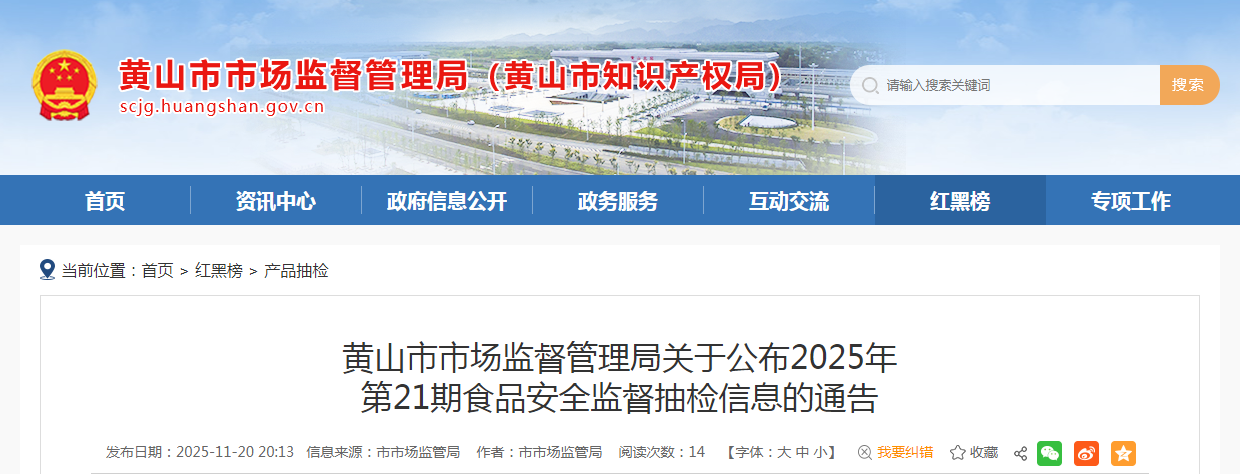
安徽省黄山市市场监督管理局关于公布2025年第21期食品安全监督抽检信息的通告
Zhong Guo Zhi Liang Xin Wen Wang· 2025-11-21 08:50
Summary of Key Points Core Viewpoint - The Huangshan Market Supervision Administration conducted a food safety inspection, revealing that out of 37 food samples tested, 36 were compliant while 1 was found to be non-compliant, prompting local regulatory actions [1]. Group 1: Inspection Results - A total of 10 categories of food were sampled, with 37 batches tested [1]. - 36 batches passed the inspection, while 1 batch was deemed non-compliant [1]. - The non-compliant product was identified as "Jinsi Huangju" tea from Huangshan Tea Qing Mountain Tea Co., with a mold count of 1300 CFU/g, exceeding the acceptable limit of 1000 CFU/g [1]. Group 2: Compliant Products - Multiple food items from various institutions, including cooking oils from Huangshan College and Huangshan Vocational Technical College, were found compliant [1]. - Other compliant products included alcoholic beverages, health supplements, and various agricultural products from local companies [1][2]. Group 3: Non-Compliant Product Details - The non-compliant product was produced by Huangshan Tea Qing Mountain Tea Co., located in Shexian Economic Development Zone, with a production date of August 18, 2025 [1]. - The specific non-compliance was related to mold levels in the tea product [1].
5亿基金启航,酒业“反周期”投资的破局与生长|AIIC2025
Sou Hu Cai Jing· 2025-11-21 07:51
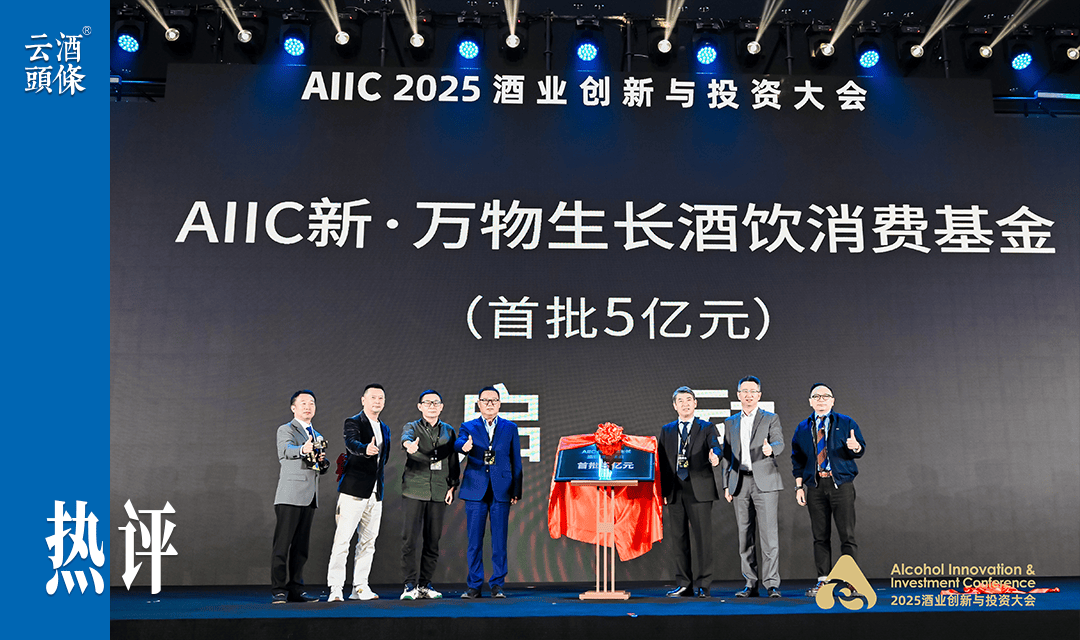
来源:市场资讯 (来源:云酒头条) "AIIC新·万物生长酒饮消费基金"的诞生跳出了"顺周期逐利"的传统逻辑,选择以"反周期布局"承接行业创新诉求。 这场"反周期"的创新投资,终将成为行业穿越周期、迈向未来的重要推力。 文|夏伟 11月19日,在厦门举办的#AIIC2025酒业创新与投资大会 现场,"AIIC新·万物生长酒饮消费基金"正式启动。 今年AIIC汇聚投资人资源,开启与晨哨集团的战略合作,通过首批5亿元酒业创新基金的投资运行,助力酒业变革力量的成长,将AIIC打造成为万物生长 的酒业森林生态。 "AIIC新·万物生长酒饮消费基金"的诞生,根植于酒业深刻的市场变革。正如AIIC创立五年来所见证的,行业正经历传统路径调整下行与创新力量孕育生 长的双重博弈。 当下,酒业消费市场既面临终端需求分化、传统营销模式失灵的现实挑战,也涌现出低度酒、健康酒、数字化营销、供应链革新等新赛道机遇。 投资领域同样处在当下困难与未来可期的十字路口,多数资本趋于谨慎,却也为精准布局创新项目留出了窗口期。 在这样的行业周期中,"AIIC新·万物生长酒饮消费基金"的诞生跳出了"顺周期逐利"的传统逻辑,选择以"反周期布局"承接行业 ...
中经酒业周报∣1-10月白酒产量达290.2万千升、1-10月葡萄酒进口量同比下降23.8%、五粮液参设智能装备公司
Xin Lang Cai Jing· 2025-11-21 03:09
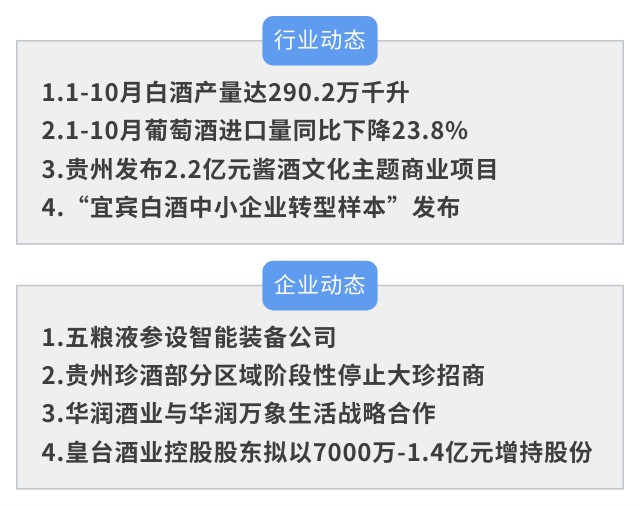
Industry Dynamics - In October, the production of liquor (calculated at 65 degrees) reached 276,000 kiloliters, a year-on-year decrease of 18.3%. From January to October, the cumulative production was 2.902 million kiloliters, down 11.5% year-on-year [3] - Wine imports in October amounted to 12.35 million liters, a year-on-year decline of 37.6%, with an import value of 742 million yuan, down 11.4%. For the first ten months, the total wine import volume was 17.849 million liters, a decrease of 23.8% [3] - Guizhou Province announced a 220 million yuan investment in a cultural theme commercial project focused on sauce liquor, expecting annual revenue of 190 million yuan upon completion [3] - A report titled "Digital Transformation Practices of Small and Medium-sized Enterprises in Yibin's Liquor Industry" was released, highlighting the challenges faced by SMEs in digital transformation, which is still in its early exploratory phase [3] Company Dynamics - Sichuan Puxi Intelligent Equipment Co., Ltd. was established with a registered capital of 25 million yuan, focusing on the development and sales of intelligent robots and AI applications [3] - Guizhou Zhenjiu announced a temporary halt to the recruitment of distributors in certain regions to ensure healthy market operations [3] - China Resources Liquor and China Resources Vientiane Life signed a strategic cooperation agreement to enhance product collaboration, including the development of high-quality customized liquor products [3] - Huangtai Liquor's controlling shareholder plans to increase its stake in the company by investing between 70 million and 140 million yuan through the secondary market within six months [3]

桃源县桃香醇酒业经营部(个体工商户)成立 注册资本2万人民币
Sou Hu Cai Jing· 2025-11-20 06:23
天眼查App显示,近日,桃源县桃香醇酒业经营部(个体工商户)成立,法定代表人为廖稳山,注册资 本2万人民币,经营范围为许可项目:酒类经营;酒制品生产。(依法须经批准的项目,经相关部门批 准后方可开展经营活动,具体经营项目以相关部门批准文件或许可证件为准)一般项目:食品互联网销 售(仅销售预包装食品);食品销售(仅销售预包装食品)。(除依法须经批准的项目外,凭营业执照 依法自主开展经营活动)。 ...
古蔺县飞洪猛酒业经营部(个体工商户)成立 注册资本2万人民币
Sou Hu Cai Jing· 2025-11-18 11:29
天眼查App显示,近日,古蔺县飞洪猛酒业经营部(个体工商户)成立,法定代表人为王志猛,注册资 本2万人民币,经营范围为许可项目:酒类经营;食品销售;烟草制品零售。(依法须经批准的项目, 经相关部门批准后方可开展经营活动,具体经营项目以相关部门批准文件或许可证件为准)一般项目: 新鲜水果批发;日用杂品销售;日用品批发;日用百货销售;日用品销售;农副产品销售;初级农产品 收购;互联网销售(除销售需要许可的商品)。(除依法须经批准的项目外,凭营业执照依法自主开展 经营活动)。 ...
第四届中国酒业活态文化·国际化大会在山西太原举行
Zhong Guo Zhi Liang Xin Wen Wang· 2025-11-18 08:07
Core Insights - The Fourth China Liquor Industry Living Culture and International Development Conference was held in Taiyuan, Shanxi, focusing on "creative transformation and innovative development" [1] - The conference released the "14th Five-Year Plan" for new cultural development in the Chinese liquor industry and initiated the drafting of the "Oral History Group Standard" for the industry [1][5] Industry Development - The concept of "living culture" is being transformed from industry consensus into corporate practice, with Fenjiu Group's chairman sharing the company's internationalization achievements, covering 72 countries and over 200 cities [2] - Fenjiu is focusing on nine key areas for internationalization, including brand operation, cultural dissemination, and product expression, adapting products for global markets [2] Cultural Significance - The essence of Chinese liquor's living culture is rooted in its brewing techniques, social customs, and aesthetic evolution, embodying cultural confidence [1][2] - The conference emphasized the need to activate the potential of "living culture" through innovative cross-border expressions and dynamic exchanges [3] Strategic Framework - The "14th Five-Year Plan" outlines key tasks, including the recognition and protection of "living culture" heritage, and aims to establish interdisciplinary support for the preservation of brewing techniques and oral traditions [4] - The establishment of the Oral History Group Standard aims to standardize the recording of brewing techniques and industry stories, preserving nearly lost oral traditions [5] Global Positioning - The conference highlighted the importance of breaking the mindset that "Chinese liquor cannot go global" and emphasized the need for cultural adaptation to diverse scenarios [2][3] - The industry is positioned to leverage its cultural heritage as a bridge for international cultural exchange, promoting Chinese liquor as a global cultural symbol [5]