
热力

Search documents
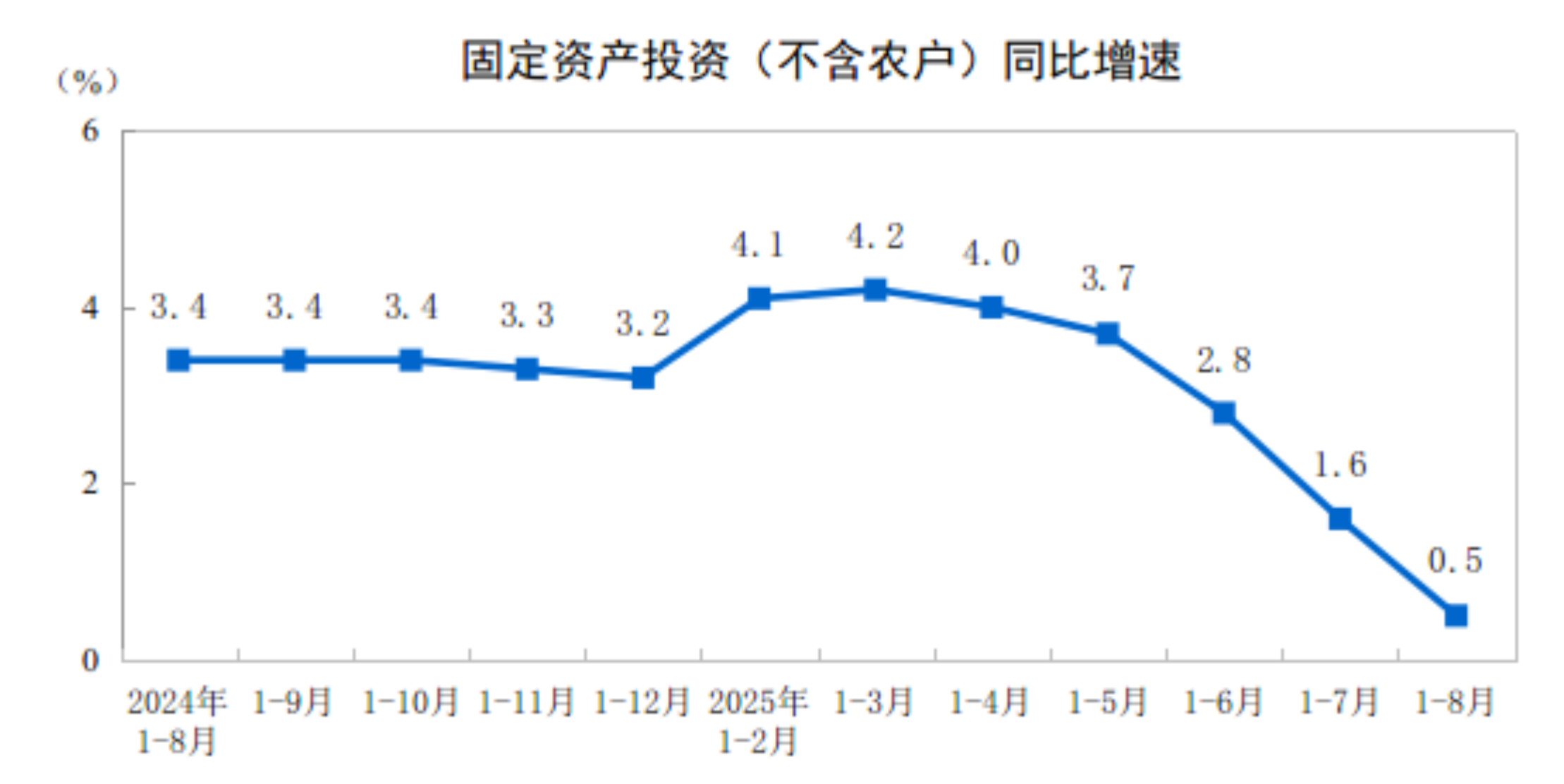
国家统计局:1—8月份全国固定资产投资增长0.5%
Guo Jia Tong Ji Ju· 2025-09-15 02:12
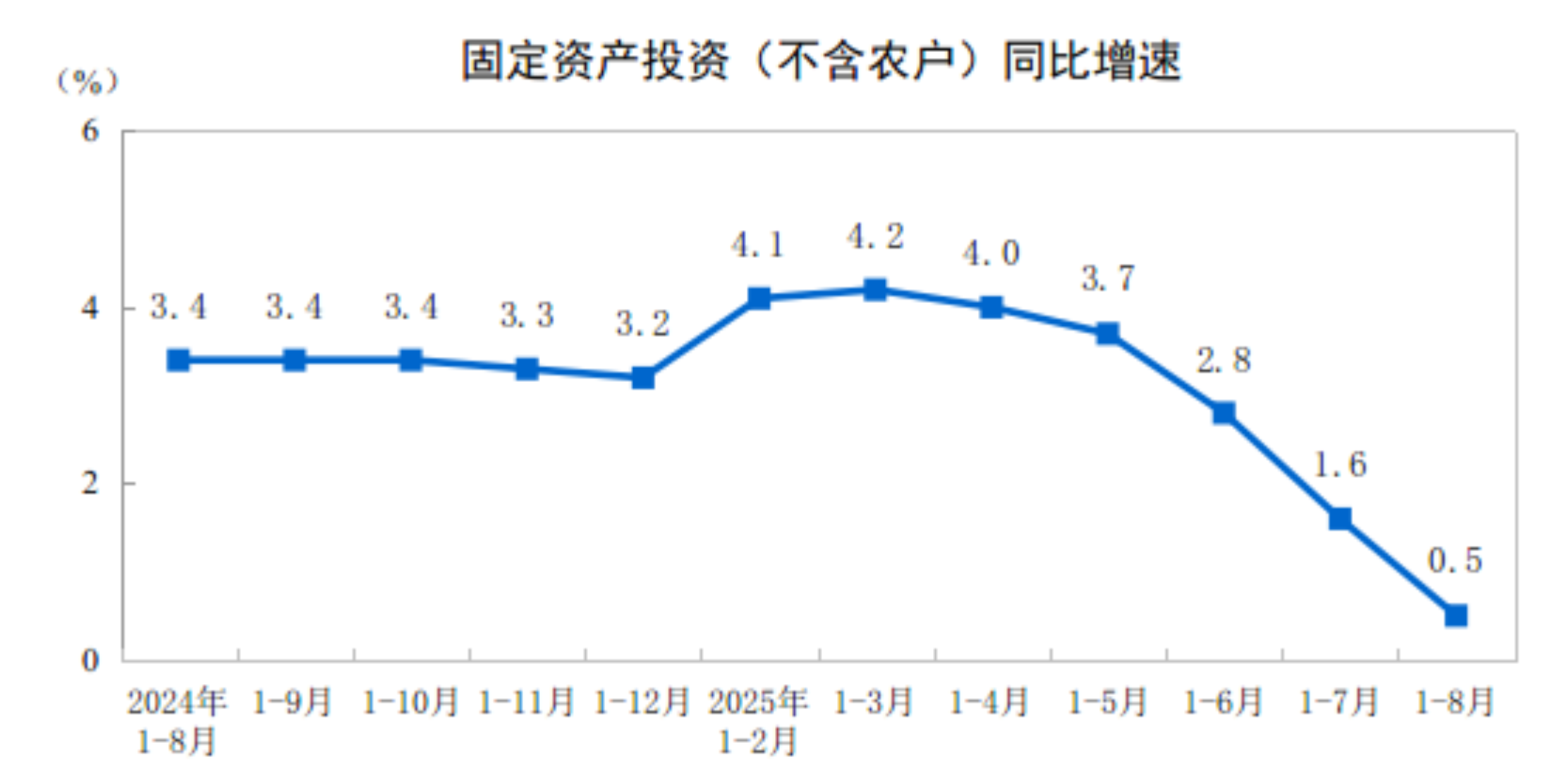
Summary of Key Points Core Viewpoint - In the first eight months of 2025, China's fixed asset investment (excluding rural households) reached 32,611.1 billion yuan, showing a year-on-year growth of 0.5%. However, private fixed asset investment declined by 2.3% [1][3]. Investment by Industry - Investment in the primary industry was 646.1 billion yuan, with a year-on-year increase of 5.5% [3]. - Investment in the secondary industry totaled 11,824.6 billion yuan, growing by 7.6%. Within this sector, industrial investment rose by 7.7%, with mining investment increasing by 3.0%, manufacturing investment by 5.1%, and investment in electricity, heat, gas, and water production and supply up by 18.8% [3]. - The tertiary industry saw investment of 20,140.4 billion yuan, which represented a decline of 3.4%. Infrastructure investment (excluding electricity, heat, gas, and water production and supply) grew by 2.0%, with notable increases in water transport investment (15.9%), water conservancy management (7.4%), and railway transport (4.5%) [3]. Investment by Region - Eastern region investment decreased by 3.5%, while the central region saw a growth of 2.5%, and the western region increased by 2.3%. The northeastern region experienced a decline of 6.0% [3]. Investment by Registration Type - Domestic enterprises' fixed asset investment grew by 0.5%, while investment from Hong Kong, Macau, and Taiwan enterprises increased by 2.3%. In contrast, foreign enterprises' fixed asset investment fell by 15.4% [3].

中国1-8月规模以上工业增加值同比增长6.2%
Guo Jia Tong Ji Ju· 2025-09-15 02:05
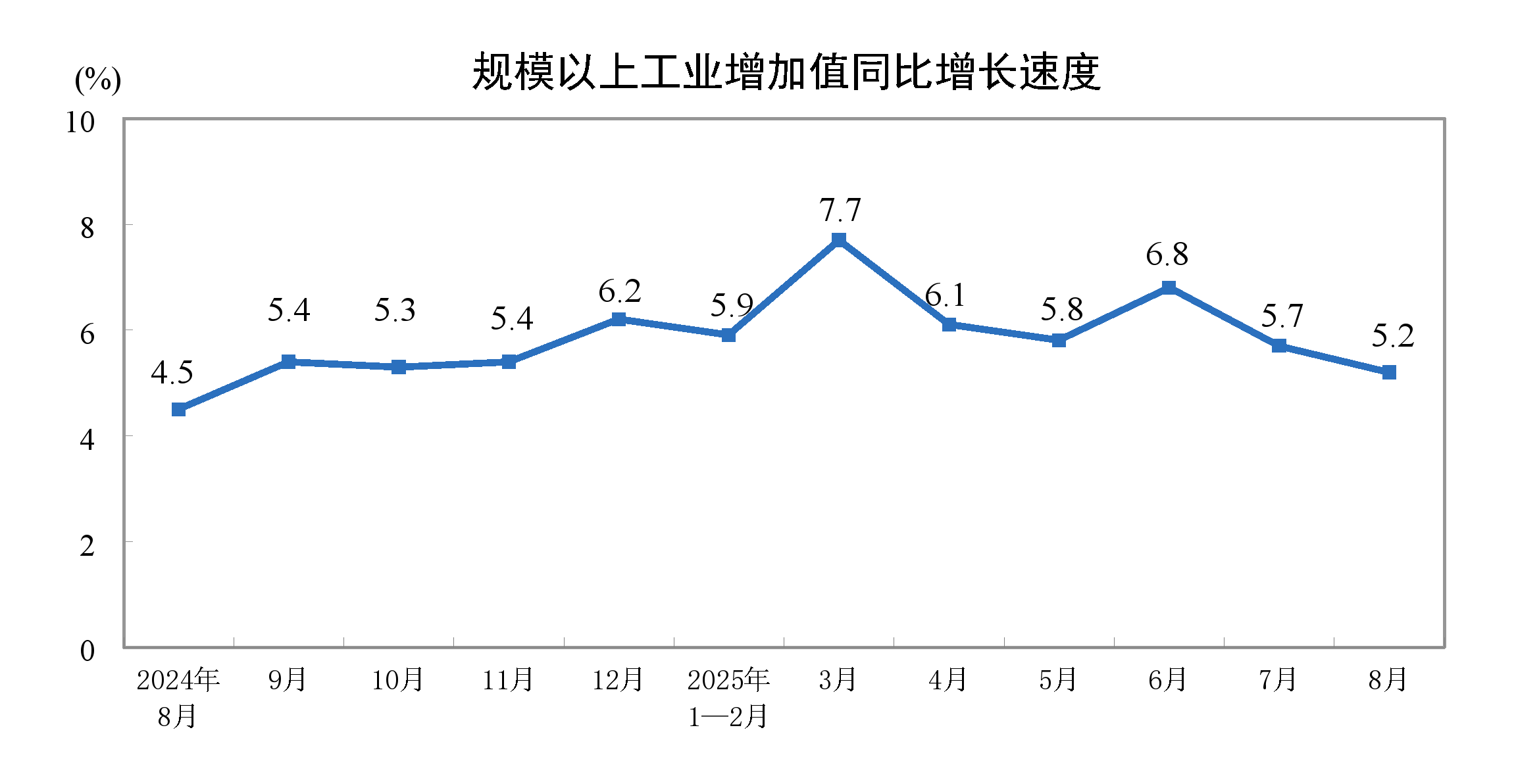
8月份,规模以上工业增加值同比实际增长5.2%(增加值增速均为扣除价格因素的实际增长率)。从环比看,8月份,规模以上工业增加值比上月增长 0.37%。1—8月份,规模以上工业增加值同比增长6.2%。 分三大门类看,8月份,采矿业增加值同比增长5.1%,制造业增长5.7%,电力、热力、燃气及水生产和供应业增长2.4%。 分经济类型看,8月份,国有控股企业增加值同比增长4.7%;股份制企业增长6.0%,外商及港澳台投资企业增长2.3%;私营企业增长4.6%。 分行业看,8月份,41个大类行业中有31个行业增加值保持同比增长。其中,煤炭开采和洗选业增长5.1%,石油和天然气开采业增长4.7%,农副食品加工业 增长4.7%,酒、饮料和精制茶制造业下降2.4%,纺织业增长1.5%,化学原料和化学制品制造业增长7.6%,非金属矿物制品业增长0.5%,黑色金属冶炼和压 延加工业增长7.3%,有色金属冶炼和压延加工业增长9.1%,通用设备制造业增长7.3%,专用设备制造业增长4.0%,汽车制造业增长8.4%,铁路、船舶、航 空航天和其他运输设备制造业增长12.0%,电气机械和器材制造业增长9.8%,计算机、通信和其他电子设备 ...
2025年8月份规模以上工业增加值增长5.2%
Guo Jia Tong Ji Ju· 2025-09-15 02:01
Economic Overview - In August, the industrial added value increased by 5.2% year-on-year, with mining growing by 5.1%, manufacturing by 5.7%, and electricity, heat, gas, and water production and supply by 2.4% [5] - Among economic types, state-controlled enterprises saw a 4.7% increase, joint-stock enterprises grew by 6.0%, foreign and Hong Kong, Macao, and Taiwan-invested enterprises increased by 2.3%, and private enterprises grew by 4.6% [5] Industry Performance - Out of 41 major industries, 31 maintained year-on-year growth in added value in August. Notable growth was seen in coal mining and washing (5.1%), oil and gas extraction (4.7%), and chemical raw materials and products manufacturing (7.6%) [2][5] - The automotive manufacturing sector experienced an 8.4% increase, while the railway, shipbuilding, aerospace, and other transportation equipment manufacturing grew by 12.0% [2][5] Product Output - In August, among 623 industrial products, 319 saw year-on-year output growth. Steel production reached 12.277 million tons, up 9.7%, while cement production fell by 6.2% to 14.802 million tons [3][5] - The output of new energy vehicles surged by 22.7% to 1.333 million units, contributing to a total automotive production of 2.752 million units, which is a 10.5% increase [3][5] Sales and Exports - The sales rate of products from large-scale industrial enterprises was 96.6%, a decrease of 0.1 percentage points year-on-year. The export delivery value reached 1.3029 trillion yuan, reflecting a nominal decline of 0.4% [4][5]
8月份国民经济运行总体平稳、稳中有进
Guo Jia Tong Ji Ju· 2025-09-15 02:01
Economic Overview - In August, the national economy maintained overall stability with a steady growth trend, supported by strong leadership and effective macroeconomic policies [2][10] - The industrial production showed a year-on-year increase of 5.2% in August, with a month-on-month growth of 0.37% [3][18] - The service sector's production index grew by 5.6% year-on-year in August, indicating a positive trend in modern service industries [4][18] Industrial Production - The industrial value-added for large-scale enterprises increased by 6.2% from January to August, with manufacturing and high-tech manufacturing sectors growing by 5.7% and 9.3% respectively [3][18] - Notable product growth included 3D printing equipment (40.4%), new energy vehicles (22.7%), and industrial robots (14.4%) [3][18] Service Sector - The service industry saw a production index increase of 5.9% from January to August, with significant growth in information transmission, software, and financial services [4][18] - The business activity index for the service sector was at 50.5 in August, indicating expansion [4][18] Retail Sales - The total retail sales of consumer goods reached 39,668 billion yuan in August, a year-on-year increase of 3.4% [5][18] - Online retail sales amounted to 99,828 billion yuan from January to August, growing by 9.6% year-on-year [5][18] Fixed Asset Investment - Fixed asset investment (excluding rural households) was 326,111 billion yuan from January to August, with a year-on-year growth of 0.5% [6][18] - Manufacturing investment increased by 5.1%, while real estate development investment saw a decline of 12.9% [6][18] Trade and Exports - The total value of goods imports and exports reached 38,744 billion yuan in August, with exports growing by 4.8% [7][18] - From January to August, the total trade value was 295,696 billion yuan, reflecting a year-on-year increase of 3.5% [7][18] Employment - The urban surveyed unemployment rate was 5.3% in August, showing a slight increase from the previous month [8][18] - The average working hours for employees were reported at 48.5 hours per week [8][18] Price Trends - The Consumer Price Index (CPI) decreased by 0.4% year-on-year in August, with food prices dropping by 2.5% [9][19] - The Producer Price Index (PPI) for industrial producers fell by 2.9% year-on-year, indicating a narrowing decline [9][19]

2025年1—8月份全国固定资产投资增长0.5%
Guo Jia Tong Ji Ju· 2025-09-15 02:00
Core Insights - The total fixed asset investment (excluding rural households) in China from January to August 2025 reached 32,611.1 billion yuan, showing a year-on-year growth of 0.5% on a comparable basis [1][5] - Private fixed asset investment experienced a decline of 2.3% year-on-year [1][5] Investment by Industry - Investment in the primary industry amounted to 646.1 billion yuan, with a year-on-year increase of 5.5% [3][6] - The secondary industry saw an investment of 11,824.6 billion yuan, growing by 7.6% year-on-year, with industrial investment specifically increasing by 7.7% [3][6] - The tertiary industry investment totaled 20,140.4 billion yuan, reflecting a year-on-year decrease of 3.4% [3][6] - Within the secondary industry, mining investment grew by 3.0%, manufacturing investment increased by 5.1%, and investment in electricity, heat, gas, and water production and supply surged by 18.8% [3][6] Investment by Region - Eastern region investment declined by 3.5% year-on-year, while the central region saw a growth of 2.5%, and the western region increased by 2.3%. The northeastern region experienced a decline of 6.0% [3] Investment by Registration Type - Domestic enterprises' fixed asset investment grew by 0.5%, while investment from Hong Kong, Macau, and Taiwan enterprises increased by 2.3%. In contrast, foreign enterprises' investment fell by 15.4% [4][6]
信披指南“扩容”助推ESG信披“提质” A股公司国际评级领先阵营加速壮大
Zhong Guo Jing Ying Bao· 2025-09-05 15:20
Core Viewpoint - The new regulations on ESG disclosure for listed companies in China aim to enhance the quality of sustainable development information reporting and guide companies in implementing sustainable practices [1][4]. Group 1: New Guidelines - The revised "Guidelines for the Preparation of Sustainable Development Reports" now includes three new application guidelines focusing on "Pollutant Emissions," "Energy Utilization," and "Water Resource Utilization," expanding the framework to five specific topics [1][2]. - The new guidelines provide detailed guidance on common risks and opportunities related to pollutant emissions, energy utilization, and water resource management, without imposing additional mandatory disclosure requirements [2][3]. Group 2: Improvement in Disclosure Quality - As of the end of 2024, 32% of companies listed on the Shanghai and Shenzhen stock exchanges have seen improvements in their MSCI ESG ratings, with the proportion of companies rated AAA or AA rising from 0% five years ago to 7.2% [1]. - The overall quality of sustainable information disclosure among A-share listed companies has improved, with a disclosure rate of 46.09% in 2024, and significant progress in climate-related disclosures [5]. - The financial sector had the highest disclosure rate at 91.94%, followed by the electricity, heat, gas, and water production and supply sectors at 75.69%, and the transportation, warehousing, and postal sectors at 72.32% [5].
前7月化学原料和化学制品制造业实现利润总额2133.9亿元
Zhong Guo Chan Ye Jing Ji Xin Xi Wang· 2025-09-04 01:04
Core Insights - In the first seven months of the year, the total profit of industrial enterprises above designated size in China reached 40,203.5 billion yuan, a year-on-year decrease of 1.7% [1] - The profit of the petroleum and natural gas extraction industry fell by 12.6%, while the chemical raw materials and chemical products manufacturing industry saw a decline of 8.0% [1] - State-owned enterprises reported a profit of 12,823.4 billion yuan, down 7.5%, while private enterprises experienced a profit increase of 1.8% to 11,183.7 billion yuan [1] Industry Performance - The mining industry suffered a significant profit drop of 31.6%, while the manufacturing sector achieved a profit growth of 4.8% [1] - The electricity, heat, gas, and water production and supply industry reported a profit increase of 3.9% [1] - Key industries such as agricultural and sideline food processing saw a profit increase of 14.5%, and electrical machinery and equipment manufacturing grew by 11.7% [2] Financial Metrics - The total operating revenue for industrial enterprises was 78.07 trillion yuan, reflecting a year-on-year growth of 2.3%, with operating costs rising by 2.5% to 66.80 trillion yuan [2] - The operating profit margin decreased by 0.21 percentage points to 5.15% [2] - As of the end of July, total assets of industrial enterprises amounted to 183.67 trillion yuan, a 4.9% increase year-on-year, while total liabilities grew by 5.1% to 106.26 trillion yuan [2] Accounts and Inventory - Accounts receivable reached 26.84 trillion yuan, up 6.8%, and finished goods inventory was 6.67 trillion yuan, increasing by 2.4% [3] - The cost per 100 yuan of operating revenue was 85.57 yuan, an increase of 0.24 yuan year-on-year [3] - The average collection period for accounts receivable extended to 69.8 days, an increase of 3.7 days compared to the previous year [3] Monthly Trends - In July, the profit of industrial enterprises decreased by 1.5% year-on-year [4]
宏观经济与转债策略研究系列之一:反内卷:宏观演变、行业分化和转债策略
EBSCN· 2025-09-01 03:05
Group 1 - The current "anti-involution" policy is characterized by administrative directives or legal measures to limit production capacity in upstream industries, while downstream industries rely on self-discipline to reduce competition [1][45]. - The "anti-involution" phenomenon began with the concentration of orders in mid-2020, leading to capacity expansion until mid-2021, followed by a decline in global demand in the second half of 2021 and subsequent recovery of supply [1][45]. - Industrial enterprises experienced a dual decline in revenue and profit in 2022, but began to exchange price for volume in 2023, resulting in increased revenue but decreased profitability [1][45]. Group 2 - The report categorizes industries based on revenue quality, revenue capability, and asset quality, leading to three classifications: stable allocation, opportunistic allocation, and cautious allocation [2][46]. - Stable allocation industries are those with consistently rising revenue profit margins, while opportunistic allocation includes industries with rising revenue growth but declining profit margins, excluding those with significantly rising debt ratios [2][46]. - Cautious allocation includes industries with rising revenue but declining profit margins and increasing debt ratios, as well as those with both declining revenue and profit margins [2][46]. Group 3 - The report outlines three convertible bond strategies: stable allocation, opportunistic allocation, and cautious allocation, each with two different bond portfolios [3]. - The performance of these portfolios from 2022 to 2024 indicates that stable allocation portfolios performed better, while opportunistic allocation showed a larger decline in 2022 but outperformed cautious allocation in 2023 and 2024 [4]. - From 2025 onwards, the performance of different portfolios needs to be observed in two phases, with the first half of 2025 showing good performance for opportunistic allocation and cautious allocation portfolios [4].
规上工业增加值增长10.1%,惠州前7月经济数据发布
Nan Fang Du Shi Bao· 2025-08-29 02:19
Economic Overview - The overall economic operation of Huizhou is stable, with a focus on high-quality development and effective implementation of macro policies during January to July 2025 [2] Industrial Production - The industrial added value of above-scale enterprises increased by 10.1% year-on-year, with mining decreasing by 4.1%, manufacturing growing by 10.4%, and utilities increasing by 6.2% [2] - The electronic industry grew by 14.4%, petrochemical energy and new materials by 5.6%, and life health manufacturing by 10.3% [2] - Advanced manufacturing added value increased by 10.3%, accounting for 61.7% of the total industrial added value, while high-tech manufacturing increased by 13.9%, making up 42.5% [2] Fixed Asset Investment - Fixed asset investment decreased by 20.3% year-on-year, with cultural, sports, and entertainment investment increasing by 57.5%, while manufacturing investment fell by 11.4% [2] - New commercial housing sales area dropped by 33.3% [2] Consumer Market - The total retail sales of social consumer goods reached 1210.47 billion yuan, growing by 4.8%, with urban retail sales increasing by 5.1% and rural retail sales by 3.6% [3] - Online retail sales surged by 43.5% [3] Foreign Trade - The total foreign trade import and export volume reached 2374.65 billion yuan, growing by 6.8%, with exports at 1342.41 billion yuan (up 7.5%) and imports at 1032.24 billion yuan (up 5.9%) [3] Fiscal and Financial Performance - General public budget revenue was 282.48 billion yuan, up 2.9% year-on-year, while total tax revenue decreased by 1.9% [3] - By the end of July, financial institutions' deposits reached 9687.93 billion yuan, growing by 4.0%, and loans reached 11297.44 billion yuan, increasing by 3.6% [3] Consumer Price Index - The Consumer Price Index (CPI) decreased by 0.7% year-on-year, with food and tobacco prices down by 0.2% and clothing prices up by 6.5% [4][5]

7月中国企业信用指数为160.10 总体保持高位运行态势
Zhong Guo Chan Ye Jing Ji Xin Xi Wang· 2025-08-27 23:34
Core Insights - In July, China's enterprise credit index stood at 160.10, showing a slight decline due to complex external environments and adverse domestic weather conditions, but overall remains at a high operational level [1] - The index decreased by 2.35 points from June, influenced by an increase in the number of enterprises listed in the abnormal operation directory, although the overall credit level remains resilient [1] Regional Performance - The top five regions in terms of credit index in July were Beijing, Anhui, Tianjin, Chongqing, and Shaanxi, with Beijing's index rising and reclaiming the top position nationally [1] - Most regions experienced a decline in credit index, with Tianjin and Fujian showing smaller declines and significant improvements in rankings [1] Industry Performance - The top five industries by credit index in July were finance, electricity, heat, gas, and water production and supply, residential services, repair and other services, manufacturing, and water conservancy, environment, and public facilities management [1] - Despite a general decline across industries, the agriculture, forestry, animal husbandry, and fishery sector saw a significant rise in its index, while the mining industry experienced growth, indicating a positive trend [1]