
智能电动汽车

Search documents
小米汽车从铜陵到成都的198天
Di Yi Cai Jing· 2025-10-15 22:45
Core Viewpoint - Xiaomi's automotive division is facing significant challenges related to safety and product quality, highlighted by two fatal accidents within 198 days, leading to a decline in market reputation and increased scrutiny from regulatory bodies [1][3][5]. Group 1: Recent Incidents and Public Response - The recent accident involving the Xiaomi SU7 Ultra in Chengdu resulted in severe vehicle damage and fatalities, occurring shortly after a previous incident in Anhui [1][5]. - Following the Chengdu accident, Xiaomi's chairman Lei Jun continued to promote the company's products on social media without directly addressing the incident or offering condolences to the victims' families, leading to public backlash and loss of followers [4][5]. - The company has faced multiple controversies, including issues with the SU7 Ultra's carbon fiber hood and a large-scale recall due to software quality problems [5][6]. Group 2: Regulatory Developments - The accidents have prompted the introduction of new national safety standards for electric vehicles, focusing on battery safety, door handle functionality, and the reliability of advanced driver-assistance systems [8][9][10]. - The Ministry of Industry and Information Technology has emphasized the need for rigorous testing and clear communication regarding the capabilities and limitations of intelligent driving systems [8][9]. - New standards require that vehicle doors must be operable without tools in emergency situations, directly addressing the issues raised by the accidents involving Xiaomi vehicles [10]. Group 3: Company Strategy and Leadership - Lei Jun has acknowledged the difficulties faced in the automotive sector, emphasizing the challenges of vehicle manufacturing and the high expectations from the public [7]. - Despite the controversies, Xiaomi's new model YU7 saw significant initial demand, with over 240,000 orders within 18 hours of launch, raising questions about the authenticity of these figures [6]. - The company has not publicly addressed the safety concerns in its promotional materials, focusing instead on product features and performance [7].


机器人概念股早盘回调,机器人ETF易方达(159530)获近1亿份净申购
Mei Ri Jing Ji Xin Wen· 2025-10-10 05:26
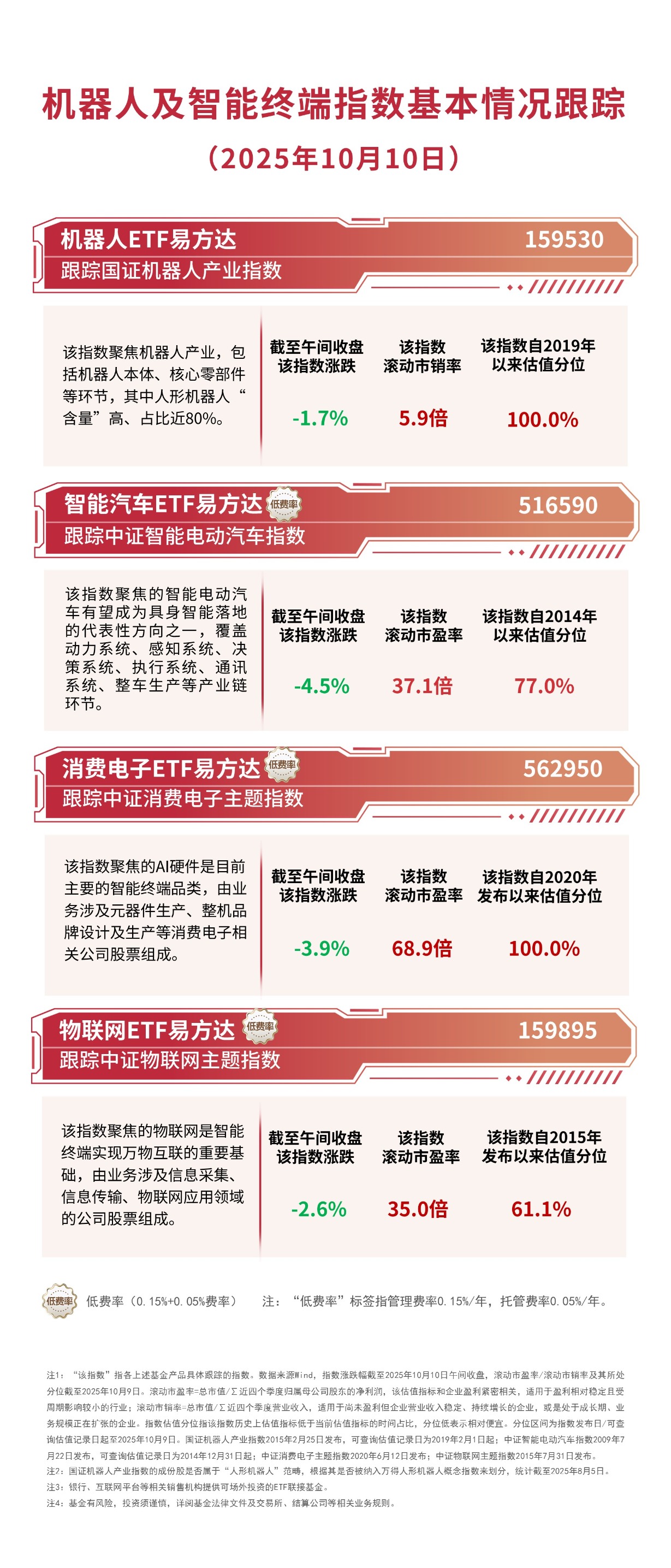
Group 1 - The index focuses on AI hardware, which is currently a major category of smart terminal products, including companies involved in component production, complete machine manufacturing, and design in the consumer electronics sector [3] - The index experienced a decline of 3.9% as of the midday close [3] - Since its launch in 2020, the index has a rolling market rate of 68.9 times and a valuation percentile of 100% [3]

智能车ETF泰康(159720)涨超2%,智能驾驶技术加速落地,端到端大模型推动智驾能力飞跃
Xin Lang Cai Jing· 2025-10-09 07:01
Core Insights - The smart vehicle ETF, Taikang (159720), has seen a 2.07% increase, marking its third consecutive rise, with the underlying index, the CSI Smart Electric Vehicle Index (H11052), up by 2.22% [1] - Major electric vehicle manufacturers, including Xiaopeng, NIO, and Li Auto, reported record-high monthly deliveries for September, indicating strong market demand [1] - The Ministry of Industry and Information Technology has released a draft for mandatory national standards for intelligent connected vehicles, which is expected to enhance consumer trust in smart driving technologies [2] Group 1: ETF Performance and Market Trends - The smart vehicle ETF Taikang (159720) reached a new high in size at 70.4062 million yuan as of September 30, with a significant increase of 200,000 shares over the past two weeks [1] - Key stocks within the ETF, such as Chipone Technology (688521) and Ganfeng Lithium (002460), have shown substantial gains, with increases of 12.84% and 9.00% respectively [1] - The ETF employs a full replication strategy to closely track the CSI Smart Electric Vehicle Index, outperforming its benchmark by 0.41% in Q2 2025 [3] Group 2: Industry Developments and Standards - The newly proposed national standards for intelligent driving systems include features for hand and gaze detection, which are expected to increase the penetration of L2 and higher-level driving functions [2] - The introduction of these standards is anticipated to expand the market for essential components such as lidar, high-performance driving chips, and driver monitoring systems [2] Group 3: Investment Opportunities - The ETF covers critical segments of the smart driving industry, with top holdings in companies like CATL and BYD, which are well-positioned to benefit from the dual trends of electrification and intelligence in vehicles [4][5] - The ETF's top ten holdings account for 55.33% of its total weight, indicating a strong focus on companies that are integral to the L4 autonomous driving supply chain [3] - Investors are encouraged to monitor developments in smart driving regulations and pilot operations of Robotaxi services to capitalize on investment opportunities in the smart driving sector [3]



消费电子板块大幅走强,消费电子ETF易方达(562950)助力布局产业链龙头
Sou Hu Cai Jing· 2025-10-09 05:16
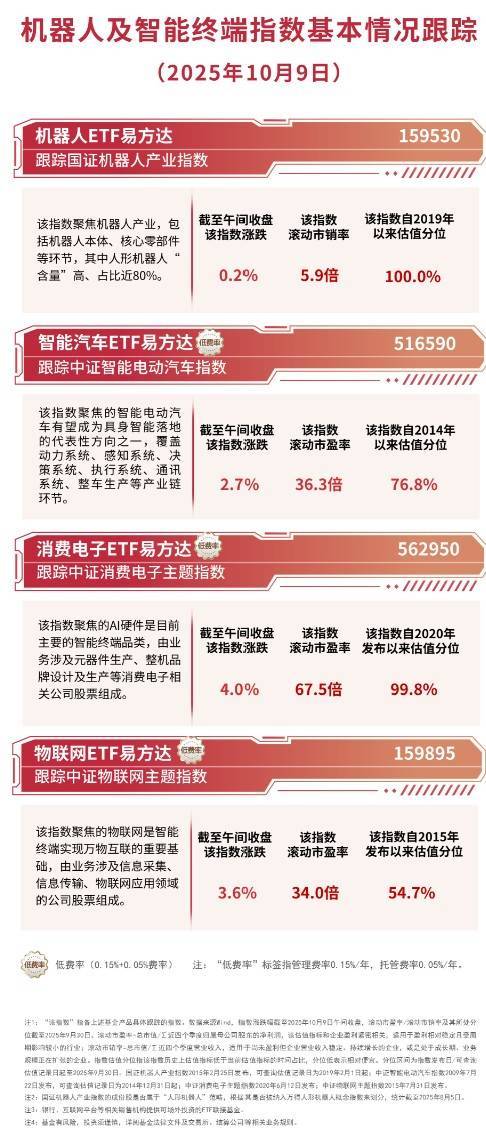
Group 1 - The National Robot Industry Index increased by 0.2% as of the midday close [1] - The China Securities Intelligent Electric Vehicle Index rose by 2.7% [1] - The China Securities Consumer Electronics Theme Index saw a rise of 4.0% [1] - The China Securities Internet of Things Theme Index increased by 3.6% [1] - As of September 30, the E Fund Consumption Electronics ETF (562950) experienced a net inflow of over 400 million yuan in the last 10 trading days [1]
小鹏汽车-W9月创记录交付智能电动汽车41581辆,同比增长95%
Zhi Tong Cai Jing· 2025-10-02 10:58
Core Insights - Xpeng Motors achieved a record delivery of 41,581 smart electric vehicles in September 2025, representing a year-on-year increase of 95% and a month-on-month growth of 10%, surpassing the milestone of 40,000 monthly deliveries [1] - In Q3 2025, Xpeng Motors delivered a total of 116,007 smart electric vehicles, marking a year-on-year growth of 149% [1] - Cumulatively, Xpeng Motors delivered 313,196 vehicles in the first nine months of 2025, which is a 218% increase compared to the same period in 2024 [1] Delivery Milestones - The 10,000th all-new Xpeng P7 rolled off the production line in September 2025, making it the fastest model to achieve a production rate of 40 vehicles per hour on the new production line [1] ESG Rating - Xpeng Motors maintained its "AAA" rating from MSCI ESG for three consecutive years, which is the highest global rating, reinforcing the company's leading position in the global automotive industry [1] Technology and User Engagement - The monthly active user penetration rate for Xpeng's intelligent navigation assisted driving (XNGP) reached 83% in urban driving scenarios as of September 2025 [1] - The company launched the VLA-driven version of XNGP, featuring a full-scenario parking-to-parking intelligent assisted driving system (ADAS), initially applied to the all-new Xpeng P7 and G7 Ultra models [1]
小鹏汽车-W(09868)9月创记录交付智能电动汽车41581辆,同比增长95%
智通财经网· 2025-10-02 10:54
Core Insights - Xiaopeng Motors achieved a record delivery of 41,581 smart electric vehicles in September 2025, representing a year-on-year growth of 95% and a month-on-month increase of 10%, surpassing the milestone of 40,000 monthly deliveries [1] - In Q3 2025, the total delivery of smart electric vehicles reached 116,007 units, marking a year-on-year increase of 149% [1] - Cumulatively, Xiaopeng Motors delivered 313,196 vehicles in the first nine months of 2025, a significant increase of 218% compared to the same period in 2024 [1] Delivery Milestones - The 10,000th all-new Xiaopeng P7 rolled off the production line in September 2025, making it the fastest model to achieve a production rate of 40 vehicles per hour on the new production line [1] ESG Rating - Xiaopeng Motors maintained its "AAA" MSCI ESG rating in September 2025, the highest global rating, reinforcing its leading position in the global automotive industry [1] Technology and User Engagement - The monthly active user penetration rate for Xiaopeng's intelligent navigation assisted driving (XNGP) reached 83% in urban driving scenarios as of September 2025 [1] - The company launched the VLA driving version of XNGP, featuring a full-scenario parking-to-parking intelligent driving assistance system (ADAS), initially applied to the all-new Xiaopeng P7 and G7 Ultra models [1]
小鹏汽车(09868) - 自愿公告 2025年9月及第三季度智能车交付数据
2025-10-02 10:47
2025年9月,小鵬汽車智能導航輔助駕駛(XNGP)的城區智駕月度活躍用戶滲透率達 83%。本公司已推出VLA驅動版XNGP,具備全場景車位到車位智能輔助駕駛系統 (ADAS)功能,並已首先應用於全新小鵬P7和G7 Ultra車型。 香港交易及結算所有限公司及香港聯合交易所有限公司對本公告之內容概不負責,對其準確性或完整性亦 不發表聲明,並明確表示概不會就本公告全部或任何部分內容而產生或因依賴該等內容而引致之任何損失 承擔任何責任。 自願公告 2025 年 9 月及第三季度智能車交付數據 XPeng Inc. (「本公司」或「小鵬汽車」)之董事會欣然宣佈其2025年9月及第三季度 車輛交付數據。 2025年9月,小鵬汽車創記錄交付智能電動汽車41,581輛,同比增長95%,較上月增長 10%,超過每月交付40,000輛的里程碑。2025年第三季度,小鵬汽車共交付智能電動汽 車116,007輛,同比增長149%。2025年前九個月,小鵬汽車累計交付量達到313,196輛, 較2024年同期增長218%。 2025年9月,第10,000輛全新小鵬P7正式下線,小鵬P7成為本公司車型中在新生產線上 最快達成40JP ...
机器人产业指数冲击节前二连涨,机器人ETF易方达(159530)半日净申购超2000万份
Mei Ri Jing Ji Xin Wen· 2025-10-02 10:44
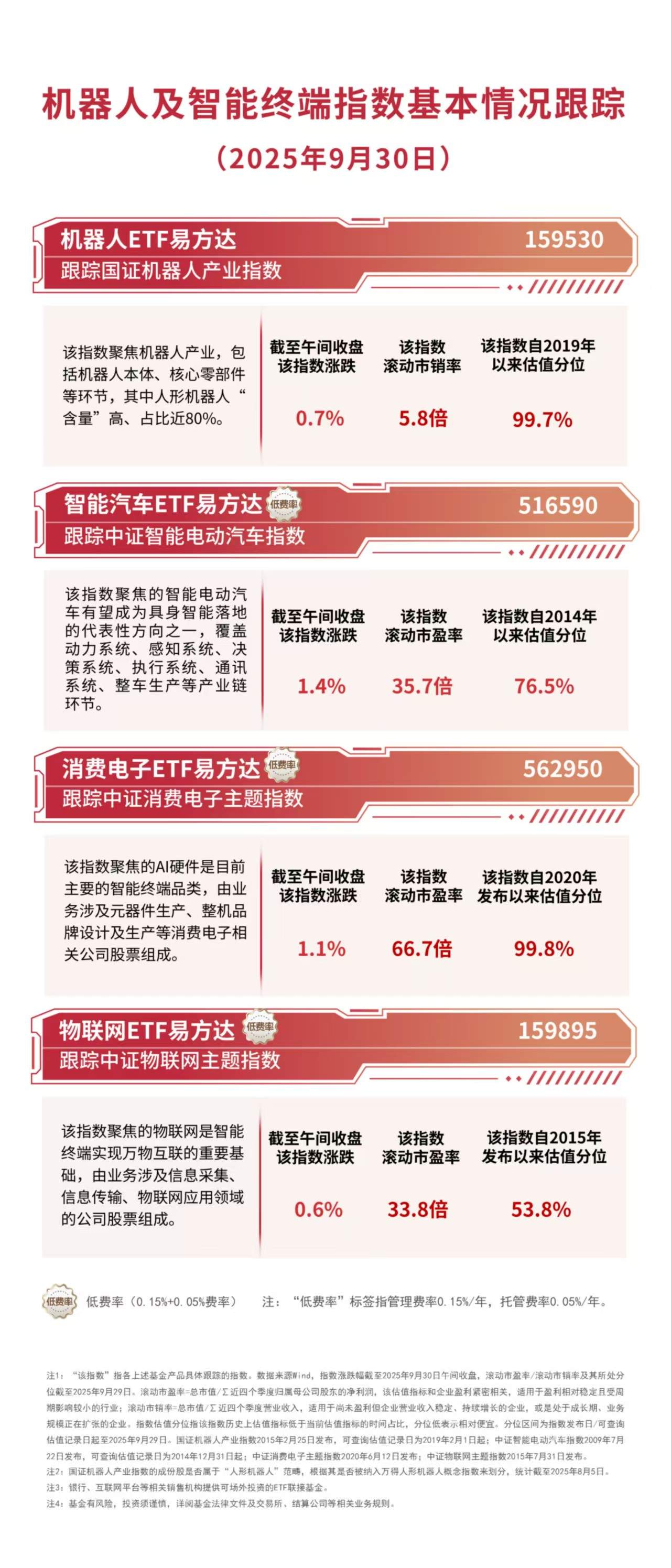
Group 1 - The index experienced a rise of 1.4% with a rolling price-to-earnings ratio of 35.7 times, reflecting a valuation increase of 76.5% since its inception [3] - Another index showed an increase of 1.1% with a rolling price-to-earnings ratio of 66.7 times, indicating a valuation increase of 99.8% since its launch [5] - A different index reported a rise of 0.6% with a rolling price-to-earnings ratio of 33.8 times, marking a valuation increase of 53.8% since its introduction [6]
蔚来(09866) - 自愿公告 - 2025年9月及第三季度交付更新资料
2025-10-01 10:05
根據不同投票權架構,我們的股本包括A類普通股及C類普通股。對於提呈我們股東大會的任 何決議案,A類普通股持有人每股可投一票,而C類普通股持有人則每股可投八票,惟法律或 《香港聯合交易所有限公司證券上市規則》或我們的組織章程大綱及細則另行規定者除外。股東 及有意投資者務請留意投資不同投票權架構公司的潛在風險。我們的美國存託股(每股美國存 託股代表一股A類普通股)於美國紐約證券交易所上市,股份代號為NIO。 蔚來集團 (於開曼群島註冊成立以不同投票權控制的有限責任公司) (股份代號:9866) 自願公告 2025年9月及第三季度交付更新資料 本公司創下月度及季度交付量新高紀錄 於2025年10月1日 - 全球智能電動汽車市場的先驅及領跑者蔚來集團(紐交所: NIO;港交所:9866;新交所:NIO)(「蔚來」或「本公司」)宣佈其於2025年9月及 第三季度的交付結果。 本公司於2025年9月交付34,749輛汽車,創下月度新紀錄,同比增長64.1%。有 關交付包括本公司旗下蔚來品牌的高端智能電動汽車13,728輛,本公司樂道品 牌的家庭智能電動汽車15,246輛,以及本公司螢火蟲品牌的智能電動高端小車 5,775 ...

月交付突破3.4万台!同比增长64%,蔚来体系化优势开启增长新纪元
Zhi Tong Cai Jing· 2025-10-01 08:50
Core Insights - NIO achieved a significant milestone in September 2025, delivering 34,749 vehicles, marking a 64% year-on-year increase, with cumulative deliveries reaching 872,785 units [1] - The company's success is attributed to its deep understanding of the smart electric vehicle industry, focusing on technology, product planning, and product definition [1] - NIO's high R&D investment, totaling over 60 billion yuan over ten years, has begun to yield substantial returns in 2025 [2] Delivery Performance - In September 2025, NIO delivered 34,749 new vehicles, with 13,728 from the NIO brand, 15,246 from the Ladao brand, and 5,775 from the Firefly brand [1] - Cumulative deliveries include 762,176 from the NIO brand, 90,279 from the Ladao brand, and 20,330 from the Firefly brand [1] Technological Advancements - NIO's R&D focus on the "new three key components"—intelligent driving chips, full-domain operating systems, and intelligent chassis—has established a technological moat [2] - The launch of the world's first mass-produced 5nm intelligent driving chip, "Shenji NX9031," signifies a major industry milestone, enhancing NIO's competitive edge [2] Infrastructure Development - NIO has established over 8,200 battery swap stations, creating a robust network that alleviates charging anxiety for users [3] - The successful deployment of the Ladao L60 and the new ES8 showcases the effectiveness of NIO's energy replenishment system [3] Market Positioning - The Ladao L90 and the new ES8 have successfully penetrated the large three-row SUV market, traditionally dominated by fuel vehicles, demonstrating NIO's strong market presence [4][5] - The Ladao L90 achieved over 20,000 deliveries within 60 days of launch, indicating strong consumer demand and effective product positioning [4] Future Outlook - NIO aims to increase production capacity for the new ES8 to 10,000 units by October and 15,000 units by December, with an overall monthly production target of 25,000 units [5] - The successful launch of these flagship models signals a shift in consumer acceptance of electric vehicles, particularly in the large SUV segment [6][7]