消费金融

Search documents
看完日本消费贷款发展史,我知道了为什么大家活得这么累
Sou Hu Cai Jing· 2025-12-10 05:47
Core Insights - The history of consumer loans in Japan serves as a cautionary tale, illustrating the impact of economic cycles on borrowing behavior and the consequences of high-interest loans [1][5][9] Group 1: Historical Development - The origins of consumer loans in Japan can be traced back to the 1950s, during the post-war economic recovery, with Osaka emerging as a hub for consumer finance [1] - The Tokyo Olympics in 1964 significantly boosted consumer demand, leading to a rise in consumer loans as people sought to purchase durable goods [1][3] - By the 1970s, the scale of consumer loans expanded, but issues such as defaults and predatory lending practices began to surface, prompting government intervention with the introduction of the Money Lending Business Control Law in 1983 [1][5] Group 2: Economic Boom and Bubble - The late 1980s saw an economic bubble fueled by easy access to credit, with consumer finance companies shifting from small unsecured loans to larger secured loans, contributing to rising asset prices [3] - The bubble burst in 1990, leading to a prolonged economic downturn known as the "Lost Decade," yet consumer finance companies continued to operate aggressively, introducing automated loan machines and extensive advertising [3][5] Group 3: Regulatory Changes and Consequences - High-interest rates, averaging 29.2%, led to widespread borrower defaults and the emergence of debt slavery, prompting the government to enact stricter regulations in 2006 [5][9] - The implementation of the Interest Rate Restriction Law forced many consumer finance companies, including major players like Wakuichi, into bankruptcy due to the requirement to refund excessive interest [5][9] Group 4: Societal Impact - Consumer loans have significantly influenced Japanese society, fostering a culture of borrowing that can lead to severe financial distress during economic downturns [7][9] - The interplay between economic conditions and consumer loans creates a vicious cycle, where economic prosperity encourages borrowing, but downturns exacerbate debt issues, leading to increased defaults and societal instability [7][9]


创立近9年总资产超420亿,中原消费金融换帅,资产质量存隐忧?
Xin Lang Cai Jing· 2025-12-10 02:44
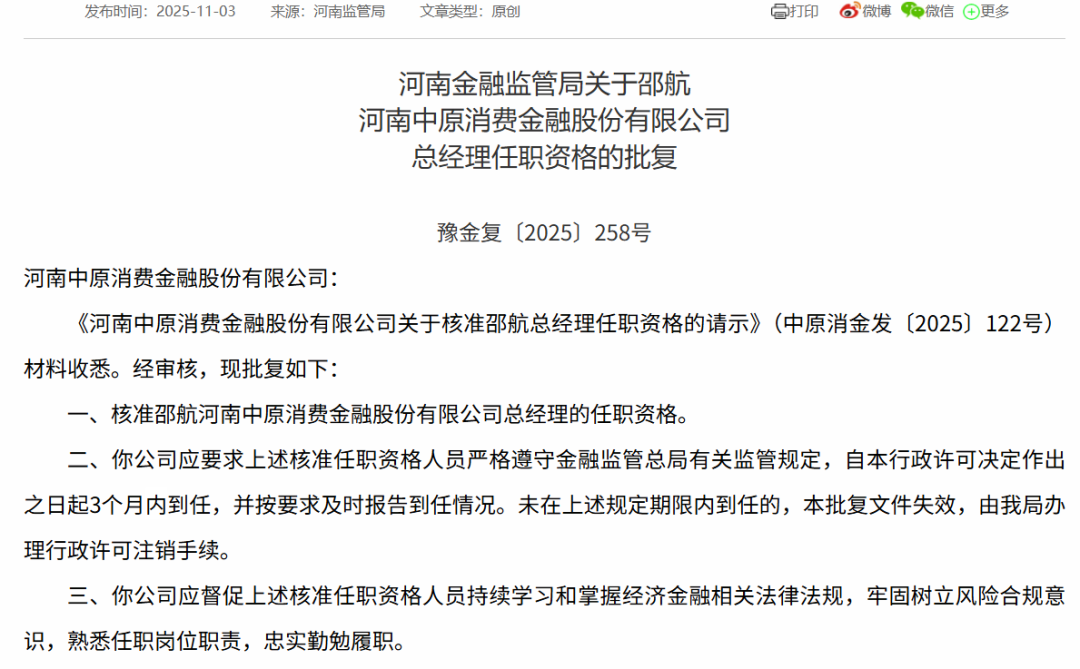
Core Viewpoint - The appointment of Shao Hang as the new general manager of Zhongyuan Consumer Finance has attracted industry attention, marking a significant leadership change in the only licensed consumer finance company in Henan Province [1][2]. Group 1: Leadership Change - Shao Hang has been approved as the general manager of Zhongyuan Consumer Finance, succeeding Zhou Wenlong, who has moved to Haier Consumer Finance [2][7]. - Shao Hang is an internal promotion and has been with the company since its inception, holding various key positions, including assistant general manager [8][10]. - The leadership transition raises questions about maintaining growth and balancing compliance and internal controls under the new management [7][11]. Group 2: Financial Performance - Zhongyuan Consumer Finance reported a significant increase in profitability, with operating income and net profit growing by 29.52% and 30.4% year-on-year, respectively, in the first half of 2025 [6][15]. - The company’s total assets reached 424.79 billion yuan by the end of 2024, ranking 12th in the industry, while its net profit ranked 8th [7][16]. - The company has seen a steady increase in revenue from 26.52 billion yuan in 2022 to 35.27 billion yuan in 2024, with net profits rising from 3.28 billion yuan to 5.03 billion yuan during the same period [12][15]. Group 3: Asset Quality and Risks - The non-performing loan (NPL) ratio for Zhongyuan Consumer Finance was reported at 2.09% at the end of 2024, with a rising trend in credit impairment loans [7][26]. - The company has faced challenges in asset quality management, with a significant increase in credit impairment losses, which reached 17.56 billion yuan in 2024, a 43.65% increase year-on-year [30][26]. - Regulatory scrutiny has intensified, particularly regarding the management of cooperative institutions, as evidenced by a fine imposed for inadequate oversight [33][30]. Group 4: Strategic Initiatives - Zhongyuan Consumer Finance has launched a product experience officer program aimed at enhancing user experience and operational efficiency, resulting in 85 app upgrades [34][25]. - The company is focusing on expanding its customer base, particularly targeting younger demographics, and enhancing its self-operated capabilities through data analysis and customer segmentation [34][25]. - The firm has also upgraded its brand and product offerings, including the rebranding of its app to improve market recognition and user engagement [20][25].
消费金融罚单背后:合规问题不容忽视
Jin Rong Shi Bao· 2025-12-10 02:02
Core Viewpoint - The consumption finance industry is expanding its services to rural areas, providing financial support to over 85.43 million county-level customers, while emphasizing the need for compliance and maintaining the principle of "finance for the people" [1] Group 1: Industry Growth and Compliance - In 2024, consumption finance companies provided services to 85.43 million county-level customers, highlighting the industry's growth potential [1] - The average consumption finance company collaborates with approximately 21.66 third-party lending platforms, indicating a trend towards resource integration and risk-sharing [1] - Regulatory scrutiny has increased, with the National Financial Supervision Administration issuing fines totaling 8.85 million yuan to six consumption finance companies for inadequate management of third-party collaborations [2][3] Group 2: Consumer Rights Protection - The "14th Five-Year Plan" emphasizes the importance of consumer rights protection, which has become a regulatory requirement for consumption finance companies [4] - New regulations will link consumer rights protection efforts to the regulatory ratings of consumption finance companies, making it a critical compliance area [4] - Companies are encouraged to enhance transparency and consumer rights protection mechanisms, integrating these responsibilities into their governance and operational processes [4][5] Group 3: Technological Integration and Industry Collaboration - Some financial institutions are leveraging digital technology to improve consumer rights protection, forming collaborative networks to combat financial misconduct [6] - The industry is moving towards a balance between growth and compliance, ensuring that financial services remain vibrant yet secure [6]
金融数字化发展联盟:2025消费金融数字化转型主题调研报告
Sou Hu Cai Jing· 2025-12-09 23:44
Core Insights - The consumer finance industry is experiencing a "stable quantity and improved quality" development trend, supported by policy initiatives and digital transformation, with consumer loans reaching 21.29 trillion yuan by Q3 2025 [1][6] - Digital transformation is a core driving force for the industry, with over 90% of institutions engaging in key digital projects, and 68% focusing on enhancing user activity and transaction volume [1][6] Group 1: Industry Development Overview - The balance of consumer loans reached 21.29 trillion yuan by Q3 2025, with 715 million active credit cards and 1.35 trillion yuan in loans from licensed consumer finance companies, indicating a shift from scale expansion to high-quality development [1][6] - Consumer spending policies are being implemented, with service retail growth outpacing goods retail by 0.2 percentage points, and per capita disposable income and consumption steadily increasing [1][6] - The industry is facing challenges such as intensified competition and difficulties in customer acquisition, leading to performance differentiation among licensed consumer finance companies [2][6] Group 2: Digital Transformation - Over 90% of institutions are implementing key digital projects, with significant applications of AI and large models in marketing, risk control, and customer service [1][6] - 68% of institutions prioritize increasing user activity and transaction volume as a key operational focus, with technology investments exceeding 3% of operating revenue for most institutions [1][6] - Half of the institutions can complete credit card approvals within 10 minutes, and over 40% report improved customer acquisition through self-operated channels, with lower costs for offline acquisition compared to online [1][6] Group 3: User Demand and Experience - The 22-35 age group constitutes over 50% of the consumer finance market, with credit card users averaging 10.4 transactions per month, spending 5,329 yuan [2][6] - Users prefer practical benefits, with promotional activities and interest-free periods being the main motivations for applying for credit cards [2][6] - 38% of users report that card applications take 10-30 minutes, with app downloads and facial recognition being the most time-consuming processes [2][6] Group 4: Future Directions - The industry needs to focus on optimizing customer experience by simplifying application processes and benefit rules, and strengthening customer service systems [2][6] - There is a call for deeper digital construction and the application of AI and large model technologies [2][6] - The integration of credit cards with retail products and the development of differentiated management systems for segmented customer groups are recommended to achieve sustainable high-quality business growth [2][6]

增强消费金融服务适配性
Jing Ji Ri Bao· 2025-12-09 22:46
Core Viewpoint - The recent implementation plan aims to enhance the adaptability of consumer finance services to meet the diverse and evolving consumption demands of the public, moving beyond traditional lending practices to a more tailored approach [1][3] Group 1: Financial Service Adaptability - There is a growing need for financial services to adapt to various consumer demands, including the interests of young people in smart home products and the increasing health and convenience needs of the elderly, which creates opportunities in the "silver economy" [1][2] - Financial institutions are encouraged to develop products that cater to different demographics, such as flexible credit products for young professionals and tailored loans for rural markets that align with agricultural cycles [2][3] Group 2: Precision and Risk Management - Differentiation and precision are essential for enhancing adaptability, requiring financial products to be designed with specific consumer needs in mind, such as flexible repayment terms and dynamic credit assessments based on real transaction data [2] - Financial institutions must balance service extension and risk control by employing technology for intelligent risk assessment while ensuring consumer protection and education through clear information disclosure [2][3] Group 3: Opportunities for Financial Institutions - The implementation of the plan presents an opportunity for financial institutions to transform their product design and service philosophy, emphasizing the need for detailed market insights and agile technology applications [3] - There is an expectation for financial institutions to create more accessible, warm, and secure consumer finance products that genuinely enhance the quality of life for consumers [3]
2025消费金融数字化转型主题调研报告
Sou Hu Cai Jing· 2025-12-09 14:17
Core Insights - The report focuses on the digital transformation trends in the consumer finance industry, highlighting the diverse landscape and transformative directions of the market [1] - By the end of Q3 2025, the balance of consumer loans reached 21.29 trillion yuan, with 715 million active credit cards and 1.35 trillion yuan in loans from licensed consumer finance companies [1][6] - The market is characterized by significant regional differences, with lower-tier cities contributing 80% of growth, and a shift towards service-oriented consumption, particularly in education, culture, entertainment, and transportation [1][6] Group 1: Industry Development Overview - Consumer finance policies have been implemented to boost consumption, with service retail growth outpacing goods retail by 0.2 percentage points [6][16] - Regulatory frameworks in the consumer finance sector are becoming more detailed, emphasizing compliance and sustainable development [6][38] - The balance of consumer loans from licensed companies reached 1.35 trillion yuan, indicating a differentiated performance among operators [6][1] Group 2: Digital Transformation Evaluation - Over 90% of institutions are engaged in digital projects, with significant investments in technology, accounting for more than 3% of operating revenue [6][1] - AI applications and large models are widely adopted, enhancing operational efficiency, with half of the institutions able to approve credit cards within 10 minutes [6][1] - A quarter of institutions have increased their technology personnel, reflecting a commitment to digital transformation [6][1] Group 3: User Experience and Market Trends - The user demographic is predominantly aged 22-35, with credit cards remaining the primary payment tool; 46% of users report an increase in credit card spending [6][1] - Users face challenges such as complicated application processes and poor customer service experiences, with over-marketing and information security concerns being significant issues [6][1] - Emerging consumption scenarios, such as second-hand trading and themed restaurants, are rapidly gaining traction, supported by policies like "old-for-new" exchanges [1][6] Group 4: Recommendations for Institutions - Institutions are advised to focus on optimizing customer experience, simplifying product rights and application processes, and enhancing digital infrastructure [1][6] - Leveraging credit cards as a pivot for retail business integration is recommended to uncover value in segmented scenarios and customer groups [1][6] - The report emphasizes the importance of high-quality development in the industry, driven by improved customer engagement and operational efficiency [1][6]

兴业消费金融两日密集挂牌8期个人不良贷款 合计未偿本息超88亿元
Jing Ji Guan Cha Wang· 2025-12-09 07:15
经济观察网银登中心网站消息,2025年12月8日至9日,兴业消费金融集中发布23-30期个人消费贷款不 良贷款转让公告,加速不良资产出清。此次挂牌的8期不良贷项目合计未偿本息总额88.62亿元,单期规 模均保持在7亿元以上,其中4期项目规模突破12亿元,呈现出单期体量较大、处置集中度高的特点。值 得注意的是,相关项目最高加权平均逾期天数达1442天,不良资产沉淀周期较长,处置难度相对突出。 (编辑:金倩) ...
平安消费金融:聚焦“金融五篇大文章”,实现普惠金融的精滴细灌
Sou Hu Cai Jing· 2025-12-09 07:08
Core Insights - Inclusive finance serves as both a stabilizing force for the economy and a catalyst for market vitality, necessitating a collective effort to create a "finance for good" ecosystem [1] - Ping An Consumer Finance has been recognized as the "Annual Outstanding Inclusive Finance Practice Institution" for its significant contributions to the field [1] Group 1: Technology and Accessibility - Inclusive finance must expand its reach while enhancing accessibility, with some consumer finance institutions achieving notable results through technology and inclusivity [3] - Ping An Consumer Finance has leveraged financial technology to automate processes and provide 24/7 online services, reaching over 10 million customers across nearly 2,500 counties, with approximately 80% of clients from lower-tier cities [3] Group 2: Deepening Impact and Support - The development of inclusive finance connects directly to improving the daily lives of citizens and the broader economic landscape, emphasizing the importance of providing timely support to meet consumer needs [4] - Ping An Consumer Finance has issued over 3 million discount and interest-free vouchers targeting new citizens and young consumers, with total discounts exceeding 200 million yuan, demonstrating its commitment to enhancing consumer spending and demand [4] - The company aims to continue innovating financial products and services to broaden and deepen its inclusive finance offerings, emphasizing sustainability and social harmony [4]

中邮消费金融重拳打击“黑灰产”,下半年识别违规信息超3000条
Jing Ji Guan Cha Wang· 2025-12-08 11:03
经济观察网12月8日,广东银行同业公会发布消息称,中邮消费金融有限公司于2025年全面启动打击金 融领域"黑灰产"违法犯罪专项行动。今年下半年以来,公司已成功识别并确认相关违规信息3000余条, 推动平台下架处置超过2000条,并通过数据模型精准预警中介包装、有组织骗贷等可疑行为,有效维护 金融秩序与消费者权益。在内部风险识别层面,中邮消费金融深度聚焦"进件地域集中""客户特征集 中""申请设备信息集中"等六个集中异常特征,通过数据模型精准识别和预警中介团伙包装、有组织骗 贷等可疑行为。 ...
从破冰到重构,锁定这场金融论坛,解锁普惠金融新路径!
Bei Jing Shang Bao· 2025-12-08 10:23
Core Insights - Inclusive finance is transitioning from "incremental expansion" to "quality improvement and efficiency enhancement," becoming a key topic in the financial sector to fulfill social responsibilities and stimulate market vitality [1][3] Group 1: Current Trends in Inclusive Finance - The financial needs of small and micro enterprises, individual businesses, rural areas, and vulnerable groups represent both a "pain point" for the real economy and a "focal point" for inclusive finance [3] - A multi-layered support system for inclusive finance has been established, covering monetary policy tools, fiscal interest subsidies, and differentiated regulatory assessments [3] - Innovations from various financial institutions, including banks and consumer finance companies, are enhancing the service efficiency of consumer finance [3][4] Group 2: Challenges and Market Dynamics - The banking sector is experiencing pressure from market changes, with challenges in identifying new clients and increasing competition leading to a saturated market [4] - Insurance companies face difficulties in accurately pricing inclusive health insurance products due to a lack of data support [4] - The consumer finance sector is caught in a dilemma of "internal competition and risk coexistence," with some institutions lowering loan rates and relaxing risk control standards to capture market share, leading to issues like "multiple borrowing" and "over-lending" [4] Group 3: Future Directions and Events - The 2025 Beijing Financial Forum special report on inclusive finance will be released, addressing the latest policy directions and showcasing breakthroughs in product design and service models across various financial institutions [4] - The forum will also feature discussions on how to navigate the "red sea" of competition and explore new opportunities in consumer finance, leveraging advanced technologies like big data and artificial intelligence [6][9] - The next decade is expected to focus on the reconstruction of inclusive finance, emphasizing "precision," "sustainability," and "ecosystem" development [9]