
科技行业

Search documents
六巨头一夜蒸发3.2万亿
第一财经· 2025-11-05 00:10
Group 1 - On November 4, US stock indices experienced a broad decline, with the Nasdaq dropping over 2% [1] - The index tracking the seven major US technology companies fell nearly 2%, with significant drops in stocks such as Tesla, Nvidia, Google, Amazon, META, and Microsoft [1] - The total market capitalization of these companies collectively decreased by approximately 3.2 trillion RMB in a single day [1]


美股受重挫 !美股六巨头一夜蒸发3.2万亿
Xin Lang Cai Jing· 2025-11-04 23:36
Core Viewpoint - The U.S. stock market experienced a significant decline, with major tech companies collectively losing approximately 3.2 trillion yuan in market value in a single day [1] Group 1: Market Performance - On November 4, all three major U.S. stock indices fell, with the Nasdaq dropping over 2% [1] - The index tracking the seven major U.S. tech giants fell nearly 2%, indicating a broad sell-off in the technology sector [1] Group 2: Company Impact - Major companies such as Tesla, Nvidia, Google, Amazon, META, and Microsoft all saw declines in their stock prices, contributing to the overall market loss [1] Group 3: Commodity Market - International gold and oil prices also weakened overnight, reflecting a broader trend in commodity markets [1] - Analysts suggest that gold prices may enter a phase of consolidation in the short term, while oil prices could decline further if supply reduction expectations do not materialize [1]





美股开盘丨三大指数集体低开 大型科技股普跌
Di Yi Cai Jing· 2025-11-04 14:57
Group 1 - The three major U.S. stock indices opened lower, with the Dow Jones Industrial Average down 0.72%, the S&P 500 down 1.13%, and the Nasdaq Composite down 1.59% [1] - Large technology stocks experienced widespread declines, with Oracle, Tesla, and Intel each falling over 3%, while Google and Nvidia dropped more than 2% [1]


果下科技股份有限公司(02655) - 整体协调人公告-委任
2025-11-02 16:00
香 港 聯 合 交 易 所 有 限 公 司 及 證 券 及 期 貨 事 務 監 察 委 員 會 對 本 公 告 的 內 容 概 不 負 責,對 其 準 確 性 或 完 整 性 亦 不 發 表 任 何 聲 明,並 明 確 表 示 概 不 就 因 本 公 告 全 部 或 任 何 部 分 內 容 而 產 生 或 因 依 賴 該 等 內 容 而 引 致 的 任 何 損 失 承 擔 任 何 責 任。 Guoxia Technology Co., Ltd.* 果下科技股份有限公司 (於 中 華 人 民 共 和 國 註 冊 成 立 的 股 份 有 限 公 司) 警 告 本 公 告 乃 根 據 香 港 聯 合 交 易 所 有 限 公 司(「聯交所」)及 證 券 及 期 貨 事 務 監 察 委 員 會(「證監會」)的 要 求 而 刊 發,僅 用 作 提 供 資 料 予 香 港 公 眾 人 士。 閣 下 閱 覽 本 公 告,即 表 示 閣 下 知 悉、接 納 並 向 果 下 科 技 股 份 有 限 公 司 (「本公司」)、其 獨 家 保 薦 人、整 體 協 調 人、顧 問 或 包 銷 團 成 員 表 示 同 意: – 1 – ( ...
策略周报:市场热情仍高,风格或有所切换-20251102
HWABAO SECURITIES· 2025-11-02 12:11
Market Overview - The report indicates that market sentiment remains high, with a potential shift in investment style towards small-cap stocks due to high valuations and performance pressures on large-cap growth stocks [4][16] - The A-share market has shown strong performance, with the Shanghai Composite Index briefly surpassing 4000 points, driven by improved Sino-U.S. relations and the release of the "14th Five-Year Plan" [13][16] Bond Market Insights - The bond market is expected to focus on tactical operations, with the People's Bank of China (PBOC) resuming government bond purchases, which is seen as a positive signal for market stability [12][14] - The report suggests a configuration value around 1.85% for bonds, recommending moderate increases near the upper range and timely profit-taking near the lower range of 1.75% [3][14] Investment Strategy - The report emphasizes a structural opportunity in the market, advising investors to focus on sectors with reasonable valuations and clear industrial trends while being cautious of high-positioned large-cap stocks [4][16] - It highlights the potential for small-cap stocks to outperform during the earnings vacuum period in November, as funds may flow from large-cap stocks to lower-valued, more elastic small-cap targets [4][16] Economic Indicators - The report notes that the U.S. Federal Reserve has lowered the federal funds rate by 25 basis points to a range of 3.75% to 4.00%, which is expected to provide a supportive liquidity environment for the market [10][14] - It also mentions that the manufacturing Purchasing Managers' Index (PMI) in China fell to 49.0% in October, indicating a contraction in the manufacturing sector [11][12] Performance Metrics - The domestic macro multi-asset model has achieved a year-to-date return of 13.10%, outperforming its benchmark by 4.26% [24] - The report indicates that the average daily trading volume in the A-share market has increased to 23,253.35 billion yuan, reflecting heightened market activity [22]
将来我们能不能出现中国版的英伟达、中国版的特斯拉?杨德龙:是有可能的
Xin Lang Zheng Quan· 2025-11-02 07:05
Core Insights - The current market trend shows that technology stocks are leading the A-share market, with potential for the emergence of Chinese versions of Nvidia and Tesla in the future [1][2] - The ongoing bull market is still in its early stages, characterized by high trading volumes but relatively low new capital inflow, leading investors to focus on high-growth technology stocks [1] - The fourth technological revolution, particularly in artificial intelligence, is driving investment enthusiasm in technology stocks, similar to trends seen in the US market [1] Market Dynamics - The technology sector is experiencing a bull market, with significant interest driven by the success of US tech companies, particularly Nvidia, which recently surpassed a market capitalization of $5 trillion [1] - Investors are currently favoring smaller-cap stocks with high growth potential, as they seek to capitalize on the ongoing technological advancements [1] - Despite the excitement, it is noted that only a small percentage of technology companies (around 10% or less) are likely to achieve significant breakthroughs and success, indicating a high level of risk within the sector [2]
【UNforex本周总结】美元稳固主导市场,黄金承压整理,贸易与政策博弈升温
Sou Hu Cai Jing· 2025-11-01 08:09
Group 1 - The US dollar remains strong, supported by the Federal Reserve's hawkish stance and high US Treasury yields, with the dollar index approaching 99.70 [1] - The euro is under pressure due to economic weakness and easing expectations, leading to a continuous decline against the dollar [1] - The Japanese yen has fallen below 154.50 against the dollar, reaching a new low for the year, raising speculation about potential official intervention [1] Group 2 - Gold prices are struggling to maintain momentum, hovering above the $4000 mark, with a brief breakout followed by a retreat due to reduced appeal of non-yielding assets [1] - The Federal Reserve's policy signals are a focal point, with officials maintaining a hawkish tone and emphasizing the need for patience in addressing inflation [1] - The probability of a rate cut in December has decreased from 90% to below 70%, impacting the strength of the dollar and putting pressure on non-US currencies and precious metals [1] Group 3 - US-China trade relations continue to be a significant factor in market volatility, with short-term uncertainties likely to suppress market sentiment, while potential improvements could boost global economic recovery in the long term [2] - The European Central Bank has kept interest rates unchanged, with President Lagarde indicating that euro appreciation may reduce inflationary pressures, suggesting a cautious policy outlook [2] - The Japanese government emphasizes the importance of exchange rate stability, with expectations of potential measures to prevent excessive depreciation of the yen [2] Group 4 - Global stock markets have generally risen, particularly in the US, with the S&P 500 and Dow Jones indices recording weekly gains, driven by strong performance in technology stocks [2] - Despite the hawkish Fed and a strong dollar potentially limiting gains, risk appetite in the market has improved [2] - Upcoming economic indicators, such as the ISM manufacturing PMI and ADP employment data, are anticipated to provide further insights into economic direction [2] Group 5 - The overall market dynamics this week are shaped by a strong dollar, adjustments in Fed policy expectations, gold price fluctuations, and trade tensions [3] - The dollar maintains its dominant position, while gold shows weak rebound potential, with European and Japanese policy signals becoming new focal points for observation [3] - Investors are advised to closely monitor Fed communications, economic data, and US-China negotiation progress, as these factors will continue to influence short-term market sentiment and direction [3]
90后券商员工内幕交易,被罚150万元
券商中国· 2025-11-01 05:22
Core Viewpoint - The article discusses the penalties imposed by the Qinghai Securities Regulatory Bureau on an individual named Xie for insider trading and violations related to stock trading as a securities professional, resulting in a total fine of 1.53 million yuan [2][8]. Summary by Sections Insider Trading Case - Xie, born in 1993, was involved in the major asset restructuring project of Tengjing Technology and was aware of insider information, leading to a loss of approximately 50,000 yuan from trading Tengjing Technology shares [2][3]. - During the insider information sensitive period from October 9, 2024, to February 26, 2025, Xie bought 57,485 shares of Tengjing Technology for a total of 2.4666 million yuan and sold them for 2.4162 million yuan, incurring a loss of about 50,000 yuan [3][4]. Violations as a Securities Professional - Xie worked at a securities company from May 11, 2021, until the investigation date of June 24, 2025, and engaged in stock trading outside the insider information sensitive period, with total purchases amounting to 7.1671 million yuan and sales of 6.6437 million yuan, resulting in a cumulative loss of approximately 496,500 yuan [5][6]. Regulatory Findings - The Qinghai Securities Regulatory Bureau found sufficient evidence, including announcements and transaction records, to confirm Xie's violations of the Securities Law, specifically regarding insider trading and improper stock trading as a securities professional [6][7]. - Xie's defense claimed that his trading decisions were based on a positive outlook for Tengjing Technology rather than insider information, and he cooperated with the investigation [6][8]. Penalty Decision - The regulatory bureau concluded that Xie's actions constituted insider trading and improper stock trading, leading to a fine of 1.5 million yuan for insider trading and 30,000 yuan for improper trading, totaling 1.53 million yuan [8].

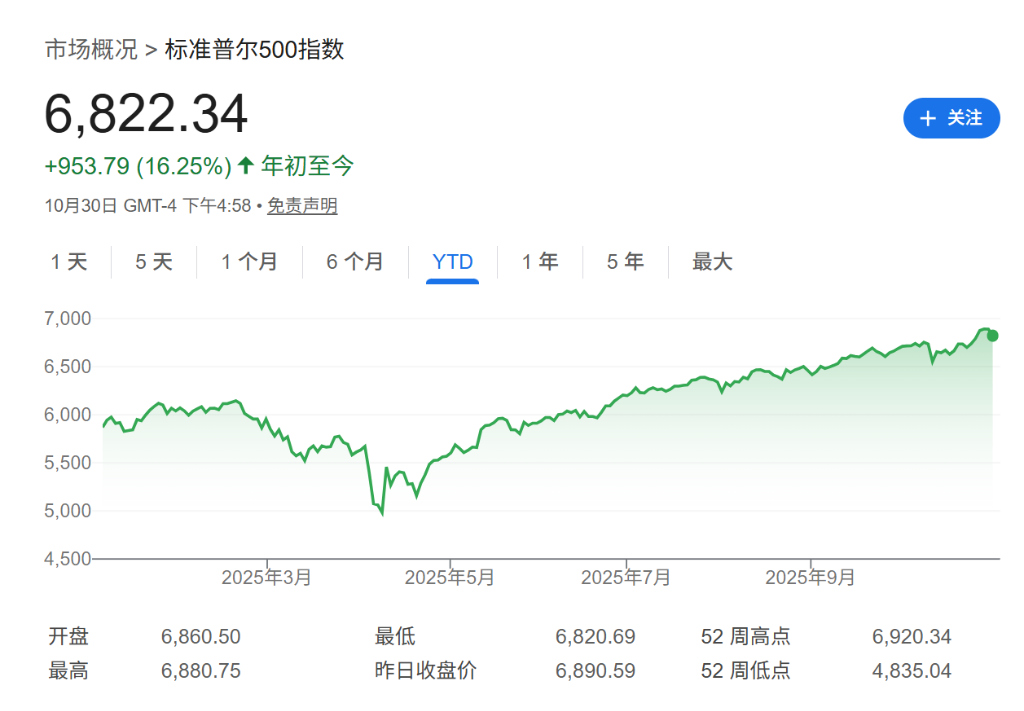
7000点成关键心理关口:期权市场预示标普500未来两月或将陷入盘整
Hua Er Jie Jian Wen· 2025-10-31 12:52
Core Viewpoint - The S&P 500 index options are heavily concentrated around the 7000 strike price, indicating cautious sentiment among market participants regarding further upward movement before year-end, despite a potential 19% increase by 2025 [1][4]. Group 1: Market Sentiment - Wall Street remains generally bullish on U.S. stocks, but there are valid reasons for caution, including comments from Fed Chair Powell about the uncertainty of a third rate cut [4]. - Concerns over the latest earnings from tech giants have raised doubts about spending in the artificial intelligence sector [4]. - Signs of economic slowdown and cracks in the high-risk credit market have led to questions about the health of U.S. consumers [4][6]. Group 2: Psychological Factors - The concentration of options at the 7000 strike price can be explained by investor behavior, as traders often gravitate towards round numbers, which naturally attract more trading activity [5]. - The 7000 strike price is viewed as a significant psychological level, drawing attention from traders [5][6]. Group 3: Market Structure - The complex structure of the options market contributes to the concentration of positions at the 7000 strike price, with about half of the open contracts potentially linked to a strategy known as "box spread" [7]. - The presence of large institutional players, referred to as "whales," who are heavily involved in selling call options, also affects the market structure and leads to unusual concentration at specific strike prices [7]. Group 4: Investment Strategy - In light of limited upward potential for the index, some market participants suggest focusing on individual stocks rather than the broader market [8]. - For investors who missed out on gains in the AI sector, individual stock options may be a more effective tool than betting on broader indices [8].
对话DWS全球研究主管:美股占比过高,中国欧洲或吸引更多资金
2 1 Shi Ji Jing Ji Bao Dao· 2025-10-31 10:00
Core Insights - There is a noticeable shift in global capital flows, with increased interest in Chinese and European assets, suggesting a potential fundamental change in investment paradigms that have persisted for decades [2][3] - Despite this shift, U.S. markets remain attractive due to strong corporate profitability, innovation, and technology, indicating that some capital will continue to stay in the U.S. [2] - The U.S. stock market's dominance in the MSCI global index, accounting for 70%, is seen as excessive, prompting a gradual trend towards diversifying investments away from U.S. reliance [2] Investment Trends - The "Sputnik Moment" has highlighted the undervaluation of Chinese assets, leading to a re-evaluation of their worth in the global market [3] - Lower trading prices and declining interest rates in China have made stock investments more appealing, contributing to the resurgence of Chinese assets [3] - The recognition of China's vibrant and innovative tech sector is driving the re-assessment of Chinese asset values, with optimism for continued strong performance if corporate earnings improve [3]