
煤炭开采

Search documents
今天,跳水三次!
Xin Lang Cai Jing· 2026-01-28 08:35
Market Overview - The market experienced fluctuations on January 28, with the Shanghai Composite Index rising by 0.27%, the Shenzhen Component Index increasing by 0.09%, and the ChiNext Index declining by 0.57% [2][12]. - A total of 1,739 stocks rose, 84 stocks hit the daily limit up, while 3,640 stocks fell [3][13]. Sector Performance - Resource stocks surged, with gold stocks leading the gains. Sichuan Gold achieved a four-day limit up, while Zhaojin Mining and Hunan Gold saw three consecutive limit ups [4][14]. - Oil and gas stocks collectively rose, with Tongyuan Petroleum and Zhongman Petroleum hitting the limit up, and China National Offshore Oil Corporation (CNOOC) increasing over 6% to reach a new high [5][16]. - The non-ferrous metals sector strengthened, with Silver Industry (Wei Quan) achieving seven consecutive limit ups, and China Aluminum hitting the limit up, marking a 16-year high [6][17]. - The coal sector also saw gains, with Shanxi Coking Coal and Shaanxi Black Cat hitting the limit up [7][18]. Declines - The pharmaceutical and medical stocks faced adjustments, with Bibete and Baipusais falling over 10% [8][19]. Trading Activity - Significant trading activity was noted, with the HuShen 300 ETF from Huatai-PB exceeding 30 billion yuan in trading volume, and other ETFs like the HuShen 300 ETF from E Fund and the CSI 500 ETF also surpassing 20 billion yuan [9][20]. - A report from CITIC Securities indicated that in previous bull markets, overheating trading conditions prompted cooling policies to prevent severe consequences, suggesting that the current proactive cooling measures are aimed at regulating market momentum without altering the overall positive policy stance [9][20].







【广发宏观王丹】同比转正,新旧分化:2025年工业企业利润数据点评
郭磊宏观茶座· 2026-01-27 15:18
广发证券 资深宏观分析师 王丹 bjwangdan@ gf.com.cn 广发宏观郭磊团队 摘要 第一, 2025 年规上工业企业营业收入同比增长 1.1% ,略低于 2024 年的 2.1% ,持平于 2023 年,营收同比连续 3 年在 1%-3% 的低位区间内徘 徊。边际变化看, 12 月单月营收同比下降 3.2% ,连续 3 个月同比为负。从四季度名义 GDP 来看,也是三产企稳、二产放缓。 第二, 利润趋势上好于营收。 2025 年全年规上工业企业利润同比增长 0.6% , 2022-2024 年同比分别为 -4.0% 、 -2.3% 、 -3.3% ;企业利润同 比结束连续 3 年负增长、实现小幅转正。边际变化看, 12 月利润同比增长 5.3% ,较 10-11 月的同比下降明显改善,也显著好于营收表现。 第三, 利润率趋稳是支撑 2025 年企业盈利同比转正的关键。从"量、价、利润率"三因素看, 2025 年呈现"量强 + 价跌"的特征;利润率是支撑利润同 比转正的关键, 2025 年营收利润率 5.31% ,同比微降 0.03 个点,较 2024 年的同比下降 0.3 个点明显收窄。我们理解 ...

12月工业企业利润数据点评:有待稳固的V型反弹
GUOTAI HAITONG SECURITIES· 2026-01-27 09:40
Profit Growth Overview - In 2025, the cumulative year-on-year profit growth rate for industrial enterprises was 0.6%, with December showing a significant increase of 5.3% compared to November's -13.1%[1] - The profit recovery is characterized as a "V-shaped" rebound, driven by improved production activity, narrowing PPI declines, and a substantial recovery in profit margins[1][4] Contributing Factors - The increase in profits is attributed to a combination of rising production volumes, improved pricing environments, and enhanced profit margins, with December's profit margin rising from 5.29% to 5.31%[5] - The industrial added value in December rose to 5.2%, up from 4.8% in November, indicating improved industrial production activity[5] Sector Performance - The profit share of upstream and midstream industries increased to 29.6% and 53.7%, respectively, while the downstream sector saw a slight decrease to 16.7%[6] - Upstream sectors like coal mining and non-ferrous metals showed strong profit recovery, while downstream sectors like automotive and food experienced profit contractions[6][14] Revenue Trends - Cumulative revenue growth for industrial enterprises in 2025 was 1.1%, with December showing a decline of 3.2%, indicating ongoing challenges in end-demand recovery[10] - The inventory growth rate for industrial finished products was 3.9%, signaling a shift from replenishment to destocking as companies respond to weak demand[10] Future Outlook - The sustainability of profit recovery is contingent on the strengthening of domestic demand and the continued effectiveness of policy measures[15] - Risks include external uncertainties and the potential for domestic demand recovery to fall short of expectations[16]
电投能源跌2.01%,成交额4.51亿元,主力资金净流出1747.95万元
Xin Lang Cai Jing· 2026-01-27 09:25
Group 1 - The core viewpoint of the news is that 电投能源's stock has experienced fluctuations, with a recent decline of 2.01% and a current price of 28.83 CNY per share, while the company has a total market capitalization of 646.25 billion CNY [1] - As of January 27, the company has seen a year-to-date stock price increase of 3.30%, with a 3.03% decline over the last five trading days, a 2.89% increase over the last 20 days, and a 14.09% increase over the last 60 days [1] - The company is primarily engaged in the production, processing, and sales of coal products, with its main business revenue composition being 55.11% from aluminum products, 30.29% from coal products, 13.02% from electricity products, and 1.59% from others [1] Group 2 - As of September 30, the number of shareholders for 电投能源 is 27,100, a decrease of 11.29% from the previous period, while the average circulating shares per person increased by 12.72% to 82,831 shares [2] - For the period from January to September 2025, 电投能源 achieved an operating revenue of 22.403 billion CNY, representing a year-on-year growth of 2.72%, while the net profit attributable to shareholders decreased by 6.40% to 4.118 billion CNY [2] - The company has distributed a total of 11.815 billion CNY in dividends since its A-share listing, with 4.550 billion CNY distributed over the last three years [3]

煤炭开采板块1月27日跌2.41%,大有能源领跌,主力资金净流出6.31亿元
Zheng Xing Xing Ye Ri Bao· 2026-01-27 08:56
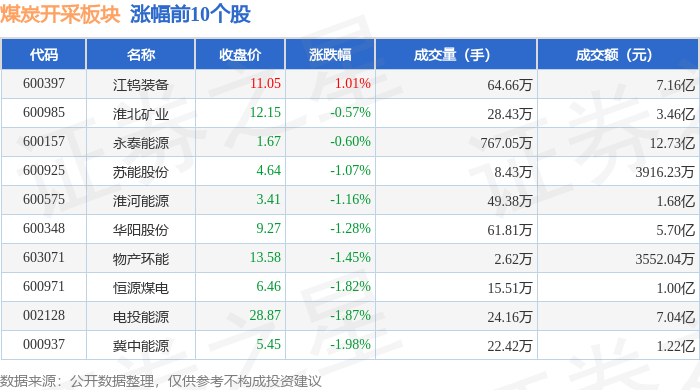
Market Overview - The coal mining sector experienced a decline of 2.41% on January 27, with Dayou Energy leading the drop [1] - The Shanghai Composite Index closed at 4139.9, up 0.18%, while the Shenzhen Component Index closed at 14329.91, up 0.09% [1] Individual Stock Performance - Jiangte Equipment (600397) closed at 11.05, up 1.01% with a trading volume of 646,600 shares and a transaction value of 716 million [1] - Dayou Energy (600403) closed at 7.01, down 4.76% with a trading volume of 608,900 shares and a transaction value of 429 million [2] - Huabei Mining (600985) closed at 12.15, down 0.57% with a trading volume of 284,300 shares and a transaction value of 346 million [1] - Yongtai Energy (600157) closed at 1.67, down 0.60% with a trading volume of 7,670,500 shares and a transaction value of 1.273 billion [1] Capital Flow Analysis - The coal mining sector saw a net outflow of 631 million from institutional investors, while retail investors had a net inflow of 174 million [2] - Major stocks like Shaanxi Coal and Chemical (601225) had a net inflow of 25.7 million from institutional investors, but a net outflow of 64.4 million from retail investors [3] - Zhongmei Energy (601898) experienced a net inflow of 15.8 million from institutional investors, with a net outflow of 21.9 million from retail investors [3]



粤宏远A:预计2025年净利润为5600万元-8300万元,同比增长217.40%-274.01%
Jin Rong Jie· 2026-01-27 08:32
粤宏远A公告,预计2025年度净利润为5600万元~8300万元,同比增长217.40%~274.01%。公司预计 2025年度业绩净利润为正值且业绩同比增长,主要是得益于本期转让贵州宏途鑫业矿业有限公司(核桃 坪煤矿)股权产生的收益。 ...

A股策略专题:2026年红利策略三问
SINOLINK SECURITIES· 2026-01-27 08:24
Group 1: Dividend Strategy Outlook for 2026 - The dividend strategy in 2025 significantly underperformed the market, primarily due to the emergence of new growth sectors like AI, which shifted market focus from dividend yield (d) to growth rate (g) from 2022 to mid-2024[2] - For 2026, the core judgment on whether dividend strategies can achieve excess returns hinges on whether the market continues to prioritize marginal changes in fundamentals[2] - With a low macro risk environment for AI investments and a recovery in corporate earnings expected, the focus may remain on growth rates rather than dividend yields, making excess returns from dividend strategies unlikely[2] Group 2: A-Shares vs. Hong Kong Stocks - Since April 2024, Hong Kong's low-volatility dividend index has outperformed A-shares by 49%, driven mainly by the industrial, financial, and energy sectors[3] - Despite the higher dividend yield of Hong Kong stocks, the PE valuation levels are now comparable to A-shares, indicating limited room for further convergence[3] - The relative performance of Hong Kong stocks is attributed more to stock selection rather than industry allocation, with financials, energy, and industrials contributing the most to excess returns[3] Group 3: Constructing the 2026 Dividend Portfolio - The 2026 dividend strategy should focus on sectors benefiting from AI investment, manufacturing recovery, and domestic consumption recovery, with traditional manufacturing and resource sectors expected to have the broadest benefits[3] - A scoring system combining payout ratios and stability with profitability metrics (ROE) is proposed to optimize sector allocation for dividends[3] - Recommended sectors for increased allocation include insurance, textile manufacturing, and logistics, while sectors with high potential but lower success rates, like banks and construction, should be considered for long-term investment[3]
A股策略专题20260127:2026 年红利策略三问
SINOLINK SECURITIES· 2026-01-27 07:17
Group 1 - The core viewpoint of the report suggests that the dividend strategy may struggle to achieve excess returns in 2026 due to a shift in market focus from dividend yield to growth rates, particularly influenced by the AI industry and improving corporate earnings in China [2][11][33] - The report indicates that the dividend strategy underperformed the market significantly in 2025, primarily due to the emergence of new growth sectors like AI, a decline in traditional manufacturing reliance, and a rise in market risk appetite [11][33] - It is noted that while the dividend strategy may not yield excess returns, it remains a crucial component for many investors as a stabilizing element in their portfolios, especially during market volatility [2][33] Group 2 - The analysis reveals that the Hong Kong stock market's low-volatility dividend index significantly outperformed the A-share market's equivalent, with a relative return of 49% attributed mainly to the industrial, financial, and energy sectors [3][36] - Despite the higher dividend yield in Hong Kong stocks, the report highlights that the absolute PE valuation levels between Hong Kong and A-share dividend stocks are now comparable, indicating limited room for further convergence [3][37] - The report emphasizes that the performance of the Hong Kong dividend stocks is primarily driven by individual stock selection rather than sector allocation, with financials, energy, and industrials contributing the most to relative performance [3][44] Group 3 - The report outlines three key themes for constructing and optimizing the dividend portfolio for 2026: the impact of overseas AI investments, resource protectionism in emerging markets, and the recovery of domestic consumption [3][22] - It suggests that resource and traditional manufacturing dividends will benefit the most from these themes, while financial dividends may only recover post-deflation [3][22] - A scoring system based on yield and profitability is proposed to identify sectors with the best potential for dividend growth, categorizing industries into four quadrants based on their risk and return profiles [3][24]
朝闻国盛:基本面高频数据跟踪:春节错位效应开始影响高频数据同比
GOLDEN SUN SECURITIES· 2026-01-27 01:18
Group 1: Fixed Income and Economic Indicators - The core high-frequency index is at 129.6 points, with a year-on-year increase of 6.0 points [3] - The industrial production high-frequency index is 128.1, with a year-on-year increase of 4.8 points [3] - The inventory high-frequency index is 164.3, showing a year-on-year increase of 7.5 points [3] - The transportation high-frequency index is 135.1, with a year-on-year increase of 11.3 points [3] - The financing high-frequency index is 248.4, with a year-on-year increase of 31.2 points [3] Group 2: Non-Banking Financial Sector - The public fund performance benchmark has been officially released, indicating short-term market fluctuations do not alter the long-term positive trend [4] - The insurance sector is expected to benefit from long-term trends despite short-term adjustments due to regulatory stability [4] - The securities sector is experiencing high trading activity and is expected to benefit from increased market risk appetite [4] Group 3: Coal Industry - The company aims to become a leading private coal supplier in China, with coal mines located in Inner Mongolia, Ningxia, and South Africa [6] - The company has a strong cost control capability, with a projected gross profit margin of 60% per ton of coal by 2024, ranking first among 17 major listed coal companies [6] - The company has acquired 100% of Ningxia Power Mining, which is expected to add 210,000 tons per year in coking coal capacity [7] - The company has signed a cooperation agreement for the Roti Fengke titanium ore project, expected to generate a gross profit of $80 million [9] - Revenue projections for the company are estimated at 4.834 billion, 6.013 billion, and 6.553 billion yuan for 2025-2027, with corresponding net profits of 1.237 billion, 1.680 billion, and 2.404 billion yuan [10] Group 4: Environmental Monitoring and Policy - Recent policies indicate a shift towards collaborative remediation and development of polluted sites, creating opportunities in soil remediation and environmental consulting [11] - The introduction of differentiated management for air quality performance is expected to provide incentives for companies to transition towards greener practices [11] Group 5: E-commerce and Delivery Services - The new national subsidy policy is expected to improve demand for JD's retail segment, particularly in home appliances and digital products [13] - The company is expanding its delivery service, with a focus on improving user experience and reducing costs [14] - Revenue forecasts for JD are projected at 1.3074 trillion, 1.3755 trillion, and 1.4699 trillion yuan for 2025-2027, with a significant focus on the impact of the new subsidy policy [15] Group 6: Electronics and Storage Solutions - The company anticipates a revenue growth of over 40% in 2025, driven by increased demand for enterprise-level storage products [16] - The company has entered a growth phase with its proprietary brand, Haipu Storage, which is expected to achieve profitability in 2025 [16] - The company has secured AMD distribution rights, enhancing its competitive position in the AI and high-performance computing sectors [18]
2025年山西原煤总产量超13亿吨
Ren Min Ri Bao· 2026-01-26 23:00
Core Insights - Shanxi Province's industrial raw coal production is projected to exceed 1.3 billion tons by 2025, representing a year-on-year increase of 2.1%, accounting for approximately 27% of the national output during the same period [1] Group 1: Production Capacity and Output - Shanxi Province is a significant comprehensive energy base in China, with abundant and diverse coal resources [1] - During the 14th Five-Year Plan period, Shanxi is expected to add 15 million tons of coal production capacity annually, maintaining a daily output of over 3.5 million tons [1] - Cumulatively, Shanxi is projected to produce approximately 6.5 billion tons of raw coal, which constitutes nearly 30% of the national total [1] Group 2: Supply Assurance - Shanxi has committed to supply over 2 billion tons of thermal coal to 24 provinces at long-term contract prices, effectively supporting the energy needs for national economic and social development [1] Group 3: Green Mining Initiatives - The province is actively promoting the transition from traditional coal mining methods to green mining practices [1] - A total of 75 green mining demonstration coal mines have been established, with over 200 additional mines exploring the application of green mining technologies, leading to cleaner and more efficient coal extraction [1]