
种植业

Search documents
清风为伴产业兴丨点题监督促履职
Zhong Yang Ji Wei Guo Jia Jian Wei Wang Zhan· 2026-01-24 00:03
Core Insights - The development of the star anise industry in Rongxian County, Guangxi, is being supported by improved technical guidance and sales channels, leading to increased confidence among local farmers [1] - The county's disciplinary inspection and supervision department is focusing on enhancing the management of funds and the implementation of agricultural policies to address issues in the star anise industry [2] Group 1 - The star anise planting area in Rongxian County exceeds 200,000 acres, making it a significant economic resource for local residents [1] - Previous issues included delayed funding for incentive programs, outdated planting techniques, low product quality, and poor sales channels, which hindered the growth of the industry [1] - The county's disciplinary inspection department has taken steps to improve the approval process for incentive funding and enhance technical support for farmers [1] Group 2 - The county's disciplinary inspection department has made the development of the star anise industry a key focus, monitoring the use of development funds and the implementation of agricultural policies [2] - In 2025, the department plans to address issues related to the ineffective execution of incentive programs by holding responsible parties accountable and issuing recommendations for improvement [2] - The department emphasizes a collaborative approach where community concerns drive departmental responses, ensuring effective supervision of the star anise industry [2]
广东人识食,也识种地!
21世纪经济报道· 2026-01-23 23:40
Core Viewpoint - The article emphasizes the transformation of agriculture and fishing in Guangdong, showcasing how technology has redefined traditional practices and enhanced productivity [1][9]. Group 1: Technological Innovations in Agriculture and Fishing - The "Lingding Ranch No. 1" fish farming vessel can produce up to thousands of tons of fish annually, representing a shift towards marine agriculture [3]. - The Beidou satellite system enables precision farming with centimeter-level instructions for unmanned tractors, significantly improving efficiency [5]. - Cold chain logistics for Maoming lychees extend shelf life from 3 days to 40 days, allowing for fresh produce to reach international markets like New York [5]. Group 2: New Roles and Practices in Agriculture - Farmers are now referred to as "data poets," utilizing technology to double crop yields and apply quantitative standards to traditional practices like tea making [7]. - Young returnees are transforming traditional crops into popular products, exemplifying the shift towards modern agricultural management [7]. - Live streaming from fields allows local products to reach a wider audience, enhancing market access for regional goods [7]. Group 3: Underlying Drivers of Change - The transformation is driven by the "Hundred Thousand Project" in Guangdong, which focuses on integrating technology and talent into agriculture [9]. - The initiative aims to reduce labor intensity for workers while increasing income for new farmers, promoting sustainable agricultural practices [9]. - The cultural significance of local products is emphasized, aiming to enhance their marketability and reach [9]. Group 4: Conclusion - The article concludes that technology empowers individuals and shapes the future of agriculture in Guangdong, marking a significant evolution in the sector [11].


这所“田间学校”名副其实
Xin Lang Cai Jing· 2026-01-23 21:55
□四川日报全媒体记者 徐浩煊 "大家看,这片油菜叶上的斑点是什么?""是不是被虫咬了?""看起来像霉菌。" 1月22日,一场冬雨后,南充市蓬安县河舒镇小板桥村的高标准农田里,一堂"冬培"课火热进行。 "这位大姐说对了,这就是典型的霜霉病,由寄生霉菌侵染所引起。"正在田间授课的,是蓬安县 植保站站长王琳。看到有人回答正确,她又拿出事先准备好的教具——甲霜灵样品,接着补充 道:"一旦油菜地出现这种情况,大家记得要及时准备甲霜灵喷洒。" 一位老师,一批村民、村干部和种植大户,十几个人构成了小板桥村"田间学校"此次田间实操课 的全部人员。与传统教室授课不同,"田间学校"的教学场地设在田埂上。开设的课程紧扣农事, 包括《冬季小麦控旺实操》《油菜常见病害识别与管控》等62门实用课程,并配套编写了23套乡 土教材。 提问中抢答正确的是小板桥村2组村民杨秀英。看到王琳展示甲霜灵样品,她紧接着追问:"老 师,这个甲霜灵好久喷洒合适?" "问得好,大家在喷洒时切记要注意时间,一定要在上午10点过、露水蒸发后再喷药,不然甲霜灵 会被稀释,达不到效果。"王琳解释。 作为传统的农业大县,蓬安县过去曾遭遇专家下乡无平台、农民求助无门路、 ...
扎实推进乡村振兴 农业农村发展稳中向好
Xin Lang Cai Jing· 2026-01-23 16:48
Core Insights - The agricultural sector in China is experiencing steady progress, with significant achievements in food production and rural development as the country approaches the end of the 14th Five-Year Plan in 2025 [1][2][3] Group 1: Agricultural Production - Grain production reached a historical high of 14,298 billion jin in 2025, maintaining over 14 trillion jin for two consecutive years [1] - Soybean production reached 20.91 million tons, remaining above 20 million tons for four consecutive years [1] - Livestock production, including pork, beef, lamb, and poultry, totaled 100.72 million tons, reflecting a 4.2% increase from the previous year [1] - The national agricultural product quality safety monitoring compliance rate reached 98% [1] Group 2: Poverty Alleviation and Social Welfare - The achievements in poverty alleviation are being consolidated, with over 7 million monitoring subjects identified and supported to eliminate the risk of returning to poverty by the end of 2025 [2] - The levels of education, basic healthcare, housing safety, and drinking water safety for the impoverished population have continued to improve [2] Group 3: Agricultural Modernization - By 2025, the area of newly built and upgraded high-standard farmland reached 7.568 million acres, with a total of over 100 million acres of high-standard farmland established nationwide [2] - The contribution rate of agricultural technology progress exceeded 64% in 2025 [2] - The comprehensive mechanization rate for crop farming reached 76.7% [2] Group 4: Rural Development and Reforms - The added value of the agricultural product processing industry increased by 5.6% year-on-year [3] - The per capita disposable income of rural residents reached 24,456 yuan, reflecting a real growth of 6% from the previous year [3] - The coverage rate of sanitary toilets in rural areas reached approximately 77% [3] - The pilot extension of the second round of land contracts for an additional 30 years has expanded to seven provinces, stabilizing over 25 million farm households [3] Group 5: Future Focus Areas - The Ministry of Agriculture and Rural Affairs will focus on six key areas for the upcoming 15th Five-Year Plan, including stabilizing food production, consolidating poverty alleviation results, enhancing agricultural technology, promoting farmers' income, improving rural living conditions, and advancing rural reforms [4]
冬小麦长势怎样?如何做好田间管理?专家解答
Xin Lang Cai Jing· 2026-01-23 13:45
Core Viewpoint - The current winter wheat situation in China is being closely monitored, with efforts to ensure robust growth and mitigate risks associated with delayed planting and adverse weather conditions [1][2][3] Group 1: Current Conditions and Management - In Shandong, the winter wheat is in good condition due to effective winter management practices, despite late planting caused by continuous autumn rains [1] - The Agricultural and Rural Affairs Department reports that the soil moisture levels in winter wheat planting areas are favorable, allowing for adequate sowing and seedling emergence [1][2] Group 2: Challenges and Risks - The winter wheat production faces challenges such as delayed sowing periods, a large area of late-planted wheat, and a predominance of weaker seedlings in key production areas [2] - There are significant uncertainties regarding winter and spring weather, with risks of drought and frost damage being highlighted [2][3] Group 3: Strategic Responses - The Agricultural and Rural Affairs Department plans to implement targeted strategies to enhance wheat production, focusing on early intervention and precise management practices [2][3] - Initiatives such as the "Promote Strong Seedling Agricultural Technology Hundred-Day Action" will involve expert teams providing on-site guidance and training to improve seedling health [3]
(乡村行·看振兴)晋北小城山西左云大作为:特色产业富农家 科技赋能稳增收
Zhong Guo Xin Wen Wang· 2026-01-23 12:16
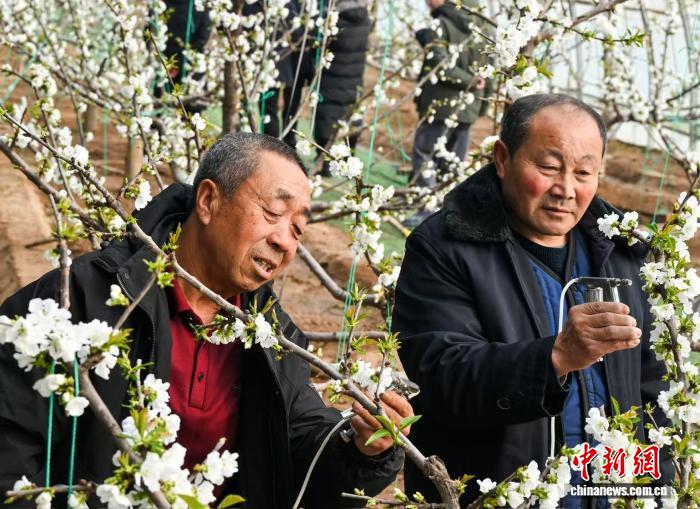
Core Viewpoint - The article highlights the agricultural development in Zuoyun County, Shanxi Province, focusing on the establishment of特色产业 (characteristic industries) and the integration of technology to enhance farmers' income and stabilize agricultural growth [1][2]. Group 1: Agricultural Development - Zuoyun County has invested 1.2 million yuan to build two cherry greenhouses, yielding over 12,000 yuan from 1,300 jin of cherries harvested in a short period [1]. - The county promotes a model of "government guidance, enterprise leadership, and farmer cooperation" to transform resource advantages into industrial strengths, thereby boosting collective village economies and increasing farmers' income [1]. Group 2: Scale and Standardization - The county is transitioning agriculture towards scale, standardization, and precision management, with over 2,600 acres of land being transferred for large-scale farming and more than 4,000 modern greenhouses established [2]. - In Heitokou Village, the introduction of green management measures has led to a single greenhouse producing over 5,000 jin of tomatoes, targeting the mid-to-high-end market [2]. Group 3: Technological Empowerment - Zuoyun County has developed a complete production system for potatoes, producing around 12 million virus-free micro-potato seeds annually, with over 10 million jin of original seeds and more than 24 million jin of first-class seeds [4]. - The county's leading seed breeding company has increased potato yields from 1,000 jin to over 3,000 jin per acre, benefiting farmers with nearly 200 million yuan in increased income [6]. Group 4: Circular Economy - The county explores a "plant-animal cycle" development model, with a company raising over 50,000 bass fish in a water recycling greenhouse, which also irrigates surrounding orchards, achieving ecological sustainability [7]. - The expected revenue from the sale of 50,000 bass fish is projected to be around 1 million yuan [7]. Group 5: Overall Impact - Zuoyun County's focus on特色产业培育 (characteristic industry cultivation),科技赋能 (technology empowerment), and生态循环发展 (ecological circular development) effectively promotes agricultural quality improvement and stable income growth for farmers [9].
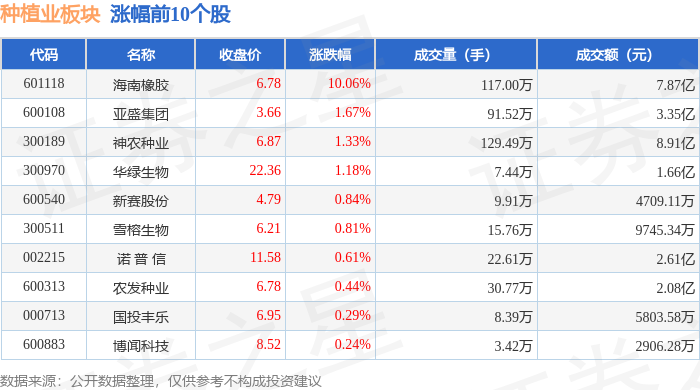
种植业板块1月23日涨1.37%,海南橡胶领涨,主力资金净流入1442.76万元
Zheng Xing Xing Ye Ri Bao· 2026-01-23 09:04
Market Overview - The planting industry sector increased by 1.37% on January 23, with Hainan Rubber leading the gains [1] - The Shanghai Composite Index closed at 4136.16, up 0.33%, while the Shenzhen Component Index closed at 14439.66, up 0.79% [1] Stock Performance - Hainan Rubber (601118) closed at 6.78, up 10.06% with a trading volume of 1.17 million shares and a transaction value of 787 million yuan [1] - Other notable stocks included: - Yasheng Group (600108) at 3.66, up 1.67% [1] - Shennong Agricultural (300189) at 6.87, up 1.33% [1] - Hualu Biological (300970) at 22.36, up 1.18% [1] Fund Flow Analysis - The planting industry sector saw a net inflow of 14.43 million yuan from institutional investors, while retail investors contributed a net inflow of 34.81 million yuan [2] - However, there was a net outflow of 49.24 million yuan from speculative funds [2] Individual Stock Fund Flow - Hainan Rubber (601118) had a net inflow of 15.2 million yuan from institutional investors, but a net outflow of 66.72 million yuan from speculative funds [3] - Other stocks with significant fund flows included: - Noposion (002215) with a net inflow of 9.17 million yuan from institutions [3] - Yasheng Group (600108) with a net inflow of 7.76 million yuan from institutions [3]

我国农业农村发展稳中有进、稳中向好 顺利完成2025年全年和“十四五”各项目标任务
Yang Guang Wang· 2026-01-23 01:49
Group 1 - The core viewpoint of the articles emphasizes the stable progress and positive trends in agricultural and rural development in China, with a focus on achieving food security and high-quality economic growth by 2025 [1][2] - By 2025, China's grain production is projected to reach 14,298 billion jin, an increase of 168 billion jin, maintaining a historical high for two consecutive years above 14 trillion jin [1] - The Ministry of Agriculture and Rural Affairs plans to enhance grain production through measures such as stabilizing acreage, increasing yield, optimizing structure, improving efficiency, and disaster reduction [1] Group 2 - The Ministry is accelerating the legislative process for farmland protection and quality improvement, aiming to maintain 1.865 billion acres of farmland and 1.546 billion acres of permanent basic farmland protection [1] - A supplementary method for farmland quality acceptance has been issued to ensure compliance with balance standards in land use [2] - The second round of land contract extensions is being piloted across seven provinces, covering 2.5 million farming households, ensuring stability in land tenure for farmers [2]
板块公募配置比例环比继续回落,处于低配水平
GF SECURITIES· 2026-01-23 01:10
Investment Rating - The industry investment rating is "Buy" [2] Core Insights - The public fund allocation in the agriculture, forestry, animal husbandry, and fishery sector has decreased by 0.15 percentage points, currently at a low allocation level of approximately 1.01%, which is 0.38 percentage points below the standard allocation ratio of 1.39% [15][21] - The report highlights a continued decline in holdings across various sub-sectors, with the feed sector experiencing the most significant drop of 0.14 percentage points [21] - Major public fund holdings are concentrated in leading companies within the livestock breeding industry and related agricultural sectors, with notable stocks including Muyuan Foods (0.28%), Wens Foodstuffs (0.07%), and others [22][24] Summary by Sections 1. Sector Allocation - The public fund allocation in the agriculture, forestry, animal husbandry, and fishery sector is approximately 1.01%, down 0.15 percentage points from the previous quarter, indicating a low allocation level compared to the standard ratio of 1.39% [15] 2. Sub-sector Holdings - The holdings in the feed and breeding sectors have both decreased, with the feed sector at 0.47% (down 0.14 percentage points) and the breeding sector at 0.43% (down 0.01 percentage points) [21] 3. Major Holdings - The report indicates that public fund holdings are primarily in leading companies in the livestock breeding chain and related agricultural sectors, with significant holdings in Muyuan Foods, Wens Foodstuffs, and others [22] 4. Investment Recommendations - In the pig farming sector, the report suggests that companies with cost advantages will have a significant competitive edge, recommending major players like Wens Foodstuffs and Muyuan Foods, while also highlighting potential in smaller firms like Tian Kang Biological and Shennong Group [37] - For the poultry sector, the report notes potential supply declines due to avian influenza, recommending attention to companies like San Nong Development and Yisheng Biological [37] - In the feed sector, the report remains optimistic about leading companies expanding their market share domestically and internationally, emphasizing the importance of cost efficiency [37] - The report also suggests monitoring developments in biotechnology and industry consolidation in the planting sector, recommending companies like Suqian Agricultural Development and Beidahuang [37] - In the pet industry, the report highlights the trend towards market consolidation and recommends companies like Guibao Pet and Zhongchong Co. [37]



盘锦市大洼区入选国家首批美丽乡村先行区名单
Liao Ning Ri Bao· 2026-01-23 01:01
Core Viewpoint - The Ministry of Ecology and Environment has released the first batch of beautiful countryside pilot areas, with 23 counties (cities, districts) selected, including Dawa District of Panjin City, which has become a benchmark for beautiful countryside construction [1] Group 1: Selection Criteria - The first batch of beautiful countryside pilot areas is categorized into three core features: those emphasizing rural ecological functions, those focusing on urban-rural integration, and those highlighting agricultural production functions [1] - Dawa District is classified under the category that emphasizes agricultural production functions [1] Group 2: Development Achievements - Dawa District serves as a base for integrated breeding and propagation of Northeast japonica rice and is a core area for intensive rice production [1] - The district has adopted the "Ten Million Project" experience, following a unique development path characterized by "ecological foundation, industrial empowerment, and quality of life improvement" [1] - The area has successfully improved and utilized saline-alkali land, establishing 838,000 acres of high-standard farmland [1] Group 3: Technological Advancements - The introduction of "smart greenhouses" and "digital farms" has significantly advanced agricultural modernization through technological innovation [1] - The brand value and market influence of local specialty agricultural products such as "Panjin rice," "Panjin river crabs," and "Panjin alkaline persimmons" continue to rise [1] Group 4: Ecological Governance - Ecological governance efforts have led to efficient disposal of rural household waste and sewage, significantly enhancing the resource utilization level of agricultural waste [1] - The district has achieved the elimination of all black and odorous water bodies, resulting in a more vibrant rural ecological environment [1] - The outcomes of beautiful countryside construction are tangibly benefiting the local population, contributing to a livable and prosperous Dawa District [1]