
半导体与集成电路

Search documents
2025城市经济研究专题:向先而行,深圳加快建设中国特色社会主义先行示范区
Sou Hu Cai Jing· 2026-01-10 07:11
Core Viewpoint - Shenzhen is accelerating its development as a leading demonstration zone for socialism with Chinese characteristics, leveraging its unique urban positioning and economic vitality to achieve high-quality growth [1]. Group 1: Urban Positioning - Shenzhen has transformed from an early processing trade model to a technology-driven industrial transformation, supported by multiple strategic advantages such as being a special economic zone and a core engine of the Guangdong-Hong Kong-Macao Greater Bay Area [1][10]. - The city aims to cultivate new productive forces, with the added value of strategic emerging industries accounting for 42.3% of GDP in 2024, maintaining the highest total industrial output value and added value among cities in China for three consecutive years [1][18]. Group 2: Industrial Growth - Shenzhen has established leading advantages in several frontier industries, including a complete semiconductor and integrated circuit supply chain, rapid growth in the smart connected vehicle sector, and a strong foundation in high-end medical devices [2][18]. - The "20+8" industrial cluster strategy is being upgraded to create several trillion-yuan and 500-billion-yuan industrial clusters, showcasing strong development potential [1][18]. Group 3: Collaborative Development - The city's development relies on both internal collaboration and close ties within the Greater Bay Area, with key districts like Nanshan and Futian leading in technological innovation and international finance, respectively [2][18]. - Shenzhen's cooperation with Hong Kong is advancing towards deeper integration of rules and cross-border flow of innovative factors, while collaboration with surrounding cities like Dongguan and Huizhou forms an efficient industrial chain [2][18]. Group 4: Advantages and Challenges - Shenzhen's high-quality development is supported by its innovative capabilities, with a 10.5% year-on-year growth in the added value of strategic emerging industries in 2024, and a significant increase in high-tech manufacturing investments [18][25]. - The city faces challenges such as external uncertainties, competition in key technologies, and regional competition, necessitating continued efforts in economic reform, optimizing the business environment, and enhancing the innovation ecosystem [3][18]. Group 5: Future Opportunities and Policy Recommendations - The report emphasizes the need for Shenzhen to strengthen its competitive edge in artificial intelligence, semiconductors, and biomedicine through institutional innovation and capital empowerment, positioning itself as a global leader in industrial innovation [3][18].

广州加快建设先进制造业强市 力争十年工业增加值翻一番 到2035年建成万亿级“智车之城”
Nan Fang Ri Bao Wang Luo Ban· 2026-01-09 07:44
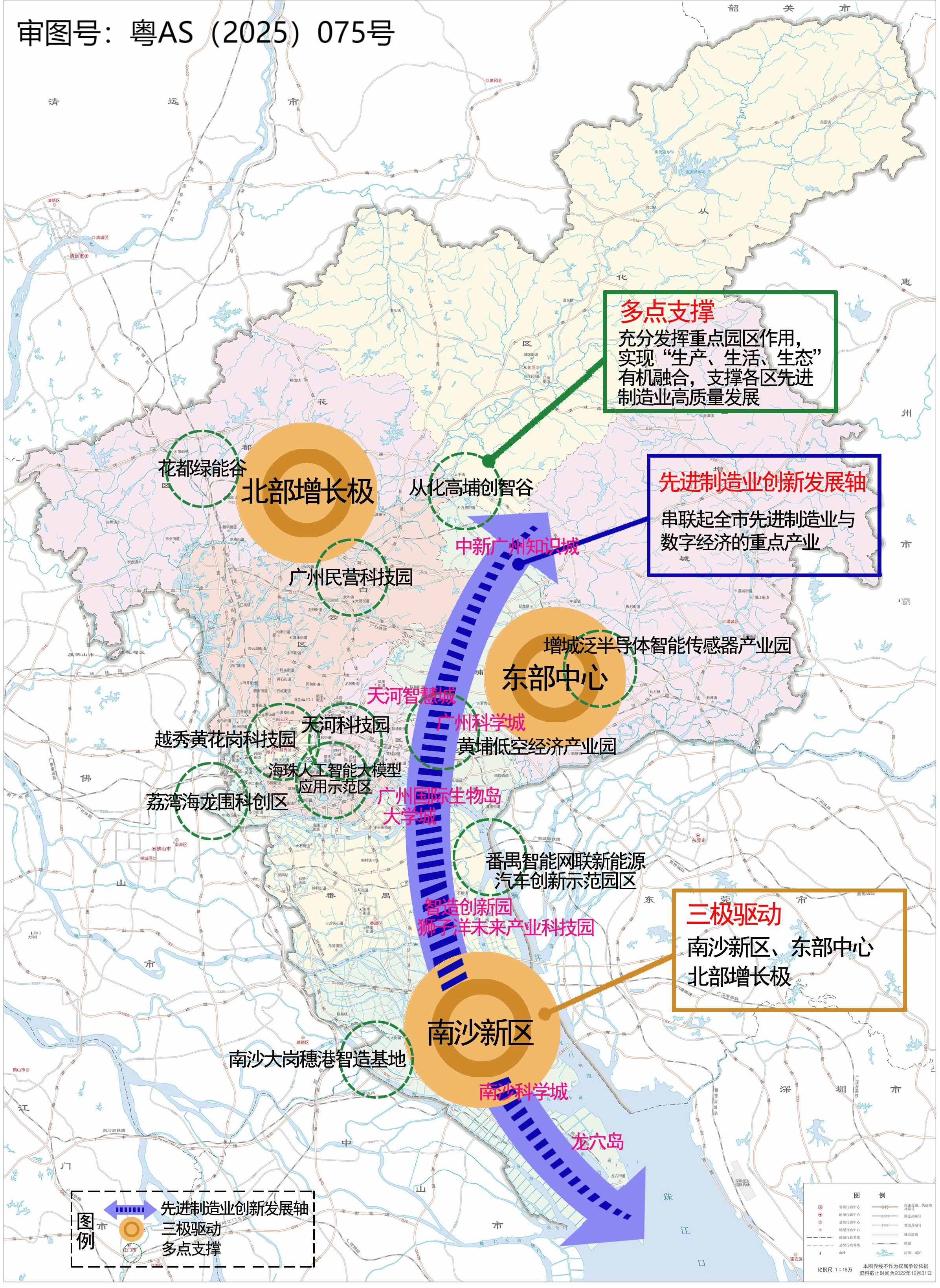
Group 1 - The core viewpoint of the news is the release of the "Guangzhou Plan for Accelerating the Construction of a Strong Advanced Manufacturing City (2024-2035)", which aims to double the industrial added value by 2035 and establish Guangzhou as a globally competitive advanced manufacturing hub [1][2] - By 2030, Guangzhou plans to build several world-class advanced manufacturing clusters and achieve significant breakthroughs in key core technologies, positioning itself at the high end of the global value chain [1][2] - The plan outlines four strategic positions for Guangzhou's advanced manufacturing development: a world-class advanced manufacturing base, a global manufacturing innovation center, a benchmark city for digital-physical integration, and a model city for new-type industrialization [1][2] Group 2 - The plan specifies development directions for emerging pillar industries, including the intelligent connected new energy vehicle sector, which aims to reach a trillion-level scale by 2035, establishing Guangzhou as a "Smart Car City" [2] - In the ultra-high-definition and new display sector, the industry scale is projected to reach 300 billion by 2035, while the intelligent equipment and robotics sector is also expected to achieve a scale of 300 billion [2] - The plan emphasizes the introduction and cultivation of leading enterprises in the semiconductor and integrated circuit fields, as well as the development of key aerospace bases in the low-altitude economy sector [2][3] Group 3 - The spatial layout of advanced manufacturing is defined by "one axis, three poles, and multiple points," with the "one axis" representing the innovation development axis that connects key national development zones [3] - The "three poles" refer to important advanced manufacturing bases in Nansha New Area, Eastern Center, and Northern Growth Pole, which will drive the transformation of manufacturing towards high-end, intelligent, and green directions [3] - The "multiple points" strategy aims to leverage key industrial platforms to create high-quality industrial clusters by linking surrounding advantageous industries [3]
广州:加快建设先进制造业强市,到2035年工业增加值翻一番
Sou Hu Cai Jing· 2026-01-08 11:04
Core Viewpoint - Guangzhou aims to accelerate the construction of an advanced manufacturing city by 2035, targeting a doubling of industrial added value and focusing on the "12218" modern industrial system, integrating advanced manufacturing with modern services, and promoting digital and green transformations [2][14]. Group 1: Key Industrial Directions - The plan emphasizes the development of 15 strategic industrial clusters and six emerging pillar industries, including smart connected new energy vehicles, ultra-high-definition video and new displays, biomedicine and health, green petrochemicals and new materials, software and the internet, and intelligent equipment and robotics [2][38]. - Five strategic leading industries will be cultivated, including artificial intelligence, semiconductors and integrated circuits, new energy and new energy storage, low-altitude economy and aerospace, and biomanufacturing [3][38]. - Four characteristic advantageous industries will be strengthened, such as fashion consumer goods, rail transit, shipbuilding and marine engineering, and intelligent construction and industrialized buildings [4][38]. Group 2: Implementation Strategies - The plan outlines five major projects: industrial agglomeration, industrial innovation, intelligent manufacturing traction, integrated development, and supply chain optimization [14][34]. - Six action plans are proposed, including structural optimization, investment leap, talent attraction and cultivation, digital empowerment, spatial innovation, and element guarantee [14][34]. Group 3: Development Foundations - Guangzhou has a solid manufacturing base, being the most complete industrial city in South China, with significant advantages in technological innovation, green development, and international cooperation [19]. - The city ranks 8th globally in the "Nature Index - Research Cities" and has a robust innovation ecosystem, including numerous national and provincial manufacturing innovation centers [20][27]. Group 4: Opportunities and Challenges - The plan identifies major opportunities from national strategies, such as the manufacturing power strategy and the development of the Guangdong-Hong Kong-Macao Greater Bay Area, which enhances Guangzhou's role as a manufacturing hub [24][18]. - Challenges include the pressure from global economic downturns, the need for industrial upgrades, and competition from other metropolitan areas [28][29]. Group 5: Future Goals - By 2030, the advanced manufacturing city construction is expected to reach significant milestones, with a focus on optimizing industrial structure and enhancing quality and efficiency [36]. - By 2035, Guangzhou aims to solidify its status as an advanced manufacturing city, achieving breakthroughs in key technologies and maintaining a leading position in the global value chain [36][38].
利好来了!
中国基金报· 2026-01-08 10:14
Core Viewpoint - Guangzhou is accelerating the construction of an advanced manufacturing city with a focus on strategic industries and innovation, aiming for significant progress by 2030 and a robust industrial system by 2035 [2][4]. Group 1: Strategic Industry Development - By 2030, Guangzhou aims to establish a modern industrial system with a new structure that includes trillion-yuan driving forces and significant improvements in quality and efficiency [4]. - The city plans to cultivate five strategic leading industries, including artificial intelligence, semiconductors, new energy, low-altitude economy, and biomanufacturing, to double industrial added value by 2035 [5][6]. - Six emerging pillar industries will be developed, such as smart connected vehicles and biomedicine, alongside four characteristic advantage industries [6]. Group 2: Technological Innovation and Infrastructure - Guangzhou will support the exploration of autonomous driving applications in public transport and the establishment of intelligent transportation demonstration zones [9]. - The city is focused on promoting the large-scale application of self-controlled automotive chips and enhancing the security of the supply chain [10]. - There will be a push for the construction of intelligent computing infrastructure and the development of a public computing center to support AI and digital transformation [11]. Group 3: Robotics and Advanced Manufacturing - The city will prioritize the development of embodied robots for various applications, including home services and industrial manufacturing [12]. - There is a strong emphasis on advancing third-generation semiconductor materials and promoting the manufacturing of high-value medical devices [13][16]. - By 2035, the robotics and intelligent equipment sector is expected to reach a scale of 300 billion [14]. Group 4: Aerospace and Satellite Development - Guangzhou aims to establish a liquid rocket assembly and testing base to support the development of reusable rocket technology [18]. - The city will encourage local universities and enterprises to participate in satellite constellation projects, fostering a complete commercial aerospace ecosystem [19]. - By 2035, Guangzhou plans to become a core area for integrated circuits and a significant player in the commercial aerospace sector [20][21]. Group 5: Superconducting Materials and Applications - The city will promote the application of high-temperature superconducting materials in various fields, including nuclear fusion and medical devices [22].
广州:积极谋划芯片研发设计、晶圆制造、封装测试、半导体材料和设备等全产业链布局
Zheng Quan Shi Bao Wang· 2026-01-08 09:17
Core Viewpoint - The Guangzhou Municipal Government has issued a plan to accelerate the development of an advanced manufacturing strong city, focusing on the semiconductor and integrated circuit industry from 2024 to 2035 [1] Group 1: Industry Development - The plan emphasizes the promotion of the semiconductor and integrated circuit industry, including chip research and design, wafer manufacturing, packaging and testing, as well as semiconductor materials and equipment [1] - The strategy aims to fill gaps in the industry chain by leveraging districts such as Huangpu, Nansha, and Zengcheng [1] Group 2: Supply Chain and Equipment - The initiative includes the establishment of production lines for manufacturing materials like photomasks, photoresists, electronic gases, and high-purity target materials [1] - It also focuses on attracting and nurturing leading enterprises in manufacturing equipment and components for processes such as lithography, etching, ion implantation, deposition, cleaning, and testing [1]
“车药芯智”强力驱动 深圳坪山区稳居中国工业百强区前列
Zhong Guo Jing Ji Wang· 2026-01-08 08:09
Core Insights - Shenzhen Pingshan District has significantly improved its ranking in the 2025 China Industrial Top 100 list, moving from 49th in 2022 to 19th, reflecting its rapid advancement in new industrialization [1] - The district focuses on developing its economy through the real economy, emphasizing emerging industries such as new energy, smart connected vehicles, biomedicine, and semiconductors [1][2] Group 1: Industrial Development - Pingshan has established a modern industrial system centered around the "vehicle, medicine, chip, and intelligence" cluster, with industrial output exceeding 600 billion yuan during the 14th Five-Year Plan [1] - The region has over 500 biopharmaceutical companies, with significant achievements such as the record-setting $16.4 billion licensing deal for innovative drugs [2] - The first integrated land-air testing ground in the Greater Bay Area has been launched, supporting a production value exceeding 400 billion yuan [2] Group 2: Innovation and Technology - Pingshan has implemented a comprehensive innovation ecosystem, introducing policies to support the entire cycle from research to industrial application [3] - The district has seen breakthroughs in key technologies, including BYD's blade battery and advanced medical devices, supported by a high R&D investment of 11.8% of GDP in 2024 [3] - The number of national high-tech enterprises has surpassed 1,000, with significant growth in specialized and innovative small giant enterprises [5] Group 3: Government Support and Infrastructure - The government has facilitated industry development by organizing supply-demand matching events, leading to preliminary cooperation agreements that are expected to generate over 10 million yuan in industrial synergy [4] - Pingshan has developed a 2.68 square kilometer contiguous industrial land area and established 4,165 5G base stations, enhancing infrastructure for AI industry development [4] - A comprehensive enterprise service platform has been created to address business needs, with 1.41 billion yuan in support funds allocated to benefit over 2,200 enterprises during the 14th Five-Year Plan [4]

政策与生态共振 助力深圳“强芯”
Shen Zhen Shang Bao· 2026-01-01 22:00
Core Insights - Shenzhen is accelerating the construction of a complete semiconductor industry chain, from chip design to manufacturing and ecological applications, to promote high-quality development in the semiconductor industry [1] Group 1: Industry Development - As of the end of 2024, Shenzhen will have a total of 727 integrated circuit companies, including 456 design companies, 8 manufacturing companies, 82 packaging and testing companies, 133 equipment and component companies, and 48 materials companies [1] - By the first half of 2025, the scale of Shenzhen's integrated circuit industry is expected to reach 142.4 billion yuan, representing a year-on-year growth of 16.9% [1] Group 2: Policy Initiatives - Following the release of the "Shenzhen Action Plan for Cultivating and Developing the Semiconductor and Integrated Circuit Industry Cluster (2022-2025)," Shenzhen issued further measures in July 2025 to promote high-quality development in the semiconductor and integrated circuit industry [1] - The new measures focus on breakthroughs in high-end chip products, strengthening chip design support, accelerating the promotion of EDA tools, and overcoming challenges in core equipment and supporting components [1] Group 3: Recommendations for Growth - Suggestions include enhancing support for small and medium-sized high-tech enterprises to identify potential future leaders in the industry [2] - Emphasis on strengthening application scenarios to drive progress in both hardware and software, with increased support for upstream industries like core EDA design software and advanced packaging [2] - A dual approach is recommended for hardware and ecosystem development, including guiding funds to promote hardware companies' ecological transformation and establishing special subsidies for software companies to adapt to domestic architectures [2]
新一批16个省级特色产业园授牌 广东首设人工智能与机器人特色产业园
Nan Fang Ri Bao Wang Luo Ban· 2025-12-26 01:47
Core Insights - The 2025 Provincial Industrial Park (Yangjiang) Industrial Chain Collaborative Development Conference highlighted the recognition of 16 new provincial characteristic industrial parks, marking a breakthrough in the artificial intelligence and intelligent robotics sectors [1][2] Group 1: Industrial Park Development - The total number of characteristic industrial parks in the province has reached 70, covering all 21 cities and involving 17 industrial cluster directions, including 7 strategic pillar industries and 6 strategic emerging industries [1] - The newly recognized parks demonstrate stronger systemic and coordinated regional and industrial layouts, with coverage across 13 cities including Guangzhou, Shenzhen, and Zhuhai [2] Group 2: Sectoral Focus - The new characteristic industrial parks encompass 13 industrial cluster directions such as software and information services, advanced materials, and intelligent robotics, reflecting both upgrades to traditional industries and forward-looking layouts for future sectors [2][3] - The Guangzhou Science City AI Emerging Characteristic Park has attracted leading companies like Jiadu Technology and Southern Power Grid Research Institute, showcasing strong innovation capabilities in industrial software and smart transportation [2] Group 3: Traditional Industry Revitalization - The Yadi electric vehicle production base in Qingyuan has achieved an annual output value of 6.885 billion yuan, with a year-on-year growth of 23.3%, becoming the county's leading pillar industry [4] - The Renhua Industrial Park in Shaoguan focuses on resource recycling, contributing 72.1% of the park's industrial output value in 2023 through a complete recycling chain [4] Group 4: Green Transformation - The Zhanjiang Economic and Technological Development Zone is developing a green petrochemical cluster, with Zhongke Refining achieving a production value of 69.1 billion yuan in the first three quarters [5] - Zhanjiang has been selected as a national pilot for low-carbon hydrogen energy transition, emphasizing systematic decarbonization in manufacturing [5] Group 5: Historical Context - The conference coincided with the 20th anniversary of the establishment of provincial industrial parks, which have seen significant growth and now support over 2.4 trillion yuan in annual industrial output [5]

“才聚天府·筑梦成都”城市行首站奔赴深圳 背后有何深意?
Xin Lang Cai Jing· 2025-12-22 18:17
Core Viewpoint - The "Talent Gathering Tianfu · Building Dreams in Chengdu" event aims to attract high-quality talent from Shenzhen to Chengdu, emphasizing collaboration between the two cities to enhance industrial upgrading and innovation [1][3][4]. Group 1: Talent Attraction and Industrial Needs - Chengdu's talent recruitment initiative is driven by the need for high-level talent in key industries such as artificial intelligence, integrated circuits, and biomedicine, addressing the talent gap for industrial upgrades [3][4]. - The event features over a thousand quality job openings, including specialized recruitment for integrated circuits and biomedicine, with attractive salary packages reaching up to one million [4][5]. Group 2: Regional Cooperation and Synergy - The collaboration between Chengdu and Shenzhen is characterized by a focus on mutual benefits rather than competition, aiming for a "win-win" scenario through resource linkage and talent mobility [5][7]. - The establishment of the Bailu Bay Technology Ecological Park symbolizes the deepening partnership, serving as a core hub for AI innovation and showcasing successful cooperation between the two cities [6][7]. Group 3: Investment and Project Development - Six key industrial projects from the Greater Bay Area were signed during the event, with a total investment exceeding 3.5 billion, enhancing Chengdu's industrial chain [7]. - Chengdu's strategy includes signing talent development agreements with four well-known institutions from the Greater Bay Area, broadening access to high-end talent and innovation resources [7][8]. Group 4: Talent Ecosystem and Support - Chengdu's supportive environment for entrepreneurs includes efficient government services, research resource connections, and comprehensive talent support, making it an attractive destination for talent [9]. - The city's initiatives, such as the "Ten Measures to Attract and Gather Talent," reflect its commitment to fostering a conducive environment for talent retention and development [9].
深圳宝安:场景开放牵引产业变革
Jing Ji Ri Bao· 2025-12-18 04:50
Core Insights - The article highlights the rapid development of innovative industrial transformations in Bao'an District, Shenzhen, focusing on low-altitude logistics, smart manufacturing, and smart city applications [1][2][3] Group 1: Industrial Innovation and Scene Opening - Bao'an District has opened 158 drone routes, achieving 383,800 low-altitude flights and establishing China's first "air-ground collaborative" smart operation center [1] - The district has organized 641 government-enterprise scene matching activities over the past three years, attracting over 11,700 companies and facilitating transactions exceeding 20 billion yuan [1][2] - The "Baojing Chuangxiang" scene matching conference released over 500 scene opportunities, with more than 60 companies signing contracts, resulting in over 10 billion yuan in intended transaction amounts [2][3] Group 2: Technological and Product Development - Bao'an has become a hub for various innovative companies, including those focusing on perovskite solar technology, benefiting from the district's scene opening initiatives [3][4] - The district has established a development framework for technology-based SMEs, with 7,397 national high-tech enterprises, leading the country for eight consecutive years [4] Group 3: Ecosystem and Support Platforms - Bao'an aims to create a scene innovation ecosystem by leveraging policy innovation and smart manufacturing advantages, promoting a collaborative environment for enterprises [5][6] - The district has developed a supply-demand capability list and opportunity list to facilitate precise matching between enterprises and government-led public service needs [6] - The establishment of the Guangdong-Hong Kong-Macau Greater Bay Area Application Scene Innovation Center in Bao'an will focus on new technology testing and creating a platform for productivity enhancement [8][9]