
国防装备

Search documents
Cadre Holdings, Inc. (CDRE) Analyst/Investor Day Transcript
Seeking Alpha· 2025-10-09 02:46
Core Insights - The company views the current geopolitical risks and security challenges as opportunities for growth and leadership in the industry [2][3] - The commitment to support professionals in high-stakes environments, such as EOD technicians and nuclear safety teams, is a fundamental aspect of the company's culture and operational focus [2][3] Industry Overview - The landscape of protection has evolved, now encompassing not just physical armor but also the safeguarding of critical infrastructure and energy systems [3] - The company's expansion into nuclear safety, including the development of containment, detection, and rapid response platforms, aligns with its strategic goals and core competencies [3] - Recent achievements, such as the award of Advanced Blast Sensors over a five-year period, highlight the company's ongoing commitment to innovation and excellence in safety technology [3]



美股异动|Unusual Machines盘前涨超5% 获1280万美元国防订单
Ge Long Hui A P P· 2025-09-30 13:31
Core Viewpoint - Unusual Machines has received a significant defense contract worth $12.8 million to supply equipment for the Strategic Logix S RRSL drone system, leading to a pre-market stock increase of over 5% [1] Company Summary - Unusual Machines is set to enhance its revenue stream through a new defense order, indicating strong demand for its products in the defense sector [1] - The contract highlights the company's involvement in advanced technology and defense systems, positioning it favorably within the industry [1] Industry Summary - The defense sector continues to show robust growth, with companies like Unusual Machines benefiting from government contracts [1] - The Strategic Logix S RRSL drone system represents a growing area of investment and development within the defense industry, reflecting broader trends in military technology [1]
西部证券晨会纪要-20250829
Western Securities· 2025-08-29 01:55
Group 1: Zhujiang Beer (002461.SZ) - Zhujiang Beer is the leading regional beer brand in Guangdong Province, with a strong market foundation and high consumer recognition. The flagship product, 97 Pure Draft, is leading product upgrades and capturing market share from competitors [6][7]. - The company has experienced continuous revenue and profit growth, with a CAGR of 7.8% in revenue and 9.2% in net profit from 2020 to 2024. The proportion of high-end products has increased significantly from 49.1% in 2019 to 70.8% in 2024 [6][7]. - The new management team, including a newly appointed chairman and general manager, is expected to drive further growth and innovation. The company has a solid reserve of high-end products and aims to expand its market presence outside Guangdong [7]. Group 2: Hanshuo Technology (301275.SZ) - Hanshuo Technology's revenue for the first half of 2025 was 1.974 billion yuan, a year-on-year decrease of 7%, with a net profit of 222 million yuan, down 42% year-on-year. The company is focusing on the North American market, which shows significant growth potential [16][17]. - The global demand for retail digitalization continues to grow, with electronic shelf label (ESL) module shipments reaching 248 million units in the first half of 2025, a 56% increase year-on-year. The demand from major retailers like Walmart is expected to drive further digital upgrades in the retail sector [16][17]. - The company has established a comprehensive business system centered on electronic shelf label systems and SaaS cloud platform services, with international operations in over 70 countries [17]. Group 3: Guoci Materials (300285.SZ) - Guoci Materials reported a revenue of 2.154 billion yuan in the first half of 2025, a year-on-year increase of 10.29%, with a net profit of 332 million yuan, up 0.38% year-on-year. The company is experiencing growth in electronic materials and new energy materials [18][19]. - The company’s six major business segments are developing synergistically, with a projected net profit of 774 million yuan, 886 million yuan, and 1.058 billion yuan for 2025-2027, respectively [19][20]. - The company is focusing on strategic investments and acquisitions to enhance its capabilities in clinical materials and digital equipment, particularly in the biomedical materials sector [20]. Group 4: Yuhua Software (300339.SZ) - Yuhua Software achieved a revenue of 1.747 billion yuan in the first half of 2025, a year-on-year increase of 10.55%, while the net profit decreased by 29.43% to 60 million yuan. The company is actively promoting its innovative business [22][23]. - The company’s gross margin was 23.72%, down 2.36 percentage points year-on-year, but it has optimized its expense ratios, leading to improved operational efficiency [23][24]. - The revenue from innovative business segments reached approximately 368 million yuan, accounting for 21.07% of total revenue, indicating a growing contribution from new business areas [24]. Group 5: New Dairy Industry (002946.SZ) - New Dairy Industry reported a revenue of 5.526 billion yuan in the first half of 2025, with a net profit of 397 million yuan, reflecting a year-on-year increase of 33.8%. The company’s low-temperature strategy is showing significant results [48][49]. - The direct-to-consumer (DTC) model has driven growth, with revenue from this channel increasing by 23% to 3.39 billion yuan, representing 66.3% of total revenue [48][49]. - The company is focusing on core markets and has achieved stable growth in key regions, with a notable increase in high-end fresh milk sales [48][49].




深夜突发!欧盟:拟取消部分美国商品关税
证券时报· 2025-08-28 16:01
Core Viewpoint - The European Commission has proposed legislation to eliminate certain tariffs on American goods, aiming to enhance transatlantic trade and investment stability following the U.S. tariff reductions on the EU automotive sector starting August 1 [2][3]. Group 1: Tariff Changes - The EU will eliminate tariffs on all American industrial products and provide preferential market access for U.S. seafood and non-sensitive agricultural products [4][5]. - The U.S. will reduce tariffs on EU automobiles and parts from 27.5% to 15%, and implement zero or near-zero tariffs on several products including softwood, aircraft, and generics starting September 1 [2][5]. Group 2: Legislative Process - The proposed measures are necessary legislative steps to fulfill commitments outlined in the EU-U.S. joint statement, requiring approval from the European Parliament and the EU Council to take effect [3][12]. Group 3: Future Cooperation - The EU and U.S. have agreed to continue discussions on further tariff reductions and to identify additional areas for cooperation [11][13]. - The EU plans to procure U.S. energy products, AI chips, and defense equipment, with expected purchases reaching $750 billion by 2028 for energy products and at least $400 billion for AI chips [9][10].

欧盟如何兑现对美的天价承诺?专家:能源采购、投资和国防支出上都有挑战
Di Yi Cai Jing· 2025-08-24 09:46
Group 1: Trade Agreement Overview - The US and EU have announced a trade agreement framework, with the EU committing to purchase $750 billion worth of US energy products by 2028 and invest $600 billion in US strategic industries during the same period [1][6] - The agreement also includes increased military and defense equipment purchases from the US to enhance NATO defense cooperation [1][6] Group 2: Challenges in Energy Procurement - The ambitious target of $750 billion in energy purchases is deemed difficult to achieve, particularly due to the significant reliance on liquefied natural gas (LNG) exports from the US [3][4] - The US Energy Information Administration (EIA) projects that US energy exports to the EU will remain at $78.5 billion in 2024, necessitating a more than twofold increase in annual imports from the EU to meet the target [3][4] - Current LNG import capacity and infrastructure limitations pose significant challenges, as the US LNG export terminals are operating at full capacity and cannot double their output until 2030 [4] Group 3: Investment and Defense Spending Challenges - The framework indicates that EU companies are expected to invest an additional $600 billion in the US by 2028, but convincing private companies to invest in the US remains a challenge [6][7] - The EU's defense spending has been primarily directed towards external procurement, with 63% of defense spending flowing to the US [6][7] - The EU's long-term budget proposal aims to increase defense and aerospace spending significantly, raising questions about the compatibility of this with the new trade agreement [7][8]

美国与欧盟发表联合声明:欧盟承购美能源产品、人工智能芯片及国防装备
财联社· 2025-08-21 12:29
Group 1 - The core viewpoint of the article is that the United States and the European Union have reached an agreement on a trade framework, which includes significant energy and technology procurement commitments from the EU to the US [1][2][3][4] Group 2 - The EU is set to purchase US energy products, including liquefied natural gas, oil, and nuclear products, with expected purchases reaching $750 billion by 2028 [2] - The EU has committed to acquiring at least $40 billion worth of US artificial intelligence chips for the construction of data centers in Europe [3] - By 2028, European companies are projected to invest an additional $600 billion in strategic sectors in the US, alongside plans to significantly increase procurement of military and defense equipment from the US [4]

达成一致!美国与欧盟发表联合声明
21世纪经济报道· 2025-08-21 12:22
Core Viewpoint - The United States and the European Union have reached an agreement on a trade framework that includes various sectors such as agriculture, industrial products, and energy, aiming to enhance trade relations and reduce tariffs [1][10]. Group 1: Trade Agreement Details - The trade agreement framework consists of 19 key points covering agricultural products, automobiles, aircraft, semiconductor chips, energy, EU investments in the US, environmental regulations, cybersecurity agreements, and digital trade barriers [1]. - The EU will eliminate tariffs on all US industrial products and provide preferential market access for US agricultural products, including nuts, dairy, fresh and processed fruits and vegetables, processed foods, seeds, soybean oil, and meat products [4][3]. - The US will apply either the most-favored-nation (MFN) tariff rate or a 15% tariff rate on EU-origin goods, with specific products like non-renewable natural resources, aircraft, pharmaceuticals, and chemicals being subject to MFN tariffs starting September 1, 2025 [6][5]. Group 2: Energy and Investment Commitments - The EU plans to purchase US energy products, including liquefied natural gas, oil, and nuclear products, with expected purchases reaching $750 billion by 2028 [8]. - The EU will also commit to acquiring at least $400 billion worth of US artificial intelligence chips for the construction of data centers in Europe [8]. - European companies are expected to invest an additional $600 billion in strategic sectors in the US by 2028 [8]. Group 3: Future Negotiations - The EU will continue discussions with the US to agree on further tariff reductions and identify additional areas for cooperation [10]. - The EU Commission will initiate the implementation of the agreement's main content with the support of EU member states and the European Parliament [10].

中国海防:部分子公司已完成人工智能的本地化部署和试点应用
Zheng Quan Ri Bao· 2025-08-15 12:49
Group 1 - The company has completed the localization deployment and pilot applications of artificial intelligence in some subsidiaries [2] - The company is actively promoting the innovative application of AI technology in scientific research and production [2]

天奥电子(002935.SZ):产品主要应用于国防装备领域
Ge Long Hui· 2025-08-13 07:23
格隆汇8月13日丨天奥电子(002935.SZ)于投资者互动平台表示,公司产品主要应用于国防装备领域。 ...

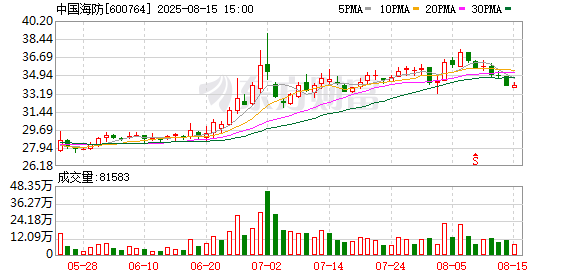
中国海防(600764.SH):防务类产品广泛应用于各类有人无人舰艇平台
Ge Long Hui· 2025-08-04 08:51
Core Viewpoint - China Haifang (600764.SH) emphasizes the extensive application of its defense products across various manned and unmanned vessel platforms [1] Group 1 - The company’s defense products are widely utilized in both manned and unmanned vessel platforms [1]