
数字文化

Search documents
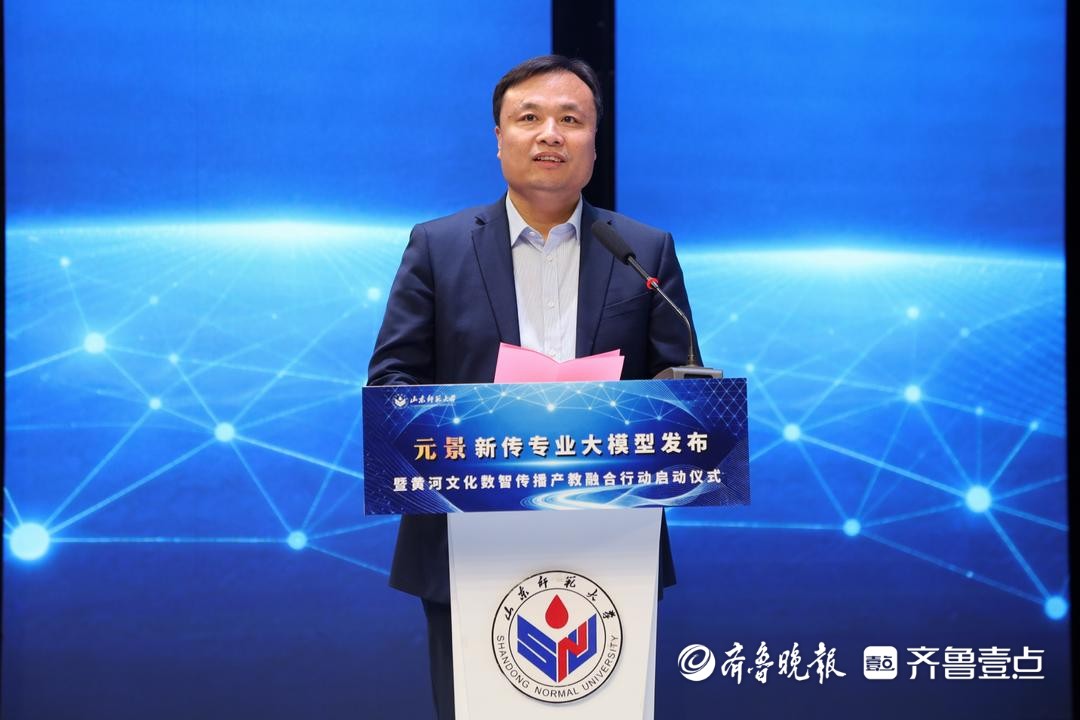
山东数字文化集团:以元景大模型为平台,推进产教融合高质量发展
Qi Lu Wan Bao· 2026-01-22 07:23
Core Insights - The "Yuanjing" new media model was launched to enhance the integration of industry and education, focusing on the innovative dissemination of Yellow River culture and the reform of journalism education [1][3] - The model aims to provide a comprehensive tool for journalism education, integrating AI technology with core functions such as content production, media distribution simulation, and research analysis [3][5] Group 1: Industry Transformation - Digital intelligence technology is reshaping the ecology of the news dissemination field, indicating a significant industry transformation and educational reform [3] - The collaboration between Shandong Normal University and Shandong Digital Culture Group represents a breakthrough in school-media cooperation, responding to national strategies for cultural strength and digital development [3][5] Group 2: Development Initiatives - Shandong Digital Culture Group is committed to exploring effective mechanisms for the integration of culture and technology, focusing on developing new digital cultural industries [5] - The group is undertaking significant projects, including the development of a cultural database and a high-performance GPU cluster to support the creation of the Qilu cultural model [5][6] Group 3: Future Plans - Future initiatives include the construction of high-quality datasets related to Yellow River culture, aiming to enhance practical teaching and the development of multimedia narrative and intelligent communication skills [6][8] - The group plans to deepen the integration of the "Yuanjing" model into educational strategies, contributing to the cultivation of outstanding media talents and the promotion of Yellow River stories [8]

在临港 打造青年创业理想城 “临港科创城”建设方案发布 建设国际科创中心重要基地
Jie Fang Ri Bao· 2026-01-22 01:31
Core Points - The "Lingang Science and Technology Innovation City" construction plan aims to leverage the innovative advantages of the new area, promoting innovation and entrepreneurship, and establishing Lingang as a key hub for technology transfer, emerging industries, and youth entrepreneurship [1] - The plan sets two phased goals for 2027 and 2030, including the establishment of at least 7 high-level laboratories and research institutions, maintaining R&D expenditure at over 5.5% of GDP, nurturing over 2,000 high-tech enterprises, and attracting over 40,000 innovative talents [1] Group 1: Goals and Communities - The plan outlines four benchmark science and technology innovation communities: 1. Dishui Lake AI Innovation Port focusing on digital culture, automotive electronics, and smart terminals 2. Dishui Lake IC Innovation Port concentrating on integrated circuits, brain-machine science, and new materials 3. Dishui Lake Financial Bay targeting overseas services and cross-border finance 4. Dishui Lake International Data Port emphasizing digital services and e-commerce live streaming [2] Group 2: Action Plans - Five major action plans are proposed: 1. Strengthening technology transfer by leveraging high-level research institutions and major scientific facilities, focusing on key industries like integrated circuits and civil aviation [3] 2. Leading frontier industries by nurturing future industry tracks such as fourth-generation semiconductors and controlled nuclear fusion [3] 3. Attracting innovative and entrepreneurial talent through the "Blue Whale Plan" targeting digital nomads and entrepreneurs [3] 4. Accelerating capital empowerment with a 600 million yuan fund to support innovative projects in civil aviation and biomedicine [3] 5. Building an innovation ecosystem by providing over 300,000 square meters of low-cost entrepreneurial space and 5,000 youth apartments within five years [4]

天下文枢谱新章 创新潮涌映金陵
Jiang Nan Shi Bao· 2026-01-20 13:36
Core Viewpoint - Nanjing, as a historical and cultural city, exemplifies the integration of cultural heritage and economic development, showcasing a unique model of humanistic economics that drives modern growth [1][2][3]. Group 1: Cultural Heritage and Economic Development - Nanjing has a rich history of over 3,100 years and has been a significant cultural hub, known as the "天下文枢" (World Literary Center), which has fostered the integration of Southern and Northern Chinese civilizations [2]. - The city has successfully transformed its cultural heritage into a driving force for modern development through innovative practices, emphasizing the importance of creative transformation [2][3]. - Nanjing's cultural identity is deeply embedded in its economic practices, demonstrating a symbiotic relationship between culture and economy [1][3]. Group 2: Urban Development and Quality of Life - Nanjing is recognized as a "幸福之城" (City of Happiness), having won the title of "China's Most Livable City" for 16 consecutive years, reflecting its commitment to high-quality public services [3]. - The city promotes an open and inclusive urban character, integrating various cultural and economic elements to enhance its development [2][3]. - Nanjing's urban planning incorporates natural and cultural elements, creating a harmonious living environment that prioritizes both development and preservation [6]. Group 3: Cultural Industry and Innovation - The cultural industry in Nanjing is thriving, with significant contributions from digital culture, where core digital cultural enterprises account for over 34% of Jiangsu Province's economic output [5]. - Nanjing is fostering a cluster of digital cultural enterprises, enhancing competitiveness and innovation through the establishment of key laboratories and cultural parks [5][8]. - The city is actively developing new cultural brands and IPs, such as "World Literary City" and "Night Tour in Jinling," to stimulate tourism and cultural consumption [4][5]. Group 4: Integration of Technology and Culture - Nanjing is building a comprehensive digital cultural innovation system that encompasses technology research, content production, and application scenarios, aiming to lead in the new humanistic economic landscape [8]. - The city is leveraging digital technologies to enhance consumer experiences, creating smart tourism and retail environments that integrate online and offline interactions [8]. - Collaborative innovation among government, industry, academia, and research is being emphasized to optimize the transformation of cultural and technological achievements [8].
北京加快培育“超现场”产业生态
Xin Lang Cai Jing· 2026-01-18 22:33
北京市经济和信息化局将发挥在产业布局、技术创新、基础设施建设方面的引领作用,重点牵头推 进"超现场"关键核心技术攻关、建设数字视听智控中心和打造旗舰应用场景。北京市广电局将发挥在内 容制播、安全传输等方面的专业优势,重点牵头加大"超现场"优质内容供给和技术支持监管。两部门将 形成政策合力,共同推进"超现场"标准体系制定、商业模式创新、协同能力建设和宣传推广等相关工 作。 市经信局方面表示,在推进关键核心技术攻关中,企业是创新的主体,也是技术攻关最重要的力量。为 了发挥好企业主体作用,一是要用好"揭榜挂帅"机制,将广泛征集产业面临的真实技术难题,形成"榜 单",谁有本事谁就"揭榜答题"。二是鼓励联合攻关,支持产业链龙头企业、高校院所与中小企业组成 创新联合体共同揭榜,对于入选的攻关项目,不仅提供必要的资金支持,更会对接测试场景、智控中心 等基础设施资源,帮助其技术快速迭代和验证,加快构建充满活力的协同创新生态。 市广电局方面表示,将重点计划从三个方面推动"超现场"优质内容供给。一是加强内容储备与精品扶 持。2026年,将联动国家大剧院、中国国家话剧院、北京人艺、东方演艺集团、北京京剧院等在京头部 院团,共同策划 ...
北京出台9项措施培育“超现场”产业
Xin Lang Cai Jing· 2026-01-18 19:30
(来源:工人日报) 本报讯(记者赖志凯 见习记者沙剑青)1月15日,北京市经信局、北京市广播电视局联合印发《北京市 关于加快培育"超现场"产业生态的若干措施》(以下简称《若干措施》)。《若干措施》从标准体系、 技术攻关、内容供给等九大方面精准施策,推动超高清视听技术与文化产业深度融合,为首都新质生产 力发展注入文化科技融合新动能。 技术攻关是产业发展的核心支撑。《若干措施》明确,将聚焦超高清摄像设备、智能导播系统等关键方 向,重点突破高性能8K实时编解码芯片、高分辨率图像传感器等"卡脖子"技术。 优质内容供给是产业落地的关键抓手。北京市广播电视局将联动国家大剧院、北京人民艺术剧院等在京 头部院团,策划适配"超现场"形态的特色内容,推动话剧、戏曲等优质文化资源转化为数字产品。目前 正筹备2026年春节期间的"超现场"演出,为群众献上沉浸式视听盛宴。 所谓"超现场",是依托超高清视听技术与数字制播系统,对演出、赛事等现场活动进行实时拍摄、制作 与传输,向异地同步提供超高清沉浸式体验的数字文化新业态。 ...
北京加快培育“超现场”产业
Xin Hua She· 2026-01-15 14:46
Core Viewpoint - Beijing is accelerating the development of the "super现场" (Super Live) industry ecosystem, focusing on building a nationwide digital audio-visual control center to enhance diverse application scenarios and achieve high-quality industry development [1][2]. Group 1: Industry Development Measures - The "super现场" industry is defined as a new digital cultural format that utilizes ultra-high-definition audio-visual technology and digital broadcasting systems to provide real-time filming, production, and transmission of live events, offering immersive experiences at multiple remote locations [1]. - Beijing will establish a standardized technical working group for "super现场" and focus on key technological breakthroughs, including high-performance 8K real-time encoding and decoding chips, high-resolution image sensors, and high-quality, reliable transmission technologies [1]. Group 2: Content Support and Innovation - The city will enhance support for quality content by promoting innovative applications of ultra-high-definition technology in "super现场" content production, establishing quality content evaluation standards, and nurturing exemplary "super现场" projects with innovation and demonstration effects [1]. - A content incubation platform will be created to provide technical guidance, creative incubation, and resource matching services for creators [1]. Group 3: Application Scenarios and Business Model Innovation - Beijing plans to develop flagship application scenarios for "super现场," equipped with advanced systems for ultra-high-definition production, transmission, and presentation [2]. - The city encourages various stakeholders in the industry chain, including technology service companies, content producers, and theater operators, to explore diversified business cooperation models such as "technology licensing + equipment leasing + content sharing + value-added services" [2]. - There will be a push for multi-format integration in "super现场" spaces, guiding theaters, commercial districts, and cultural spaces to upgrade their equipment and expand the coverage of "super现场" terminals [2].
北京两部门联合发布新政,加快培育“超现场”产业生态
Xin Jing Bao· 2026-01-15 08:22
《若干措施》聚焦标准体系、技术攻关、内容供给、技术监管、智控中心、场景打造、商业模式、协同 能力和宣传推广等九大方面,旨在构建技术领先、产业协同、生态完善的"超现场"产业高质量发展新格 局。 其中提到,要建立配套的评价与认证机制,对符合相关规范的产品与服务开展认证,推动标准贯彻实 施;搭建内容孵化平台,为创作者提供技术指导、创意孵化和资源对接服务;推进多业态融合的"超现 场"承载空间建设,引导有条件的剧院(场)、商圈、文化空间等开展设备改造升级,持续扩大"超现 场"终端覆盖范围等。 北京市经济和信息化局与北京市广电局将形成政策合力,共同推进"超现场"标准体系制定、商业模式创 新、协同能力建设和宣传推广等相关工作。 新京报讯(记者展圣洁)1月15日,北京市经济和信息化局与北京市广电局召开政策通气会,正式发布 《北京市关于加快培育"超现场"产业生态的若干措施》(以下简称《若干措施》)。 "超现场"是以超高清视听技术与数字制播系统为支撑,对演出、赛事等各类现场活动进行实时拍摄、制 作与传输,并向多个异地场所同步提供超高清、沉浸式视听体验的数字文化新业态。 ...
中文在线:2025年四季度减亏明显,AI+全球化战略筑基引增长
Zheng Quan Shi Bao Wang· 2026-01-14 02:52
Group 1 - The company expects a net loss attributable to shareholders of 580 million to 700 million yuan for the year 2025, with a significant reduction in losses in the fourth quarter, indicating a clear trend of loss reduction [1] - The company is strategically focusing on "global short drama export" and "AI content industrialization," with increased investments in overseas market expansion and AI core technology development [2] - The overseas micro-short drama market has shown substantial growth, with total revenue reaching 1.525 billion USD in the first eight months of 2025, a year-on-year increase of 194.9% [2] Group 2 - The company is leveraging AI technology to enhance business operations, achieving a 70% reduction in production cycle and costs for individual works through its self-developed AI tools [3] - The company has built a core business framework of "IP + AI + globalization," with upcoming tools expected to improve production efficiency and open new revenue channels [4] - The company's overseas business now covers over 100 countries and regions, aiming to transition from "content going out" to "industry going in," thereby enhancing its influence in the industry chain [4]

AI医疗+互联网医疗+NFT概念联动2连板!浙数文化9:45再度涨停,背后逻辑揭晓
Sou Hu Cai Jing· 2026-01-13 02:12
Core Insights - Zhejiang Shuculture has experienced a consecutive two-day trading limit increase, indicating strong market interest and momentum [1] - The stock reached a trading limit at 9:45 AM with a transaction volume of 1.605 billion yuan and a turnover rate of 7.55% [1] Company Developments - The company is actively involved in the multi-modal AI sector, with applications in AI healthcare, internet healthcare, and NFTs [1] - Zhejiang Shuculture's subsidiary, Chuanbo Brain Technology, has developed a large model for media that has been successfully registered with the National Internet Information Office, marking it as the first media-specific large model developed by a media technology company in China [1] - The company is investing in infrastructure such as the Fuchun Cloud Internet Data Center and the Zhejiang Big Data Trading Center, establishing a comprehensive digital business ecosystem [1] Market Trends - The recent performance of the multi-modal AI concept sector has been robust, aligning with the company's strategic focus on AI and the digital economy [1]

跨城观赛成年轻新风尚
Jiang Nan Shi Bao· 2026-01-07 13:51
Core Insights - Cultural and entertainment consumption is a significant indicator of regional development and residents' quality of life, contributing to economic structure upgrades and cultural soft power enhancement [1] Group 1: Market Trends - The cultural and entertainment consumption market in Jiangsu has been expanding, with a shift from basic needs to enjoyment-oriented spending, as 25.8% of surveyed households plan to prioritize cultural entertainment as a high consumption item by 2025 [1] - By 2026, cultural entertainment is expected to rank fifth in consumption priorities among residents [1] Group 2: Film Industry - The film industry leads the cultural entertainment market in Jiangsu, with a selection rate of 58%, making it the most popular form of entertainment, surpassing concerts and sports events [2] - Female consumers show a higher preference for movies, with a participation rate 4.4 percentage points higher than males, while the age group of 36 to 45 years has a participation rate of 65.4%, significantly higher than other age groups [2] Group 3: Sports Events - Sports events are emerging as a crucial growth area in cultural entertainment consumption, driven by the "National Fitness" strategy and increased health awareness among residents, particularly the youth [3] - 19.8% of respondents consider participating in or watching sports events as a primary cultural entertainment consumption item, with 23.9% willing to travel for events, indicating strong market potential [3] Group 4: Digital Culture and Tourism - The dual forces of consumption upgrading and digital technology development are shifting consumer preferences from ownership to experiential participation, creating growth opportunities in digital culture and cultural tourism [4] - 31.7% of respondents plan to increase spending in digital culture and cultural tourism, with younger consumers showing a higher inclination towards digital culture (35.5%) compared to older consumers, who prioritize travel experiences (40.9%) [4]