
汽车流通

Search documents
匹配新质生产力,重塑经销商价值
Zhong Guo Qi Che Bao Wang· 2025-11-24 07:03
Core Insights - The automotive market in China is experiencing growth in retail sales, particularly in the new energy vehicle (NEV) segment, but the overall profitability is declining, leading to significant challenges for automotive dealers [1][2][3] - The automotive circulation industry is facing a dual reality, with strong retail performance contrasted by severe operational difficulties for dealers, including increased losses and inventory pressures [2][3][4] Group 1: Market Performance - From January to October 2025, domestic passenger car retail sales reached 19.395 million units, a year-on-year increase of 9% [2] - New energy vehicle retail sales reached 10.27 million units, with a year-on-year growth of 23%, resulting in a cumulative retail penetration rate of 53% [2] Group 2: Dealer Challenges - In 2024, the number of 4S dealerships in China decreased by 4,419, with a net reduction of 625 in the first half of 2025, indicating a continued contraction in the industry [3] - The proportion of dealers reporting losses rose to 52.6% in the first half of 2025, up from 41.7% in 2024, highlighting the worsening financial situation [3] - 74.4% of dealers experienced price inversion, with 43.6% facing price inversions exceeding 15% [3] Group 3: Industry Dynamics - The automotive circulation industry is undergoing a revolutionary transformation, moving from traditional 4S dealership models to a more diversified system including authorized, direct, and mixed models [3][4] - The industry is grappling with high inventory levels, with a comprehensive inventory coefficient of 1.35 in September 2025, indicating increased operational costs and cash flow pressures for dealers [3] Group 4: Recommendations and Future Outlook - The China Automobile Circulation Association is advocating for standardized exit clauses in dealer contracts and has proposed measures to address issues like price inversion and excessive inventory [5][7] - The second-hand car market is projected to grow significantly, with transaction volumes and values expected to surpass 20 million units and 1 trillion yuan, respectively, driven by policy support and market demand [7][8] - The "Brand Grading Index" has been introduced to assist dealers in making informed investment decisions amidst the complex market landscape [12][14]


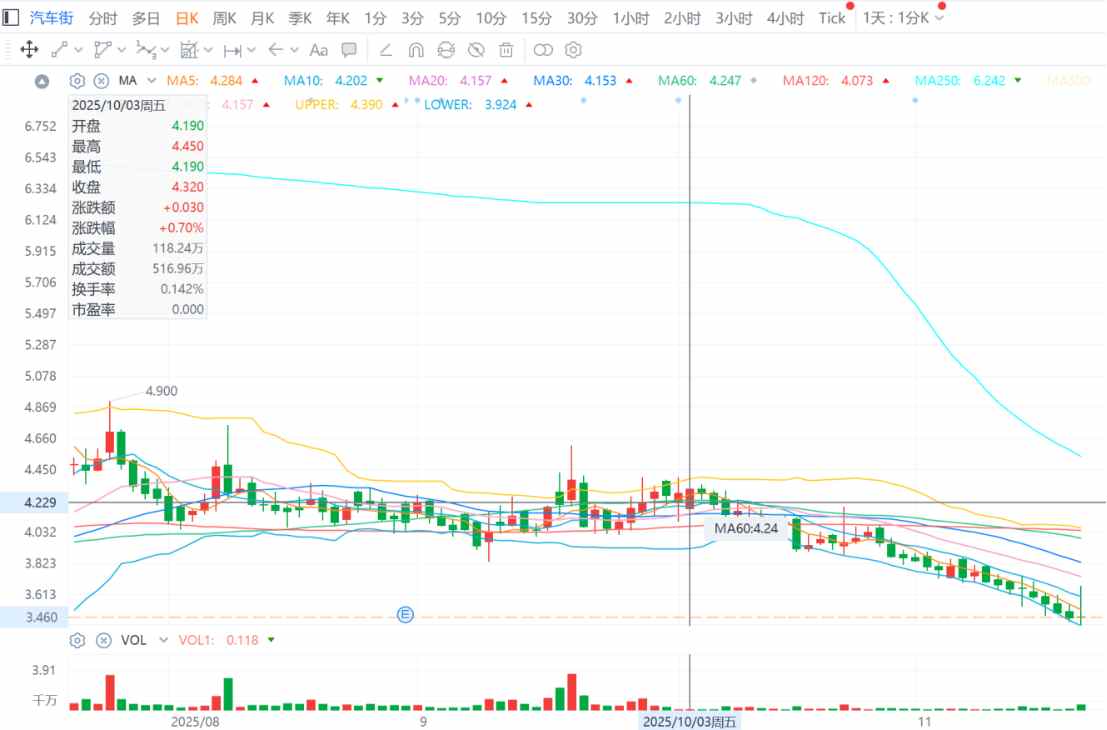
汽车街进入“出通”倒计时,港股通资金逆市操作博弈短期反弹?
Zhi Tong Cai Jing· 2025-11-22 01:38
Core Viewpoint - The stock price of Automobile Street (02443) has experienced significant volatility since its listing, with recent trends indicating a potential exit from the Hong Kong Stock Connect program due to its market capitalization falling below the required threshold [5][7]. Price Performance - Since reaching a peak of 5.11 HKD on July 18, the stock has entered a downward trend, with a recent low of 3.38 HKD observed on November 21 [2][11]. - The stock has been in a state of decline since its listing, with a drop of over 60% from its initial offering price of 10.2 HKD [1][5]. Technical Analysis - The stock is currently in a downward trend, with all moving averages showing a downward divergence, indicating a fundamental shift in the previous technical trend [2][3]. - The stock has entered an oversold territory, with a low profit-taking ratio of only 0.16%, suggesting a high level of trapped investors [8][15]. Market Capitalization and Stock Connect - The average market capitalization of Automobile Street during the review period is 33.44 billion HKD, significantly below the 61.01 billion HKD threshold for inclusion in the Stock Connect program [5][6]. - The next review for the Stock Connect program is scheduled for February 25, 2025, with the assessment period from January 1, 2025, to December 31, 2025 [5][6]. Trading Volume and Investor Behavior - The stock has seen a significant decrease in trading volume, with only five days in the past two months exceeding 500,000 shares traded, indicating a lack of market activity and investor interest [14]. - Despite the downward trend, some mainland investors are buying the stock, possibly speculating on a short-term technical rebound [11][13]. Potential Impact of Stock Connect Removal - If removed from the Stock Connect program, mainland investors will be unable to buy shares, potentially leading to increased selling pressure as approximately 14% of shares could be offloaded [15].
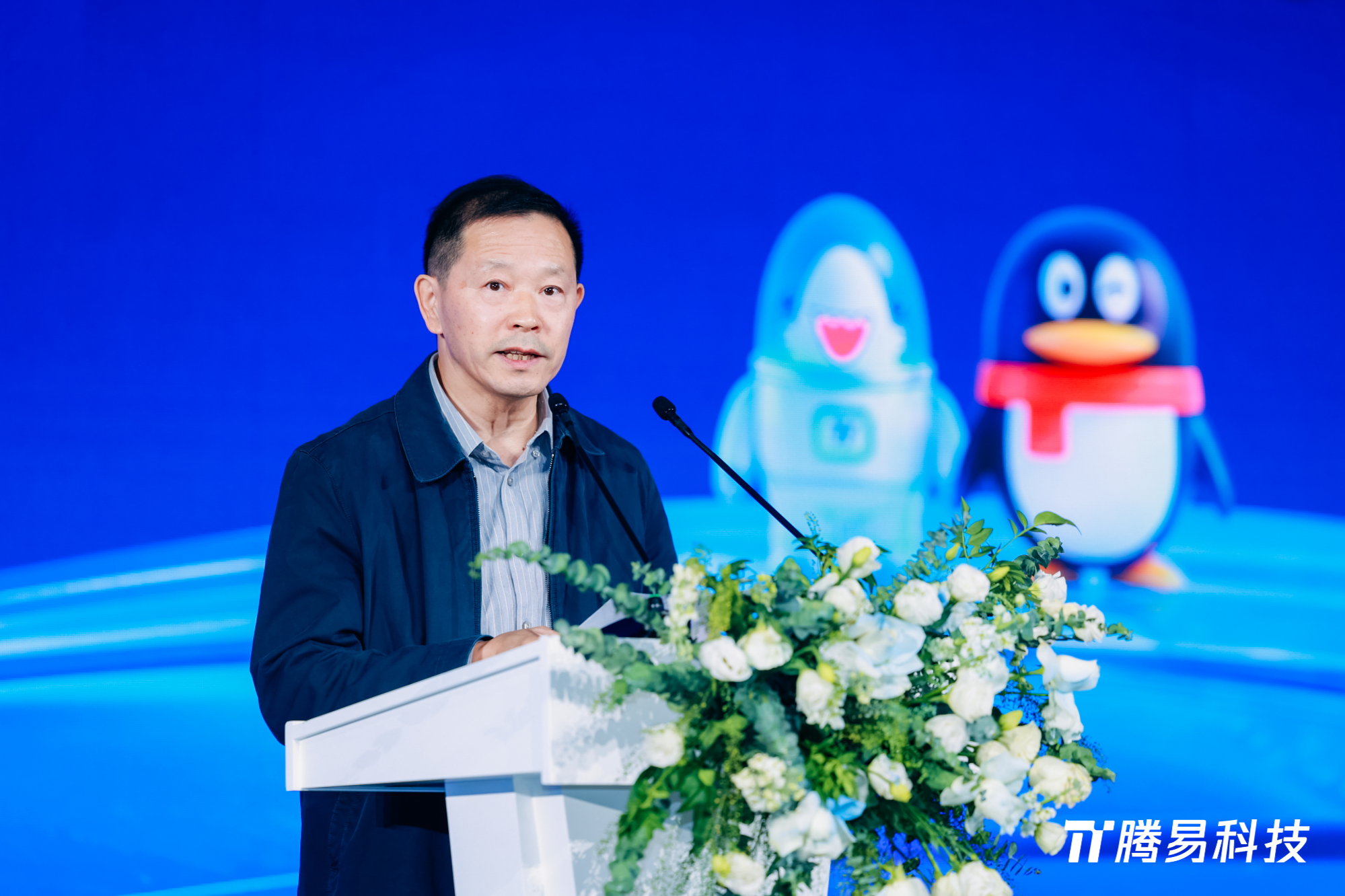
“腾易新风 融智共赢” 2025中国汽车经销商高峰论坛共绘行业新蓝图
Yang Guang Wang· 2025-11-21 03:26
Core Insights - The 2025 China Automotive Dealer Summit, guided by the China Council for the Promotion of International Trade Automotive Industry Committee and hosted by Tengyi Technology, gathered over 1,200 guests to discuss key topics such as industry trends, ecological integration, and AI technology empowerment for high-quality development in the automotive circulation industry [1] Group 1: Industry Challenges and Opportunities - The automotive industry is undergoing profound changes, facing challenges such as intensified competition and the need for growth transformation, as highlighted by Li Jianjun, Assistant to the Special President of the China Council for the Promotion of International Trade Automotive Industry Committee [2] - Li Jianjun proposed three strategies to overcome these challenges: enhancing development confidence, optimizing integration through AI technologies, and transforming from sales to service providers to become lifelong partners for users [2] Group 2: Tengyi Technology's Strategic Developments - Tengyi Technology's CEO, Zhang Xuan, emphasized the company's evolution from a vertical platform to a comprehensive ecological service provider, leveraging Tencent's traffic advantages and professional automotive services [5] - The company aims to continue integrating resources to build a complete ecological loop and deepen collaboration with Tencent to explore new opportunities in the industry [5] Group 3: Ecosystem and User Engagement - Tengyi Technology has established a vast traffic network covering over 1.4 billion users, with over 32,000 deep partnerships with dealers, achieving a monthly transaction rate that ranks first in the industry for 36 brands [8] - The company has developed a powerful content ecosystem, with its evaluation system becoming a leading automotive content brand, and its AI-driven marketing solutions significantly enhancing marketing efficiency [8] Group 4: Future Initiatives and Innovations - Tengyi Technology's Assistant President, Chen Shu, introduced a core empowerment system focused on increasing traffic sources, enhancing efficiency through data and AI, and improving value-added services to boost profitability [10] - The launch of the new AI partner platform "Tengyi Tong" aims to simplify marketing operations for dealers, allowing them to achieve cost reduction and efficiency improvement without needing specialized teams [10] Group 5: Industry Dialogue and Insights - A roundtable forum discussed the changing customer demographics, digital services, and local ecosystem channel construction, highlighting the need for optimizing product combinations and online-offline integration [13] - Economist Fu Peng addressed the imbalance in supply and demand and the aging population's impact on consumption structure, advocating for a focus on optimizing supply-demand balance and encouraging new productive forces [13] Group 6: Commitment to Industry Development - Tengyi Technology is committed to deepening ecological openness and expanding the influence of local ecological alliances, aiming to drive high-quality development in the automotive circulation industry [14]
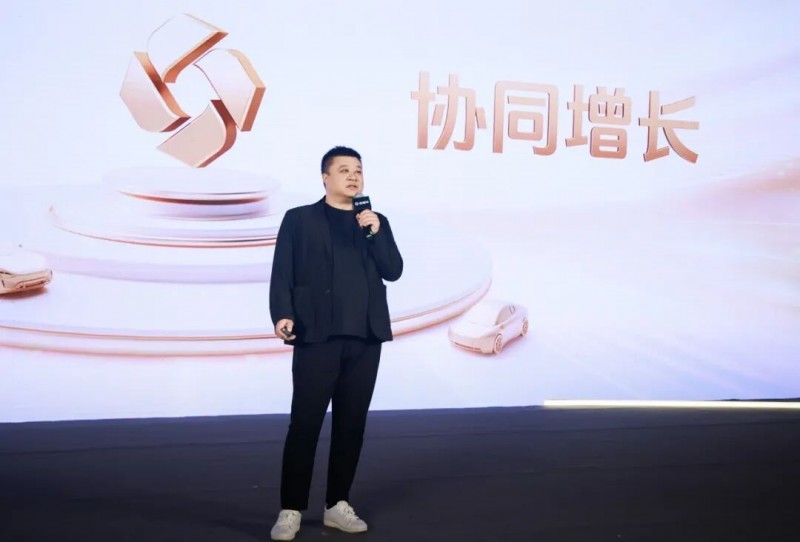
2025懂车帝巨懂车经销商伙伴大会在广州举行
Huan Qiu Wang· 2025-11-19 11:09
从市场角度看,在政策激励的作用下,购车需求加速释放,2025年汽车大盘的销量同比增长6.4%,远超年初2%的 预期水平;与此同时,从用户角度看,超过76.4%的用户在到店前就已完成车型选择,72%的消费者愿意接受线上 买车,线上获客最终贡献成交的比例已经达到58%以上,成为最主要的成交来源。巨懂车副总裁(商业产品)郑 文雅表示,巨懂车融合抖音和懂车帝的双端优质流量,通过抖音端的懂车云店和懂车帝端卖车通产品,构建起巨 懂车OneSaaS一体化经营提效平台,帮助商家完成双端线索管理、双端经营、双端投放的全链提效。官方数据显 示,巨懂车平台线索转化率较传统线下经营模式获客高出3倍,而商家通过巨懂车实现抖懂双端经营,较单端能够 实现60%的经营成本下降。 AI 驱动经营提效 来自巨懂车经销商数据后台的统计数据显示,2025年抖音端单日汽车线索量突破81万条,单日单店线索量最高突 破2.3万条。巨懂车商业产品线索产品运营总监王全介绍称,2026年,巨懂车将依托抖音端产品懂车云店,基于流 量获取、直播互动、用户对接、线索分发、跟进邀约、提效转化等商家实际经营中的核心环节进行全链路智能升 级。 11月18日,2025懂车帝 ...
久车GO以“链接与赋能”重塑汽车供应链 长久股份出席2025年度汽车经销商发展论坛
Bei Jing Ri Bao Ke Hu Duan· 2025-11-14 10:51
Core Insights - The automotive industry in China is facing significant structural challenges, including high inventory levels and thin profit margins, prompting the need for innovative solutions [4] - Jiuche GO's ecological strategy focuses on "linking demand, optimizing the ecosystem, and empowering with digital intelligence" to reconstruct the relationships within the automotive distribution sector [4][5] Group 1: Market Dynamics - The lower-tier markets are identified as key drivers for growth in China's automotive consumption, with sales in fifth-tier cities increasing by 14.6% year-on-year, nearly three times the growth rate of first-tier cities [5] - The market share of fuel vehicles in third-tier cities and below is less than 50%, indicating substantial unmet demand [5] Group 2: Jiuche GO's Strategic Initiatives - Jiuche GO has established a large third-party fulfillment network, with over 5,800 local regulatory personnel covering more than 17,000 4S stores, effectively filling the market gap at the distribution end [5] - The platform has served nearly 100 dealers across 14 provinces and 31 cities, processing over 40,000 units of D-class inventory with a regulatory asset value exceeding 5 billion [6] Group 3: Ecosystem Optimization - The "direct connection between manufacturers and secondary networks" strategy has transformed the traditional multi-level distribution model, significantly reducing logistics, inventory, and capital costs [5][6] - Jiuche GO aims to create a collaborative ecosystem where information, funds, and vehicles form an efficient closed loop, integrating manufacturers, platforms, and dealers into a cohesive unit [10] Group 4: Digital Empowerment - The platform serves as both a "digital distribution network" and a "market sensor" for manufacturers, providing real-time decision support for product planning and inventory allocation [9] - For dealers, Jiuche GO offers stable vehicle sources and utilizes data integration and intelligent algorithms to identify and distribute precise customer leads [9] Group 5: Vision for the Future - Jiuche GO aspires to establish not just a trading platform but a new ecosystem of collaborative growth, aiming for a digital transformation of the automotive supply chain [10] - As of November 2025, the platform has facilitated over one million vehicle transactions and served more than 50,000 dealers, positioning itself as a benchmark for innovation in the industry [10]

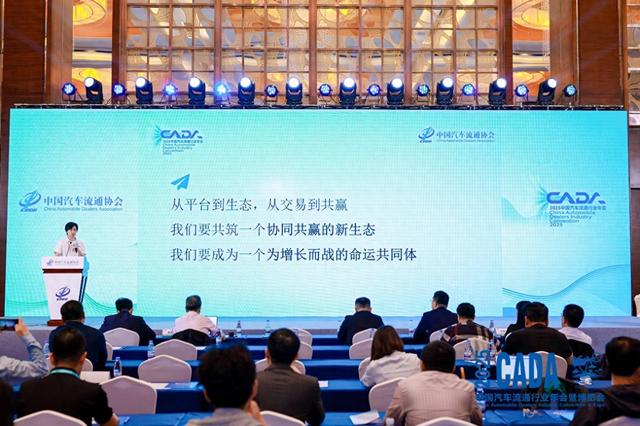
破界重构 共创汽车渠道新生态 2025中国汽车流通行业年会在海口召开
Zheng Quan Ri Bao Wang· 2025-11-13 12:00
Core Insights - The 2025 China Automotive Circulation Industry Annual Conference and Expo was held in Haikou, focusing on industry trends and challenges in the context of rising penetration of new energy vehicles (NEVs) [1] - The automotive distribution channels are shifting from scale expansion to integration, innovation, and digital transformation, necessitating a user-centered ecosystem [1] - The total number of 4S stores in China has decreased by 1.9% to approximately 32,000 by mid-2025, indicating a trend towards optimization and quality improvement in the industry [1] Industry Trends - The independent sales service network for NEVs has surpassed 23,000, but its growth rate is slowing, reflecting a shift in focus from expansion to quality enhancement [1] - There is a notable increase in the growth rate of exhibition-type outlets within the NEV independent sales service network, while traditional 4S stores and after-sales outlets are experiencing slower growth [2] - The automotive culture is evolving, with over 50% of respondents expressing a willingness to modify their vehicles, indicating a shift in consumer preferences towards overall driving experience [2] Channel Transformation - The essence of channel transformation is changing the business relationship between manufacturers and offline stores, with a focus on enhancing customer experience and reducing negotiation stages [3] - The industry is moving towards a "1+N" channel model to achieve cost reduction and efficiency, transitioning from integrated 4S stores to a more diversified channel approach [3] - Predictions indicate that the domestic new car registration volume is expected to reach 28 million units in 2025, with retail sales of passenger vehicles projected to grow by 5% [3] Collaborative Strategies - Traditional channel networks are seen as both a burden and a valuable asset during the transition to electrification and intelligence in the automotive industry [4] - Companies like Toyota and Volkswagen are exploring hybrid models such as "direct sales + agency" to enhance dealer profitability and adapt to market changes [4] - The future of the automotive channel is expected to be diverse and ecosystem-oriented, emphasizing healthy manufacturer relationships and sustainable profit models as the foundation for industry growth [4][5]
久车GO:以“链接与赋能”重塑汽车供应链
Xin Hua Wang· 2025-11-11 00:55
Core Viewpoint - The automotive industry is facing significant challenges, and 久车GO aims to reshape the supply chain through a three-pronged ecological strategy of "linking demand, optimizing ecology, and digital empowerment" to provide innovative solutions for industry transformation [1][2]. Group 1: Challenges in the Automotive Market - The current Chinese automotive sales system has notable irrationalities, with manufacturers and dealers under immense operational pressure due to systemic issues accumulated over time [2]. Group 2: Linking Demand - The lower-tier markets are identified as a key driver for growth in Chinese automotive consumption, with sales in fifth-tier cities increasing by 14.6% year-on-year, nearly three times the growth rate of first-tier cities [3]. - 久车GO has established a vast third-party fulfillment network, covering over 17,000 4S stores with a localized regulatory team of more than 5,800 people, effectively activating secondary dealers in county-level markets [3]. Group 3: Optimizing Ecology - The "direct connection between manufacturers and secondary networks" has transformed the traditional multi-level distribution model, significantly reducing redundant costs related to logistics, inventory, and capital occupation [4]. - The platform has served nearly 100 dealers across 14 provinces and 31 cities, managing over 40,000 units of D-class inventory with an asset value exceeding 5 billion yuan [4]. Group 4: Digital Empowerment - The platform serves as both a "digital distribution network" and a "market sensor" for manufacturers, while acting as an "intelligent empowerment platform" for dealers [5]. - For manufacturers, the platform creates a closed-loop sales data system, providing real-time decision support for product planning and inventory allocation, while for dealers, it helps in identifying and distributing high-quality customer leads [5]. - An example includes the 一汽丰田卡罗拉 project, where the platform facilitated over 27 million exposures and provided more than 7,500 high-quality leads monthly, achieving a conversion rate of approximately 3% [5]. Group 5: Ecological Vision - The goal of 久车GO is to establish not just a trading platform but a collaborative and win-win new ecosystem, integrating information, funds, and vehicles into an efficient closed loop [6]. - As a new retail platform developed by 长久股份, 久车GO is driving the digital transformation of the automotive supply chain through a dual approach of "online trading platform + offline county-level franchises," having facilitated over 1 million vehicle transactions and served more than 50,000 dealers by November 2025 [6].


长久股份薄薪潼:下沉市场是驱动中国汽车消费的关键引擎
Zhong Guo Jing Ying Bao· 2025-11-10 09:53
Core Insights - The sinking market is identified as a key driver for the growth of China's automotive consumption, with lower-tier cities showing significant sales growth compared to first-tier cities [2][3] - The retail sales of automotive products in China reached 3.6 trillion yuan from January to September, reflecting only a slight increase of 0.6% year-on-year, which is notably lower than the overall retail sales growth [2] - The automotive manufacturing industry's profit margin stands at 4.5%, significantly below the average of 6% for downstream industries, indicating ongoing profitability challenges [2] Market Dynamics - Sales growth in lower-tier cities is substantial, with five-tier cities experiencing a year-on-year increase of 14.6%, nearly three times that of first-tier cities, while third and fourth-tier cities grew by 8.15% and 10.65% respectively [2] - Fuel vehicles hold less than 50% market share in third-tier cities and below, indicating a large unmet demand [2] Industry Challenges - The automotive sales system in China faces significant inefficiencies, with manufacturers and dealers under immense operational pressure, leading to a "three losses" situation for manufacturers, dealers, and consumers [3] - Over 70% of secondary dealers face challenges such as unstable vehicle supply and difficulty in customer acquisition, while nearly 60% struggle with thin profits and inventory backlog [5] Strategic Initiatives - Long-term strategies proposed include activating county and rural markets to create new growth areas in lower-tier markets, shifting from zero-sum competition to symbiotic growth [3] - The launch of the new retail platform, Jiuche GO, aims to optimize the automotive distribution ecosystem by linking demand, enhancing the ecosystem, and leveraging digital intelligence [3][4] Platform Development - Jiuche GO has established a vast third-party delivery network with over 5,800 local regulatory personnel covering more than 17,000 4S stores, facilitating access to previously unreachable markets [4] - The platform has registered 52,300 merchants and operates in over 400 cities and 2,300 counties, addressing the channel gaps in the end markets [4] Digital Transformation - Jiuche GO's dual-channel strategy combines online trading with offline county-level franchises to drive the digital transformation of the automotive supply chain ecosystem [7] - The platform provides comprehensive digital support to secondary dealers, including stable vehicle supply, precise lead generation, and inventory collaboration, significantly reducing operational costs and risks [6] Performance Metrics - As of November 2025, Jiuche GO has facilitated over one million vehicle transactions and served more than 50,000 dealers, showcasing its impact on the automotive retail landscape [7]

直面转型阵痛 汽车流通行业探寻发展新机遇
Xin Hua She· 2025-11-07 11:13
Core Insights - The automotive circulation industry is undergoing significant transformation due to changes in product structure, competition, and distribution models, prompting discussions on how to stabilize and optimize the circulation system [1] Group 1: Market Dynamics - As of October 22, 2023, the number of applications for the 2025 vehicle trade-in subsidy has exceeded 10 million, with over 3.4 million vehicles scrapped and more than 6.6 million vehicles replaced [1] - The retail sales of passenger vehicles have been continuously growing this year, with the penetration rate of new energy vehicles reaching new highs, supported by national consumption promotion policies [1] Group 2: Dealer Challenges - Despite positive market changes, dealers face ongoing challenges, including a general contraction of dealer networks and declining business revenues, with cash flow pressures due to delayed sales rebates [1][2] - The call for improved governance in the circulation sector and the restructuring of manufacturer-dealer relationships emphasizes the need for reasonable inventory levels and timely rebate payments to alleviate dealer survival anxieties [2] Group 3: Second-hand Vehicle Market - The existing vehicle ownership of 360 million provides a strong foundation for the expansion of the second-hand vehicle market, with improving policies and increasing transparency enhancing the operating environment [2] - Experts advocate for addressing bottlenecks in second-hand vehicle circulation and fostering professional, brand-oriented business entities to improve trust and service quality [2] Group 4: Future Directions - The automotive circulation industry is encouraged to lead new supply with new demand and to innovate in service offerings, transforming challenges into opportunities [2] - The industry association plans to collaborate with enterprises to reshape channel value, leverage technological innovations, and enhance the service capabilities throughout the vehicle lifecycle [2][3] - Establishing a more pragmatic and efficient brand authorization cooperation model is essential for fostering a healthy and orderly development of the automotive industry [3]
肖政三:2025年是汽车流通行业全面进入转型深水区和攻坚期的一年
Zhong Guo Qi Che Bao Wang· 2025-11-06 04:18
Core Insights - The 2025 China Automotive Circulation Industry Annual Conference and Expo will be held in Haikou, focusing on various sectors including new cars, used cars, new energy vehicles, marketing, financial services, digitalization, and after-sales services, with nearly 3,000 attendees expected [1] Industry Overview - The automotive market in China is experiencing a recovery supported by national consumption policies, with retail sales of passenger cars continuing to grow and new energy vehicle penetration rates reaching new highs [3] - However, the industry faces significant challenges, including a mismatch between supply and demand, leading to price inversions and widespread losses among dealers, with a profit margin of only 4.5% for the automotive manufacturing sector, below the industrial average of 6% [3][5] Government Initiatives - The Chinese government is actively implementing measures to stabilize and expand automotive consumption, including policies like "trade-in" programs and addressing issues of low-price disorder in competition [4] - The introduction of the Private Economy Promotion Law aims to provide a legal environment for fair competition and market access for private enterprises, including automotive dealers [4] Dealer Challenges - In the first half of 2025, the proportion of loss-making automotive dealers rose to 52.6%, with only 30% meeting sales targets, highlighting the severe financial strain on dealers due to market imbalances [5] - The automotive circulation industry is urged to unite and adapt to the changing market landscape, emphasizing the need for transformation and innovation in operations [5][6] Strategic Focus Areas - The industry is focusing on reshaping channel value and enhancing the role of dealers in the automotive supply chain, with an emphasis on integrating new energy vehicle services and leveraging technology [6] - There is a need to improve relationships between manufacturers and dealers to foster a resilient and healthy automotive industry, addressing issues like excessive network density and high inventory levels [7][8] Growth Drivers - The used car market is projected to see significant growth, with transaction volumes and values expected to exceed 20 million units and 1 trillion yuan, respectively, driven by policy support and market demand [10] - Automotive finance is becoming increasingly important, with the government promoting financing mechanisms to support private enterprises and enhance the availability of credit for dealers [11] Industry Standards and Initiatives - The association is launching initiatives to standardize industry practices and improve the quality of used cars, while also establishing platforms for better data sharing and collaboration among industry players [12]
