
演唱会

Search documents
开源证券晨会纪要-20250707
KAIYUAN SECURITIES· 2025-07-07 14:43
Core Insights - The report highlights a positive outlook for MEMS inertial navigation, X-ray detection, and the export of air separation equipment, driven by growth in downstream applications such as low-altitude economy, autonomous driving, and robotics [3][6] - The industrial X-ray detection market is expected to experience structural growth due to strong demand from the electronics and semiconductor industries, as well as recovery in the lithium battery sector [3][6] - The air separation equipment market, primarily used in coal chemical, petrochemical, metallurgy, and nuclear power industries, has a market space exceeding 100 billion yuan, with increasing export activities under the Belt and Road Initiative [3][6] Industry Performance - The report notes that the new housing transaction area has increased month-on-month, while year-on-year comparisons show a decline in 20 cities for second-hand housing transactions [5][14] - The land transaction area has decreased year-on-year, but the premium rate has increased month-on-month, indicating a competitive land market in certain regions like Tianjin [5][14][16] - The issuance of domestic credit bonds has increased significantly, with a year-on-year rise of 606% and a month-on-month increase of 63%, reflecting improved market conditions [17] Market Trends - The gaming industry is expected to benefit from innovative gameplay and a surge in demand for new titles, with the monthly issuance of game licenses projected to reach 135 in the first half of 2025 [11][12] - The report emphasizes the potential for AI virtual social applications, particularly with the development of AI companions, which could lead to significant commercial opportunities [12] - The three-dimensional visual digitization market is projected to reach 40.01 billion yuan by 2027, with a compound annual growth rate of 26.6%, driven by the shift from 2D to 3D applications in various industries [8]
“牛市旗手”大涨!行情或可期丨南财号联播
2 1 Shi Ji Jing Ji Bao Dao· 2025-06-26 10:09
Group 1: Marine Economy in Guangdong - Guangdong's marine economy is projected to exceed 2 trillion yuan in 2024, accounting for approximately 1/5 of the national total, marking 30 consecutive years of leading the country [1] - The province is accelerating the construction of 15 national-level marine ranches and maintains the largest scale in marine tourism [1] Group 2: Consumer Goods Recycling Policy - The National Development and Reform Commission will allocate the third batch of funds for consumer goods recycling in July, ensuring the policy is implemented smoothly throughout the year [1] Group 3: Banking Sector Adjustments - Major banks are phasing out medium- to long-term large-denomination certificates of deposit due to reduced interest rate advantages, reflecting a shift in cost control and liquidity management strategies [1] Group 4: Stock Market Trends - The A-share market is showing strength, with major indices rising and the brokerage sector experiencing a significant increase, suggesting a potential bull market [2] - The brokerage index surged by 5.52%, with a cumulative increase of 9.49% over three trading days, indicating strong market sentiment [2] Group 5: Gold Market Dynamics - Despite geopolitical tensions in the Middle East, gold prices have declined, suggesting that current prices have already factored in various influences, with potential for future upward momentum [2] Group 6: Short Drama Development in Online Literature - Leading online literature platforms are expanding their content ecosystems by incorporating short dramas, which are often based on popular web literature IPs, as a strategy to tap into new growth opportunities [3] Group 7: Concert Demand Surge - The demand for concert tickets in Beijing has surged, with many fans struggling to secure tickets for popular events, indicating a strong recovery in the live performance market [3]


预见2025:《2025年中国演唱会行业全景图谱》(附市场现状和发展趋势等)
Qian Zhan Wang· 2025-06-19 03:10
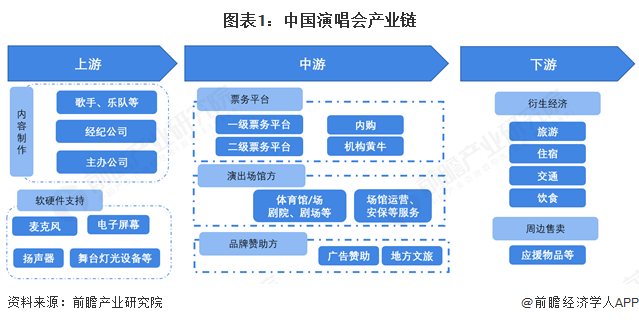
Industry Overview - The concert industry in China has a well-defined structure involving content production, hardware support, ticketing platforms, venue management, and brand sponsorship [1][2] - The concert industry chain includes upstream content creators, midstream ticketing and venue operators, and downstream economic derivatives such as tourism and merchandise sales [1] Industry Development - The concert market in China has shown a recovery post-pandemic, with ticket revenue reaching 29.636 billion yuan in 2023, a year-on-year increase of 66.53% [7] - In 2024, large-scale concerts are expected to generate over 26 billion yuan in ticket sales, reflecting a 78.1% increase year-on-year [8] - The number of artists hosting large concerts has increased by 29.5% in 2024, with 79.7% of these being tour projects [14] Competitive Landscape - CMCLive is identified as a leading concert organizer in China, with significant artist resources and experience [17] - Major ticketing platforms include Damai, Maoyan Entertainment, and Motianlun, which are commonly used by consumers for ticket purchases [17] - The distribution of concert-related enterprises is concentrated in economically developed regions, with Guangdong having over 50,000 companies [20] Future Trends - The concert industry is expected to continue expanding due to policy support, rising consumer demand, and technological innovation [22] - Digital technology will increasingly integrate into various aspects of concerts, with a focus on quality content creation and industry consolidation [22]
广东文化产业“出新招” ,“六大领域”迎机遇
21世纪经济报道· 2025-05-24 01:10
Group 1 - The 21st China (Shenzhen) International Cultural Industries Fair (CICIF) opened on May 22, showcasing Guangdong's commitment to high-quality cultural industry development through a series of policy initiatives [1] - Guangdong released a comprehensive policy package targeting six key areas: film and television, concerts, animation, online games, esports, and live streaming [1] Group 2 - The article discusses the implications of these policies for the cultural industry, emphasizing the potential for growth and innovation within these sectors [1]

关税中的宏观经济与资本市场
2025-05-19 15:20
Summary of Conference Call Records Industry Overview - The records primarily discuss the **China-US trade relations** and its implications on the **Chinese economy** and **capital markets**. The focus is on the ongoing trade negotiations, tariffs, and macroeconomic conditions in China. Key Points and Arguments Trade Negotiations and Tariffs - Initial results from the **China-US trade negotiations** in Geneva indicate a desire from both sides to reach an agreement to avoid shortages in the US and fluctuations in Chinese exports. Currently, China imposes a **10% tariff** on US goods, while the US imposes a **30% tariff** on Chinese goods, highlighting the existing tariff imbalance [1][2][3] - The negotiations are ongoing, with both parties aiming to address tariff inequalities and potentially lower tariffs on Chinese goods in the future [4][5] - The trade war has created economic pressures for both countries, with the US facing inflationary pressures and China experiencing supply chain challenges [6][8] Economic Conditions in China - China's macroeconomic situation remains unstable, with a declining real estate market and sluggish consumer demand. The first quarter saw a **4.6% growth** in consumption, which is below GDP growth rates, indicating weak domestic demand [9][10] - The government has implemented measures to stimulate domestic demand, such as increasing the **old-for-new** subsidy for durable goods from **1,500 yuan** to **3,000 yuan**, but the impact has been limited [14][15] - The government is focusing on infrastructure projects to boost economic growth, including major projects like the **Western Land-Sea New Corridor** and the **Tibet Railway** [16] Export Performance - China's export situation has improved recently, with companies actively shipping goods, particularly daily necessities and Christmas items, taking advantage of a **90-day grace period**. Exports in April and May exceeded expectations [11] - Despite the positive export performance, domestic demand has not shown significant recovery, and employment pressures remain high [11][12] Financial Market Stability - The Chinese government has taken proactive measures to stabilize the stock and financial markets amid the trade war, demonstrating a structured approach to policy-making [7] - The stock market has shown resilience, with a **10% increase** since early April, while the real estate market remains under pressure [20] Future Outlook - The outlook for the Chinese economy in the second half of the year is cautiously optimistic, with expectations of maintaining a **5% GDP growth target**. However, significant challenges remain, including employment and income issues that need to be addressed to stimulate domestic consumption [17][19] - The capital market is expected to experience structural investment opportunities, particularly in technology and high-end manufacturing sectors [25] Global Economic Context - The records also touch on the broader implications of the trade war on global markets, with the US economy facing potential downturns and the need for strategic adjustments in fiscal and monetary policies [26][27] Additional Important Content - The records highlight the importance of addressing income and employment issues in major cities like Beijing and Shanghai, where consumption patterns are influenced by financial sector employment and government policies [12][13] - The potential for future trade negotiations to include non-tariff barriers and sanctions is noted, indicating that the trade relationship remains complex and evolving [5][6] This summary encapsulates the key discussions and insights from the conference call records, providing a comprehensive overview of the current state of the China-US trade relations and its impact on the Chinese economy and capital markets.