电气

Search documents
GDP突破万亿,温州如何留住“出走”的温州人?
经济观察报· 2026-01-26 14:07
Core Viewpoint - Wenzhou is facing dual challenges of attracting and retaining population while striving to achieve its goal of reaching a permanent population of 10 million and a GDP of over 1 trillion yuan by 2025 [1][14]. Economic Growth and Goals - Wenzhou's GDP is projected to reach 1,021.39 billion yuan by 2025, with a growth rate of 6.1%, surpassing both the national and Zhejiang provincial averages [2]. - Wenzhou aims to become the third "trillion city" in Zhejiang, following Hangzhou and Ningbo, and the 28th in the country [2]. - The city has set a "double trillion" development goal since 2019, focusing on both GDP and population growth [2][3]. Historical Context and Challenges - Historically, Wenzhou's economy thrived on traditional industries such as electrical equipment, footwear, and clothing, but has faced challenges since 2000 due to a shift towards real estate and a subsequent debt crisis in 2011 [5][6]. - The city has seen a decline in its economic ranking, being overtaken by cities like Suzhou and Hangzhou, which has intensified the urgency to reclaim its status [7]. Industrial Transformation - Wenzhou is focusing on industrial transformation to return to a more robust economic base, with initiatives to strengthen traditional industries and develop new sectors like artificial intelligence and digital economy [6][9]. - The manufacturing sector remains a core driver, with significant growth in automotive parts and electrical industries, as well as emerging sectors like high-tech and digital industries [9]. Population Dynamics - As of 2024, Wenzhou's permanent population is 9.852 million, just short of the 10 million target, with a need for improved strategies to attract and retain residents [14][15]. - The city has historically lost population to other provinces, necessitating a focus on creating a more attractive living environment and job opportunities [15][16]. Innovation and Talent Attraction - Wenzhou is facing challenges in innovation capacity, with lower R&D investment compared to other cities in Zhejiang, highlighting the need for improved talent attraction and capital investment [16][17]. - The city is prioritizing artificial intelligence as a key area for innovation, aiming to build a significant AI industry cluster by 2027 [9][18]. Infrastructure and Policy Support - Improvements in transportation infrastructure and urban quality are critical for Wenzhou's growth, enhancing its connectivity within the Yangtze River Delta [12]. - The establishment of national-level innovation and economic zones is expected to provide a supportive environment for business and economic development [12].

GDP突破万亿,温州如何留住“出走”的温州人?
Sou Hu Cai Jing· 2026-01-26 10:31
Core Viewpoint - Wenzhou's GDP is projected to reach 1,021.39 billion yuan by 2025, marking a 6.1% increase from the previous year, surpassing national and Zhejiang provincial growth rates by 1.1 and 0.6 percentage points respectively [2][3] Economic Growth and Goals - Wenzhou has become the third "trillion-yuan city" in Zhejiang, following Hangzhou and Ningbo, and the 28th nationwide [3] - The city set a "double trillion" development goal in 2019, aiming for a GDP of over 1 trillion yuan and a permanent population of 10 million by 2025 [3] - Wenzhou's GDP reached 971.9 billion yuan in 2024, just shy of the 1 trillion yuan milestone [2] Historical Context and Challenges - Wenzhou's economic growth was historically driven by traditional industries such as electrical equipment, footwear, and clothing, but faced challenges due to a shift towards real estate and a subsequent debt crisis in 2011 [4][5] - The city has been working on industrial transformation since 2012, focusing on returning to a more substantial economic base [5] Industrial Development - By 2025, Wenzhou's industrial output is expected to grow by 10.3%, with significant contributions from the automotive and electrical industries [7] - The city is also focusing on emerging sectors like artificial intelligence, aiming to establish a 100 billion yuan AI industry cluster by 2027 [7] Private Sector and Economic Policies - The private sector is crucial for Wenzhou's economy, with 90.8% of industrial output coming from private enterprises [8] - The city has implemented various policies to support private businesses, including financial assistance and initiatives to attract talent [8] Infrastructure and Urban Development - Improvements in transportation infrastructure have transformed Wenzhou into a regional hub, enhancing its connectivity within the Yangtze River Delta [9] - Urban development initiatives aim to enhance the city's livability and attract talent, focusing on education, healthcare, and cultural services [9] Population Dynamics - Wenzhou's permanent population was 9.852 million in 2024, still short of the 10 million target, with a need for strategies to attract and retain residents [12][13] - The city has historically faced challenges with population outflow, necessitating a dual approach to attract and retain talent [13][14] Innovation and Future Challenges - Wenzhou's R&D investment is lower than that of other major cities in Zhejiang, indicating a need for improvement in innovation capabilities [14][15] - The city aims to enhance its innovation landscape by focusing on artificial intelligence and other high-tech industries, as part of its broader economic strategy [15]
财经聚焦|民营经济重镇温州如何跻身“万亿俱乐部”?
Xin Hua She· 2026-01-25 12:59
Group 1: Economic Growth and Structure - In 2025, Wenzhou's GDP is projected to exceed 1 trillion yuan, reaching 10213.9 billion yuan, marking it as a "trillion-dollar city" [1] - The private economy constitutes over 90% of Wenzhou's economic structure, with nearly 1.6 million registered private enterprises and individual businesses [3] - Wenzhou's economic growth is supported by innovation in the private sector, with significant contributions from industries such as electrical, footwear, new energy, and artificial intelligence [3][4] Group 2: Innovation and Technology - Wenzhou has established a city-level artificial intelligence bureau and is focusing on emerging sectors like artificial intelligence and low-altitude economy [4] - In 2025, the city's industrial added value is expected to grow by 10.3%, with strategic emerging industries and high-tech sectors seeing increases of 14.4% and 11.8% respectively [4] - The city has developed significant industrial clusters in electrical and new energy sectors, with the electrical industry recognized as a national advanced manufacturing cluster [6] Group 3: Openness and Connectivity - Wenzhou is enhancing its role as a national comprehensive transportation hub, with a focus on developing a near-ocean shipping center and a regional international aviation hub [7][8] - The port's cargo throughput is projected to reach 100.86 million tons by 2025, positioning Wenzhou among the "billion-ton ports" [7] - The total import and export volume is expected to exceed 300 billion yuan, with trade networks extending to 237 countries and regions [8]
财经聚焦丨民营经济重镇温州如何跻身“万亿俱乐部”?
Xin Hua Wang· 2026-01-25 11:13
Core Viewpoint - Wenzhou is set to surpass a GDP of 1 trillion yuan by 2025, reaching 1,021.39 billion yuan, marking its entry into the "trillion club" through a focus on reform, openness, and innovation [1] Group 1: Private Economy - The private economy is a crucial driving force for Wenzhou's socio-economic development, with over 90% of enterprises, industrial added value, employment, exports, and tax revenue coming from this sector [3] - Wenzhou has nearly 1.6 million registered private enterprises and individual businesses, showcasing its entrepreneurial spirit and robust industrial chain [3] - The "Wenzhou model" emphasizes a "small commodities, large market" approach, fostering rapid growth in light manufacturing and specialized markets [2] Group 2: Technological Innovation - Wenzhou is focusing on technological innovation as a key driver, with significant growth in strategic emerging industries, high-tech industries, and core digital economy sectors, with respective increases of 14.4%, 11.8%, and 16.4% in manufacturing value added by 2025 [4] - The establishment of the China Intelligent Valley has attracted 435 AI companies, enhancing the local industrial chain from algorithm development to smart terminals [4] - Traditional industries are transforming alongside the cultivation of new leading industries, propelling Wenzhou onto a path of high-quality development [4] Group 3: Openness and Connectivity - Wenzhou is enhancing its connectivity through the construction of a comprehensive transportation hub, with a cargo throughput of 100.86 million tons by 2025, positioning it as a key player in global logistics [7] - The city has implemented a 240-hour visa-free transit policy at its air and sea ports, facilitating international trade and tourism [7] - By 2025, Wenzhou's total import and export volume is expected to exceed 300 billion yuan, with trade networks extending to 237 countries and regions, demonstrating the multiplier effect of openness [8]
“GDP万亿俱乐部”再添三城 专家倡言城市评价迈入“市值时代”
证券时报· 2026-01-22 00:12
Core Viewpoint - The article highlights the emergence of three new cities—Dalian, Xuzhou, and Wenzhou—joining China's "trillion-yuan club" by 2025, bringing the total number of such cities in mainland China to 30 [1][2]. Group 1: New "Trillion-Yuan Cities" - Wenzhou is set to surpass a GDP of 1 trillion yuan by 2025, becoming the third "trillion-yuan city" in Zhejiang province after Hangzhou and Ningbo [4]. - Xuzhou's GDP is projected to grow by approximately 5.8%, reaching 953.712 billion yuan in 2024, and is expected to cross the 1 trillion yuan mark in 2025, making it the sixth "trillion-yuan city" in Jiangsu province [5]. - Dalian anticipates a GDP growth of over 5.5%, with a projected GDP of 951.69 billion yuan in 2024, also expected to exceed 1 trillion yuan by 2025, marking a breakthrough for Northeast China [5]. Group 2: Common Characteristics and Development Strategies - The three new cities share a strong industrial foundation and leading industry clusters, such as Xuzhou's renowned engineering machinery cluster, Wenzhou's private economy-driven electrical and apparel industries, and Dalian's complete petrochemical industry chain [5][6]. - Experts emphasize the importance of "industry anchoring + institutional adaptation" for the success of these cities, highlighting the need for a flexible and efficient business environment [6]. - Each city has a unique positioning strategy: Wenzhou as a pioneer of private economy, Xuzhou as a leader in the Huaihai Economic Zone, and Dalian aiming to become a Northeast Asia international shipping center [6]. Group 3: Future Prospects and Competitors - Other cities are also vying to join the "trillion-yuan club," with potential candidates like Yancheng, Yangzhou, and Shaoxing in the Yangtze River Delta region aiming for this goal during the 14th Five-Year Plan period [10]. - Xiamen is projected to become the third "trillion-yuan city" in Fujian province by 2025, with a GDP of 858.901 billion yuan in 2024 [10]. - Shenyang is expected to become the second "trillion-yuan city" in Liaoning province, with a GDP of 902.71 billion yuan in 2024, indicating a high probability of surpassing the 1 trillion yuan mark during the 14th Five-Year Plan [10]. Group 4: Urban Development Evaluation System - The article calls for a re-evaluation of urban development metrics, moving beyond mere GDP figures to include quality indicators such as per capita GDP, total factor productivity, and green innovation intensity [12]. - It suggests incorporating metrics like the Gini coefficient of resident income and the number of patents per capita into the evaluation system for "trillion-yuan cities" to promote a shift from scale expansion to modernization focused on people [12]. - The transition from a "GDP era" to a "market value era" is proposed, where the total market value of listed companies in a city serves as a precise measure of development quality [13].

德国人创造工业4.0,中国人引领工业5.0,今年汉诺威中德如何相遇
吴晓波频道· 2026-01-19 01:30
Core Viewpoint - The article emphasizes the transformation of Chinese manufacturing from learning and observing to actively participating and co-defining the future of global industrial intelligence, particularly through the Hannover Messe 2026, which is positioned as a platform for collaboration and innovation in the manufacturing sector [3][4][28]. Group 1: Hannover Messe Overview - Hannover Messe is the world's largest and most authoritative industrial technology exhibition, serving as a source of industrial automation, digitalization, and energy revolution since 1947 [7]. - The 2026 exhibition will focus on "Artificial Intelligence in Manufacturing," marking a shift where AI moves from a conceptual stage to a value-creating phase, showcasing applications that can significantly impact profit margins [10]. - The event gathers around 4,000 top companies and over 130,000 professional decision-makers annually, defining the technological roadmap and business ecosystem for the next three to five years [8][9]. Group 2: Insights from Hidden Champions - The article highlights the importance of learning from "hidden champions," which are small to medium-sized enterprises that excel in niche markets, showcasing their core efficiency and innovation philosophies [12][20]. - Companies like Sennheiser, Hettich, and Wilo are presented as case studies, demonstrating long-term R&D investment, precision manufacturing, and digital transformation as key strategies for sustainable growth [14][16][18]. - These visits aim to uncover the underlying logic and cultural roots of excellent manufacturing, providing insights into how these companies navigate economic cycles and maintain competitive advantages [20]. Group 3: Strategic Engagement in North Rhine-Westphalia - The article discusses the strategic importance of North Rhine-Westphalia as a hub for Chinese enterprises entering the European market, with over 1,100 Chinese companies having established a presence there [23][24]. - A workshop with the North Rhine-Westphalia Investment and Trade Agency will focus on the core challenges of Chinese companies going abroad, emphasizing agile innovation and digital capabilities [24]. - The dialogue with former Siemens CEO Joe Kaeser is expected to provide valuable insights into global operations and strategic frameworks for Chinese enterprises [25][28].
两年连超徐州大连唐山 温州晋级“万亿GDP俱乐部” “民营经济第一城”再出发
Zhong Guo Jing Ying Bao· 2026-01-16 19:17
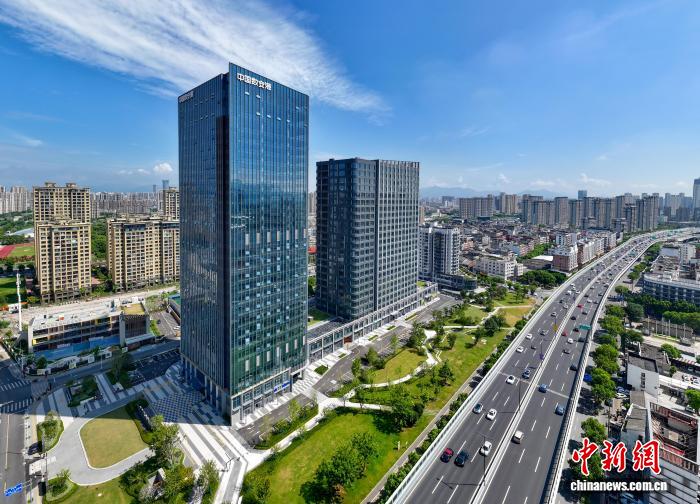
Core Viewpoint - Wenzhou has successfully entered the "trillion GDP club," with expectations to surpass a GDP of 1 trillion yuan by 2025, driven by industrial transformation and innovation initiatives [3][4][5]. Economic Growth and Development - Wenzhou's GDP has increased by nearly 300 billion yuan during the "14th Five-Year Plan" period, crossing three significant thresholds in four years, showcasing its rapid economic resurgence [4]. - The city's GDP figures are as follows: 2020 at 687.1 billion yuan, 2021 at 758.5 billion yuan (up 7.7%), 2022 at 802.98 billion yuan, 2023 at 873.06 billion yuan, and 2024 at 971.88 billion yuan [4][5]. Industrial Transformation - Wenzhou is focusing on upgrading traditional industries and developing emerging sectors, with high-tech industries' share rising from 60.9% to 73% during the "14th Five-Year Plan" [6][7]. - The city has established significant industrial clusters, particularly in electrical and renewable energy sectors, with the latter expected to form a trillion-yuan industry cluster by 2030 [7][8]. Innovation and Talent Development - Wenzhou is enhancing its urban environment and entrepreneurial conditions to attract talent, which is crucial for economic growth [6][8]. - The city has seen a fourfold increase in incubated enterprises and over 120,000 young innovators in recent years, indicating a robust innovation ecosystem [9][10]. Challenges and Future Directions - Despite its growth, Wenzhou faces challenges such as insufficient innovation resources and transportation infrastructure compared to other cities like Hangzhou and Ningbo [8][10]. - The city aims to leverage its flexible private economy to overcome these challenges and enhance its innovation capabilities, particularly in artificial intelligence [10].
波黑2025经济展现韧性,2026年挑战与机遇并存
Shang Wu Bu Wang Zhan· 2026-01-16 13:59
Economic Overview - Bosnia's economy has shown strong adaptability despite global shocks, with many companies shifting towards modernization, digitalization, and market diversification to mitigate the negative impacts of reduced EU orders [1][2] - The GDP growth rate for Bosnia in 2025 is estimated at 2.4%, indicating a positive but moderate economic momentum, while the average inflation rate is projected to be around 4%, primarily influenced by food and logistics prices [1] Industrial Sector Insights - The industrial sector in Bosnia is facing significant pressure from global conditions, including a slowdown in demand from major European markets, fluctuating energy prices, and rising transportation costs [1] - Investment in automation, energy-efficient processes, and data management has significantly increased, indicating efforts within the industrial sector to achieve structural transformation and enhance competitiveness [2] Export Dynamics - The metal and electrical industries remain the backbone of Bosnia's export activities, accounting for over 40% of total exports, demonstrating their critical role as a driver of foreign trade even amid global economic uncertainty [3] - The implementation of the EU Carbon Border Adjustment Mechanism (CBAM) starting January 1, 2026, is expected to have a severe impact on Bosnia's industrial sector, particularly as the EU is a key export market [2][3] Future Outlook - The outlook for Bosnia's economy in 2026 is cautiously optimistic, with expectations of moderate growth, although it will still face a range of complex international and domestic challenges [3] - Strategic investments, targeted reforms, and support for the export sector are essential for Bosnia to accelerate growth, create new jobs, and solidify its position in international markets [3]
浙江两会观察:新晋“万亿之城”频提“人工智能+”
Zhong Guo Xin Wen Wang· 2026-01-16 10:39
Core Insights - Artificial intelligence (AI) is a significant focus in Zhejiang's development, with projected core industry revenue reaching approximately 680 billion yuan by 2025 [1] - The recent Zhejiang Provincial Two Sessions highlighted the emphasis on "AI+" as a strategic technology for driving new productivity and industrial transformation [1] Group 1: AI Development in Wenzhou - Wenzhou aims to leverage AI to enhance various industries and improve overall competitiveness as it aspires to be a "trillion-yuan city" by 2026 [2] - The city has established the China (Wenzhou) Data Security Port to support high-quality training of AI models and has been approved for six national data infrastructure projects [1][2] - The establishment of Wenzhou's first AI bureau in 2025 signifies the city's commitment to AI development [1] Group 2: Challenges in Traditional Manufacturing - Traditional manufacturing sectors in Wenzhou, such as footwear and apparel, face risks of obsolescence without AI integration to optimize production and management [2] - Industry leaders emphasize the need for continuous algorithm updates and significant upfront investments in equipment and R&D to successfully implement AI technologies [2] Group 3: Recommendations for AI Integration - Collaboration among government, financial institutions, and innovative mechanisms is essential to support manufacturing transformation through AI [4] - Proposals include establishing a manufacturing transformation fund to support long-term AI projects and fostering a collaborative service platform for the entire industry chain [4] - The lack of specialized service providers who understand both manufacturing and digital technology is identified as a major barrier to AI adoption [4] Group 4: Cultural Integration with AI - The integration of AI in cultural sectors, such as the development of innovative products based on traditional crafts, is also highlighted as a growth area [5] - The government aims to deepen the "AI+" initiative across various sectors, including cultural development, to enhance overall societal benefits [5]
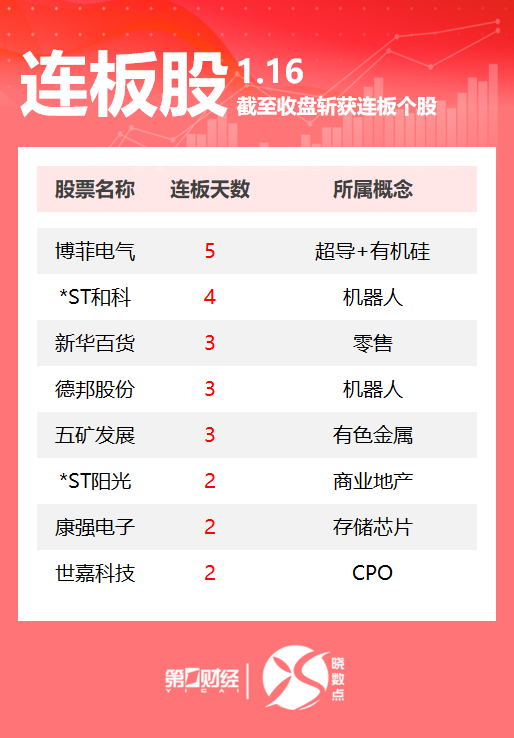
连板股追踪丨A股今日共67只个股涨停 这只机器人概念股4连板
Di Yi Cai Jing· 2026-01-16 08:18
Group 1 - The core viewpoint of the article highlights the performance of specific stocks in the A-share market, particularly focusing on the surge in robot concept stocks and storage chip stocks [1] - A total of 67 stocks reached their daily limit up on January 16, with notable performances from *ST HeKe, which achieved a four-day limit up, and Kangqiang Electronics, which saw a two-day limit up [1] - The article provides a detailed list of stocks that have achieved consecutive limit ups, including BoFei Electric with five consecutive days, and other companies like DeBang Shares and XinHua Department Store with three consecutive days [1] Group 2 - The stocks listed under the robot concept include *ST HeKe and DeBang Shares, indicating a strong interest and potential growth in this sector [1] - The storage chip sector is represented by Kangqiang Electronics, which has shown a two-day limit up, reflecting positive market sentiment towards this industry [1] - Other sectors mentioned include retail with XinHua Department Store and non-ferrous metals with WuKang Development, showcasing a diverse range of industries experiencing growth [1]