预测市场

Search documents
4个月翻了10倍!“市场预测龙头”Polymarket寻求以150亿美元估值进行融资
Hua Er Jie Jian Wen· 2025-10-23 02:39
Core Insights - The blockchain prediction market is experiencing explosive valuation growth, with Polymarket seeking to raise funds at a valuation of $12 billion to $15 billion, a more than tenfold increase from four months ago [1][2] - The Intercontinental Exchange (ICE) announced an investment of up to $2 billion in Polymarket at an approximate valuation of $8 billion, excluding new funds [2] - Kalshi, a major competitor, is also seeing a surge in valuation, exceeding $10 billion, reflecting strong investor confidence in the prediction market sector [2][4] Valuation Surge - Polymarket's valuation trajectory is remarkable, rising from $1 billion in June after a funding round led by Founders Fund to a target of $12 billion to $15 billion within four months [2] - The recent ICE deal is a key milestone in this valuation leap, providing both funding and traditional financial market endorsement [2] - Kalshi's valuation has also skyrocketed, doubling to over $10 billion shortly after raising $185 million at a $2 billion valuation in June [2] Trading Volume Increase - Both Polymarket and Kalshi have seen a significant increase in trading volume, surpassing $2 billion in the week ending October 19, marking a new high [3] Wall Street and Sports Betting Involvement - The soaring valuations highlight strong market interest in this rapidly growing sector, particularly as gambling and financial markets converge [4] - Wall Street firms and sports betting giants are forming partnerships with leading prediction market companies, anticipating potential industry disruptions [4] - Polymarket is set to act as a clearinghouse for DraftKings as it enters the prediction market space [4] Sports Industry Engagement - The NHL has announced a multi-year partnership with Kalshi and Polymarket, becoming the first major U.S. sports league to collaborate with these platforms [5] - The sports sector is emerging as a significant growth driver for prediction markets, with Kalshi previously partnering with Robinhood to offer prediction contracts for NFL and college football events [5] - Kalshi's trading volume reached $875 million in August, while Polymarket's monthly trading volume hit $1 billion [5] Regulatory Uncertainty - Despite soaring valuations, the prediction market faces significant regulatory uncertainties [6] - The CFTC has allowed Kalshi to open new markets, but state gambling regulators have raised objections in court [6] - Polymarket's regulatory path has been complex, having previously settled with the CFTC over operating an unregistered derivatives exchange, but has since made strides to re-enter the U.S. market [6]
硅谷这个新风口,顶级VC追着投!
Zheng Quan Shi Bao Wang· 2025-10-20 12:04
Core Insights - Prediction markets are gaining significant attention from Silicon Valley investment firms, with major funding rounds and the involvement of established exchanges indicating a move towards mainstream acceptance [1][6]. Funding and Valuation - Kalshi, a prediction market platform, raised over $300 million in its Series D funding round on October 10, achieving a valuation of $5 billion, up from $2 billion just four months prior [2][3]. - The funding round was led by prominent firms such as Sequoia Capital and a16z, with participation from other notable investors [2]. Company Background and Development - Kalshi was founded in 2018 by Tarek Mansour and Luana Lopes Lara, both of whom have backgrounds in major financial institutions [3][4]. - The platform aims to simplify trading on event outcomes, addressing a gap in the market where investors lacked direct methods to trade on specific events [4]. Regulatory Milestones - Kalshi became the first fully regulated platform in the U.S. to offer legal election trading, overcoming initial regulatory hurdles with the Commodity Futures Trading Commission (CFTC) [4][5]. Market Potential and Growth - Kalshi has seen a 200-fold increase in trading volume over the past year, reaching $50 billion, and has captured over 60% of global prediction market activity [6][7]. - The prediction market is viewed as a potential major asset class, with the ability to directly trade based on real-world events [6][8]. Competitive Landscape - Kalshi's main competitor, Polymarket, recently raised $2 billion, achieving a post-money valuation of $9 billion, and has gained traction during the 2024 U.S. presidential election [6][7]. - The Chicago Mercantile Exchange (CME) is also entering the prediction market space, planning to launch financial contracts linked to sports events and economic indicators [7][8]. Industry Trends and Future Outlook - The simplicity and intuitiveness of prediction markets are seen as key factors for their potential widespread adoption, contrasting with the complexity of traditional financial products [8]. - The growth potential of prediction markets is viewed as limitless, with the possibility of them becoming as large as the biggest financial markets [8].
预测市场网站Kalshi获超3亿美元融资:估值50亿美元
Sou Hu Cai Jing· 2025-10-12 11:16
Core Insights - Kalshi has raised over $300 million in funding, achieving a valuation of $5 billion, with participation from existing investor Sequoia Capital and new investor Andreessen Horowitz [2] - The company's valuation has increased 2.5 times from $2 billion in the last funding round three months ago [2] - Kalshi's annual trading volume is projected to reach $50 billion, significantly higher than the estimated $300 million trading volume for 2024 [2] - Competitor Polymarket has also announced funding, securing up to $2 billion from the Intercontinental Exchange (ICE), with a pre-funding valuation of $8 billion, up from $1 billion two months prior [2]


神秘交易员,成功押中诺贝尔和平奖归属
财联社· 2025-10-11 08:14
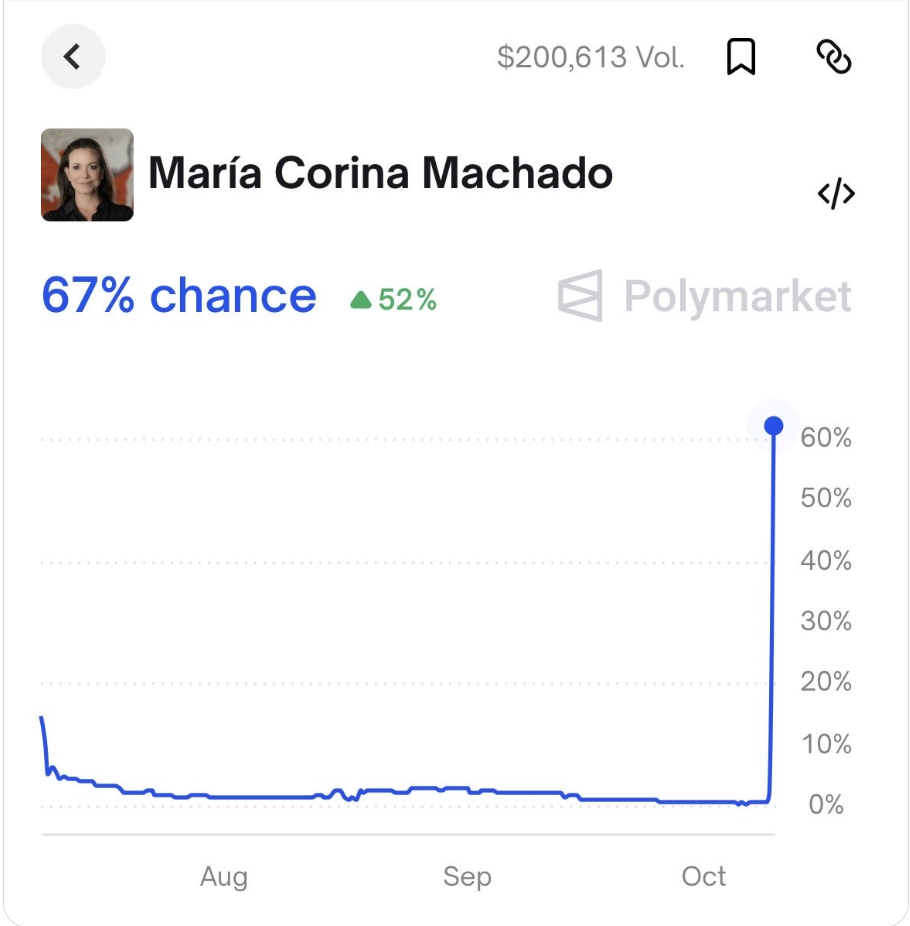
Core Viewpoint - The article discusses the sudden surge in betting on Maria Corina Machado as the winner of the Nobel Peace Prize, raising concerns about potential insider trading in prediction markets [1][6]. Betting Surge - Just hours before the announcement, betting on Machado's victory increased dramatically, with her odds rising from approximately 3.7% to 73.5% shortly after midnight [1][2]. - A new account on Polymarket, identified as "6741," initiated significant bets on Machado, resulting in over $50,000 in profits due to the low trading volume at that time [2][5]. Market Dynamics - Other traders followed the lead of the "6741" account, particularly after the betting activity gained attention on social media [5]. - The total betting amount on Machado's victory reached $2.2 million, compared to $13.9 million for Donald Trump's potential win [7]. Insider Trading Concerns - The Norwegian Nobel Institute is investigating the possibility of insider information being leaked, as significant profits were made through betting on Machado [6][8]. - Polymarket, which allows users to bet on various events, has been noted for its ability to predict outcomes accurately, raising questions about the integrity of such markets [7][8]. Regulatory Context - Polymarket operates as an offshore market not subject to U.S. regulations against insider trading, which has led to concerns about the prevalence of such activities [10]. - The platform has plans to re-enter the U.S. market after acquiring a CFTC-licensed exchange, indicating potential growth in the sports betting sector [10].

诺奖有“内鬼”?开奖前12小时,神秘交易员在Polymarket“精准押注”和平奖得主
美股IPO· 2025-10-11 05:48
Core Insights - A mysterious trader, using the account "6741," made significant bets on María Corina Machado winning the Nobel Peace Prize just 12 hours before the announcement, raising her winning probability from around 5% to 70% [3][5] - The incident has raised concerns about insider trading, prompting an investigation by the Norwegian Nobel Institute to determine if internal information was leaked [3][4] - This event highlights the regulatory gaps in the rapidly growing prediction market, particularly on platforms like Polymarket, which operates offshore and is not subject to U.S. laws against insider trading [8] Market Dynamics - The Polymarket platform has seen a surge in valuation, reaching $8 billion, with the Intercontinental Exchange planning to invest up to $2 billion, indicating growing interest from mainstream financial institutions [4][10] - The platform allows users to bet on various events, reflecting traders' judgments on future probabilities, but does not prohibit insider trading, creating a gray area in market operations [8][10] Trading Behavior - The account "6741" placed a $1,500 bet on Machado and $1,085 against a previously favored candidate, significantly impacting the odds in a relatively small market [7] - Other traders quickly followed suit, with one account named "GayPride" profiting over $85,000 as Machado's winning probability fluctuated between 60% and 71% [7] Regulatory Environment - Polymarket's operations are not regulated in the same way as traditional markets, leading to questions about the legality of trades based on leaked information [8] - Some economists argue that insider trading could enhance the predictive accuracy of markets, contrasting with regulated platforms like Kalshi, which prohibit such practices [8] Future Prospects - Polymarket's expansion plans include a potential return to the U.S. market after acquiring a CFTC-licensed exchange, with sports betting seen as a significant growth opportunity [10]

a16z 和红杉联合领投 Kalshi 3 亿美金,又一华人挑战 Scale AI 一年 900 万美金 ARR
投资实习所· 2025-10-11 05:22
Core Insights - Kalshi has completed a significant $300 million Series D funding round, led by a16z and Sequoia, with a valuation reaching $5 billion, marking a rapid increase from its previous $2 billion valuation just four months prior [1][2]. Group 1: Company Overview - Kalshi aims to create a unified liquidity pool for prediction markets, facilitating global expansion and connecting traders across over 140 countries [3][4]. - The company has experienced a remarkable growth trajectory, with trading volume increasing 200 times to $50 billion in the past year and a user base expanding 20 times [4]. Group 2: Market Potential - Prediction markets are evolving into a mature financial asset class, allowing direct trading based on real-world events, which could position them as one of the largest asset categories globally [4]. - Kalshi's platform is designed to provide event contracts that cover various sectors, including elections and economic changes, offering businesses and investors a means to hedge risks [9]. Group 3: Economic Theory - The investment in Kalshi is rooted in classical economic theories articulated by Friedrich Hayek, emphasizing the decentralized nature of knowledge and the market's role as an information system [6][7]. - Hayek's insights suggest that markets can aggregate dispersed knowledge, transforming it into actionable information through pricing mechanisms, which Kalshi embodies by applying this concept to future predictions [8][10].

诺奖有“内鬼”?开奖前12小时,神秘交易员在Polymarket“精准押注”和平奖得主
Hua Er Jie Jian Wen· 2025-10-11 03:24
Core Insights - A mysterious trader made a significant bet on María Corina Machado winning the 2024 Nobel Peace Prize just 12 hours before the announcement, raising concerns about insider trading [1][2] - The trader, identified as "6741," increased Machado's winning probability from 5% to 70% on the Polymarket platform, resulting in over $50,000 in profits [1][4] - The Norwegian Nobel Institute has initiated an investigation into potential information leaks related to the betting activity [1][5] Summary by Sections Betting Activity - The account "6741" placed a $1,500 bet on Machado and $1,085 against the previously favored candidate, leading to a rapid increase in her winning odds from 3.7% to 73.5% [2][4] - Other traders followed suit, with one account named "GayPride" profiting over $85,000 as Machado's odds fluctuated between 60% and 71% [4] Regulatory Environment - Polymarket operates as an offshore, unregulated platform that does not prohibit insider trading, raising questions about the legality of trades based on leaked information [5][6] - The platform is currently barred from U.S. participation due to a settlement with the Commodity Futures Trading Commission (CFTC) [7] Market Dynamics - The controversy coincides with Polymarket's valuation surge to $8 billion, following a $2 billion investment announcement from the parent company of the New York Stock Exchange [1][7] - Polymarket has gained recognition for accurately predicting outcomes, such as the 2024 U.S. presidential election, and is exploring potential growth in sports betting [7]
纽交所母公司ICE洽谈投资“预测第一股”Polymarket 估值或达百亿美元
Hua Er Jie Jian Wen· 2025-10-07 11:12
Core Insights - Traditional financial giants are increasingly focusing on emerging crypto prediction markets, with Intercontinental Exchange (ICE) negotiating a significant investment in Polymarket, potentially valuing the platform between $8 billion and $10 billion [1][2] Group 1: Investment and Market Dynamics - ICE is reportedly close to finalizing a $2 billion investment in Polymarket, which could reshape the platform's future and enhance its credibility in the market [1] - The investment comes as Polymarket seeks to re-enter the crucial U.S. market after being banned from serving U.S. users since 2022 [1][2] - The political environment has shifted favorably for Polymarket, with improved relations with U.S. regulatory bodies under the Trump administration [2] Group 2: Growth of Prediction Markets - The interest from ICE highlights the growing influence of prediction markets, with Polymarket gaining significant traction during the 2024 U.S. presidential election, achieving over $2 billion in trading volume [3] - Competitors like Kalshi are also experiencing rapid growth, with a recent valuation of $2 billion and record trading volumes through partnerships with platforms like Robinhood [3] Group 3: Strategic Moves and Controversies - ICE's negotiations with Polymarket align with its strategic focus on capturing emerging trends in financial market infrastructure, reflecting a significant bet on the future potential of prediction markets [4] - The entry of ICE into the prediction market space places it at the center of ongoing debates regarding financial innovation and traditional regulatory boundaries, especially in light of pushback from traditional gambling industries [4]

万亿美元新牌桌,亿万富豪们正在下注我们的未来
3 6 Ke· 2025-09-25 10:31
Group 1 - Charles Schwab, a billionaire and founder of Charles Schwab Corporation, has invested significantly in the prediction market startup Kalshi, which has seen its valuation rise to $2 billion as of June 2023 [1] - Kalshi's user base expanded tenfold after receiving regulatory approval to offer presidential election contracts, with over 2 million users betting more than $1 billion by election night [5][6] - The prediction market industry is attracting investments from numerous billionaires, including Thomas Peterffy and Jeff Yass, who see potential in using probability thinking for future events [2][6] Group 2 - Kalshi's revenue model is based on traditional commission fees for each contract traded, with a monthly trading volume of approximately $1 billion [8][9] - The company has established partnerships with major platforms like Robinhood, enhancing its liquidity and market presence [9][10] - The potential market size for prediction markets is estimated to be in the hundreds of billions, with significant growth opportunities anticipated [10] Group 3 - Kalshi's main competitor, Polymarket, has also attracted high-profile investments and is preparing for new funding rounds, with its valuation expected to reach $9 billion [3][12] - The prediction market sector is becoming a cultural focal point, with various betting opportunities emerging around significant events [5] - Regulatory challenges remain, as Kalshi faces lawsuits regarding the legality of its sports betting contracts, which are a major part of its business [12]
万物皆可下注,Polymarket在预测未来,还是操纵未来?
Hu Xiu· 2025-09-15 07:52
Core Insights - Polymarket is a decentralized prediction market that allows users to bet on various global events, transforming uncertainty into tradable financial instruments [5][9][12] - The platform has gained significant traction, with a notable bet on the 2024 U.S. presidential election generating $3.68 billion in wagers, highlighting its appeal and the potential for substantial profits [3][4] - Polymarket's unique structure eliminates the traditional "house" advantage found in casinos, allowing for a more equitable betting environment [12][16] Group 1: Polymarket's Functionality - Polymarket operates like a stock market for events, where users can place bets on outcomes such as interest rate changes or election results, with prices reflecting the market's perceived probabilities [9][10][11] - The platform allows users to trade their positions at any time before the event concludes, enabling dynamic risk management and profit-taking [17][20] - Polymarket incentivizes liquidity by rewarding users who provide buy and sell orders near current market prices, enhancing market activity [21][23] Group 2: Historical Context and Evolution - The concept of prediction markets dates back centuries, with early examples seen in political elections and public events, evolving into modern platforms like Polymarket [46][48][51] - Polymarket's rise is attributed to the increasing demand for effective information markets in a world filled with uncertainty, particularly following the COVID-19 pandemic [70][72] - The platform's founders learned from previous failures in the space, such as Augur, to create a user-friendly experience that prioritizes accessibility and stability [68][74] Group 3: Legal and Regulatory Challenges - Polymarket faces legal scrutiny in the U.S., particularly regarding betting on elections, which has led to fines and operational restrictions [81][82] - Despite these challenges, the platform is exploring ways to re-enter the U.S. market, including acquiring a licensed derivatives exchange [83][84] - The platform's growth has attracted significant investment, with a valuation exceeding $1 billion, indicating strong market confidence [80] Group 4: Impact on Traditional Polling and Information Finance - Polymarket's data is increasingly recognized as a valuable alternative to traditional polling methods, with major financial institutions integrating its insights [87][88] - The platform is seen as a potential "fifth power" in the information landscape, challenging traditional media narratives and providing real-time sentiment analysis [106][112] - Critics raise ethical concerns about the implications of financializing human suffering and the potential for manipulation within the betting markets [127][128]