
私募

Search documents
“低波动+高收益”!百亿私募夏普10强揭晓!幻方等量化短期占优,君之健中长期霸榜
私募排排网· 2025-12-08 07:00
Core Viewpoint - The article emphasizes the importance of considering both risk and return in investment, particularly in a volatile and uncertain market environment [2]. Group 1: Sharpe Ratio and Its Importance - The Sharpe Ratio is defined as the ratio of the excess return of an investment portfolio over the risk-free rate to the standard deviation of the portfolio's returns, serving as a measure of risk-adjusted return [3]. - The increasing focus on the Sharpe Ratio among investors highlights its role as a "cost-performance" indicator for risk and return [4]. - Data from "Private Equity排排网" shows that the average Sharpe Ratios for private equity products over the past year, three years, and five years are 1.69, 0.9, and 0.65, respectively, with products over 1 billion yuan showing higher averages [4]. Group 2: Top Performing Private Equity Products - In the past year, nine out of ten top-performing private equity products based on the Sharpe Ratio are quantitative long products, with "稳博小盘激进择时指增1号" leading the list [6][9]. - "幻方量化500指数专享65号1期" ranks third among the top products, utilizing AI for investment and achieving significant returns [9]. - For the past three years, "平方和财赢平衡1号B类份额" ranks first with a Sharpe Ratio exceeding *** [10][12]. Group 3: Trends in Investment Strategies - The article notes a trend towards quantitative strategies, with firms like 宁波幻方量化 and 君之健投资 leading in performance [9][10]. - The use of AI and advanced models in investment strategies is highlighted as a key factor for success, particularly in the context of deep learning and risk management [12]. - The article also mentions the increasing number of private equity firms obtaining licenses, indicating a growing market for private equity investments [16].


杨东“跨界”:中国私募“新物种”成型
华尔街见闻· 2025-12-08 03:40
Core Viewpoint - A new type of private equity is emerging, with Ningquan Asset's decision to suspend new investor subscriptions indicating a strategic shift towards high-net-worth clients and a focus on risk management and wealth preservation [2][3][4]. Group 1: Market Dynamics - The private equity industry in China is experiencing a significant transformation, with a portion of investors moving towards a segmented market that caters to specific needs, estimated to have a potential demand of several hundred billion [4]. - There is a mismatch between the high-net-worth clients' demand for products with high Sharpe ratios and the current market supply, which predominantly offers high-risk, high-return or low-return, low-risk products [4][5]. - Ningquan Asset's products have shown stable performance, with a year-to-date increase of 14.97% as of October 31, compared to the 18.12% increase of the CSI 300 index, indicating a preference for steady returns even in a bullish market [5][6]. Group 2: Strategic Shifts - Ningquan Asset is moving away from traditional active equity strategies to create a new market niche, focusing on high-net-worth clients who are seeking stable returns and effective risk management [3][11]. - The firm has integrated hedging tools into its investment strategy, which has allowed it to maintain lower drawdowns compared to the market, showcasing a shift towards a more defensive investment approach [7][8]. - This strategic pivot has positioned Ningquan Asset alongside other leading private equity firms, with rumors suggesting its scale may approach 800 billion to 1 trillion [8][12]. Group 3: Client Evolution - High-net-worth clients are increasingly seeking products that offer stability and risk control, moving away from traditional fixed-income investments that have become less reliable [10][11]. - The emergence of a new buyer group in the private equity sector is characterized by a demand for active equity products that incorporate hedging strategies, filling a gap left by traditional strategies and quantitative funds [13][14]. - The "Ningquan phenomenon" represents a new demand line in the private equity market, creating a third category of investors who desire relative stability without completely abandoning active management [13][14].

蒙玺投资深耕“全频段Alpha”!中证1000&A500指增同时登顶百亿量化榜首!| 量化私募风云录
私募排排网· 2025-12-08 03:33
私募排排网最新数据显示,截至2025年11月21日,蒙玺投资旗下今年以来有业绩展示且符合排名规则的产品共有10只,均由李骧管理,今年 来平均收益为***%。其中,有8只为量化多头产品,它们今年来的平均超额收益为***%。( 点击查看收益 ) [应监管要求,私募产品不能公开展示业绩,文中涉及收益数据用***替代,合格投资者可扫码查看收益数据。] 本文首发于公众号"私募排排网"。 (点击↑↑ 上图查看详情 ) 今年以来,在市场流动性改善以及友好的策略环境下,多家量化私募凭借着其投研、风控、策略优势,进入百亿私募阵营。蒙玺投资就是其中一 家新晋的百亿量化私募。 蒙玺投资成立于2016年,是国内量化行业先行者之一。 依托强大的数据挖掘、统计分析和软件开发能力, 公司构建了覆盖多市场、多品种、 全频段的量化资产管理平台 。公司自主研发的低延迟交易策略和系统,经长期实践检验,形成一定技术壁垒,业绩表现获得了市场广泛认可。 蒙玺投资的投研团队有60余人,具备世界顶级高校的物理、数学、金融等多元学科背景。另外,公司在数据方面资源储备充足,除常用的量 价、基本面数据外,每年额外有千万级别另类数据购买成本,构建来自全球200+的 ...
杨东“跨界”:中国私募“新物种”成型
3 6 Ke· 2025-12-07 23:18
一个新的私募"物种"正在悄然崛起。 2025年10月30日,杨东执掌的顶流私募机构宁泉资产突然宣布暂停新投资者申购。 在一个热络到接近沸腾的市场里,拥有过去几年"业绩领先"标签的宁泉,毅然选择"封盘"。 这个安排出人意料,也引人关注。 是杨东对未来行情发展有了转折性看法?还是渠道对宁泉的产品有了"嫌隙"?还是另有其他原因?业内 一度一轮纷纷 资事堂在广泛接触了私募销售渠道、客户和接近管理机构的人士后,得出了一个意外的结论: 封盘背后是宁泉"谋划已久"的一次策略"跨界"和"变身"。 来自业内的部分观点认为,宁泉资产正在进行"有计划"的转型,或将把更多的资源和精力放在"资产净 值较高、专业见识鲜明、对风控要求非常严"的一批高净值投资者身上。 来自渠道的统计显示,桥水中国的主力产品在2019年至今的牛熊周期中,获得了年化约17%左右的回报 率,以及最大回撤6%的良好风险控制水平。 这个回报水平在6年的维度里只能算行业中等,但该类产品同时拥有很高的夏普比率和良好的回撤控 制,后两者才是吸引特定客群的真正原因。 这批投资者可能包括家族办公室、慈善机构、高净值个人。他们历史上是PE、信托、银行理财VIP、机 构专户等金融 ...
年内私募分红超170亿元
Shen Zhen Shang Bao· 2025-12-07 22:42
Group 1 - The private equity sector in the A-share market has experienced explosive growth in dividends this year, with a total of 1,658 dividend distributions amounting to 17.338 billion yuan, a year-on-year increase of 236.59% [1] - Equity strategies dominate the dividend distribution, accounting for 76.24% of the total, with 984 distributions totaling 13.219 billion yuan [1] - Multi-asset strategies have also shown significant performance, with 232 distributions amounting to 1.501 billion yuan, representing 8.66% of the total [1] Group 2 - There is a notable divergence in dividend distribution between subjective and quantitative private equity, with non-quantitative products distributing dividends 1,101 times for a total of 11.469 billion yuan, which is 66.15% of the total [2] - Quantitative private equity products, despite strong performance, only distributed dividends amounting to 5.869 billion yuan, making up 33.85% of the total [2] - A total of 707 private equity managers have distributed dividends this year, with notable contributions from firms such as Dayou Investment and Jiukun Investment, which distributed 2.821 billion yuan and 463 million yuan respectively [2]
高仓位!私募“迎战”年末行情
Zhong Guo Ji Jin Bao· 2025-12-07 12:19
Group 1 - The core viewpoint of the article highlights that private equity firms are maintaining high positions as the A-share market enters the final trading month of the year, with a stock position of 82.97%, marking a new high for the year and the highest in nearly 185 weeks [1][2] - The strategy among private equity firms is shifting towards balanced layouts and "high-low cuts," focusing on both high-growth industries and sectors with improved supply-demand relationships [4][7] - Private equity firms express optimism for the A-share market in 2026, with expectations of marginal improvements in corporate earnings driving market performance, indicating a potential "slow bull" trend [6][7] Group 2 - The distribution of positions among private equity firms shows an aggressive stance, with 68.99% of firms fully invested, while medium, low, and empty positions have decreased significantly [2] - Companies like Rongyang Investment and Xingshi Investment maintain high positions due to optimistic expectations for investment opportunities, driven by improving corporate earnings and fundamental factors [2][5] - The investment strategy of companies like Xiangju Capital reflects a balanced approach, focusing on assets at the bottom of the cycle with growth potential, while also tracking high-heat trend assets like AI and new energy [5] Group 3 - Private equity firms are cautious about the crowded nature of technology stocks, particularly in the AI sector, and are seeking opportunities in less crowded areas [8] - Concerns regarding potential market risks include changes in global liquidity expectations, high valuation bubbles, and inflation issues, with oil price fluctuations and U.S. monetary policy being key factors to monitor [8]
高仓位!私募“迎战”年末行情
中国基金报· 2025-12-07 12:14
Group 1 - The core viewpoint of the article is that private equity funds are maintaining high positions as they approach the end of the year, with a focus on balanced strategies and "high-low cuts" in their portfolio adjustments [2][6] - As of November 21, 2025, the stock private equity position reached 82.97%, an increase of 1.84 percentage points from the previous week, marking a new high for the year and the highest level in nearly 185 weeks [4] - The distribution of positions indicates an aggressive stance among private equity funds, with the proportion of fully invested funds rising to 68.99%, while medium, low, and empty positions have significantly decreased [4] Group 2 - Private equity firms are adopting a balanced approach in their year-end strategies, focusing on high-growth industries and sectors with improved supply-demand relationships, emphasizing fundamental research and valuation matching [7] - The investment strategy of companies like Xiangshi Investment and Chongyang Investment reflects a shift towards "high-low cuts," seeking stocks with dividends and long-term growth potential while avoiding speculative stocks detached from fundamentals [8] - Companies are optimistic about the A-share market for 2026, with expectations of economic recovery and gradual improvement in corporate earnings, which are seen as core drivers for market performance [10] Group 3 - Specific sectors expected to perform well include AI, innovative pharmaceuticals, machinery, and military industries, as well as traditional industries with improved supply-demand dynamics [10] - The article highlights that the copper market is anticipated to have a strong performance in the first half of the year, while the chemical industry is expected to present investment opportunities in the second half [11] - Concerns regarding market risks include changes in global liquidity expectations, potential bubbles in high-valuation sectors, and inflation issues abroad, with oil price fluctuations and U.S. monetary policy being key factors to monitor [11]

增量资金来了!激增30%
Sou Hu Cai Jing· 2025-12-07 02:45
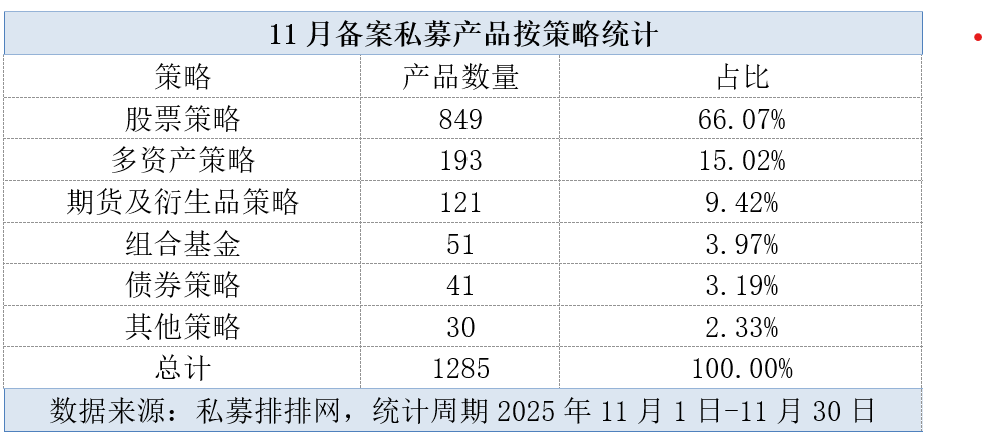
Group 1 - The core viewpoint of the articles indicates that despite market fluctuations, both existing and new funds are optimistic about the medium to long-term performance of equity assets, as evidenced by a significant increase in private equity fund registrations and high stock positions [1][2][4]. - In November, over 1200 private equity securities investment funds were registered, marking a nearly 30% increase from October, with stock strategy funds accounting for 66.07% of new registrations [2][3]. - The stock private equity position index reached 82.97% as of November 21, reflecting a 1.84 percentage point increase from the previous week, indicating a strong commitment from existing funds [4][6]. Group 2 - The number of newly registered private equity funds in November was 1285, which is close to the year's highest monthly registration of 1302, showing a robust market activity [2][3]. - The majority of new registrations were in stock strategies, with 849 funds, while multi-asset and futures strategies also saw significant activity, with 193 and 121 new funds respectively [2][3]. - The average stock position for large private equity firms (over 10 billion) was reported at 89.23%, indicating a more aggressive stance among larger players [7]. Group 3 - The increase in private equity positions is attributed to two main factors: positive policy signals and the belief in the long-term value of A-shares, with recent market fluctuations providing good entry points [8]. - Investment focus is shifting towards technology and cyclical sectors, with firms expressing confidence in the recovery of corporate earnings, particularly in technology and advanced manufacturing sectors [9]. - Companies are expected to maintain high positions in sectors aligned with industrial trends, such as electronics, telecommunications, pharmaceuticals, and materials, as well as gold [9].
私募整体仓位创新高,看好A股中长期趋势
Zheng Quan Shi Bao· 2025-12-06 11:53
Group 1 - The overall strategy of private equity firms remains consistent, with a focus on growth assets, although some structural adjustments have occurred [1][4] - As of November 21, 2025, the stock private equity position index reached 82.97%, marking a significant increase of 1.84% from the previous week, and setting a new high for the year [5] - The proportion of fully invested private equity firms (over 80% positions) has risen to 68.99%, indicating a strong bullish sentiment despite market adjustments [5] Group 2 - Investment firms are optimistic about the medium to long-term trends of A-shares, with expectations for structural opportunities despite recent market volatility [2][6] - The market is experiencing a phase of self-disturbance due to collective investor behavior, while core trends such as policy direction and industrial development remain unchanged [3] - Key areas of focus for growth include companies benefiting from the restructuring of global supply chains, advancements in semiconductor technology, and the emergence of new consumer demographics [6][7]
“星耀领航计划”走进启林投资 以量化投资锻造科创新引擎
Zhong Guo Zheng Quan Bao· 2025-12-06 00:51
Group 1 - The "Starry Navigation Plan" aims to create a leading private equity empowerment platform focused on technology innovation and fostering a positive cycle between technology, capital, and the real economy [1] - The plan emphasizes the importance of private equity firms in supporting technology innovation and local economic services, particularly those with state-owned backgrounds [1] - The research team engaged with Qilin Investment to explore how quantitative investment can assist in technology innovation and the mutual empowerment paths between private equity and technology enterprises [1] Group 2 - Qilin Investment, founded in 2015, integrates technology into its investment approach, viewing itself as a financial technology company [2] - Over 80% of Qilin Investment's managed assets are in index-enhanced strategies, primarily focusing on the CSI 500 ETF and CSI 1000 ETF, which include numerous technology stocks [2] - The firm has developed a unique system for investing in technology innovation, focusing on the characteristics of technology companies and optimizing models to capture their growth trajectories and risk features [2][3] Group 3 - Qilin Investment employs artificial intelligence and machine learning algorithms throughout its quantitative investment process, enhancing its ability to understand and participate in technological innovation [3] - The company has made significant investments in compliance and risk control, ensuring that its operations adhere to regulatory requirements while utilizing advanced technologies [4] - Qilin Investment collaborates with top universities for talent development and aims to provide investors with sustainable returns through education and long-term investment strategies [4] Group 4 - The "Starry Navigation Plan" aligns with national strategies encouraging technology innovation, recognizing the synergy between quantitative private equity and technology enterprises [5] - Qilin Investment's research and development investment intensity surpasses that of many listed technology companies, facilitating potential collaboration [5] - The plan aims to foster diverse exchanges between quantitative institutions and technology enterprises, ultimately creating a beneficial cycle among technology, capital, and the real economy [5][6] Group 5 - The "Starry Navigation Plan" staff highlighted Qilin Investment's comprehensive capabilities in practicing technology finance, maintaining compliance, and contributing to society [6] - As China transitions to high-quality economic development, quantitative investment is becoming a crucial link between capital markets and technology innovation [6] - Qilin Investment's practices demonstrate that rigorous models, advanced technology, and a long-term investment perspective can create value for investors while empowering technology enterprises and supporting national strategies [6]