充电桩

Search documents
特锐德20250918
2025-09-18 14:41
Summary of the Conference Call for 特瑞德 (Teradyne) Industry and Company Overview - 特瑞德 is a leading supplier in the power equipment and charging sectors, particularly in the new energy market, achieving breakthroughs in prefabricated substation segments [2][3] - The company has successfully secured a 700 million RMB order from the Saudi national grid and expanded its business along the "Belt and Road" initiative [2][3] Core Insights and Arguments - **Market Position**: 特瑞德's subsidiary, 特来电, is positioned in the top tier of the charging pile market, benefiting from the rapid increase in new energy vehicle ownership and supportive policies [2][3] - **Financial Performance**: The company has shown steady growth in revenue and profit, driven by the demand for phase change products and the growth of its charging business. Despite increased expenses in 2024 due to higher business investments, there is still potential for improvement in expense ratios [2][4] - **Service Transition**: 特来电 has transitioned from being a pure equipment supplier to a service provider, achieving its first profit in 2022 and enhancing operational efficiency through smart operations and value-added services [2][5] - **Stable Management**: The company has a stable shareholding structure and an experienced management team, ensuring continuity and strategic focus on customer pain points [2][6] Additional Important Content - **Future Growth Potential**: The company has significant growth potential in AI applications, especially in charging operations and data center power systems. It also has a strong position in virtual power plants, which could lead to long-term growth and performance improvement [2][8] - **Competitive Advantages**: 特瑞德 has strong capabilities in hardware sales and post-operation services, with a solid track record in the rail transit sector and good prospects in new energy generation and commercial sectors [2][9] - **International Expansion**: The company has made significant strides in international markets, particularly in the Middle East, with a solid foundation for future green energy demands [2][12] - **Charging Infrastructure Trends**: By 2025, the number of new energy vehicles is expected to reach 40 million, with charging piles estimated at 1 to 1.5 million units. The charging pile market is projected to grow significantly, with sales growth expected to exceed 20% in the coming years [2][14] - **SaaS Platform Performance**: 特来电's SaaS platform is performing well, with a broad user base and significant revenue potential from its services [2][16] - **Revenue and Profit Forecast**: For 2025, 特来电's overall revenue is projected to reach around 7 billion RMB, with strong potential in virtual power plants and auxiliary services [2][18] - **Investment Recommendation**: The overall assessment of 特瑞德 is positive, particularly in its overseas market presence and operational capabilities. The stock is currently viewed as a quality investment opportunity due to its low price point despite recent performance [2][20]

广州力争到2025年底建成V2G桩不少于300个
Cai Jing Wang· 2025-09-16 07:29
Core Viewpoint - The Guangzhou government has issued a work plan for the construction of a national vehicle-to-grid (V2G) interactive application pilot city from 2025 to 2027, focusing on the development of a benchmark demonstration area in Baiyun District [1] Group 1: V2G Development - The plan emphasizes multi-party collaboration to advance the construction of the V2G benchmark demonstration area [1] - The pilot scope will cover at least eight types of scenarios, including residential communities, industrial parks, office parks, battery swap stations, bus stations, logistics stations, government offices, and parks [1] - The goal is to establish no less than 300 V2G charging piles by the end of 2025, with a discharge capacity of at least 300,000 kilowatt-hours and regular participation of no fewer than 400 V2G vehicles [1]
最高补贴达50%,广州大举加码车联网V2X建设
Xuan Gu Bao· 2025-09-15 23:33
Industry Overview - Guangzhou government has issued a plan for the large-scale application of Vehicle-to-Grid (V2G) technology from 2025 to 2027, aiming for over 1,000 V2G charging stations and vehicles by the end of 2025, with V2G discharge volumes reaching 1.5 million kWh in 2025, 2 million kWh in 2026, and 2.5 million kWh in 2027 [1][2] - V2G technology allows electric vehicles to act as energy storage devices, absorbing energy when grid load is low and releasing it when the load is high, thus generating profit from price differences [2] Company Insights - Teruid: The company is a leader in the charging station and operation sector, with a leading position in V2G technology deployment and the highest market share in V2G equipment nationwide [3] - Tonghe Technology: The company is a domestic leader in charging modules, with a wide range of V2G power levels covered [4] Market Projections - Longcheng Securities projects that the number of new energy vehicles in China will reach 40 million, 100 million, and 350 million by 2025, 2030, and 2050 respectively, with vehicle-mounted energy storage capacity expected to reach 2.6 billion, 6.5 billion, and 22.8 billion kWh [2] - The number of new V2G charging stations is projected to be 11.4 million, 80 million, and 250 million by 2025, 2030, and 2050 respectively [2] - The global V2G market value is expected to grow from $3.78 billion in 2023 to $45.09 billion by 2033 [2]

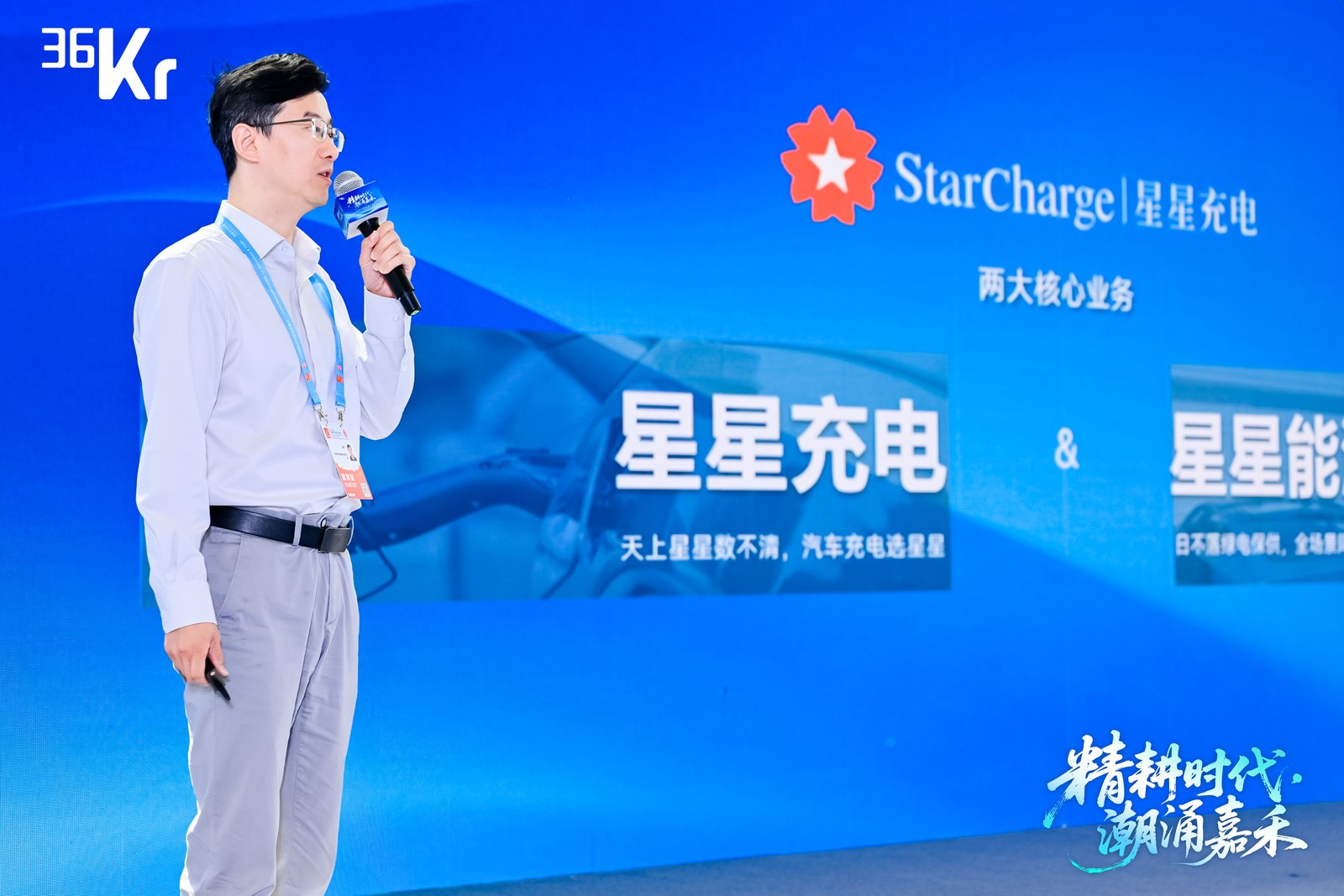
星星充电高级副总裁王迪:AI 赋能新能源,构建充电、微网与电力交易的智能生态| 2025年36氪产业未来大会
3 6 Ke· 2025-09-15 11:08
Core Insights - The 2025 36Kr Industry Future Conference, co-hosted with the Ministry of Commerce, focuses on key themes such as artificial intelligence, low-altitude economy, advanced manufacturing, new energy, and large consumption [1] - The conference aims to discuss the collaboration between government, capital, and industry to address pain points and bottlenecks in industrial development [1] Company Overview - Star Charge has developed a comprehensive charging network and smart microgrid, covering 261 cities and over 2,800 counties in China, with more than 2 million charging piles connected, accounting for approximately one-sixth of the national public charging infrastructure [3][4] AI Applications in New Energy - AI technology is pivotal in enhancing safety, efficiency, and longevity in the charging network and energy business [3] - The company has implemented an automated recommendation and validation platform for site selection in charging network planning, which helps identify risks and avoid potential issues [4] - An AI assistant named "Station Doctor" generates detailed operational reports and task lists for charging station management, improving efficiency in operations [5] Pricing and Management Innovations - AI-driven dynamic pricing models allow for precise pricing adjustments based on various factors, achieving a pricing accuracy of up to four decimal places [5] - The company has developed AI systems for 24/7 remote management of unattended charging stations, addressing common issues such as vehicle occupation and equipment damage [6] Smart Microgrid Solutions - AI optimizes the coordination of photovoltaic, energy storage, and charging systems, enhancing operational efficiency and cost management for operators [7] - The company is involved in vehicle-to-grid (V2G) initiatives, allowing electric vehicles to support grid stability during peak demand periods [7] Overall AI Strategy - Star Charge is building an AI intelligence foundation across ten business areas, focusing on efficiency improvement, cost reduction, and the development of new productive forces [8] - The integration of AI into the energy trading system aids in decision-making for energy purchases and sales, with the potential for fully automated trading in the future [8]

研报掘金丨天风证券:首予优优绿能“买入”评级,客户结构、出海方面均有优势
Ge Long Hui A P P· 2025-09-11 09:28
Core Viewpoint - Tianfeng Securities report indicates that Youyou Green Energy's main business focuses on charging pile power modules, emphasizing core technology and new product development with a light asset model [1] Group 1: Business Overview - The company has advantages in product iteration, customer structure, and overseas expansion [1] - The downstream extensibility of power modules is strong, with high-voltage direct current power modules applicable in data center direct power supply fields, opening up growth space [1] Group 2: Financial Projections - Revenue from 20kw, 30kw, and 40kw modules in 2024 is projected to be 0.7 billion, 6 billion, and 7.4 billion respectively, with year-on-year changes of -67%, -28%, and +155% [1] - Revenue shares for these modules are expected to be 5%, 40%, and 50%, with year-on-year changes of -10 percentage points, -20 percentage points, and +29 percentage points, indicating a significant increase in the revenue share of the 40kw module [1] Group 3: Future Outlook - The company is expected to see a rise in overseas revenue share and product upgrades, leading to rapid growth in net profit attributable to shareholders in 2026 and 2027 [1] - The expansion of product categories is anticipated to extend into the data center sector, with a projected PE of 40x for 2026, corresponding to a stock price of 285.7 yuan, initiating coverage with a "buy" rating [1]

加速补齐充电短板,让充电像加油一样方便
Xin Lang Cai Jing· 2025-09-11 00:18
Core Insights - The article discusses the rapid advancements in charging infrastructure for electric vehicles (EVs) in China, highlighting the shift towards high-power charging facilities to alleviate "range anxiety" among EV users [1][2][3] - The goal is to make charging as convenient as refueling, with significant improvements needed in both speed and coverage of charging stations [2][3] Charging Infrastructure Development - As of now, China has a total of 16.1 million charging guns, with 4.096 million public charging facilities and 12.004 million private ones [1] - High-power charging facilities are still concentrated in a few urban areas, indicating a need for broader distribution across the country [1][2] Speed and Coverage Disparities - The current charging speed for most public stations is still around 40 kW, while ultra-fast charging stations are primarily located in regions like Beijing-Tianjin-Hebei and the Yangtze River Delta [2] - Over 70% of private charging stations exist, but many EV owners without fixed parking spots rely on public facilities, which often do not meet the "charge and go" demand [2] Strategic Development Initiatives - Authorities have proposed to upgrade charging facilities with over 40% utilization to high-power standards, with cities like Shenzhen already surpassing the number of gas stations with ultra-fast charging stations [2] - Key locations for new charging stations include highway service areas, core business districts, and underserved rural areas to enhance accessibility [2] Technological and Standardization Advances - Significant technological advancements, such as liquid cooling and smart algorithms, are essential for the effective implementation of high-power charging [3] - The establishment of new national standards for charging interfaces and safety is crucial, although compatibility issues with older vehicle models remain a challenge [3] Future Outlook - The article emphasizes that achieving the goal of making charging as convenient as refueling requires not only speed improvements but also equitable distribution of charging facilities across urban and rural areas [3] - The ongoing development of ultra-fast charging infrastructure and the refinement of technical standards are expected to enhance the overall user experience for EV owners [3]
科大智能:全资子公司参股的公司科大智能(合肥)科技有限公司主要产品包括随车配交流桩、快充直流桩等
Mei Ri Jing Ji Xin Wen· 2025-09-10 08:44
Core Viewpoint - Solid-state battery technology is expected to promote the widespread adoption of ultra-fast charging in electric vehicles, raising questions about the preparedness of charging equipment suppliers like the company for high-power charging technologies [1] Company Summary - The company, through its wholly-owned subsidiary, holds an 18% stake in a joint venture focused on charging pile technology, which includes products such as on-board AC piles, fast DC piles, and ultra-fast charging piles [1] - The company plans to continuously increase R&D investment to ensure a competitive advantage in the charging pile industry, aligning with the evolving trends in the charging sector [1]

特锐德:充电网业务收入和利润在今年上半年保持较好增长
Ge Long Hui· 2025-09-05 10:28
Core Viewpoint - The company, Teruid (300001.SZ), reported that its charging network business revenue and profit have maintained good growth in the first half of this year, driven by the expansion of its charging network and diversification of its business model [1]. Group 1 - The company has expanded its charging network scale [1] - The diversification of the company's business model has contributed to revenue growth [1] - The charging network business has shown positive performance in terms of both revenue and profit in the first half of the year [1]
特锐德(300001.SZ):充电网业务收入和利润在今年上半年保持较好增长
Ge Long Hui· 2025-09-05 09:43
Core Viewpoint - The company, Teruid (300001.SZ), reported good growth in revenue and profit from its charging network business in the first half of this year, driven by the expansion of its charging network and diversification of its business model [1] Group 1 - The company's charging network scale is expanding [1] - The diversification of the company's business model is contributing to growth [1] - Revenue and profit from the charging network business have maintained good growth in the first half of the year [1]
Blink Charging Co. (BLNK) Virtual Fireside Chat (Transcript)
Seeking Alpha· 2025-09-04 22:07
Core Insights - The company has made significant progress but acknowledges there is still much work to be done to achieve profitability and meet investor expectations [1]. Group 1 - The CEO expressed that rather than focusing on negative aspects, the primary concern is the balance between the progress made and the remaining challenges [1]. - There is a strong emphasis on the company's journey towards profitability and the management team's commitment to achieving this goal [1].