智能穿戴设备

Search documents
机构:上半年国内消费级AI/AR眼镜市场销量同比增长73%
Zheng Quan Shi Bao Wang· 2025-09-05 00:17
Core Insights - The Chinese consumer-grade AI/AR glasses market is projected to reach sales of 262,000 units in the first half of 2025, representing a year-on-year growth of 73%, marking a historical high [1] - Screenless AI glasses are identified as the core growth driver with a remarkable year-on-year increase of 463, indicating a significant shift in consumer preferences [1] - Major brands such as Thunderbird and Xiaomi are leveraging technological advancements and ecosystem development to propel the industry into a new phase of large-scale adoption [1] Market Outlook - CINNO Research forecasts that the shipment volume of AI/AR glasses in China will reach 900,000 units by 2025, reflecting a year-on-year increase of 133%, with the industry expected to surpass a scale of 100 billion within three years [1] - Despite existing challenges, policy support and market potential continue to underpin optimistic expectations for the sector [1] Competitive Landscape - Domestic brands are building content ecosystem barriers through three dimensions: cross-device collaboration, cross-field applications, and cross-industry cooperation, which are crucial for competitive advantage [1] - Technological breakthroughs and ecosystem enhancements are identified as key variables determining success in the market [1]
CINNO Research:1H’25新品和政策助推 国内消费级AI/AR市场销量同比激增73%
智通财经网· 2025-09-04 23:49
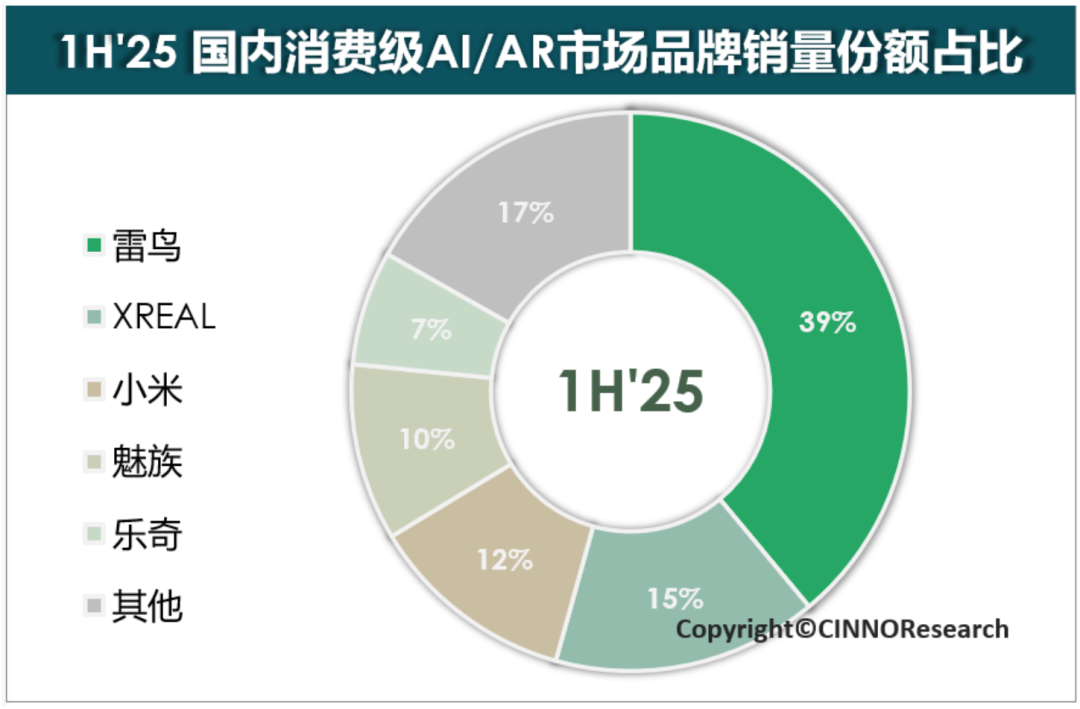
Group 1 - The Chinese consumer-grade AI/AR glasses market experienced explosive growth, with sales reaching 262,000 units in the first half of 2025, a year-on-year increase of 73% [1][2] - The market is driven by government subsidies and the 618 e-commerce promotion, leading to a new wave of product iteration across three major segments: split AR glasses, screen AI glasses, and non-screen AI glasses [2][6] - Non-screen AI glasses led the market with a staggering year-on-year growth of 463%, driven by products like Thunder V3 and Xiaomi AI smart glasses, which integrate AI voice interaction and health monitoring features [2][4] Group 2 - Local brands are diversifying the market, with Thunder leading with a 39% market share and a year-on-year sales increase of 113%, while Xiaomi entered the market with a 12% share, achieving rapid sales growth [4][5] - Thunder's new product launches, including the Air 3S series and X3 Pro AR glasses, have contributed to its strong market position, while Xiaomi's AI glasses achieved 31,000 units sold in the first week [4][5] Group 3 - The dual engines of government policy and e-commerce promotions have significantly boosted the AI/AR market, with consumers benefiting from a 15% subsidy and promotional discounts during the 618 shopping festival [6] - During the core promotional period from May 20 to June 20, sales of AI/AR products across major e-commerce platforms reached 59,000 units, with AR products seeing an increase of over 130% [6] Group 4 - Local brands are focusing on building a content ecosystem to achieve breakthroughs, emphasizing cross-device collaboration, cross-domain applications, and cross-industry cooperation [8] - The integration of AR devices with mobile phones and partnerships with cloud services and content platforms are key strategies for enhancing user experience and expanding market applications [8]


机构:2025年Q2全球智能手表出货量同比增长8%,华为智能手表出货量首次超越苹果
Mei Ri Jing Ji Xin Wen· 2025-09-04 01:29
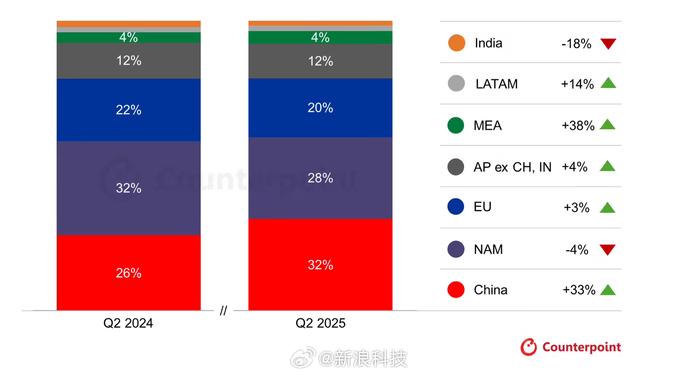
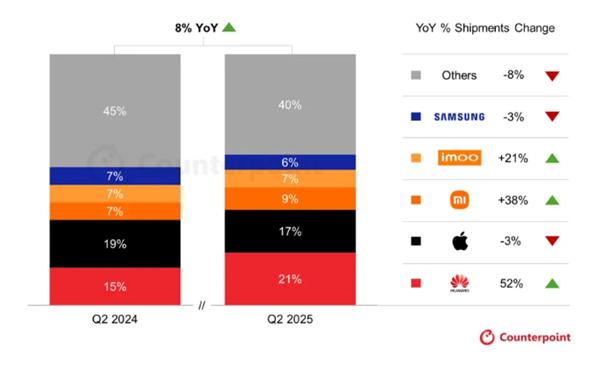
Core Insights - Huawei's smartwatch shipments surpassed Apple's for the first time in Q2 2025, making Huawei the global leader in this segment [1] - Global smartwatch shipments experienced an 8% year-on-year growth in Q2 2025, marking the first recovery after five consecutive quarters of decline since Q1 2024 [1] - The growth in the Chinese market played a significant role in this recovery, driven by sustained consumer demand, particularly for brands like Huawei, Xiaomi, and Little Genius [1]

2025年全球AR眼镜出货量预计约60万台
Bei Jing Shang Bao· 2025-09-03 07:22
北京商报讯(记者 陶凤 实习记者 王天逸)9月3日,TrendForce集邦咨询发布最新研报称,随着Meta、 Google等国际大厂加速布局,AR眼镜市场将进入高速增长期:2025年全球出货量预计约60万台,2028 年起年比年增速将明显放大,至2030年达3210万台。 AI技术让消费者对AR眼镜应用形成明确认知,品牌方对光引擎提出功耗<300 mW、体积<1 cc、重量 <3 g等新标准,推动供应链规格趋同。Meta、Google的持续投入,正加速LUMUS、歌尔股份、JBD、 Xreal、Omnivision等关键供应商的技术迭代与产能扩张,为2030年实现千万级出货量奠定基础。 报告指出,信息提示类AR是主要增长引擎,2028年高阶全彩技术成熟后,国际大厂更完善的产品将集 中上市,推动出货量快速放大。区域结构方面,目前中国仍是出货主力,但受Meta、Google等巨头带 动,北美与欧洲份额将迅速提升,到2030年中国市场占比预计降至50.2%。 ...


楼层定位,是如何实现的?
Hu Xiu· 2025-09-03 05:40
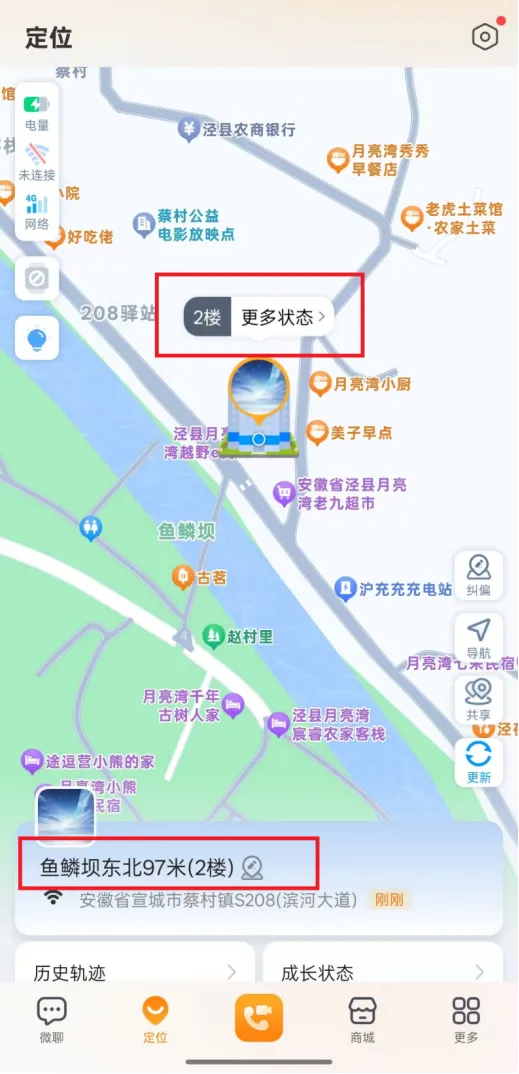
最近这段时间带娃在外地旅行,使用儿童电话手表(小天才的Z10)比较多。 在查看手表App的时候,我突然发现一个有意思的细节,那就是在App的定位界面,竟然可以看到娃所在的建筑楼层: Wi-Fi、基站等属于地面网络定位。它们依据周边的无线信号特征,通过一定的算法解算出设备的位置。这种定位技术通常是卫星定位的补充和辅助。 蓝牙、UWB是短距离通信技术。最近这几年经常被用于进行室内定位。 大家都知道,建筑内部的卫星信号很弱,往往无法借助卫星进行定位。采用地面网络定位的话,精度又比较差。即便是实现了定位,也是二维平面定位。 那么,为什么小小的儿童电话手表,却可以做到难度极高的立体楼层定位呢?它采用的是什么技术? 带着这个疑问,我详细地查阅了相关资料。最后在一份技术专利说明书上,我找到了答案。 这份名为"基于气压计的楼层定位方法、装置及智能手表"的创新专利(专利号:202210439105.1)由广东小天才科技有限公司提交于2022年4月。其中明 确指出: "可以基于气压传感器感知不同楼层间气压差异的特性,建立起气压值与楼层之间的对应关系,从而实现针对楼层的定位判断。" 作为一个通信工程师,我立刻察觉到其中的不简单。 ...
AI眼镜持续走弱,龙旗科技跌超6%
Mei Ri Jing Ji Xin Wen· 2025-09-02 02:06
Group 1 - The AI glasses market is experiencing a decline, with several companies showing significant stock price drops [1] - Longqi Technology has seen a drop of over 6% in its stock price [1] - Other companies such as Stitek and Shuo Beid have also reported declines of over 5% [1] - Jingyan Technology and Yian Technology have experienced declines of over 4% [1]

成交量10倍增长,平均9天一款新品,深扒AI眼镜野蛮生长背后
3 6 Ke· 2025-09-01 10:37
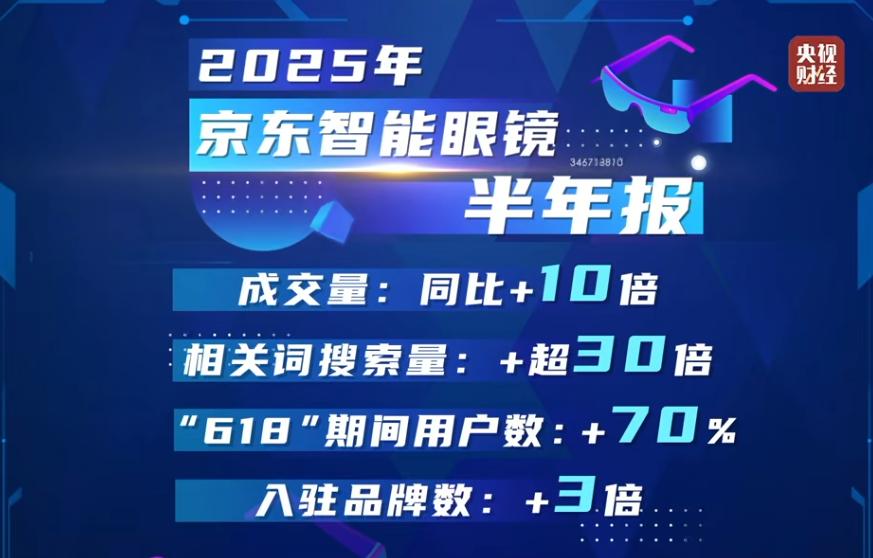
Core Insights - The AI glasses market is experiencing rapid growth, with a reported 10-fold increase in transaction volume year-on-year for the first half of 2025, and a threefold increase in the number of brands entering the market [1][3] - Despite the influx of new products, significant challenges remain, including high prices, short battery life, and limited content, which need to be addressed for the market to mature [3][5] - The average price of AI glasses has decreased from over 2000 yuan to around 1500 yuan, indicating a trend towards more affordable options [12][14] Market Dynamics - A total of 25 notable AI glasses products have been reported in the first eight months of the year, showcasing a mix of established and new players in the market [3][6] - Major tech companies, including Xiaomi and Lenovo, have entered the AI glasses space, contributing to the market's growth and competitive landscape [7][9] - The price range for AI glasses is becoming polarized, with a significant portion of products priced between 1500 and 2000 yuan, which is also a key price segment for mid-range smartphones [12][14] Product Features and Performance - The average daily battery life for AI glasses is around 8 hours, with some models offering extended capabilities through charging cases [35][37] - The weight of AI glasses averages around 38 grams, which is heavier than traditional glasses, indicating a need for further optimization in design [38][39] - Many products share similar hardware specifications, leading to a high degree of standardization in the market, particularly with the use of Qualcomm AR1 chips and 12-megapixel cameras [25][27] AI Functionality and User Experience - The integration of AI features is a key selling point, but many products exhibit a lack of differentiation in their AI capabilities, leading to a perception of "AI weak glasses" [42][44] - Current AI functionalities include object recognition, translation, and recipe suggestions, but the overall user experience remains inconsistent [42][44] - The reliance on voice and touch controls for interaction presents challenges in certain environments, limiting the practicality of AI glasses [46][48] Industry Outlook - The AI glasses sector is still in its early stages, with ongoing product iterations and a focus on addressing user experience challenges [49][50] - The potential for AI glasses to become the next computing platform exists, but significant technical hurdles must be overcome to realize this vision [50]
华为首次超越苹果,成全球第一
3 6 Ke· 2025-09-01 03:40
Core Insights - Huawei's smartwatch shipments are projected to grow by 52% year-on-year by Q2 2025, achieving a market share of 21%, surpassing Apple for the first time [1] - Apple's market share has declined to 17%, marking a significant drop after nearly seven years of dominance in the global smartwatch market [3] Market Positioning - Huawei's success is attributed to its comprehensive product line that covers all consumer levels, from entry-level to high-end flagship models, while Apple's offerings are more limited [4][7] - The high-end models of Huawei are priced between 2,699 yuan and 23,999 yuan, featuring advanced functionalities such as dual Beidou satellite messaging and 100-meter water resistance [4] - Mid-range models like WATCH GT and WATCH FIT are priced between 699 yuan and 2,488 yuan, appealing to a younger demographic with over 60% market share [6] Competitive Landscape - Xiaomi has seen a 38% year-on-year increase in shipments, capturing 9% of the market share, while Kid's Genius has grown by 21% to hold 7% [3] - Samsung's market share has decreased by 3%, placing it fifth in the global rankings [3] Distribution Strategy - Huawei has expanded its offline presence to over 30,000 stores in China, targeting third and fourth-tier cities, while also increasing its international footprint across Europe, the Middle East, Africa, and Asia-Pacific [7] - As of Q2 this year, Huawei has established over 62,000 stores and counters globally, covering more than 170 countries and regions [7] Product Innovation - Huawei's WATCH 5 series introduced the "X-TAP Smart Window" feature, which combines ECG, PPG, and tactile sensing technologies to provide comprehensive health metrics [8] - In contrast, Apple's recent updates have been criticized for lacking significant advancements, with some features being restricted in the Chinese market [10][12] Upcoming Releases - Both Huawei and Apple are expected to launch new products soon, with Huawei's WATCH GT6 series likely debuting alongside the Mate XTs foldable phone on September 19 [13] - Apple's upcoming event on September 10 will feature the Apple Watch Ultra 3, which aims to enhance outdoor performance capabilities [14]
AI眼镜电致变色专家会
2025-09-01 02:01
Summary of Key Points from the Conference Call Industry Overview - The conference focuses on the AI glasses industry, specifically the application of electrochromic (EC) technology in smart glasses, highlighting its advantages over photochromic technology in terms of control and intelligence [1][4][5]. Core Insights and Arguments - **Electrochromic Technology**: EC technology is favored for AR glasses due to its low power consumption, continuous adjustment, material stability, and long lifespan, despite its higher cost [1][5]. - **Market Adoption**: Xiaomi's AI glasses are expected to ship 400,000 units in 2025, with 30% featuring the electrochromic function. The shipment is projected to double to 1 million units in 2026, maintaining the same percentage for the electrochromic version [9][8]. - **Cost Structure**: The cost of the EC film is currently around $50, with expectations to drop to $30-$35 as production scales up and additional suppliers are introduced [2][24]. - **Meta's Product Launch**: Meta plans to release the "Super Nova" AR glasses with electrochromic functionality in September 2025, targeting a shipment of 200,000 units in Q4 2025 [10][13]. The overall shipment is expected to double to 10 million units in 2026 [11]. - **Supplier Strategy**: Both Xiaomi and Meta are exploring partnerships with non-listed companies for their electrochromic solutions, which may offer advantages in early customer engagement and specialized technology [25]. Additional Important Content - **Technical Differences**: The conference discusses the differences between electrochromic and photochromic technologies, emphasizing that electrochromic technology allows for active control of color changes, making it more suitable for smart glasses [3][4]. - **Future Trends**: The electrochromic technology is anticipated to become a trend in higher-end glasses priced around $300-$400, as these products can absorb the premium associated with the technology [23]. - **Competitive Landscape**: The AR glasses market is expected to remain stable in the next two years, with limited suppliers currently offering products with electrochromic features [28]. - **Huawei's Plans**: Huawei is set to release a smart glasses model in August 2026, which will utilize a similar technology route as competitors but with a cost reduction of 10%-15% due to local suppliers [30][31]. This summary encapsulates the key points discussed in the conference call, providing insights into the current state and future outlook of the AI glasses industry, particularly focusing on electrochromic technology.
华为智能手表出货量首超苹果登顶全球第一
Xin Lang Ke Ji· 2025-08-29 00:25
Core Insights - Huawei has surpassed Apple to become the global leader in smartwatch shipments, with a year-on-year growth of 52% [2] - The global smartwatch market has rebounded with an 8% year-on-year increase in shipments in Q2 2025, following five consecutive quarters of decline [1] - The growth in the smartwatch market is driven by increasing consumer demand, particularly in China, where brands like Huawei, Xiaomi, and 小天才 are leading the charge [1][3] Brand Performance - Huawei's shipments are primarily concentrated in China, accounting for over 75% of its total shipments, with most products priced between $100 and $400 [2] - Apple Watch shipments have declined for the seventh consecutive quarter, resulting in Apple losing its top position in the global market [2] - Xiaomi's shipments increased by 38% year-on-year, driven by its value-oriented products and extensive geographical reach [3] - 小天才 has seen a 21% year-on-year growth, maintaining its dominance in the children's smartwatch segment [3] - Samsung's shipments have decreased by 3% year-on-year, indicating a decline in its market presence [4] Market Trends - The increasing health awareness among consumers and the integration of artificial intelligence and the Internet of Things are contributing to the growth of the smartwatch market [1] - Consumers are increasingly viewing smartwatches as multifunctional lifestyle devices that seamlessly integrate with smartphones and expanding app ecosystems [1]