
软件服务

Search documents
2025年股权融资规模暴增251%!2026港股IPO热潮延续
Zheng Quan Shi Bao· 2026-01-18 02:46
Group 1 - The Hong Kong stock market experienced a significant surge in equity financing in 2025, with a total financing amount of HKD 612.2 billion, representing a year-on-year increase of 250.91% [2] - The IPO market in Hong Kong regained its position as the global leader, with 117 companies raising a total of HKD 285.8 billion, a year-on-year growth of 224.24% [2] - The outlook for 2026 remains positive, with expectations that the IPO fundraising scale will exceed HKD 300 billion, driven by favorable policies from the Hong Kong Stock Exchange and the return of Chinese concept stocks [2][3] Group 2 - As of January 15, 2026, there are 327 companies waiting to go public in Hong Kong, with nearly half being A-share listed companies, indicating strong future market activity [3] - The influx of quality IPOs is expected to attract more international capital, enhancing market liquidity rather than detracting from it [4][6] - The performance of IPOs post-listing reflects the effectiveness of the pricing mechanism in mature markets, influenced by factors such as IPO pricing and investor composition [5] Group 3 - International long-term capital has significantly returned to the Hong Kong market, with participation rates in IPO projects rising from approximately 10%-15% in early 2024 to 85%-90% by early 2026 [6] - The types of companies attracting international investors include those with clear business models, predictable profitability, and reasonable valuations, particularly in sectors like AI and consumer goods [6][7] - The biotechnology sector in Hong Kong is expected to continue its growth trajectory, with international investors likely to remain engaged due to the unique market opportunities [7]
2025,股权融资规模暴增251%!2026,港股IPO热潮延续!
券商中国· 2026-01-18 01:46
Core Viewpoint - The Hong Kong stock market experienced a significant surge in equity financing in 2025, with a 251% increase, and is expected to maintain a strong performance into 2026, albeit at a potentially lower growth rate [1][2]. Group 1: Market Performance and Projections - In 2025, the total equity financing in the Hong Kong market reached HKD 612.2 billion, marking a year-on-year increase of 250.91% [2]. - The IPO market regained its global leading position, with 117 companies raising a total of HKD 285.8 billion, reflecting a year-on-year growth of 224.24% [2]. - Projections for 2026 suggest that the IPO fundraising scale may exceed HKD 300 billion, driven by favorable policies from the Hong Kong Stock Exchange, the return of Chinese concept stocks, and increasing demand for international expansion [2][3]. Group 2: IPO Dynamics and International Capital - The influx of A-share companies into the Hong Kong IPO market was significant in 2025, but this trend may shift in 2026 towards more first-time listings [3]. - As of January 15, 2026, there are 327 companies waiting to list on the Hong Kong stock exchange, with nearly half being A-share companies [3]. - International long-term capital has significantly returned to the Hong Kong market, with participation rates in IPO projects rising from approximately 10%-15% in early 2024 to 85%-90% by early 2026 [7]. Group 3: Quality of IPOs and Market Impact - High-quality IPOs are expected to attract more international capital, enhancing market liquidity rather than detracting from it [4][5]. - The phenomenon of IPOs leading to market corrections, such as instances of new stocks breaking below their issue prices, is viewed as a normal market adjustment rather than a sign of a bearish trend [5][6]. - The performance of stocks post-IPO, particularly during the six-month lock-up period for cornerstone investors, is crucial for understanding the long-term impact on the market [5][6]. Group 4: Sector Focus and Future Trends - The Hong Kong IPO market is anticipated to see an influx of companies from the AI and related sectors, including communications, data centers, and semiconductors [3]. - The biotechnology sector is expected to maintain its high growth trajectory, with international investors likely to remain engaged due to the unique opportunities presented in the Hong Kong market [8]. - Key sectors driving the IPO market in 2026 include biotechnology, specialized technology (AI, new energy, semiconductors), traditional industry upgrades, and new consumer brands from mainland China [8].


2025,股权融资规模暴增251%!2026,港股IPO热潮延续!
Xin Lang Cai Jing· 2026-01-18 01:45
Core Viewpoint - The Hong Kong stock market experienced a significant surge in equity financing in 2025, with a total financing amount of HKD 6,122 billion, reflecting a year-on-year increase of 250.91%. The IPO market regained its global leading position, raising HKD 2,858 billion from 117 companies, a year-on-year growth of 224.24%. The outlook for 2026 remains positive, with expectations of continued high levels of IPO and refinancing activity, although growth rates may not match those of 2025 [2][10]. Group 1: Market Performance and Trends - The number of companies waiting for IPOs in Hong Kong has exceeded 300, indicating a robust market environment [1][8]. - Market consensus suggests that the active trend in Hong Kong's equity financing will persist, driven by favorable policies from the Hong Kong Stock Exchange, the return of Chinese concept stocks, and increasing demand for cross-border listings [2][10]. - As of January 15, 2026, there are 327 companies queued for listing, with nearly half being A-share companies, providing a solid foundation for market activity [3][11]. Group 2: International Capital Inflow - There has been a substantial return of international capital to the Hong Kong market, with participation rates from major international long-term funds rising to 85%-90% in IPO projects, compared to only 10%-15% at the beginning of 2024 [6][15]. - International investors are particularly interested in companies with clear business models, predictable profitability, and reasonable valuations, especially in sectors like AI and consumer goods [6][15]. Group 3: IPO Impact on Market Liquidity - The influx of quality IPOs is expected to attract more international capital, enhancing overall market activity rather than draining liquidity [4][12]. - Discussions around the potential pressure on the secondary market due to high IPO demand highlight the need to differentiate between structural issues and temporary phenomena [4][12]. - The performance of stocks post-IPO is influenced by various factors, including pricing, investor structure, and industry conditions, with a focus on the six-month period following the IPO for key investor unlocks [5][13]. Group 4: Future Outlook for IPOs - The IPO market in 2026 is anticipated to be driven by four main categories of companies: biotechnology firms, specialized technology companies (including AI and semiconductors), traditional industry upgrade representatives, and new consumer brands from mainland China [7][16]. - The biotechnology sector is expected to maintain its high growth trajectory, while other technology sectors are also poised for significant activity [7][16].
晚间利空!超过十家上市公司发布减持、4家超过2.2%!
Sou Hu Cai Jing· 2026-01-17 05:40
Group 1 - Multiple listed companies announced shareholder reduction plans, with notable reductions including Ruimaite at 4.98%, Youyan Silicon at 3%, Chengdu Xian Dao at 2.51%, and Zhen Shitong at 2.24% [1] - Other companies such as Lianchuang Optoelectronics and Xiongdi Technology announced reductions of 2%, while several others planned reductions of 1% [3] - The reasons given for these reductions were primarily "personal funding needs," which may be interpreted negatively in a sensitive market environment [3] Group 2 - Some stocks, like Zhizhi New Materials, experienced significant price increases but later clarified that their business does not involve popular market concepts such as AI or quantum technology, which led to a denial of the narrative supporting their stock price surge [4] - Liou Co. faced a trading suspension due to a 96.77% price increase over ten trading days, with the company indicating that its AI-related revenue is minimal [4] Group 3 - Several companies, including Kunlun Wanwei and Shanghai Hanhua, forecasted significant losses for 2025, with Kunlun Wanwei expecting a loss between 1.9 billion to 2.4 billion [6][7] - The list of companies predicting profit declines or losses is growing, with Weiyuan Co. expecting a more than 2000% drop in net profit [8] Group 4 - On January 16, 2026, institutional investors showed mixed sentiments, with Meinian Health receiving a net buy of 579.4 million and Sanan Optoelectronics 552.4 million, while Jin Feng Technology faced a net sell of 1.097 billion [9][12] - The divergence in fund flows indicates a split in market sentiment among institutional investors [12] Group 5 - Industry-wide pressures are emerging, with a report indicating that the smartphone market will face tight supply and rising prices for memory chips starting in the second half of 2025, which may lead to decreased consumer demand [14] - The automotive sector also reported declines, with major brands like BMW, Mercedes-Benz, and Audi showing significant drops in sales in China [14] Group 6 - Global commodity price fluctuations, such as a 4.56% drop in NY crude oil prices, are impacting the profitability of energy and raw material companies in the A-share market [16] - Despite negative news, market activity continues with notable trading in stocks like Tongyu Communications and Hongxiang Shares, indicating ongoing volatility [16] Group 7 - The evening of January 16, 2026, presented a mixed market landscape with ongoing shareholder reductions, risk warnings from popular stocks, and a blend of positive and negative earnings forecasts [17]
德邦老基金,一个月暴涨35%
Xin Lang Cai Jing· 2026-01-17 04:10
Core Viewpoint - The recent rumor of Debon Stable Growth Fund attracting over 12 billion yuan in a single day has sparked discussions in the fund industry, driven by a significant 35% increase in net value over the past month, largely attributed to early investments in the AI application sector [1][13]. Group 1: Fund Performance and Strategy - As of the end of Q3 2025, the fund's size was only 724 million yuan, but it has gained attention due to its concentrated investments in AI-related stocks, with the top ten holdings accounting for 70% of the fund's net value [1][16]. - The fund's performance over the past three years has been underwhelming, with a net value growth rate of -15.14% in 2023, 0.26% in 2024, and 8.06% in 2025, all failing to outperform their respective benchmarks [2][14]. - The fund's investment strategy aims for a balanced approach between stocks and bonds, with a focus on risk control, yet recent holdings reveal a more aggressive stance with five new AI stocks among the top ten [4][16]. Group 2: Market Reactions and Investor Behavior - Following the rumors of significant inflows, the fund quickly denied the claims, stating that daily scale data requires end-of-day settlement for confirmation, and subsequently imposed purchase limits, indicating high demand [1][9]. - The T+2 rule for mixed funds means that new investors will not see immediate returns, as they must wait two days to start earning from their investments, potentially leading to diluted returns for new entrants [20][21]. - As of January 16, 2026, eight of the top ten holdings had seen price declines, highlighting the volatility and risks associated with the recent surge in interest [21][23].

广联达:公司目前是采取AI赋能现有业务提质升级+新增的AI原生产品单独收费的双轨模式
Zheng Quan Ri Bao Wang· 2026-01-16 10:19
Core Viewpoint - The company is implementing a dual-track model that combines AI empowerment of existing business for quality enhancement and the introduction of new AI-native products with separate charges, clearly distinguishing between existing and new businesses without affecting the original annual fee system [1] Group 1: AI Empowerment Strategy - The company aims to enhance the core value of traditional construction quantity takeoff and pricing services through AI empowerment [1] - The strategy focuses on strengthening customer engagement and loyalty by creating higher value for clients [1] - The company plans to optimize pricing strategies reasonably to improve customer renewal willingness and new purchase conversion efficiency [1]

龙虎榜丨华胜天成今日跌9.95% 中国银河大连黄河路净卖出5.13亿元
Ge Long Hui A P P· 2026-01-16 09:11
Group 1 - The stock of Huasheng Tiancheng fell by 9.95% today, with a trading volume of 10.9 billion yuan and a turnover rate of 43.47% [1] - The Shanghai Stock Connect special seat bought 385 million yuan and sold 266 million yuan [1] - China Galaxy's Dalian Huanghe Road recorded a net sell of 513 million yuan [1]


爆量第三日:巨额资金,甩卖?
Ge Long Hui A P P· 2026-01-16 09:10
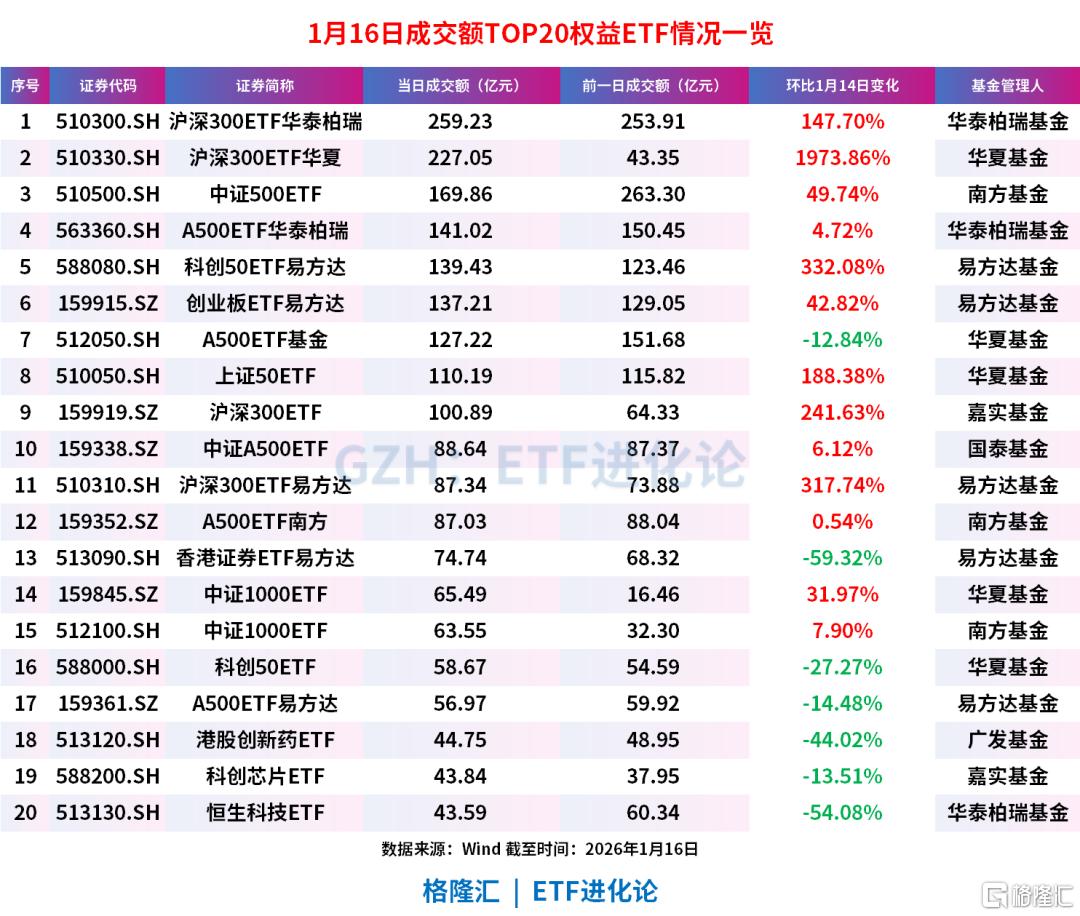
Core Viewpoint - The A-share market is experiencing an unprecedented tug-of-war between bulls and bears, highlighted by significant net outflows from major ETFs and a surge in leveraged funds [1][9][11]. Group 1: ETF Market Activity - Major broad-based ETFs saw a net outflow of 700 billion, with the total margin balance exceeding 2.7 trillion for the first time in history [1]. - The trading volume of ETFs reached a record high of 752.25 billion, marking the third consecutive day of record-breaking activity [1]. - Multiple broad-based ETFs, including the Huatai-PineBridge CSI 300 ETF and the Huaxia CSI 300 ETF, recorded transaction volumes exceeding 20 billion, with the latter seeing a nearly 20-fold increase compared to January 14 [2][4]. Group 2: Institutional Fund Flows - The top ten ETFs with the highest net outflows were all broad-based ETFs, totaling 715 billion in outflows, with the Huatai-PineBridge CSI 300 ETF alone experiencing a net outflow of 200 billion [9][10]. - Institutional funds showed a net outflow across nearly all major ETFs, indicating a trend of selling pressure despite high trading volumes [4][5]. Group 3: Leverage and Margin Trading - Leveraged funds have been aggressively buying, with net purchases of 206 billion on January 15, contributing to a total of 1.77 trillion in net purchases over the first nine trading days of the year [13][15]. - The current pace of leveraged fund inflows suggests that they could match last year's total net purchases in just over 25 trading days [15]. Group 4: Market Sentiment and Regulatory Environment - The market is showing signs of cooling, with regulatory measures aimed at tempering excessive speculation following a period of high trading volumes and bullish sentiment [11][19]. - The shift in regulatory stance is seen as a response to the rapid increase in trading activity, particularly after three consecutive days of trading volumes exceeding 3 trillion [19][20]. Group 5: Wealth Transfer and Investment Trends - A significant portion of the 160 trillion in household savings is being reallocated, which could have profound implications for the capital markets [21][30]. - The upcoming maturity of long-term deposits, estimated at 32 trillion, coincides with a bullish market environment, potentially leading to increased equity market participation [25][26].
AI应用板块回调,中证软件服务指数跌逾2%,关注软件ETF易方达(562930)投资机会
Mei Ri Jing Ji Xin Wen· 2026-01-16 07:07
Core Viewpoint - The AI application sector is experiencing a correction, but there are signs of potential growth as AI business revenue for several A-share companies is expected to exceed 10% [1] Group 1: Market Performance - As of 14:40 on January 16, the CSI Software Service Index fell by 2.3%, while the software ETF E Fund (562930) saw a net inflow of nearly 1 billion yuan over the past five trading days [1] - Despite external factors affecting the market, the software index is at a relatively low position, indicating that a spring market rally may still be on the horizon [1] Group 2: AI Business Development - The penetration of AI applications has reached a turning point, with multiple A-share companies expected to see their AI business revenue share surpass 10% [1] - Overseas AI applications are accelerating in commercialization, suggesting a broader market opportunity [1] Group 3: Future Catalysts - There are multiple catalysts to look forward to, including the Deepseek V4 model, the Zhiyuan GLM-5 model, and ongoing activities from ByteDance and Alibaba during the Spring Festival [1] Group 4: Index Composition - The CSI Software Service Index consists of 30 stocks involved in software development and services, covering various AI application scenarios such as AI + office, AI + finance, and AI + education [1] - The top ten weighted stocks account for over 60% of the index, indicating concentrated investment opportunities [1]
金蝶取得信息处理方法系统及相关产品专利
Jin Rong Jie· 2026-01-16 03:46
Group 1 - The core point of the article is that Kingdee Software (China) Co., Ltd. has obtained a patent for an "Information Processing Method, System, and Related Products," with the authorization announcement number CN119887136B and an application date of December 2024 [1] - Kingdee Software (China) Co., Ltd. was established in 1993 and is located in Shenzhen, primarily engaged in software and information technology services [1] - The company has a registered capital of 1.4 billion RMB and has invested in 66 enterprises, participated in 3,702 bidding projects, and holds 810 trademark records and 1,912 patent records [1]