自动驾驶

Search documents
花几百万开发布会结果无人问津?或许你该看看这个…
量子位· 2026-01-30 04:23
Core Viewpoint - In 2025, technology companies have realized that having advanced technology is meaningless if it is not visible to the public, leading to a shift in how technology is communicated and perceived in everyday life [1][4]. Group 1: Technology Communication Evolution - Traditional methods of technology communication, such as white papers and parameter tables, are becoming less effective, while short videos on platforms like Douyin (TikTok) are gaining traction [2][3]. - The competition now revolves around who can make technology relatable and accessible to the general public, with Douyin emerging as a central player in this transformation [5][28]. - Short videos are bringing technology back to real-life scenarios, allowing audiences to see and understand advancements like autonomous driving in a relatable context [6][9]. Group 2: Impact of Short Videos - A specific example includes a video by creator Lin Yi, which showcased the operation of a Chinese autonomous taxi service in Abu Dhabi, garnering 2 million views and significantly impacting public perception [7][10]. - These videos provide a high-density of information, answering key questions about technology in a straightforward manner, which was previously communicated through lengthy reports [11][12]. - The ability of short videos to convey complex information quickly and effectively is changing the landscape of technology communication, making it more accessible to a broader audience [28][36]. Group 3: Collaborative Content Creation - The collaboration between Douyin and technology companies has led to a large-scale experiment involving 30 tech products and 30 creators, marking a shift from one-way communication to a co-creation model [27][42]. - This new model allows companies to showcase their capabilities while creators translate and present these technologies in engaging ways, enhancing user understanding and engagement [28][39]. - Douyin's role has evolved from merely being a platform to acting as a "producer," facilitating the creation of content that resonates with audiences and effectively communicates technological advancements [37][40]. Group 4: Growing Demand for Technology Content - According to Douyin's report, the demand for technology content has surged, with over 1.4 trillion views in the past year, indicating that users are increasingly interested in tech-related topics [43][44]. - The growth of high-quality, in-depth technology content, particularly videos longer than 30 minutes, has increased by 298%, positioning Douyin as a leading platform for technology discussions [44][45]. - Major technology events and announcements are now frequently originating from Douyin, highlighting its importance as a communication channel for tech companies [46][47].


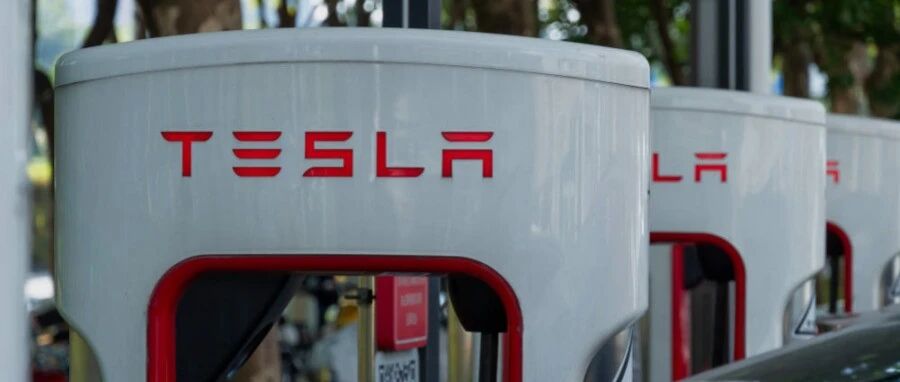
特斯拉20260129
2026-01-30 03:11
Summary of Tesla's Conference Call Company Overview - **Company**: Tesla - **Date**: January 29, 2026 Key Points Industry and Company Developments - **CyberCab Project**: Testing is ongoing in six locations including Austin and San Francisco, with vehicle manufacturing costs expected to be below $30,000 and operational costs reduced to $0.20 per mile. Large-scale production is planned to start in April 2026 [2][3] - **Robotaxi Operations**: Officially launched in Austin on January 22, 2026, with 72 Robotaxis operating in Austin and 168 in San Francisco as of January 28, totaling 240 vehicles. This significantly reduces labor costs and accelerates fleet expansion [2][3][7] - **AI Chip Development**: Continuous upgrades from HW 1.0 to HW 4.0, with computing power increased to 500 TOPS. Future AI5 chips are expected to reach 2000-2500 TOPS using 3nm technology, with new chips planned every 9 months [2][5][6] Market Expansion - **Geographic Expansion**: Tesla is actively expanding into the Middle East and Europe, with FSD testing in countries like the Netherlands, which is expected to grant national approval in February 2026. Italy, Germany, and France have opened FSD trial projects, with the UAE as a key focus in the Middle East [2][5][7] - **Future Robotaxi Service Expansion**: Plans to expand Robotaxi services to seven new cities in the first half of 2026, including Dallas, Phoenix, and Miami. Production of Model S and Model X will be halted in Q2 2026 to make space for the Cybertruck factory [4][8] Financial and User Metrics - **FSD Subscription Growth**: By the end of 2025, FSD subscription users increased from 400,000 in 2021 to 1.1 million, with 330,000 monthly subscribers. The global fleet collects data equivalent to over 500 years of continuous driving [2][9] Competitive Landscape - **Waymo's Developments**: Waymo has a fleet of 2,500 vehicles as of the end of 2025 and plans to introduce the sixth-generation model O.High in 2026, aiming for 1 million rides per week. The company is also expanding its operational cities significantly [4][10][11] Future Market Trends - **Robotaxi Market Outlook**: The U.S. Robotaxi market is expected to grow rapidly, supported by ongoing developments from companies like Tesla and Waymo, along with favorable legislative changes. Other companies to watch include Pony.ai, Horizon Robotics, and XPeng [12]

金融护航,无人卡车领军者重塑物流时代
Jiang Nan Shi Bao· 2026-01-30 03:03
江南时报讯 清晨的天津港码头,几辆无驾驶室的智能卡车平稳穿梭,无需人工操控,精准将满载日用 品与生产物资的集装箱转运至仓储区——这是主线科技L4级自动驾驶技术的日常应用场景,也是我国 人工智能技术加速融入千行百业、渗透生产生活的生动写照。 "十五五"规划建议提出,"全面实施'人工智能+'行动"。去年8月,国务院印发《关于深入实施"人工智能 +"行动的意见》,明确实施"人工智能+"行动的总体要求、发展目标和重点方向。"AI+"的未来图景正变 得越来越真实可感。 从落地天津港的第一台无人驾驶卡车,到获得新疆喀什的首张智能网联汽车道路测试资质,再到跨境运 输与海外落地,主线科技直击港口与公路物流高成本、人力短缺的行业痛点,走出一条自动驾驶商业化 路径,让技术惠及长期处于行业一线的劳动者。 无人卡车领军者的商业化进阶之路 作为国内自动驾驶赛道卡车领域的标杆企业,主线科技的成功,既源于其"清华系+百度系"核心团队深 厚的研发实力,也源于对行业现状的精准洞察。 公司创始人张天雷不仅拥有清华大学计算机科学与技术专业博士学位,还曾任职于微软亚洲研究院,是 百度无人车项目"创始30人"之一及技术委员会核心成员,全程参与多个自动 ...
自动驾驶元年,一二级市场或将迎来估值重塑
Huan Qiu Wang· 2026-01-30 03:02
Group 1 - The Shanghai government has launched the "Mosu Zhixing" action plan aiming for large-scale implementation of high-level autonomous driving scenarios by 2027, emphasizing "cross-domain connectivity" and "scene integration" [1] - The focus of autonomous driving development has shifted from mere vehicle intelligence to a spatial service network deeply integrated with urban functions [1] Group 2 - Citic Securities notes that Tesla's FSD V14 may have reached near Level 4 autonomy, with expectations for a relaxed regulatory environment, making 2026 a potential year for commercializing autonomous driving [2] - The industry is undergoing a paradigm shift, moving from "transportation technology validation" to "scaled scene services and sustainable operations" [2][3] - Nvidia's launch of the "Alpamayo" platform aims to accelerate the development of autonomous vehicles and support new-generation robots, indicating a shift towards a composite model of "space services + high-frequency operations" [2] Group 3 - The competitive landscape is evolving from a focus on "chip-algorithm-data" self-research to an ecosystem collaboration, with Nvidia's open-source approach lowering R&D barriers for second-tier automakers and tech companies [3] - Companies like PIX are exemplifying new business models by launching commercial operations such as the "WonderLoop" project, which integrates smart transportation into urban infrastructure [3] Group 4 - The changing industry dynamics are leading to a revaluation in the capital markets, with companies like Joyson Electronics being recognized for their role in integrating open-source models into production [4] - Joyson Electronics has seen its market value increase from 24 billion on January 28, 2025, to 44 billion on January 28, 2026, reflecting market recognition of its upgraded positioning as "automotive + robotics Tier 1" [4] Group 5 - The competition in the second half of the autonomous driving sector will hinge on understanding specific scenarios, building sustainable business models, and enhancing collaborative efficiency within the open industry ecosystem [5][6] - Innovative companies like PIX are focusing on "urban robots" to avoid saturated competition, leveraging modular chassis for flexible configurations and efficient integration into the open industry ecosystem [6]


融资70亿,英伟达沃尔沃出手,前Uber技术大牛瞄准无人重卡
3 6 Ke· 2026-01-30 00:19
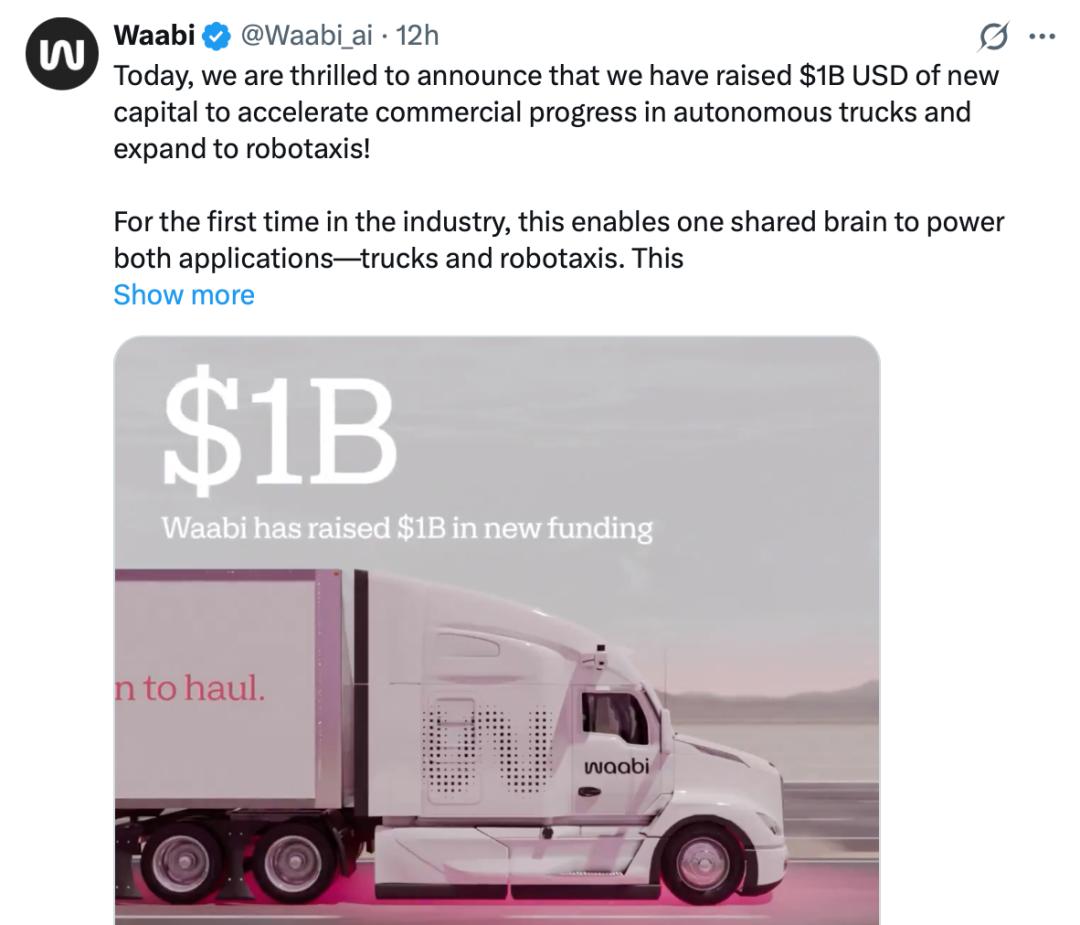
Core Insights - Waabi, an autonomous driving startup, has announced a $1 billion financing round, consisting of a $750 million Series C led by Khosla Ventures and G2 Venture Partners, along with an additional $250 million commitment from Uber [3][13] - Following this financing, Waabi has entered into an exclusive agreement with Uber to deploy 25,000 RoboTaxis powered by Waabi Driver on the Uber platform, although a specific timeline for deployment has not been provided [3][8] Financing Details - The financing round includes $750 million from Khosla Ventures and G2 Venture Partners, and an additional $250 million from Uber, totaling $1 billion [3][13] - Waabi's cumulative funding has reached approximately $1.284 billion, with a target valuation of $3 billion post-Series C [13] - Previous funding rounds include $83.5 million in 2021 and $200 million in 2024, with notable investors such as NVIDIA, Volvo, and Porsche participating [11][13] Business Operations - Waabi's primary operations are based in Texas, with logistics centers in cities like Toronto, San Francisco, Phoenix, and Pittsburgh, and it is conducting commercial trials with human safety drivers [4][8] - The company has expanded its transportation routes across the U.S., covering both coasts and central regions [4] Technology and Innovation - Waabi follows a "factory-integrated" approach in hardware development, collaborating with Volvo to integrate Waabi Driver into Volvo VNL Autonomous models [6][8] - The company emphasizes a unified technology stack for both trucks and passenger vehicles, utilizing a high-fidelity neural simulator called "Waabi World" to create digital twins for real-time sensor simulation [6][8] Leadership and Vision - Waabi was founded in 2021 by Raquel Urtasun, a former chief scientist at Uber ATG, who combines academic and industrial experience in autonomous driving [14][16] - Urtasun focuses on a technology path that is verifiable, explainable, and scalable, aiming for a faster commercialization pace [16] Market Context - The significant investment in Waabi reflects the ongoing interest in the autonomous heavy-duty trucking sector, with major players like NVIDIA and Volvo accelerating resource concentration in companies with high-fidelity simulation capabilities [17] - The current financing trend indicates a competitive landscape for achieving commercial viability in autonomous freight logistics [17]

新股消息 | 伯镭科技递表港交所
Zhi Tong Cai Jing· 2026-01-29 22:53
Group 1 - The core viewpoint of the article is that Shanghai Boonray Intelligent Technology Co., Ltd. has submitted its listing application to the Hong Kong Stock Exchange, aiming to become a global leader in zero-carbon autonomous mining solutions [1] - The company is recognized as the first in the world to deploy a fleet of fully electric autonomous mining trucks in mining areas [1] - According to Zhaoshang Consulting, by 2024, the company is projected to be the largest provider of fully electric autonomous mining trucks globally in terms of shipment volume and revenue, and the second largest provider of autonomous mining solutions in China [1]
伯镭科技递表港交所
Zhi Tong Cai Jing· 2026-01-29 22:51
Group 1 - The core point of the article is that Shanghai Berai Intelligent Technology Co., Ltd. has submitted its listing application to the Hong Kong Stock Exchange, aiming to become a leading provider of zero-carbon unmanned mining solutions globally [1] - The company is the first in the world to deploy a fleet of fully electric autonomous mining trucks in mining areas [1] - According to data from Zhaoshang Consulting, by 2024, the company is projected to be the largest provider of fully electric autonomous mining trucks globally in terms of shipment volume and revenue, and the second largest provider of autonomous mining solutions in China [1]
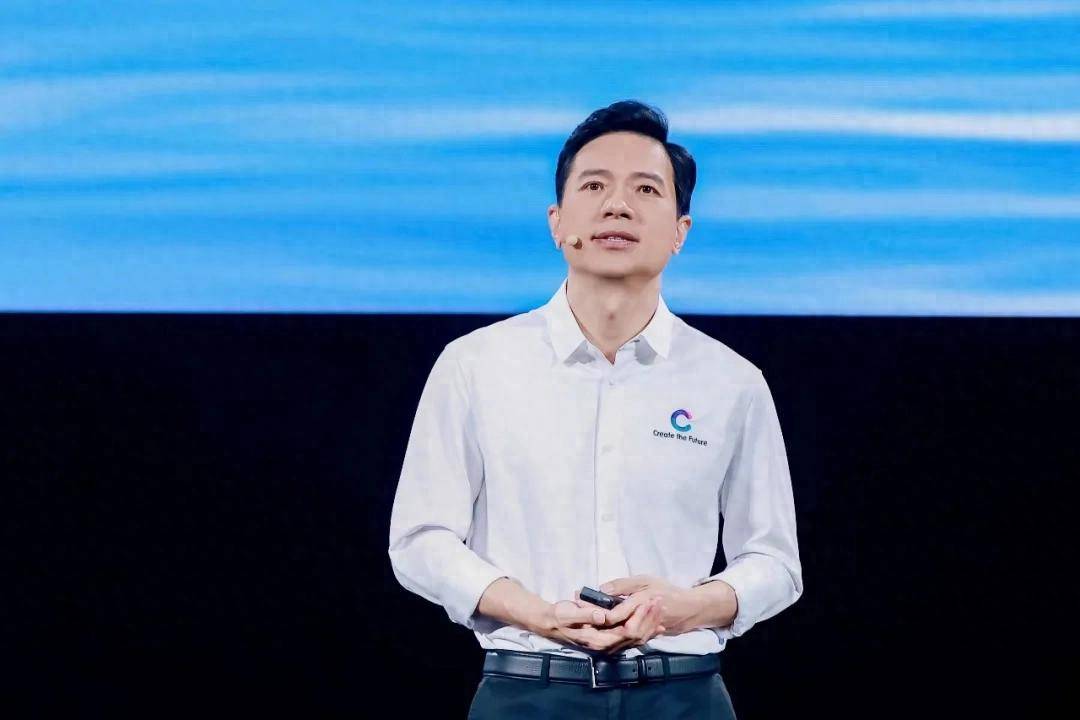
搜索失速、大模型遇阻,李彦宏的AI生死局
Sou Hu Cai Jing· 2026-01-29 15:44
Core Viewpoint - The upcoming AI red envelope competition during the 2026 Spring Festival is expected to be a critical battle for survival among tech giants, rather than just a traffic frenzy [2] Group 1: Strategic Moves and Financial Performance - Baidu has announced significant strategic moves, including the independent listing of its AI chip subsidiary Kunlun and the restructuring of its business units to focus on AI [2][13] - In Q3 2025, Baidu reported a long-term asset impairment loss of 16.2 billion yuan, while AI cloud revenue grew by 33% year-on-year, indicating a clear path for transformation [3] - The core online marketing revenue, primarily from search ads, plummeted by 18% year-on-year to 15.3 billion yuan, highlighting a structural decline in its traditional business [5] Group 2: Challenges in Search and AI Business - The decline in search business is attributed to a shift in user attention towards platforms like Douyin and WeChat, with average daily usage of search engines dropping from 47 minutes in 2020 to just 12 minutes in 2025 [5] - Baidu's attempt to restructure its search model using AI has raised concerns about its traditional revenue model, as direct answers from AI could reduce ad clicks and revenue [6] - The competitive landscape in the AI model sector has intensified, with new entrants disrupting Baidu's previous advantages, forcing the company to adopt an open-source strategy [8][9] Group 3: Organizational Restructuring and Future Outlook - Baidu has initiated significant layoffs, with reductions of 10%-30% across various departments, focusing resources on AI development [11] - The restructuring is seen as a move to consolidate power under CEO Li Yanhong, who aims to directly oversee AI research and development [12] - The success of Kunlun's upcoming IPO is critical for Baidu, as it could alleviate cash flow pressures and enhance its position in the AI chip market [13][17] Group 4: Long-term Viability and Investment Risks - Baidu's future hinges on its ability to find sustainable profit models for its AI initiatives and the successful commercialization of its large models [17] - The company faces high execution risks in its AI transformation, with short-term performance likely to be under pressure [17] - 2026 is positioned as a pivotal year for Baidu, where the outcomes of its restructuring and market strategies will determine its survival in the AI era [16][17]

对话它石智航陈亦伦:不做 VLA,不仿真,一家具身智能公司的非主流判断
晚点Auto· 2026-01-29 14:51
Core Viewpoint - The article discusses the emergence of a new company, It Stone, founded by Chen Yilun, focusing on embodied intelligence and its unique approach to data collection and model development, diverging from mainstream methods like VLA (Vision-Language-Action) [4][38]. Group 1: Company Overview - It Stone has raised a record $1.2 billion in angel funding, marking a significant milestone in China's embodied intelligence sector [4]. - The company aims to develop its own model, AWE (AI World Engine), which emphasizes the expression of physical quantities and world information rather than relying on visual and language models [4][38]. Group 2: Data Collection Strategy - It Stone has developed wearable devices for data collection, allowing workers to gather real-world task data without the high costs associated with remote operation methods [5][24]. - The company has already collected approximately 100,000 hours of data, with plans to significantly increase this volume in the coming year [31]. Group 3: Technical Insights - Chen Yilun emphasizes that the current bottleneck in embodied intelligence is data acquisition, which is challenging and expensive compared to the vast amounts of data available for language models [15]. - The company’s approach to data collection is designed to be more efficient and scalable, aiming for a foundational scale of at least 10 million hours of data for effective training [27][28]. Group 4: Market Position and Future Outlook - It Stone is positioning itself to address complex tasks in industrial manufacturing, particularly in areas like wire harness assembly, which traditional robots struggle to perform [41]. - The company believes that the embodied intelligence sector is on the verge of significant advancements, with expectations for scaling and performance improvements in the coming years [40].

特斯拉史上首次年营收下滑,将停产Model S/X
21世纪经济报道· 2026-01-29 11:39
Core Viewpoint - Tesla faces unprecedented challenges as it reports its first annual revenue decline in history, with total revenues down 3% year-over-year in 2025, primarily due to a significant drop in automotive revenues and net income [4][6][7]. Financial Performance - Total automotive revenues for 2025 were $69.526 billion, a decrease of 10% from 2024, while total revenues were $94.827 billion, down 3% [6][7]. - Net income attributable to common stockholders (GAAP) fell by 46% to $3.794 billion, with diluted EPS dropping 47% to $1.08 [6][7]. - In Q4 2025, automotive revenue decreased by 11% to $17.693 billion, with vehicle deliveries down 15.61% to 418,200 units [7]. Strategic Shifts - CEO Elon Musk announced a new mission to "create incredible wealth," indicating a shift from being solely an electric vehicle manufacturer to a technology and mobility service company focused on autonomous driving and AI [8][11]. - Tesla plans to invest over $20 billion in 2026 for AI infrastructure and production capacity for Optimus robots and Robotaxi projects [8][11]. Product and Capacity Adjustments - The production of Model S and Model X will be gradually phased out, with the Fremont factory being repurposed for Optimus robot production [8][12]. - The Optimus 3 robot is set to be released soon, with a long-term production goal of 1 million units annually [8][12]. Autonomous Driving and Robotaxi Developments - Tesla has approximately 1.1 million paid users for its Full Self-Driving (FSD) feature, representing a 12% penetration rate among total vehicle sales [9][11]. - The company is transitioning to a subscription model for FSD, which may impact short-term automotive gross margins [11][13]. Vertical Integration and Core Technology Investments - Tesla is prioritizing the development of its AI chips, with plans for a self-built wafer factory to mitigate future supply chain risks [10][11]. - The company has invested in xAI to enhance AI capabilities for managing Robotaxi and Optimus operations [10][11]. Competitive Landscape - Tesla identifies China as its strongest competitor in AI and large-scale manufacturing [14]. - The company believes it uniquely possesses the capabilities to address key challenges in high-performance robotics, real-world AI, and scalable production [14]. Other Product Updates - The Cybertruck maintains its market leadership, with no plans for traditional pickup designs [15]. - The next-generation Roadster is expected to launch in April, promising an extraordinary experience [15].