ETF

Search documents
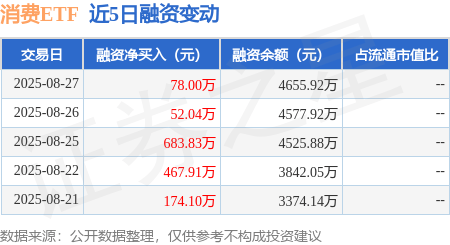
消费ETF:8月27日融资净买入78万元,连续3日累计净买入813.87万元
Sou Hu Cai Jing· 2025-08-28 02:51
Core Insights - The consumption ETF (510150) recorded a net financing purchase of 780,000 yuan on August 27, 2025, with a financing balance of 46.5592 million yuan, marking a continuous net purchase over the last three trading days totaling 813.87 million yuan [1][3]. Financing Activity Summary - On August 27, 2025, the financing net purchase was 780,000 yuan, with a financing balance of 46.5592 million yuan [2][4]. - The financing balance increased by 1.7% compared to the previous day [3][4]. - Over the last 20 trading days, there were 13 days with net financing purchases, indicating a positive trend in investor sentiment towards the ETF [1]. Daily Financing Data - August 27: Net financing purchase of 780,000 yuan, financing balance of 46.5592 million yuan [2]. - August 26: Net financing purchase of 520,400 yuan, financing balance of 45.7792 million yuan [2]. - August 25: Net financing purchase of 6.8383 million yuan, financing balance of 45.2588 million yuan [2]. - August 22: Net financing purchase of 4.6791 million yuan, financing balance of 38.4205 million yuan [2]. - August 21: Net financing purchase of 1.7410 million yuan, financing balance of 33.7414 million yuan [2].

多只人工智能ETF上涨;ETF新品抢滩科技主题丨ETF晚报
2 1 Shi Ji Jing Ji Bao Dao· 2025-08-27 09:31
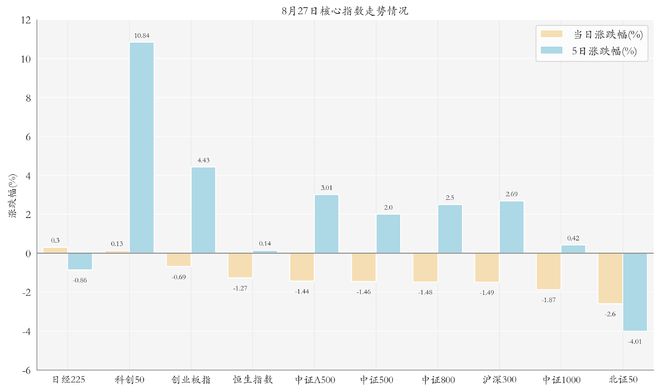
ETF Industry News Summary Group 1: Market Performance - Major indices experienced fluctuations with the Shanghai Composite Index down by 1.76%, Shenzhen Component down by 1.43%, and ChiNext down by 0.69% [1][5] - Several AI sector ETFs saw gains, including the Huaxia Sci-Tech AI ETF (589010.SH) up by 3.29%, the Sci-Tech Board AI ETF (588930.SH) up by 3.22%, and the AI ETF Sci-Tech (588760.SH) up by 3.07% [1][12] - The real estate sector faced declines, with the Real Estate ETF (512200.SH) down by 3.33%, the Real Estate ETF Fund (515060.SH) down by 3.10%, and the Real Estate ETF (159707.SZ) down by 2.98% [1] Group 2: ETF Records - On August 26, the ETF market set two records: total scale exceeding 5 trillion yuan for the first time and the number of products over 100 billion yuan surpassing 100 [2] - The time taken for the ETF market to grow from the first trillion to the fifth trillion was reduced from 16 years to just 4 months, indicating a growing preference for index investment strategies [3] Group 3: Structural Changes in ETF Investments - The ETF market is witnessing a dichotomy, with a surge in the issuance of technology-themed ETFs while overall stock ETFs experienced a net outflow of over 20.7 billion yuan [4] - Funds are increasingly flowing into industry themes, bonds, and cross-border ETFs, reflecting a shift in capital towards technology innovation amid China's economic structural transformation [4] Group 4: ETF Category Performance - Among different ETF categories, money market ETFs performed the best with an average change of 0.00%, while strategy index ETFs had the worst performance with an average decline of 1.74% [10] - The top-performing ETFs in the stock category included the Huaxia Sci-Tech AI ETF (589010.SH), the Sci-Tech Board AI ETF (588930.SH), and the AI ETF Sci-Tech (588760.SH), with respective returns of 3.29%, 3.22%, and 3.07% [12][13] Group 5: Trading Volume Insights - The top three ETFs by trading volume were the Sci-Tech 50 ETF (588000.SH) with 11.043 billion yuan, the ChiNext ETF (159915.SZ) with 8.092 billion yuan, and the CSI 300 ETF (510300.SH) with 6.408 billion yuan [15][17]
每日市场观察-20250827
Caida Securities· 2025-08-27 05:30
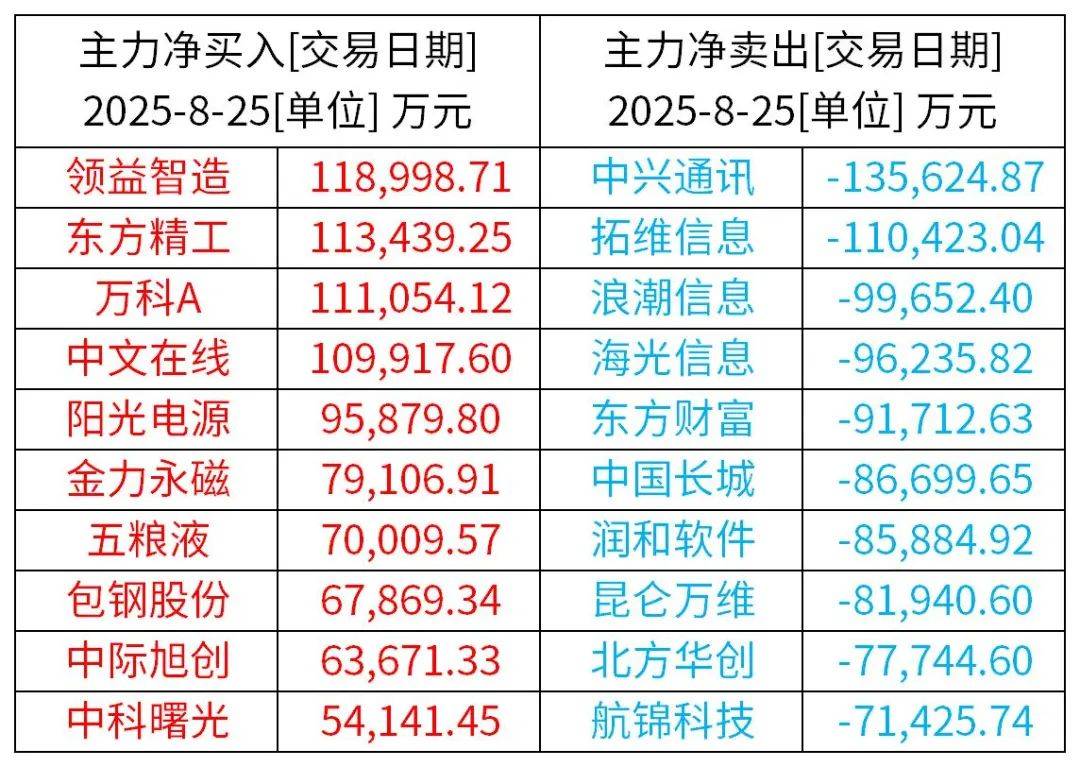
Market Overview - On August 26, the market experienced mixed performance with the Shanghai Composite Index down by 0.39%, the Shenzhen Component up by 0.26%, and the ChiNext Index down by 0.75%[3] - The total trading volume was 2.71 trillion CNY, a decrease of approximately 470 billion CNY from the previous trading day[1] Sector Performance - Sectors such as agriculture, chemicals, and media showed notable gains, while pharmaceuticals, non-bank financials, steel, military, and telecommunications sectors faced declines[1] - The recent adjustments in the market are seen as normal profit-taking after significant gains, particularly in sectors like innovative drugs, military, and semiconductors[1] Fund Flow - On August 26, the net outflow from the Shanghai Stock Exchange was 5.587 billion CNY, while the Shenzhen Stock Exchange saw a net inflow of 16.440 billion CNY[4] - The top three sectors for capital inflow were consumer electronics, software development, and optical electronics, while small metals, chemical pharmaceuticals, and securities faced the largest outflows[4] ETF Market - The total scale of ETFs in China reached a historic high of 5.07 trillion CNY, marking a rapid increase from 4 trillion CNY in just four months[5] - There are currently 1,271 ETFs in the market, with 101 exceeding 10 billion CNY in scale and 6 exceeding 100 billion CNY[5] Energy Sector Developments - China has established the world's largest electric vehicle charging network, with a ratio of 2 charging stations for every 5 vehicles[6] - The renewable energy generation capacity has increased from 40% to approximately 60% during the 14th Five-Year Plan[6] Industry Innovations - China launched its first photon-counting spectral CT, marking a significant advancement in medical technology[11] - The new generation of the Chinese operating system, Galaxy Kirin V11, was officially released, enhancing operational experience and security[10]
Is Nuveen ESG Mid-Cap Value ETF (NUMV) a Strong ETF Right Now?
ZACKS· 2025-08-26 11:21
Core Insights - The Nuveen ESG Mid-Cap Value ETF (NUMV) offers broad exposure to the mid-cap value segment of the market and debuted on December 13, 2016 [1] - NUMV is managed by Nuveen and aims to match the performance of the TIAA ESG USA Mid-Cap Value Index [5] - The ETF has accumulated over $396.66 million in assets, making it an average-sized fund in its category [5] Fund Characteristics - NUMV has an annual operating expense ratio of 0.31%, which is competitive within its peer group [6] - The fund's 12-month trailing dividend yield is 1.65% [6] - The largest sector allocation is to Industrials at 18.4%, followed by Financials and Real Estate [7] Holdings and Performance - United Rentals Inc. (URI) is the largest individual holding at 2.42% of total assets, with the top 10 holdings comprising 20.07% of total assets [8] - Year-to-date, NUMV has gained approximately 9.53%, and it is up about 8.32% over the last 12 months as of August 26, 2025 [10] - The ETF has a beta of 0.99 and a standard deviation of 17.37% over the trailing three-year period, indicating effective diversification [10] Alternatives - Other ETFs in the mid-cap value space include Vanguard ESG U.S. Stock ETF (ESGV) and iShares ESG Aware MSCI USA ETF (ESGU), which have significantly larger assets of $11.1 billion and $14.22 billion respectively [12] - ESGV has a lower expense ratio of 0.09%, while ESGU has an expense ratio of 0.15% [12]

Should Goldman Sachs MarketBeta Russell 1000 Value Equity ETF (GVUS) Be on Your Investing Radar?
ZACKS· 2025-08-26 11:21
Core Viewpoint - The Goldman Sachs MarketBeta Russell 1000 Value Equity ETF (GVUS) is a newly launched passively managed ETF aimed at providing broad exposure to the Large Cap Value segment of the US equity market, with assets exceeding $360.01 million [1]. Group 1: ETF Overview - GVUS was launched on November 28, 2023, and is sponsored by Goldman Sachs Funds [1]. - The ETF has an annual operating expense of 0.12%, making it one of the least expensive options in its category [4]. - It has a 12-month trailing dividend yield of 1.91% [4]. Group 2: Market Characteristics - Large cap companies typically have a market capitalization above $10 billion and are considered stable with lower risk compared to mid and small cap companies [2]. - Value stocks generally exhibit lower price-to-earnings and price-to-book ratios, but they have historically outperformed growth stocks in most markets over the long term [3]. Group 3: Sector Exposure and Holdings - The ETF has a significant allocation to the Financials sector, comprising about 22.6% of the portfolio, followed by Industrials and Healthcare [5]. - Berkshire Hathaway Inc (BRK/B) is the largest individual holding at approximately 3.14% of total assets, with Jpmorgan Chase & Co (JPM) and Amazon.com Inc (AMZN) also among the top holdings [6]. Group 4: Performance Metrics - GVUS aims to match the performance of the Russell 1000 Value 40 Act Daily Capped Index, which measures large and mid-capitalization value stocks [7]. - The ETF has gained about 9.35% year-to-date and approximately 9.87% over the past year, with a trading range between $42.82 and $51.80 in the last 52 weeks [7]. - It has a beta of 0.84 and a standard deviation of 13.86% over the trailing three-year period, indicating effective diversification of company-specific risk with around 869 holdings [8]. Group 5: Alternatives and Market Position - GVUS holds a Zacks ETF Rank of 3 (Hold), suggesting it is a viable option for investors seeking exposure to the Large Cap Value segment [9]. - Other comparable ETFs include the Schwab U.S. Dividend Equity ETF (SCHD) and the Vanguard Value ETF (VTV), which have significantly larger asset bases of $72.08 billion and $143.10 billion, respectively [10].


农业板块ETF涨幅靠前;国内ETF规模破5万亿元丨ETF晚报
2 1 Shi Ji Jing Ji Bao Dao· 2025-08-26 10:58
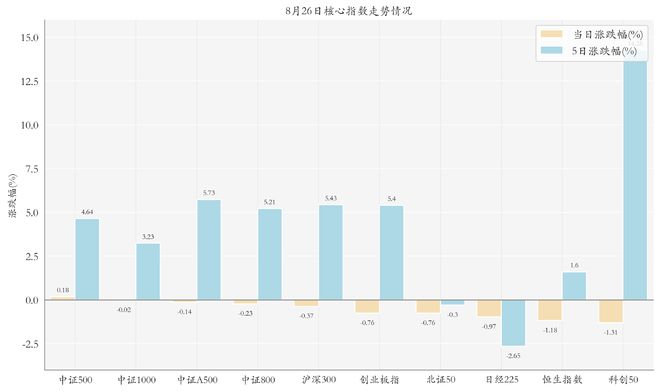
ETF Industry News - Major indices showed mixed performance with the Shanghai Composite Index down 0.39%, Shenzhen Component Index up 0.26%, and ChiNext Index down 0.76. Several agricultural sector ETFs saw gains, including E Fund Agricultural ETF (562900.SH) up 2.94%, Agricultural ETF (159825.SZ) up 2.90%, and Agricultural 50 ETF (516810.SH) up 2.85. In contrast, multiple electronic sector ETFs declined, with AI ETF (588760.SH) down 3.35%, Chip Design ETF (588780.SH) down 3.10%, and AI ETF on the Sci-Tech Innovation Board (588930.SH) down 2.69 [1][5]. Domestic ETF Scale - The total scale of domestic ETFs has surpassed 5 trillion yuan, reaching a historic high of 5.07 trillion yuan as of August 25. The breakdown includes stock ETFs at 3.46 trillion yuan, cross-border ETFs at 753.72 billion yuan, bond ETFs at 555.90 billion yuan, commodity ETFs at 153.26 billion yuan, and money market ETFs at 142.47 billion yuan [2]. Growth of Equity ETFs - The equity ETF market in China has seen significant growth, with a total scale of 41,170.94 billion yuan as of August 25, marking a year-to-date increase of 7,982.72 billion yuan, or 24.05%. A total of 718 equity ETFs have experienced growth this year, with 23 products increasing by over 10 billion yuan. Industry experts suggest that with policy support and market maturity, equity ETFs are expected to play a crucial role in market stability and asset allocation [3]. Brokerage ETF Business - The top three brokerages in terms of ETF holdings remain unchanged, with China Galaxy leading at 23.46% market share, followed by Shenwan Hongyuan at 17.25%. CITIC Securities, China Merchants Securities, and Guotai Junan hold 6.71%, 4.72%, and 4.71% respectively. The rankings indicate stability in the brokerage sector's ETF business [4]. Market Performance Overview - On August 26, the A-share market showed mixed results, with the Shanghai Composite Index down 0.39% to 3,868.38 points, the Shenzhen Component Index up 0.26% to 12,473.17 points, and the ChiNext Index down 0.76% to 2,742.13 points. The top performers over the past five trading days include the Sci-Tech Innovation 50, with a gain of 14.26% [5]. Sector Performance - In sector performance, Agriculture, Beauty Care, and Basic Chemicals led the day with gains of 2.62%, 2.04%, and 1.26% respectively. Conversely, the Pharmaceutical, Non-Bank Financials, and Steel sectors lagged with declines of -1.09%, -1.06%, and -0.98% [7]. ETF Market Overview - The average performance of various ETF categories indicates that commodity ETFs performed the best with an average increase of 0.15%, while cross-border ETFs had the worst performance with an average decline of -0.85% [10]. Top Performing ETFs - The top five performing ETFs today include E Fund Agricultural ETF (562900.SH) with a gain of 2.94%, Online Consumption ETF (159728.SZ) up 2.92%, and Agricultural ETF (159825.SZ) up 2.90%. Other notable mentions include Agricultural 50 ETF (516810.SH) up 2.85% and Livestock Breeding ETF (516670.SH) up 2.78% [12][13]. ETF Trading Volume - The top three ETFs by trading volume today were Sci-Tech Innovation 50 ETF (588000.SH) with 6.126 billion yuan, A500 ETF (512050.SH) with 5.828 billion yuan, and ChiNext ETF (159915.SZ) with 5.706 billion yuan [15][16].
A股特别提示(8-26):中国ETF即将突破5万亿大关!有择股择时困惑的投资者看过来
Sou Hu Cai Jing· 2025-08-26 00:53
Group 1 - Shanghai has introduced new housing policies allowing eligible families to purchase unlimited properties outside the city center, and single adults will be subject to the same housing purchase restrictions as families [1] - The National Development and Reform Commission (NDRC) is working on the "14th Five-Year Plan" focusing on expanding domestic demand and stabilizing employment [1][2] - The customs authority reported that during the "14th Five-Year Plan," the average annual supervision of import and export goods reached 5.2 billion tons, with a total value of 41.5 trillion yuan, making it the largest globally [2] Group 2 - The A-share market saw all three major indices rise, with the Shanghai Composite Index aiming for 3,900 points and a trading volume of nearly 3.2 trillion yuan, marking a historical high [2] - The Hong Kong Hang Seng Index closed up 1.94%, reaching a nearly four-year high, with significant trading volume of 369.7 billion HKD [3] - China's ETF market is approaching a scale of 5 trillion yuan, with over 100 ETF products exceeding 10 billion yuan in size, making it the largest ETF market in Asia [3] Group 3 - The Ministry of Natural Resources has initiated a new round of oil and gas exploration and development, indicating a resurgence in the sector [4] - The gaming industry saw 166 domestic games and 7 imported games receive approval in August, with major companies like Tencent and NetEase benefiting [4] - The recent surge in the Shenzhen real estate market is reflected in a 0.9% week-on-week increase in second-hand home transactions [4] Group 4 - Galaxy Digital and others are in talks to raise approximately 1 billion USD for acquiring Solana tokens, aiming to establish a significant reserve in the digital currency sector [5] - ByteDance has stated that its upcoming AI glasses are still in the exploratory phase, with no immediate release plans [5] - SAIC and Huawei have launched the H5 model, priced from 169,800 yuan, which features Huawei's ADS 4 intelligent driving system [5] Group 5 - The U.S. plans to impose a 50% tariff on certain Indian products, signaling a potential escalation in trade tensions [8] - The U.S. has added copper and potassium salts to its list of critical minerals for national security and economic importance [9] - The Turkish government is set to allow the expiration of a short-selling ban to attract foreign investment, following a recent surge in the Istanbul stock index [10]
Should First Trust Mid Cap Value AlphaDEX ETF (FNK) Be on Your Investing Radar?
ZACKS· 2025-08-25 11:21
Core Viewpoint - The First Trust Mid Cap Value AlphaDEX ETF (FNK) is designed to provide broad exposure to the Mid Cap Value segment of the US equity market, with a focus on balancing growth potential and stability [1][2]. Group 1: Fund Overview - Launched on April 19, 2011, FNK has accumulated assets over $204.79 million, categorizing it as one of the smaller ETFs in its segment [1]. - The ETF is passively managed and sponsored by First Trust Advisors [1]. Group 2: Investment Characteristics - Mid cap companies, with market capitalizations between $2 billion and $10 billion, are generally seen as having higher growth prospects compared to large cap companies while being less risky than small cap companies [2]. - Value stocks, which FNK focuses on, typically have lower price-to-earnings and price-to-book ratios, and have historically outperformed growth stocks in long-term performance [3]. Group 3: Costs and Performance - FNK has annual operating expenses of 0.7%, making it one of the more expensive ETFs in its category, with a 12-month trailing dividend yield of 1.62% [4]. - The ETF aims to match the performance of the Nasdaq AlphaDEX Mid Cap Value Index, with a year-to-date return of approximately 5.62% and a one-year return of about 7.56% as of August 25, 2025 [7]. Group 4: Sector Exposure and Holdings - The ETF has a significant allocation to the Consumer Discretionary sector, comprising about 22.1% of the portfolio, followed by Financials and Industrials [5]. - Riot Platforms, Inc. (RIOT) is the largest individual holding at approximately 1.18% of total assets, with the top 10 holdings accounting for about 9.23% of total assets under management [6]. Group 5: Risk and Alternatives - FNK has a beta of 1.08 and a standard deviation of 21.97% over the trailing three-year period, indicating a medium risk profile [8]. - Alternatives to FNK include the iShares Russell Mid-Cap Value ETF (IWS) and the Vanguard Mid-Cap Value ETF (VOE), which have significantly larger asset bases and lower expense ratios [10].

Is iShares MSCI USA Quality GARP ETF (GARP) a Strong ETF Right Now?
ZACKS· 2025-08-25 11:21
Core Insights - The iShares MSCI USA Quality GARP ETF (GARP) was launched on January 14, 2020, and offers broad exposure to the Style Box - All Cap Growth category of the market [1] Fund Overview - GARP is managed by Blackrock and has accumulated over $625.49 million in assets, making it an average-sized ETF in its category [5] - The fund aims to match the performance of the MSCI USA Quality GARP Select Index, which consists of U.S. large and mid-cap growth stocks with favorable value and quality characteristics [5] Cost Structure - GARP has an annual operating expense ratio of 0.15%, making it one of the least expensive products in the smart beta ETF space [6] - The fund has a 12-month trailing dividend yield of 0.38% [6] Sector Allocation and Holdings - The Information Technology sector represents 47.3% of GARP's portfolio, followed by Consumer Discretionary and Financials [7] - Nvidia Corp (NVDA) accounts for approximately 5.71% of the fund's total assets, with the top 10 holdings making up about 40.72% of total assets under management [8] Performance Metrics - As of August 25, 2025, GARP has increased by roughly 10.42% year-to-date and is up approximately 20.72% over the past year [10] - The fund has traded between $45.13 and $62.54 in the past 52 weeks, with a beta of 1.14 and a standard deviation of 24.65% over the trailing three-year period [10] Alternatives - Other ETFs in the same space include iShares Morningstar Growth ETF (ILCG) and iShares Core S&P U.S. Growth ETF (IUSG), with assets of $2.94 billion and $24.34 billion respectively [12] - Both ILCG and IUSG have an expense ratio of 0.04%, presenting lower-cost options for investors [12]
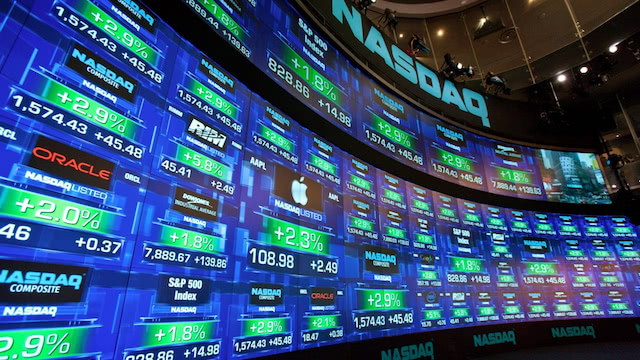
Should Goldman Sachs MarketBeta Russell 1000 Growth Equity ETF (GGUS) Be on Your Investing Radar?
ZACKS· 2025-08-25 11:21
Core Viewpoint - The Goldman Sachs MarketBeta Russell 1000 Growth Equity ETF (GGUS) is a newly launched passively managed ETF aimed at providing broad exposure to the Large Cap Growth segment of the US equity market, with assets exceeding $295.45 million [1]. Group 1: Large Cap Growth Characteristics - Large cap companies typically have market capitalizations above $10 billion, characterized by stability and predictable cash flows, resulting in lower volatility compared to mid and small cap companies [2]. - Growth stocks are associated with higher sales and earnings growth rates, expected to outperform the market, but they come with higher valuations and risks [3]. Group 2: Cost Structure - GGUS has an annual operating expense ratio of 0.12%, making it one of the least expensive ETFs in its category, with a 12-month trailing dividend yield of 0.51% [4]. Group 3: Sector Exposure and Holdings - The ETF has a significant allocation to the Information Technology sector, comprising approximately 46.8% of the portfolio, followed by Consumer Discretionary and Telecom [5]. - Nvidia Corp (NVDA) is the largest holding at about 11.61% of total assets, with Microsoft Corp (MSFT) and Apple Inc (AAPL) also among the top holdings; the top 10 holdings represent around 50% of total assets [6]. Group 4: Performance Metrics - GGUS aims to match the performance of the Russell 1000 Growth 40 Act Daily Capped Index, with a year-to-date return of approximately 10.95% and a one-year return of about 22.37% as of August 25, 2025 [7]. - The ETF has a beta of 1.16 and a standard deviation of 19.91% over the trailing three-year period, indicating effective diversification with around 380 holdings [8]. Group 5: Alternatives and Market Position - GGUS holds a Zacks ETF Rank of 2 (Buy), indicating strong potential based on expected returns, expense ratio, and momentum, making it a favorable option for investors in the Large Cap Growth segment [10]. - Other comparable ETFs include the Vanguard Growth ETF (VUG) and Invesco QQQ (QQQ), with VUG having $184.39 billion in assets and an expense ratio of 0.04%, while QQQ has $369.27 billion in assets with a 0.2% expense ratio [11]. Group 6: Investment Appeal - Passively managed ETFs like GGUS are increasingly popular among retail and institutional investors due to their low costs, transparency, flexibility, and tax efficiency, making them suitable for long-term investment strategies [12].