
人民币强势

Search documents
连平:金融强国建设需要强势人民币
Di Yi Cai Jing· 2026-02-19 07:42
Core Viewpoint - The construction of a financial power in China is essential for the country's economic development, with a focus on maintaining a reasonable level of the RMB exchange rate as a foundation for a modern financial system [1][6]. Group 1: Strong Currency - A strong currency is a key element for a financial power, characterized by its widespread use in international trade and investment, and its status as a global reserve currency [2]. - An appropriately strong RMB will facilitate its broader use in global trade, support Chinese enterprises in international expansion, and encourage foreign capital to hold RMB for investment [2][6]. - The RMB's strength is crucial for increasing its share in foreign reserves globally, as a weak currency may lead countries to reduce their RMB holdings [2][3]. Group 2: Strong Financial Institutions - Strong financial institutions are essential, defined by comprehensive service offerings, high operational efficiency, and strong risk management capabilities [3]. - Despite having the largest banking sector globally, Chinese financial institutions face challenges in international competitiveness, partly due to the low global usage of the RMB [3]. - Sustained strength of the RMB could enhance the international competitiveness of Chinese financial institutions by increasing their RMB-denominated assets and liabilities abroad [3]. Group 3: International Financial Center - A strong international financial center is necessary to attract global investors and influence international pricing systems [4]. - Shanghai's financial center has not yet reached the level of leading centers like New York and London, partly due to insufficient foreign participation and the RMB's limited appreciation [4][5]. - Historical evidence suggests that a currency must maintain strength over time to support the development of a world-class international financial center [5]. Group 4: Central Bank Role - A strong central bank is vital for effective monetary policy and macro-prudential management, which helps prevent systemic risks [6]. - The internationalization of the RMB may be hindered if it remains a weak currency, affecting its acceptance and influence globally [6]. - A relatively strong RMB supports the central bank's functions and aligns with the need for a stable exchange rate policy that considers both supply and demand [7].
半两财经|美联储年内连续第三次降息
Sou Hu Cai Jing· 2025-12-11 01:47
Group 1 - The Federal Reserve announced a reduction in the federal funds rate target range to 3.5% to 3.75%, marking the third consecutive rate cut since September and the sixth cut since the current easing cycle began in September 2024 [1] - The Federal Open Market Committee stated that while U.S. economic activity is expanding moderately, job growth has slowed, the unemployment rate rose in September, and inflation remains elevated, indicating a high level of uncertainty regarding the economic outlook [1] - Fed Chairman Powell indicated that the federal funds rate is now within a neutral range and that further observations of economic conditions are warranted, attributing inflation above the Fed's target mainly to tariffs imposed by the U.S. government [1] Group 2 - Morgan Stanley's analysis suggests that the resumption of the Fed's rate-cutting cycle will facilitate the return of overseas funds to A-shares and Hong Kong stocks, benefiting the innovative pharmaceutical sector as increased overseas investment activities will aid domestic companies in expanding into international markets [2]
航空股延续近期涨势 油价下滑叠加人民币强势 航司盈利或能进一步增长
Zhi Tong Cai Jing· 2025-10-20 01:54
Core Viewpoint - The aviation sector continues its recent upward trend, driven by favorable oil prices, currency adjustments, and improving demand dynamics in both domestic and international routes [1] Group 1: Stock Performance - Eastern Airlines (00670) increased by 5.31%, trading at HKD 3.77 - Southern Airlines (01055) rose by 4.33%, trading at HKD 4.58 - Air China (00753) saw a 4.08% increase, trading at HKD 6.12 - Cathay Pacific (00293) gained 0.94%, trading at HKD 10.74 [1] Group 2: Oil Prices and Currency Impact - Crude oil prices have declined for three consecutive weeks - The average jet fuel price in October decreased by 0.1% year-on-year - The RMB/USD exchange rate rose above 7.1, reaching a new high in over 11 months [1] Group 3: Industry Demand and Pricing - CITIC Securities indicates that civil aviation demand may benefit from fiscal policies, with costs potentially decreasing due to falling oil prices - The industry maintains a high passenger load factor, with both domestic and international routes experiencing strong travel demand - Recent ticket prices have shown a consistent positive trend, leading to a significant recovery in airline unit revenue [1] Group 4: Future Outlook - The implementation of "anti-involution" measures and the "Convention" is expected to reduce malicious low pricing in the industry - This reduction in low pricing may lead to further ticket price recovery, enhancing airline unit revenue - Combined with the cost reductions from lower oil prices, airline profitability is likely to see further growth [1]

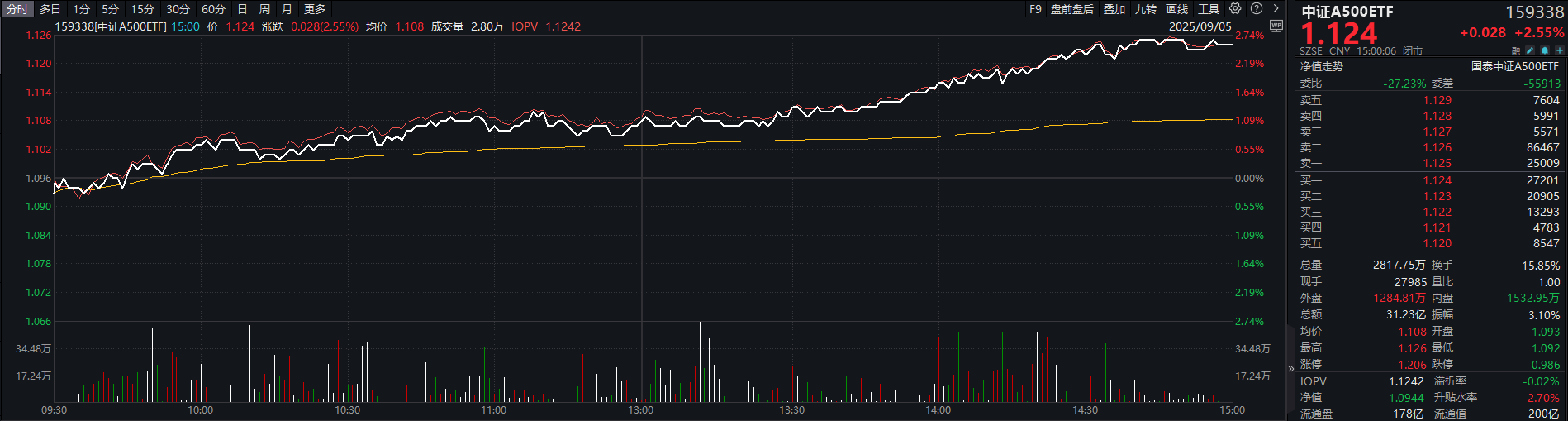
中证A500ETF大涨2.55%点评
Mei Ri Jing Ji Xin Wen· 2025-09-05 12:10
Market Performance - The three major A-share indices collectively rose, with the Shanghai Composite Index up 1.24%, the Shenzhen Component Index up 3.89%, and the ChiNext Index up 6.55% [1] - The total market turnover was 2.35 trillion yuan, a decrease of 233.5 billion yuan compared to the previous trading day [1] - Various ETFs showed positive performance, with the CSI A500 ETF rising 2.55%, the ChiNext 50 ETF up 8.06%, the Sci-Tech Innovation ETF up 7.34%, and the Sci-Tech 100 ETF up 4.7% [1] Reasons for the Rise - The market experienced a short-term rebound due to the release of profit-taking pressure following significant events from September 2 to September 4 [5] - A collective surge in the banking sector on September 4 afternoon significantly boosted the indices, indicating strong market support and improved investor confidence [5] - The VIX index suggests that market sentiment has stabilized, with a downward trend indicating no panic among investors [5] Future Outlook - The strengthening of the RMB and signs of foreign capital inflow are expected to continue supporting A-shares [7] - The relative attractiveness of the RMB has increased as the appeal of the USD has declined, marking the end of a three-year upward cycle since September 30, 2021 [9] - Active foreign capital has shown a net inflow for three consecutive weeks since August 15, 2023, indicating a potential trend reversal and further attraction of foreign investment [9] - Investors are encouraged to focus on broad-based index products such as the CSI A500 ETF, the 300 Enhanced ETF, and others [9]

每日市场观察-20250827
Caida Securities· 2025-08-27 05:30
Market Overview - On August 26, the market experienced mixed performance with the Shanghai Composite Index down by 0.39%, the Shenzhen Component up by 0.26%, and the ChiNext Index down by 0.75%[3] - The total trading volume was 2.71 trillion CNY, a decrease of approximately 470 billion CNY from the previous trading day[1] Sector Performance - Sectors such as agriculture, chemicals, and media showed notable gains, while pharmaceuticals, non-bank financials, steel, military, and telecommunications sectors faced declines[1] - The recent adjustments in the market are seen as normal profit-taking after significant gains, particularly in sectors like innovative drugs, military, and semiconductors[1] Fund Flow - On August 26, the net outflow from the Shanghai Stock Exchange was 5.587 billion CNY, while the Shenzhen Stock Exchange saw a net inflow of 16.440 billion CNY[4] - The top three sectors for capital inflow were consumer electronics, software development, and optical electronics, while small metals, chemical pharmaceuticals, and securities faced the largest outflows[4] ETF Market - The total scale of ETFs in China reached a historic high of 5.07 trillion CNY, marking a rapid increase from 4 trillion CNY in just four months[5] - There are currently 1,271 ETFs in the market, with 101 exceeding 10 billion CNY in scale and 6 exceeding 100 billion CNY[5] Energy Sector Developments - China has established the world's largest electric vehicle charging network, with a ratio of 2 charging stations for every 5 vehicles[6] - The renewable energy generation capacity has increased from 40% to approximately 60% during the 14th Five-Year Plan[6] Industry Innovations - China launched its first photon-counting spectral CT, marking a significant advancement in medical technology[11] - The new generation of the Chinese operating system, Galaxy Kirin V11, was officially released, enhancing operational experience and security[10]